
Daniel 5:8
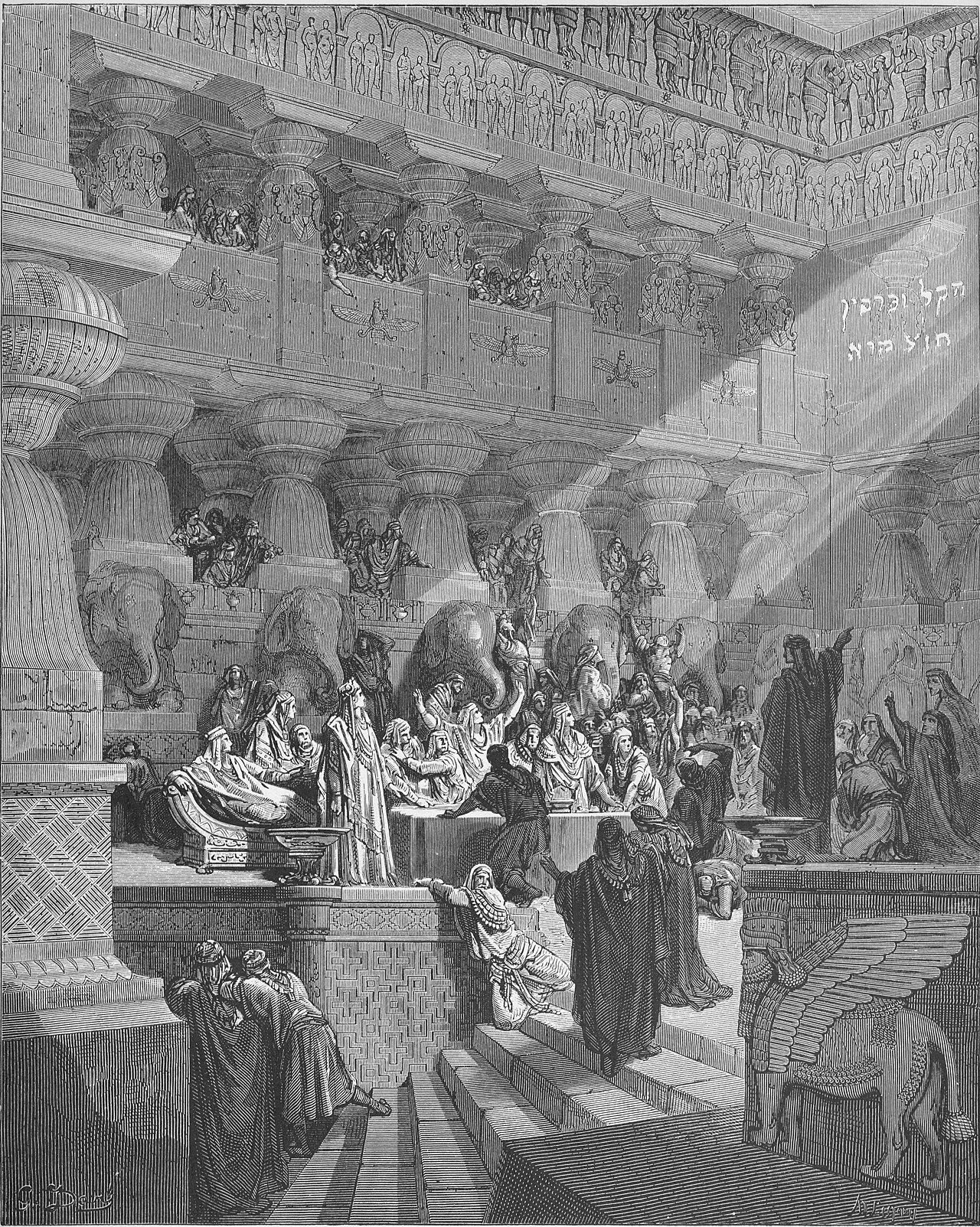
in Daniel 5So all the king’s wise men came in, but they could not read the inscription or interpret it for him.
BSB
The same verse in ASV and KJV ▾
ASV
Then came in all the king’s wise men; but they could not read the writing, nor make known to the king the interpretation.
KJV
Then came in all the king’s wise men: but they could not read the writing, nor make known to the king the interpretation thereof.
⋯
This verse in Daniel 5
Commentary
6 notes on this verseA commentator
Albert Barnes1798–1870
Notes, Explanatory and Practical, on the Old and New Testaments (1832-1869)
Then came in all the king’s wise men - The classes above referred to, Dan 5:7. But they could not read the writing - The character was an unknown character to them. It may have been a character which was not found in any language, and which made the power of Daniel to read it the more remarkable, or it may have been, as suggested in the notes at Dan 5:7, a foreign character with which they had no acquaintance, though familiar to Daniel.
This site's exposition
the third ruler in the kingdom
on Daniel 5:7-9
The king's wise men are called for exactly as Nebuchadnezzar once called for his, and fail exactly as they once failed, the second such scene in the book and the second time Babylon's own experts cannot read what Babylon's own God has written. The promised reward, scarlet clothing, a gold chain, and the third ruler in the kingdom, has puzzled readers expecting first or second place, and the evidence lane answers it directly below rather than treating it as a slip of the pen. Verse 9 leaves the whole court astonied, the same word used of Nebuchadnezzar's counselors, tying this failure to the pattern the book has already established twice.
The record, by era
The Church Fathers1 voice
And so after all were called, the king said to them, "'Whoever shall read this writing and make known to me its interpretation, shall be clothed in purple and a golden necklace shall be upon his neck and he shall rule as third in my kingdom.'
The Puritans and the Awakening2 voices
Then came in all the king's wise men,....
The interpretation of the mystical characters by Daniel, who was at length brought in to him, and dealt plainly with him, and showed him his doom written,
The Nineteenth Century1 voice
They could not read the writing - Because it was in the pure Hebrew, not the Chaldean character. See below.
The words behind it
12 Hebrew wordsEvery Hebrew word of this verse in the order it stands, with what it means and the door to its own study. The last column counts the times a word stands in the whole Bible: the rarer the word, the more the places it appears belong together.
| Hebrew | Sound | Meaning | Word study | In the Bible |
|---|---|---|---|---|
| אֱדַ֙יִן֙ | ʾedayin | then | H116 → | 57 times |
| עָֽלִּ֔ין | alalin | [were] going in | H5954 → | 14 times |
| כֹּ֖ל | kol | all | H3606 → | 82 times |
| חַכִּימֵ֣י | chakimei | [the] wise men of | H2445 → | 14 times |
| מַלְכָּ֑א | malka' | king the | H4430 → | 180 times |
| וְלָֽא־ | vela'- | and not | H3809 → | 82 times |
| כָהֲלִ֤ין | khahalin | [they were] able | H3546 → | 4 times |
| כְּתָבָא֙ | ketava' | writing the | H3792 → | 12 times |
| לְמִקְרֵ֔א | lemikre' | to read aloud | H7123 → | 11 times |
| וּפִשְׁרֵ֖הּ | ufishrah | and interpretation its | H6591 → | 31 times |
| לְהוֹדָעָ֥ה | lehodaah | to make known | H3046 → | 47 times |
| לְמַלְכָּֽא׃ | lemalka' | to king the | H4430 → | 180 times |
אֱדַ֙יִן֙then
ʾedayinH116 →57 times
עָֽלִּ֔ין[were] going in
alalinH5954 →14 times
כֹּ֖לall
kolH3606 →82 times
חַכִּימֵ֣י[the] wise men of
chakimeiH2445 →14 times
מַלְכָּ֑אking the
malka'H4430 →180 times
וְלָֽא־and not
vela'-H3809 →82 times
כָהֲלִ֤ין[they were] able
khahalinH3546 →4 times
כְּתָבָא֙writing the
ketava'H3792 →12 times
לְמִקְרֵ֔אto read aloud
lemikre'H7123 →11 times
וּפִשְׁרֵ֖הּand interpretation its
ufishrahH6591 →31 times
לְהוֹדָעָ֥הto make known
lehodaahH3046 →47 times
לְמַלְכָּֽא׃to king the
lemalka'H4430 →180 times
A shaded row is a word that stands 400 times or fewer in the Bible.
The walk
8 stopsEach card is a verse this one points to, and under it the verses that one points to in turn. Where several paths arrive at the same place, that place is listed first: the text keeps returning to it.
Through
Daniel 4:7When the magicians, enchanters, astrologers, and diviners came in, I told them the dream, and they could not interpret it for me.
it leads to
- Isaiah 44:25
who foils the signs of false prophets and makes fools of diviners, who confounds the wise and turns their knowledge into nonsense,
Reached by 2 separate paths from here.
- Isaiah 44:25
Through
Daniel 5:15Now the wise men and enchanters were brought before me to read this inscription and interpret it for me, but they could not give its interpretation.
it leads to
- Daniel 5:7–8
The king called out for the enchanters, astrologers, and diviners to be brought in, and he said to these wise men of Babylon, “Whoever reads this inscription and tells me its interpretation will be…
Reached by 2 separate paths from here.
- Isaiah 47:12
So take your stand with your spells and with your many sorceries, with which you have wearied yourself from your youth. Perhaps you will succeed; perhaps you will inspire terror!
- Daniel 5:7–8
Through
Genesis 41:8In the morning his spirit was troubled, so he summoned all the magicians and wise men of Egypt. Pharaoh told them his dreams, but no one could interpret them for him.
it leads to
- Daniel 4:7
When the magicians, enchanters, astrologers, and diviners came in, I told them the dream, and they could not interpret it for me.
- Exodus 7:22
But the magicians of Egypt did the same things by their magic arts. So Pharaoh’s heart was hardened, and he would not listen to Moses and Aaron, just as the LORD had said.
- Daniel 4:5
I had a dream, and it frightened me; while in my bed, the images and visions in my mind alarmed me.
- Daniel 1:20
In every matter of wisdom and understanding about which the king consulted them, he found them ten times better than all the magicians and enchanters in his entire kingdom.
- Matthew 2:1
After Jesus was born in Bethlehem in Judea, during the time of King Herod, Magi from the east arrived in Jerusalem,
- Daniel 4:7
Where this verse is studied
On this page
Studies4
About Daniel
This page draws on Adam Clarke, Commentary on the Bible; Albert Barnes, Notes, Explanatory and Practical, on the Old and New Testaments (1832-1869); Albert Barnes, Notes on the Book of Daniel; Hippolytus of Rome, Commentary on Daniel 3.15.2-3; John Gill, Exposition of the Old Testament; John Gill, Exposition of the Old Testament (1748-1763) and Matthew Henry, Commentary on the Whole Bible.