
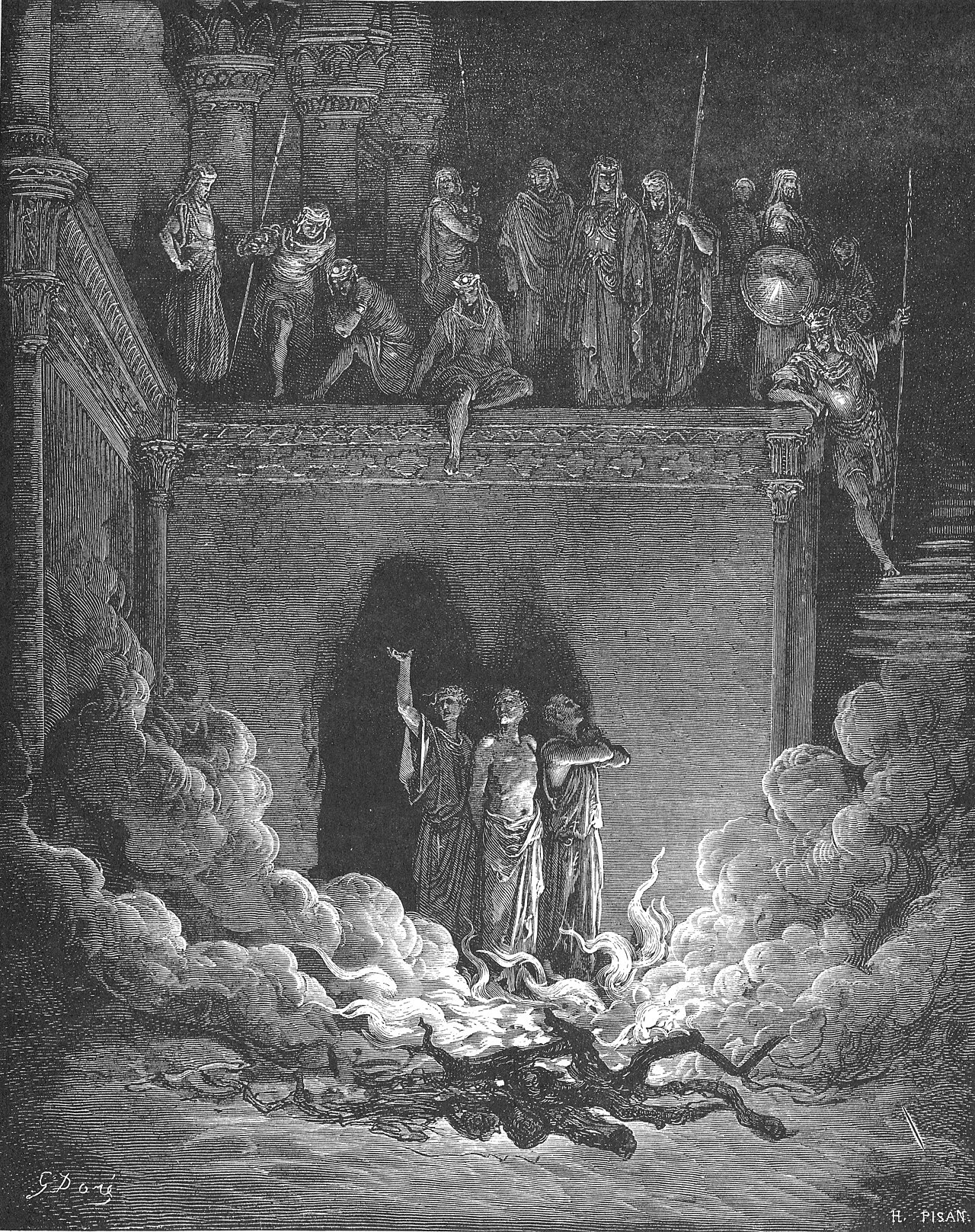
Danielchapter 3
30 verses · Daniel, by tradition · 6th century BC · The Prophets
“Look!” he exclaimed. “I see four men, unbound and unharmed, walking around in the fire—and the fourth looks like a son of the gods!”
Introduction
Daniel, by tradition, The Prophets, Daniel Overview.
This chapter was written for Jews asked, one generation after another, to make one small public act of honour toward another god. It is set on an open plain outside Babylon, at a ceremony where the whole government of the empire gathered in one place. Daniel himself does not appear in it, and the three friends carry the story. Listen for the repeated lists of officials and instruments, which make the empire sound as large as it was. Listen too for the answer the three men give the king, which has been learned by heart ever since.
Context
- Who
- Jews being asked, generation after generation, to make one small public gesture toward somebody else's god
- What
- A narrative of the golden image on the plain of Dura, the refusal of Shadrach, Meshach and Abednego to bow, and their deliverance from the furnace.
- Where
- The plain of Dura in the province of Babylon, and the king's furnace.
- When
- The reign of Nebuchadnezzar, between 605 and 562 BC; the chapter gives no year.
- Why
- To teach that worship belongs to God alone, even when refusing it costs everything, and that God is present with His servants in the fire.
Historical context
The image is ninety feet tall and nine feet wide, a ratio far too thin for a human figure, which suggests a plated obelisk or a statue standing on a tall pedestal. Solid gold at that size is impossible; ancient monuments of this kind were wood or stone sheathed in gold leaf, exactly as Babylonian building inscriptions describe.
Show the rest of the historical context, 3 more paragraphs
The guest list is the real story. Satraps, governors, treasurers, judges, counselors, the whole provincial administration summoned to one field. This was a loyalty ceremony. Every officer in the empire bows at the same moment to the same object, and everyone watches everyone else do it.
The music matters too. The instrument list includes words borrowed from Greek, which some scholars treat as evidence for a later date; others point out that Greek mercenaries and traders were all over the Near East well before 600 BC, and Greek-made goods turn up in Babylonian levels. It is a genuine argument, and the chapter does not depend on how it lands.
The furnace was ordinary industrial equipment. Babylon was a brick city, mud brick sun-dried, glazed brick fired, and large kilns burned day and night. Assyrian and Babylonian texts record burning as a punishment, so nobody in that crowd thought the threat was theater.
Significance
Every exile knew this pressure. Nobody was asking them to renounce their God. They were being asked to bow once, briefly, with everybody else, as a matter of civic loyalty, and to make a fuss about it was to look like a traitor rather than a believer.
Show the rest of the significance, 1 more paragraph
The three men answer with the sentence the exile needed: our God is able to deliver us, and if He does not, we still will not bow. That separated faith from outcome. God rescued them in the fire, but their obedience was not a bet on rescue.
This chapter in Jewish lifeWhat this chapter is in Jewish life and reading.
What is done
The furnace of the three friends is not read in the synagogue. Probed for this lane, the site's own table in src/lib/hebraic/readings.ts printed parashot total 0 and haftarah uses total 0 for Daniel, and no festival reading. The site's book dossier records that Daniel stands among the Writings in the Hebrew Bible rather than among the Prophets, so no weekly portion is drawn from it and no Haftarah either.
The corpus numbers the verses by the Hebrew text, and in the Hebrew this chapter runs to thirty-three verses. Its last three stand as the first three verses of chapter 4 in an English Bible, so the locators on the thirty-second and thirty-third verses below belong there for a reader counting in English. The story is met in the Talmud at Sanhedrin 92b, which the corpus carries under the fifth verse and the thirty-third.
How it is read
Rashi is the main commentator on this chapter in the corpus, quoted from The Judaica Press complete Tanach with Rashi, translated by A. J. Rosenberg, which Sefaria reports as CC-BY, and Ibn Ezra is quoted from the Sefaria Community Translation, which Sefaria reports as CC0, each at fifty words or fewer.
Rashi reads the image as the king's own impulse. "He had an urge to make an image of gold" (Rashi on Daniel 3:1:1). The furnace is a lime kiln, "a pit that is made to burn rocks into lime" (Rashi on Daniel 3:6:1). At the accusers' words he notes that the Aramaic verb means they shouted, since in Scripture the word always means raising the voice (Rashi on Daniel 3:9:1).
The longest note in the chapter explains why the three friends address the king by his bare name. Rashi reads their answer as a line drawn between two kinds of obedience. "If [it concerns] taking upon ourselves to pay taxes, either the tax from the crops or the head taxes, you are king over us", but "if [it concerns] denying the Holy One, blessed be He, [you are merely] Nebuchadnezzar" (Rashi on Daniel 3:16:1). He reads "and if not" in the same spirit: "And if He will not wish to save our bodies, let it be known to you" (Rashi on Daniel 3:18:1).
Ibn Ezra's two notes are glosses: the officials assembled, and the furnace of the eleventh verse is the fiery furnace (Ibn Ezra on Daniel 3:3:1 and 3:11:1). Rashi's other notes are glosses of the Aramaic, and six of them say only that the words stand as translated.
The corpus carries twenty-four commentary entries on this chapter, the cap its fetch sets, and they stop at the twenty-fourth verse, so what the commentators say on the verses after it is not reported here.
What the rabbis say
The corpus carries forty rabbinic locators on this chapter. Three of them stand in the Talmud and its minor tractates and the rest in the Midrash. The corpus carries the text of none, so each is cited by ref here and never quoted.
On the first verse it holds Bereshit Rabbah 68:13, Eikhah Rabbah, Petichta 23 and Kohelet Rabbah 12:7:1. On the second verse it holds Ein Yaakov (Glick Edition), Sanhedrin 11:17 and Shir HaShirim Rabbah 7:9:1. On the span Daniel 3:5 to 6 it holds Sanhedrin 92b:13. On the tenth verse it holds Jerusalem Talmud Peah 6:4:6. On the twelfth verse it holds Ein Yaakov (Glick Edition), Megillah 1:23 and Ein Yaakov, Megillah 1:29. On the fourteenth verse it holds Aggadat Bereshit 7:1 and Bamidbar Rabbah 15:14.
On the fifteenth verse it holds Bamidbar Rabbah 14:6 and Esther Rabbah 3:5. On the sixteenth verse it holds Midrash Lekach Tov, Leviticus 22:31:1 and Midrash Tehillim 28:2. On the seventeenth verse it holds Bereshit Rabbah 34:13 and Pesikta Rabbati 14:1. On the eighteenth verse it holds Midrash Tanchuma, Ki Teitzei 3:1 and Otzar Midrashim, Baraita of Rabbi Pinchas Ben Yair 1:23. On the nineteenth verse it holds Bereshit Rabbah 44:17 and Midrash Lekach Tov, Genesis 15:12:1. On the span Daniel 3:20 to 27 it holds Midrash Tanchuma Buber, Vayeshev 17:7.
On the twentieth verse it holds Midrash Tehillim 10:6. On the twenty-first verse it holds Bereshit Rabbah 36:6 and Esther Rabbah 3:14. On the twenty-second verse it holds Midrash Lekach Tov, Deuteronomy 32:24:1 and Midrash Tanchuma Buber, Chukat 28:1. On the twenty-third verse it holds Midrash Tanchuma, Noach 10:4. On the twenty-fourth verse it holds Otzar Midrashim, Midrashim on Megilat Esther, Midrash on the Book of Esther 6. On the twenty-fifth verse it holds Aggadat Bereshit 27:1 and Bereshit Rabbah 44:13.
On the twenty-sixth verse it holds Aggadat Bereshit 27:2 and Bamidbar Rabbah 2:13. On the twenty-seventh verse it holds Bereshit Rabbati, Parashat Noah 14 and Ein Yaakov, Sanhedrin 11:16. On the span Daniel 3:28 to 29 it holds Bamidbar Rabbah 13:4. On the twenty-eighth verse it holds Bamidbar Rabbah 14:1. On the thirty-second verse it holds Sifrei Devarim 306:37 and Yalkut Shimoni on Torah 942:31. On the thirty-third verse it holds Sanhedrin 92b:11.
What each locator teaches is a saying of the rabbis, and it is reported as theirs wherever this site quotes one. The quotations wait on a fetch that carries the text.
Sources: Rashi, Rashi on Daniel 3:1:1 to Daniel 3:24:1, The Judaica Press complete Tanach with Rashi, translated by A. J. Rosenberg, reported CC-BY; Ibn Ezra, Ibn Ezra on Daniel 3:3:1 to Daniel 3:11:1, Sefaria Community Translation, reported CC0; The Sefaria corpus, scripts/data/sources/sefaria/daniel/3.json, the 40 Talmud and Midrash locators of this chapter; The site's own files, src/lib/hebraic/readings.ts, probed for this book and printing daniel parashot total 0 and haftarah uses total 0, and src/components/book/dossier-content/daniel.ts on the place of Daniel among the Writings.
The heads below are this chapter's scenes. The numbered points under each are its verses.
A golden image and music that commands worship
sixty cubits high: The verse gives no date for the golden statue King Nebuchadnezzar set up on the plain of Dura. Albert Barnes cites the Greek and Arabic versions, and Hippolytus of Rome agrees, in placing it in his eighteenth year. Adam Clarke reports a view dating it after the king's madness.
Daniel 3:1-7
a golden statue sixty cubits high: The “golden statue sixty cubits high and six cubits wide” stands on “the plain of Dura,” gold from head to foot. Worship is ordered at the music on pain of “the blazing fiery furnace”. The people fell down, and the chapter turns on those who did not.
Daniel 3:1
“Nebuchadnezzar the king made an image of gold - The time when he did this is not mentioned; nor is it stated in whose honor, or for what design, this colossal image was erected. In the Greek and Arabic translationns, this is said to have occurred in the eighteenth year of Nebuchadnezzar. This is not, however, in the original text, nor is it known on what authority it is asserted. Dean Prideaux (Consex. I.”
2 more voices on this verseWhat preachers and commentators have said about this verse, in their own words.
Daniel 3:1
“Note, The worshippers of false gods are not wont to mind charges in setting up images and worshipping them; they lavish gold out of the bag for that purpose ( Isa. xlvi. 6 ), which shames our niggardliness in the worship of the true God. The vastness of it; it was threescore cubits high and six cubits broad.”
Matthew Henry · Commentary on the Whole Bible (1707-1721)puritan
Daniel 3:1
“But at the same time some pretense to piety was joined with it; for he pretended that he wished to worship God. Hence, also, what I formerly mentioned appears more clear, namely, -- King Nebuchadnezzar was not truly and heartily converted, but rather remained fixed in his own errors, when he was attributing glory to the God of Israel.”
John Calvin · Commentaries (1554)reformed
dedication of the statue: Albert Barnes and Adam Clarke both judge the exact duties of the satraps, prefects and the rest hard to recover. The general sense is plain. John Chrysostom observed that summoning all the officials of the provinces to the dedication made them witnesses of what followed.
Daniel 3:2
“Sent to gather together the princes - It is not easy to show what these different offices were, as it is difficult to ascertain the meaning of the Chaldee words. Parkhurst analyzes them thus: - The Princes - אחשדרפניא achashdarpenaiya, from אחש Achash, great or eminent, and דר dar, “to go about freely,” and פנים panim, “the presence.” Satraps or privy counsellors who had free access to the presence of the king. The Governors - סגניא signaiya, lieutenants or viceroys, for סגן sagan, among the Hebrews, was the name of the high priest’s deputy.”
Adam Clarke · Commentary on the Bible (1810-1826)evangelical
and they stood before it: Jamieson, Fausset and Brown read "they stood before it" as a posture of worship. The officials approve whatever the king approves. Albert Barnes pictures the rulers of the provinces drawn up before the golden statue, as the most imposing display the king could make.
Daniel 3:3
“And they stood before the image - In the presence of the image. They were drawn up, doubtless, so as at the same time to have the best view of the statue, and to make the most imposing appearance.”
the herald loudly proclaimed: Adam Clarke renders the Aramaic as a crier who called with might, and Albert Barnes explains the herald as a public crier. The command is literally plural. Barnes reads it as the voice of the king himself, addressed to every nation under his rule.
Daniel 3:4
“Then an herald cried aloud - Margin, as in Chaldee, “with might.” He made a loud proclamation. A “herald” here means a public crier. To you it is commanded - Margin, “they commanded.” Literally, “to you commanding” (plural); that is, the king has commanded. O people, nations, and languages - The empire of Babylon was made up of different nations, speaking quite different languages. The representatives of these nations were assembled on this occasion, and the command would extend to all.”
horn, flute, zither, lyre, harp, pipes: Albert Barnes judges the exact instruments impossible to identify. Adam Clarke takes the horn as the common blowing horn with its deep and hollow sound. Matthew Henry sets the music beside the furnace of verse 6: the careless people were drawn by the one and driven by the other.
Daniel 3:5
“That at what time ye hear the sound of the cornet - It would not be practicable to determine with precision what kind of instruments of music are denoted by the words used in this verse. They were, doubtless, in many respects different from those which are in use now, though they may have belonged to the same general class, and may have been constructed on substantially the same principles. A full inquiry into the kinds of musical instruments in use among the Hebrews may be found in the various treatises on the subject in Ugolin’s “Thesau Ant.”
will immediately be thrown: Behind the word immediately stands the phrase the same hour, which Adam Clarke calls the first division of time into hours in the Old Testament. Albert Barnes calls the command tyrannical and typical of that age. The decree forced all the peoples to worship alike.
Daniel 3:6
“And whoso falleth not down and worshippeth,.... Who refuses to worship it, or wilfully neglects it; which would be interpreted a contempt of it, and of the king's command: shall in the same hour be cast into the midst of a burning fiery furnace; such as were used to burn stones in for lime, as Jarchi observes: the music was to draw, the furnace was to drive, men to this idolatrous worship; the one was to please and sooth the minds of men, and so allure them to such stupid service; the other to frighten them into obedience.”
2 more voices on this verse
Daniel 3:6
“Shall the same hour - This is the first place in the Old Testament where we find the division of time into hours. The Greeks say that Anaximander was the inventor. He had it probably from the Chaldeans, among whom this division was in use long before Anaximander was born. Be cast into the midst of a burning fiery furnace - This was an ancient mode of punishment among the Chaldeans, if we may credit the tradition that Abram was cast into such a fire by this idolatrous people because he would not worship their idols.”
Adam Clarke · Commentary on the Bible (1810-1826)evangelical
Daniel 3:6
“The literal image of Nebuchadnezzar is a typical prophecy of "the image of the beast," connected with mystical Babylon, in Re 13:14. The second mystical beast there causeth the earth, and them that dwell therein, to worship the first beast, and that as many as would not, should be killed (Re 13:12, 15). furnace--a common mode of punishment in Babylon (Jer 29:22).”
Jamieson, Fausset & Brown · Commentary Critical and Explanatory on the Whole Bible (1871)reformed
would fall down and worship: Jerome and Albert Barnes take all the people as represented by their officials, for the whole empire could hardly gather on the plain of Dura. Hippolytus of Rome notes that many fell down and worshiped only from fear of the king. All became idolaters, in his judgment.
Daniel 3:7
“All the people, the nations, and the languages fell down ... - All excepting the Jews. An express exception is made in regard to them in the following verses, and it does not appear that any of them were present on this occasion. It would seem that only the “officers” had been summoned to be present, and it is not improbable that all the rest of the Jewish nation absented themselves.”
But if not: three men who will not bow
Daniel 3:8-15
accused the Jews: Some astrologers “maliciously accused the Jews,” and Keil notes the Aramaic idiom behind it: they ate the pieces of them, accusation pictured as devouring. His question, “Then what god will be able to deliver you from my hands?” is the one the rest of the chapter answers.
Daniel 3:8
“Not probably in general, but as Da 3:12 states, Shadrach, Meshach, and Abed-nego. Why Daniel was not summoned does not appear. Probably he was in some distant part of the empire on state business, and the general summons (Da 3:2) had not time to reach him before the dedication.”
Jamieson, Fausset & Brown · Commentary Critical and Explanatory on the Whole Bible (1871)reformed
may you live forever!: Albert Barnes calls "O king, may you live forever" the customary address to a king, one that treated long life as a great blessing. John Gill reads it here as a show of loyalty to King Nebuchadnezzar. The astrologers open with devotion before their charge against the Jews.
Daniel 3:9
“They spake and said to Nebuchadnezzar,.... Having got access unto him, and within his hearing, they expressed themselves in the following manner: O king, live for ever; this they said to show their fidelity and hearty attachment to him, and their regard to his welfare, and the continuance of his life; and the rather to ingratiate themselves into his affections, and gain audience of him; See Gill on Dan 2:4.”
1 more voice on this verse
Daniel 3:9
“O king, live for ever - A customary form of address to a monarch, implying that long life was regarded as an eminent blessing. See the notes at Dan 2:4.”
have issued a decree: The accusers recite the king's own law back to him. Albert Barnes notes that the decree covered everyone who heard the music, the Jews included, whatever their scruples. Matthew Henry grants that this was the law and asks whether it was a righteous one.
Daniel 3:10
“Thou, O king, hast made a decree ... - See Dan 3:4-5. As the decree included “every man” who heard the sound of the music, it of course embraced the Jews, whatever religious scruples they might have. Whether their scruples, however, were known at the time is not certain; or whether they would have been regarded if known, is no more certain.”
whoever does not fall down: John Gill separates the law into its decree and its sanction. Verse 10 states the command, and this verse states the penalty. Gill adds that a refusal would be taken as contempt of the statue and of the king's own command.
Daniel 3:11
“And whoso falleth not down and worshippeth,.... The image; the above is the decree, this that follows the sanction of it: that he should be cast into the midst of the burning fiery furnace; See Gill on Dan 3:6.”
some Jews you have appointed: John Chrysostom notes the malice of the charge: the astrologers remind the king that he had appointed these Jews to manage the province himself. Albert Barnes finds it remarkable that Daniel is not named. The account leaves him out of the scene.
furious with rage: Albert Barnes describes Nebuchadnezzar as a man given to fury and rage who was also open to deep impressions about God. John Chrysostom notes the staging. The three are brought before the king alone after all the peoples had fallen down, which made their stand the more conspicuous.
Daniel 3:13
“Then Nebuchadnezzar, in his rage and fury - The word rendered “fury” means “wrath.” Everything that we learn of this monarch shows that he was a man of violent passions, and that he was easily excited, though he was susceptible also of deep impressions on religious subjects. There was much here to rouse his rage. His command to worship the image was positive. It extended to all who were summoned to its dedication. Their refusal was an act of positive disobedience, and it seemed necessary that the laws should be vindicated.”
1 more voice on this verse
Daniel 3:13
“But someone will say, "You are making sophistries." Be educated, O man, about the things which happen under Antiochus Epiphanes. While the seven brothers together with their mother were taken, they were struck with scourges and whips, but one of them answered the whips, and he said, "Why do you delay to ask and to learn?”
Hippolytus of Rome · written before 235 · Commentary on Daniel 2.20.1-21.3patristic
is it true: The Aramaic word behind "is it true" occurs only here. John Gill follows Aben Ezra, Saadiah and the Oriental versions in that reading. Jamieson, Fausset and Brown prefer is it on purpose, which would give Shadrach, Meshach and Abednego room to tell the king why.
Daniel 3:14
“Nebuchadnezzar spake and said unto them, is it true,.... What I have heard of you, what you are charged with and accused of; surely it cannot be; so Aben Ezra and Saadiah interpret the word as we do, and all the Oriental versions: it is only used in this place: it is expressed by way of admiration, as Jacchiades observes; it being incredible to the king, what he could never believe, unless it appeared plain in his own eyes.”
1 more voice on this verse
Daniel 3:14
“Is it true--rather, as the Margin [THEODOTION], "Is it purposely that?" &c. Compare the Hebrew, Nu 35:20, 22. Notwithstanding his "fury," his past favor for them disposes him to give them the opportunity of excusing themselves on the ground that their disobedience had not been intentional; so he gives them another trial to see whether they would still worship the image.”
Jamieson, Fausset & Brown · Commentary Critical and Explanatory on the Whole Bible (1871)reformed
what god will be able: Jerome and Albert Barnes see the king offering the three a second chance, and Barnes infers that the dedication of the statue was under way. The question of what god could deliver them from his hands challenges God directly. Matthew Henry compares Pharaoh's proud question about the Lord.
Daniel 3:16-18
we have no need to answer: The three say God “is able to deliver us from the blazing fiery furnace and from your hand, O king”. They add, “But even if He does not,” “we will not serve your gods or worship the golden statue”. Their refusal holds in either case.
Daniel 3:16
“Note, Those that would avoid sin must not parley with temptation. When that which we are allured or affrighted to is manifestly evil the motion is rather to be rejected with indignation and abhorrence than reasoned with; stand not to pause about it, but say, as Christ has taught us, Get thee behind me, Satan.”
Matthew Henry · Commentary on the Whole Bible (1707-1721)puritan
If the God whom we serve: The opening words are read in more than one way. Albert Barnes takes the Aramaic as an affirmation that the God whom the three serve has the power to deliver them. Jamieson, Fausset and Brown read it as if they are thrown, and note that Vatablus rendered it assuredly.
Daniel 3:17
“If it be so--VATABLUS translates, "Assuredly." English Version agrees better with the original. The sense is, If it be our lot to be cast into the furnace, our God (quoted from De 6:4) is able to deliver us (a reply to Nebuchadnezzar's challenge, "Who is that God that shall deliver you?"); and He will deliver us (either from death, or in death, 2Ti 4:17, 18).”
Jamieson, Fausset & Brown · Commentary Critical and Explanatory on the Whole Bible (1871)reformed
1 more voice on this verse
Daniel 3:17
“If it be so - Chaldee, איתי הן hên 'ı̂ythay - “so it is.” That is, “this is true, that the God whom we serve can save us.” The idea is not, as would seem in our translation, “if we are to be cast into the furnace,” but the mind is turned on the fact that the God whom they served could save them.”
But even if He does not: Jerome notes that "even if He does not" concerns God's will and leaves his power untouched, for the three had said he is able. Cyprian read the verse as courage. The king was to know that they could also die for the God they served.
Daniel 3:18
“But if not - That is, “if he should “not” deliver us; if it should “not” occur that he would protect us, and save us from that heated oven: whatever may be the result in regard to us, our determination is settled.” Be it known unto thee, O king, that we will not serve thy gods ... - This answer is firm and noble. It showed that their minds were made up, and that it was with them a matter of “principle” not to worship false gods.”
1 more voice on this verse
Daniel 3:18
“And truly, all things considered, the saving of them from this sinful compliance was as great a miracle in the kingdom of grace as the saving of them out of the fiery furnace was in the kingdom of nature.”
Matthew Henry · Commentary on the Whole Bible (1707-1721)puritan
The furnace heated seven times hotter
seven times hotter than usual: Jamieson, Fausset and Brown note that the king had shown forbearance in verses 14 and 15, and anger fills him once it is refused. They render the order as hotter than it was ever seen to be heated. Matthew Henry says it made the rescue more illustrious.
Daniel 3:19-23
seven times hotter than usual: The king's face changes and he orders the furnace heated “seven times hotter than usual”. The three are tied up and “the fiery flames killed the men who carried up” the prisoners, so the fire is shown to be real. Still “firmly bound,” they “fell into the blazing fiery furnace”.
mighty men of valor: Albert Barnes takes these mighty men of valor as the strongest soldiers in the king's army. Adam Clarke read them as his generals and chief officers. John Wesley saw God letting the king do his worst so that God's power would show the more.
Daniel 3:20
“They were bound, that they might not struggle, or make any resistance, were bound in their clothes, for haste, or that they might be consumed the more slowly and gradually. But God's providence ordered it for the increase of the miracle, in that their clothes were not so much as singed.”
Matthew Henry · Commentary on the Whole Bible (1707-1721)puritan
robes, trousers, turbans: The names of the robes, trousers and turbans are uncertain. Jerome records that Symmachus rendered the first as trousers, and Adam Clarke cites Herodotus. Jamieson, Fausset and Brown note that throwing them in with all their clothes made the miracle greater, for verse 27 finds even their robes unaffected.
Daniel 3:21
“Then these men were bound in their coats - They were seized just as they were. No time was given them for preparation; no change was made in their dress. In “autos-da-fe” of later times, it has been usual to array those who were to suffer in a peculiar dress, indicative of the fact that they were heretics, and that they deserved the flame. Here, however, the anger of the king was so great, that no delay was allowed for any such purpose, and they proceeded to execute the sentence upon them just as they were.”
the fiery flames killed the men: Albert Barnes reads the urgency as a king who allowed no delay, even at mortal risk to his own men. The men who carried the three up died first. Matthew Henry notes that tyrants answer to God for exposing their servants to judgment through their cruelties.
Daniel 3:22
“Nebuchadnezzar himself was reserved for a further reckoning. There is a day coming when proud tyrants will be punished, not only for the cruelties they have been guilty of, but for employing those about them in their cruelties, and so exposing them to the judgments of God. The deliverance of these three faithful servants of God out of the furnace.”
Matthew Henry · Commentary on the Whole Bible (1707-1721)puritan
firmly bound, fell into: The Septuagint, Syriac, Arabic and Vulgate add the Prayer of Azariah and the Song of the Three, as Jamieson, Fausset and Brown record. The Aramaic text lacks them. Adam Clarke notes that Jerome inserted them with a note, and he marks the break between verses 23 and 24.
Daniel 3:23
“And these three men - fell down bound ... - That is, the flame did not loosen the cords by which they had been fastened. The fact that they were seen to fall into the furnace “bound,” made the miracle the more remarkable that they should be seen walking loose in the midst of the fire. In the Septuagint, Syriac, Arabic, and Latin Vulgate, there follow in this place sixty-eight verses, containing “The Song of the Three Holy Children.” This is not in the Chaldee, and its origin is unknown.”
2 more voices on this verse
Daniel 3:23
“The pain of damned sinners is more exquisite, and the smoke of their torment ascends for ever and ever, and those have no rest, no intermission, no cessation of their pains, who have worshipped the beast and his image ( Rev. xiv. 10, 11 ), whereas their pain would be soon over that were cast into this furnace for not worshipping this Babylonian beast and his image.”
Matthew Henry · Commentary on the Whole Bible (1707-1721)puritan
Daniel 3:23
“For the blessed Jeremiah in captivity was no less blessed, nor was Daniel, nor Ezra, nor the blessed Hananiah, Azariah, and Mishael, than if they had not fallen into captivity; for they were led into captivity in order to bring comfort to the people in their present circumstances, and to bring hope of escaping captivity. For it is the perfection of a virtuous man to sustain the fellowship of human nature with the courage of the mind, and to lead others to better things.”
Ambrose of Milan · written before 397 · On Jacob and the Blessed Lifepatristic
A fourth man walking in the fire
Daniel 3:24-25
Nebuchadnezzar sees “four men, unbound and unharmed,” the fourth like “a son of the gods,” which Keil takes as a heavenly being. This site teaches that the fourth is Christ before his incarnation, keeping in person Isaiah 43:2, and other readings see a created angel.
Daniel 3:24
“Then, Nebuchadnezzar the king was astonied - The word “astonied,” which occurs several times in our translation Ezr 9:3; Job 17:8; Job 18:20; Eze 4:17; Dan 3:24; Dan 4:19; Dan 5:9, is but another form for “astonished,” and expresses wonder or amazement. The reasons of the wonder here were that the men who were bound when cast into the furnace were seen alive, and walking unbound; that to them a fourth person was added, walking with them; and that the fourth had the appearance of a Divine personage.”
Readers divide over the fourth figure. John Wesley saw God's Son appearing before his incarnation as the Angel of the covenant. John Calvin and Adam Clarke took the king's phrase, “a son of the gods,” as a pagan's name for an angel or divine being.
Daniel 3:25
“He answered and said, lo, I see four men loose,.... Not bound as the three were, when cast in; but quite at liberty in their hands and feet, and separate from one another.”
4 more voices on this verse
Daniel 3:25
“No doubt God here sent one of his angels, to support by his presence the minds of his saints, lest they should faint. ... A single angel was sent to these three men; Nebuchadnezzar calls him a son of God; not because he thought him to be Christ, but according to the common opinion among all people, that angels are sons of God, since a certain divinity is resplendent in them; and hence they call angels generally sons of God.”
Daniel 3:25
If, then, neither Moses, nor Elias, nor Ezekiel, who had all many celestial visions, did see God; but if what they did see were similitudes of the splendour of the Lord, and prophecies of things to come; it is manifest that the Father is indeed invisible, of whom also the Lord said, "No man hath seen God at any time."
Irenaeus · written before 202 · Against Heresies 4:20.11patristic
Daniel 3:25
“Ps 34:7, 8; and the probably heathen centurion's exclamation (Mt 27:54). The Chaldeans believed in families of gods: Bel, the supreme god, accompanied by the goddess Mylitta, being the father of the gods; thus the expression he meant: one sprung from and sent by the gods. Really it was the "messenger of the covenant," who herein gave a prelude to His incarnation.”
Jamieson, Fausset & Brown · Commentary Critical and Explanatory on the Whole Bible (1871)reformed
Daniel 3:25
“The Son of God - Probably he had heard David speak of him. Jesus Christ, the Angel of the covenant, did sometimes appear before his incarnation. Those who suffer for Christ, have his gracious presence with them in their sufferings, even in the fiery furnace, even in the valley of the shadow of death, and therefore need fear no evil.”
John Wesley · Explanatory Notes upon the Old Testament (1765)evangelical
Daniel 3:26-27
The king calls them “servants of the Most High God,” and only three come out. The officials gather and find “the fire had no effect on the bodies of these men,” with “no smell of fire on them”. Only their ropes burned, as verse 25 shows them walking free.
Daniel 3:26
“Observe the respectful title that he gives them. When he was in the heat of his fury and rage against them it is probable that he called them rebels, and traitors, and all the ill names he could invent; but now he owns them for the servants of the most high God, a God who now appears able to deliver them out of his hand.”
Matthew Henry · Commentary on the Whole Bible (1707-1721)puritan
no smell of fire on them: The officials summoned to the statue's dedication now stand as witnesses that the fire had no effect. Albert Barnes stresses that no trick was possible, for the men came out exactly as they had been thrown in. Jamieson, Fausset and Brown see Isaiah 43:2 fulfilled.
Daniel 3:27
“And the princes, governors, and captains - Notes, Dan 3:3. And the king’s counselors - Notes, Dan 3:24. Being gathered together, saw these men - There could be no mistake about the reality of the miracle. They came out as they were cast in. There could have been no trick, no art, no legerdemain, by which they could have been preserved and restored. If the facts occurred as they are stated here, then there can be no doubt that this was a real miracle.”
The king's decree honoring the God who delivers
who has sent His angel: Jerome notes that the figure the king called a son of the gods is now called an angel. Jamieson, Fausset and Brown observe that the king praises men for setting aside his own word, conceding that God's law comes first. Matthew Henry notes that he still calls him their God.
Daniel 3:28-30
who has sent His angel: Nebuchadnezzar blesses the God “who has sent His angel and delivered His servants,”, and the older writers hear the Angel of the LORD. The king answers his own question of verse 15: “there is no other god who can deliver in this way”.
Daniel 3:28
“Blessed be the God of Shadrach, etc. - Here is a noble testimony from a heathen. And what produced it? The intrepidly pious conduct of these three noble Jews. Had they been time-servers, the name of the true God had not been known in Babylon. What honor does the Lord put on them that are steadfast in the faith!”
Adam Clarke · Commentary on the Bible (1810-1826)evangelical
1 more voice on this verse
Daniel 3:28
“Though he is not himself persuaded to own their God for his and to worship him, because, if he do so, he knows he must worship him only and renounce all others, and he calls him the God of Shadrach, not my God, yet he commends them for cleaving to him, and not serving nor worshipping any other God but their own.”
Matthew Henry · Commentary on the Whole Bible (1707-1721)puritan
no other god who can deliver: Adam Clarke notes that the decree requires reverence toward Israel's God and stops short of requiring his worship. Augustine saw two periods foreshadowed in this king, the age of the apostles and martyrs and his own. The penalty repeats the wording of 2:5.
Daniel 3:29
“Therefore I make a decree - Margin, “A decree is made by me.” Chaldee, “And from me a decree is laid down,” or enacted. This Chaldee word (טעם ṭe‛êm) means, properly, “taste, flavor;” then “judgment,” the power of “discerning” - apparently as of one who can judge of “wine,” etc., by the taste; then the sentence, the decree which is consequent on an act of judging - always retaining the idea that the determination or decree is based on a conception of the true merits of the case.”
the king promoted Shadrach: The Aramaic says only that the king made Shadrach, Meshach and Abednego prosper in the province. Albert Barnes leaves open whether this restored or raised them. Adam Clarke notes that the Septuagint adds their rule over all the Jews, and Hippolytus of Rome saw honor returned for honor given.
Daniel 3:30
“Then the king promoted, etc. - He restored them to the offices which they held before the charge of disobedience and treason was brought against them. At the end of this verse the Septuagint add, “And he advanced them to be governors over all the Jews that were in his kingdom.” This may be the meaning of the latter verse. They were more likely to be set over the Jews than over the Chaldeans.”
Adam Clarke · Commentary on the Bible (1810-1826)evangelical
Keep studying
Studies8
Places1
Words12
Trails1
Sources for this chapter
The summary
Jamieson, Fausset & Brown, Commentary Critical and Explanatory; John Calvin, Commentaries; John Wesley, Notes on the Old Testament and Matthew Henry, Complete Commentary.
The exposition
Adam Clarke, Commentary on the Bible; Albert Barnes, Notes, Explanatory and Practical, on the Old and New Testaments (1832-1869); Augustine of Hippo, LETTER 93; Carl Friedrich Keil, Biblical Commentary on the Book of Daniel; Cyprian, Epistle LV; Hippolytus of Rome; Jamieson, Fausset & Brown, Commentary Critical and Explanatory on the Whole Bible; Jerome, St. Jerome, Commentary on Daniel, CHAPTER THREE; John Calvin; John Chrysostom; John Gill; John Wesley, Explanatory Notes upon the Old Testament and Matthew Henry, Commentary on the Whole Bible.