
Daniel 3:23
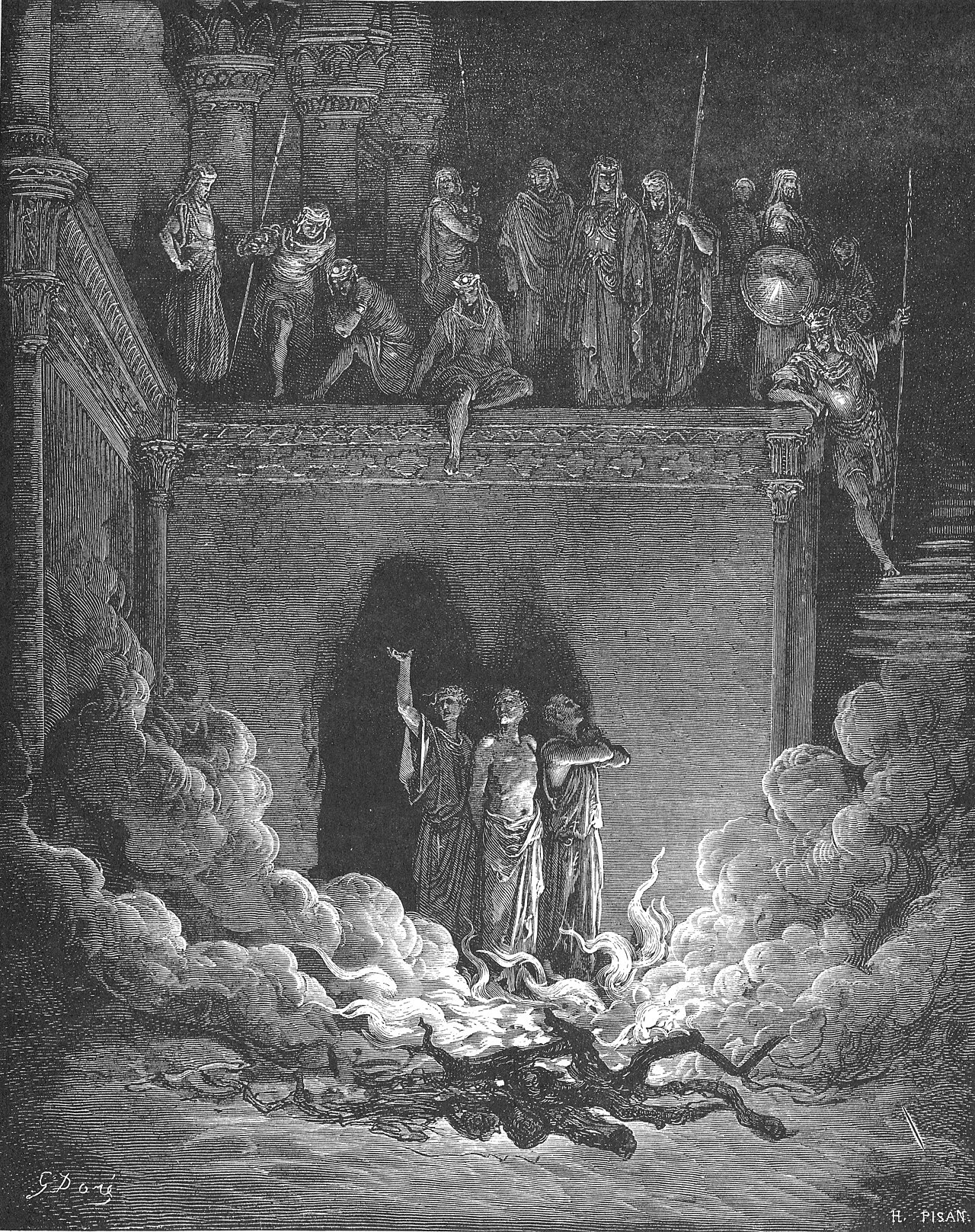
in Daniel 3And these three men, Shadrach, Meshach, and Abednego, firmly bound, fell into the blazing fiery furnace.
BSB
The same verse in ASV and KJV ▾
ASV
And these three men, Shadrach, Meshach, and Abed-nego, fell down bound into the midst of the burning fiery furnace.
KJV
And these three men, Shadrach, Meshach, and Abed–nego, fell down bound into the midst of the burning fiery furnace.
⋯
This verse in Daniel 3
Commentary
12 notes on this verseFor the blessed Jeremiah in captivity was no less blessed, nor was Daniel, nor Ezra, nor the blessed Hananiah, Azariah, and Mishael, than if they had not fallen into captivity; for they were led into captivity in order to bring comfort to the people in their present circumstances, and to bring hope of escaping captivity. For it is the perfection of a virtuous man to sustain the fellowship of human nature with the courage of the mind, and to lead others to better things.
This site's exposition
one seven times more
on Daniel 3:19-23
The king's face changes and the furnace is heated one seven times more than it was wont, fury doing physics no favors, since a hotter fire kills faster and the commentators note the order serves rage rather than punishment. The detail is court-precise: bound in their coats, their hosen, and their hats, the mightiest men of the army carrying them, and the flame slaying the executioners at the mouth, the chapter's proof before the miracle that this fire is real fire. The three fell down bound into the midst: the last the king's men see of them is men tied hand and foot in flame.
The record, by era
The Church Fathers2 voices
Accordingly, after these things happened, Scripture says, "And these three men, Shadrach, Meshach, Abednego, fell into the midst of the furnace while bound and that they were walking in the midst of the flame, hymning to God and blessing the Lord." [Daniel 3:23; Song of the Three Children 1] And so the bonds which the king put around them, these the fire consumed immediately, yet it did not singe their garments and cloaks so that even in this event the great work of God may be shown. For since the garments were clad around the bodies of the boys, these also with them were made holy and were not consumed by the fire, so that God, with the boys, may be honored in their witness. Let the arch-heretics, who deny the resurrection of themselves, tell me, how do they say there is no resurrection of the flesh, when the perishable garments and sandals, which came from the death of living creatures, are not destroyed by fire on account of the holiness which clothes their bodies? How also does the flesh, which is perishable and which clothes the holy soul, not also with the soul be made holy and be changed into incorruptible? For if what is corruptible in nature did not receive corruption, how does what is incorruptible in nature, but has died through disobedience, again having been made alive by the power of God, not actually be made alive? So that the Scripture persuades us in every way to believe in God from a whole heart, in which way those who are perfect, who have believed, may be preserved from the furnace of fire as perfect along with their garb and cloaks. For if then the fire did not tame them, how is the eternal fire able to master the saints and they who similarly believe?
Verse 23. "But these three men, (here the Vulgate inserts: "that is,") Shadrach, Meshach, and Abednego, fell fettered into the midst of the furnace of flaming fire. And they were walking about in the midst of the flames praising God and blessing the Lord. And Azariah stood and prayed after this fashion, opening his mouth in the midst of the fire and saying..." It was a great miracle for men to be cast into a furnace bound and to fall headlong into the midst of the fire, only to have the bonds burn up by which they were bound, the bodies of the fettered withal remaining untouched by the timid flames. The Hebrew text goes only up to this point and the intervening passage which now follows as far as the end of the Song of the Three Youths is not contained in the Hebrew. Lest we seem to pass over it altogether, we must make a few observations.
The Puritans and the Awakening3 voices
The pain of damned sinners is more exquisite, and the smoke of their torment ascends for ever and ever, and those have no rest, no intermission, no cessation of their pains, who have worshipped the beast and his image ( Rev. xiv. 10, 11 ), whereas their pain would be soon over that were cast into this furnace for not worshipping this Babylonian beast and his image.
Fell down - All this is exprest with emphasis, to make the power of God more glorious in their preservation; for that shame that slew the executioners, might much more easily have killed them, even before they fell down.
We are not careful - Hebrew. We care not: there is no need of any answer in this case for it is in vain for us to debate the matter; the king is resolved to have his will of us, and we are resolved on the contrary. But if not - It was therefore all one to them, which way God would honour himself; they were resolved to suffer rather than sin, and leave the cause to God.
5 more voices on this verse
The Puritans and the Awakening2 voices
And these three men fell down bound into the midst of the burning fiery furnace. The fire not so much as destroying what they were bound with, and much less them; but being bound they fell, and there they lay for the present, unbound and alive; when those that cast them in were destroyed. In the Septuagint, Vulgate Latin, Syriac, and Arabic versions, follow sixty seven verses, containing the song of Azariah and his companions in the furnace, which are not in the Hebrew text.
Their miraculous preservation in the fire by the power of God, and their invitation out of the fire by the favour of the king, who was by this miracle convinced of his error in casting them in,
The Nineteenth Century3 voices
A commentator
Albert Barnes1798–1870
Notes, Explanatory and Practical, on the Old and New Testaments (1832-1869)
And these three men - fell down bound ... - That is, the flame did not loosen the cords by which they had been fastened. The fact that they were seen to fall into the furnace “bound,” made the miracle the more remarkable that they should be seen walking loose in the midst of the fire. In the Septuagint, Syriac, Arabic, and Latin Vulgate, there follow in this place sixty-eight verses, containing “The Song of the Three Holy Children.” This is not in the Chaldee, and its origin is unknown.
A commentator
Jamieson, Fausset & Brown1802–1910
Commentary Critical and Explanatory on the Whole Bible (1871)
proposed
Here follows an addition in the Septuagint, Syrian, Arabic, and Vulgate versions. "The Prayer of Azarias," and "The Song of the Three Holy Children." It is not in the Chaldee. The hymn was sung throughout the whole Church in their liturgies, from the earliest times [RUFINUS in Commentary on the Apostles Creed, and ATHANASIUS].
And these three men - fell down bound - There is a most evident want of connection between this and the following verse; and it is between these verses that the apocryphal Song of the Three Children, as it is called, has been inserted by St. Jerome and others; but with this note: Quae sequuntur in Hebraeis voluminibus non reperi; “What follows I have not found in the Hebrew books.” And then begins, “They walked in the midst of the flame, praising God, and blessing the Lord.” The Septuagint and Arabic read the twenty-fourth verse thus: “Then Nebuchadnezzar heard them singing praise, and was astonished.” To connect the two verses Houbigant adds two verses found in the Vulgate, which are the forty-ninth and the twenty-third: “But an angel of the Lord went down with Azariah and his companions into the furnace, and drove out the flame of fire from the furnace; and they walked in the midst of the furnace.” This verse (the forty-ninth) has been added to show the reason of Nebuchadnezzar’s astonishment, and also to account for the appearance of a fourth person in the furnace, as in verse 25.
The words behind it
13 Hebrew wordsEvery Hebrew word of this verse in the order it stands, with what it means and the door to its own study. The last column counts the times a word stands in the whole Bible: the rarer the word, the more the places it appears belong together.
| Hebrew | Sound | Meaning | Word study | In the Bible |
|---|---|---|---|---|
| וְגֻבְרַיָּ֤א | veguvraiya' | and men the | H1400 → | 21 times |
| אִלֵּךְ֙ | ʾilekh | these | H479 → | 14 times |
| תְּלָ֣תֵּה֔וֹן | telatehon | three of them | H8532 → | 11 times |
| שַׁדְרַ֥ךְ | shadrakh | Shadrach | H7715 → | 14 times |
| מֵישַׁ֖ךְ | meishakh | Meshach | H4336 → | 14 times |
| וַעֲבֵ֣ד | vaaved | and Abed- | H5665 → | 28 times |
| נְג֑וֹ | nego | -nego | H5665 → | 28 times |
| נְפַ֛לוּ | nefalu | they fell | H5308 → | 11 times |
| לְגֽוֹא־ | legoy'- | to [the] midst of | H1459 → | 13 times |
| אַתּוּן־ | ʾatun- | [the] furnace of | H861 → | 10 times |
| נוּרָ֥א | nura' | fire the | H5135 → | 17 times |
| יָֽקִדְתָּ֖א | yakidta' | <the> burning | H3345 → | 8 times |
| מְכַפְּתִֽין׃ פ | mekhapetin | bound | H3729 → | 4 times |
וְגֻבְרַיָּ֤אand men the
veguvraiya'H1400 →21 times
אִלֵּךְ֙these
ʾilekhH479 →14 times
תְּלָ֣תֵּה֔וֹןthree of them
telatehonH8532 →11 times
שַׁדְרַ֥ךְShadrach
shadrakhH7715 →14 times
מֵישַׁ֖ךְMeshach
meishakhH4336 →14 times
וַעֲבֵ֣דand Abed-
vaavedH5665 →28 times
נְג֑וֹ-nego
negoH5665 →28 times
נְפַ֛לוּthey fell
nefaluH5308 →11 times
לְגֽוֹא־to [the] midst of
legoy'-H1459 →13 times
אַתּוּן־[the] furnace of
ʾatun-H861 →10 times
נוּרָ֥אfire the
nura'H5135 →17 times
יָֽקִדְתָּ֖א<the> burning
yakidta'H3345 →8 times
מְכַפְּתִֽין׃ פbound
mekhapetinH3729 →4 times
A shaded row is a word that stands 400 times or fewer in the Bible.
The walk
8 stopsEach card is a verse this one points to, and under it the verses that one points to in turn. Where several paths arrive at the same place, that place is listed first: the text keeps returning to it.
Through
Psalms 34:19Many are the afflictions of the righteous, but the LORD delivers him from them all.
it leads to
- Psalms 34:17
The righteous cry out, and the LORD hears; He delivers them from all their troubles.
- 1 Peter 4:12–13
Beloved, do not be surprised at the fiery trial that has come upon you, as though something strange were happening to you.
- 2 Corinthians 4:17
For our light and momentary affliction is producing for us an eternal weight of glory that is far beyond comparison.
- Psalms 34:6
This poor man called out, and the LORD heard him; He saved him from all his troubles.
- John 16:33
I have told you these things so that in Me you may have peace. In the world you will have tribulation. But take courage; I have overcome the world!”
- Psalms 34:17
Through
Jeremiah 38:6So they took Jeremiah and dropped him into the cistern of Malchiah, the king’s son, which was in the courtyard of the guard. They lowered Jeremiah with ropes into the cistern, which had no…
it leads to
- Jeremiah 37:21
So King Zedekiah gave orders for Jeremiah to be placed in the courtyard of the guard and given a loaf of bread daily from the street of the bakers, until all the bread in…
- Jeremiah 38:22
All the women who remain in the palace of the king of Judah will be brought out to the officials of the king of Babylon, and those women will say: ‘They misled you and…
- Psalms 69:14–15
Rescue me from the mire and do not let me sink; deliver me from my foes and out of the deep waters.
- Jeremiah 37:21
Where this verse is studied
On this page
About Daniel
This page draws on 11 works. Open the list of works
This page draws on Adam Clarke, Commentary on the Bible; Albert Barnes, Notes, Explanatory and Practical, on the Old and New Testaments (1832-1869); Ambrose of Milan, On Jacob and the Blessed Life; Carl Friedrich Keil, Biblical Commentary on the Book of Daniel; Hippolytus of Rome, Commentary on Daniel 2.28.1-7; Jamieson, Fausset & Brown, Commentary Critical and Explanatory on the Whole Bible; Jerome, St. Jerome, Commentary on Daniel, CHAPTER THREE; John Gill, Exposition of the Old Testament; John Gill, Exposition of the Old Testament (1748-1763); John Wesley, Explanatory Notes upon the Old Testament and Matthew Henry, Commentary on the Whole Bible.