
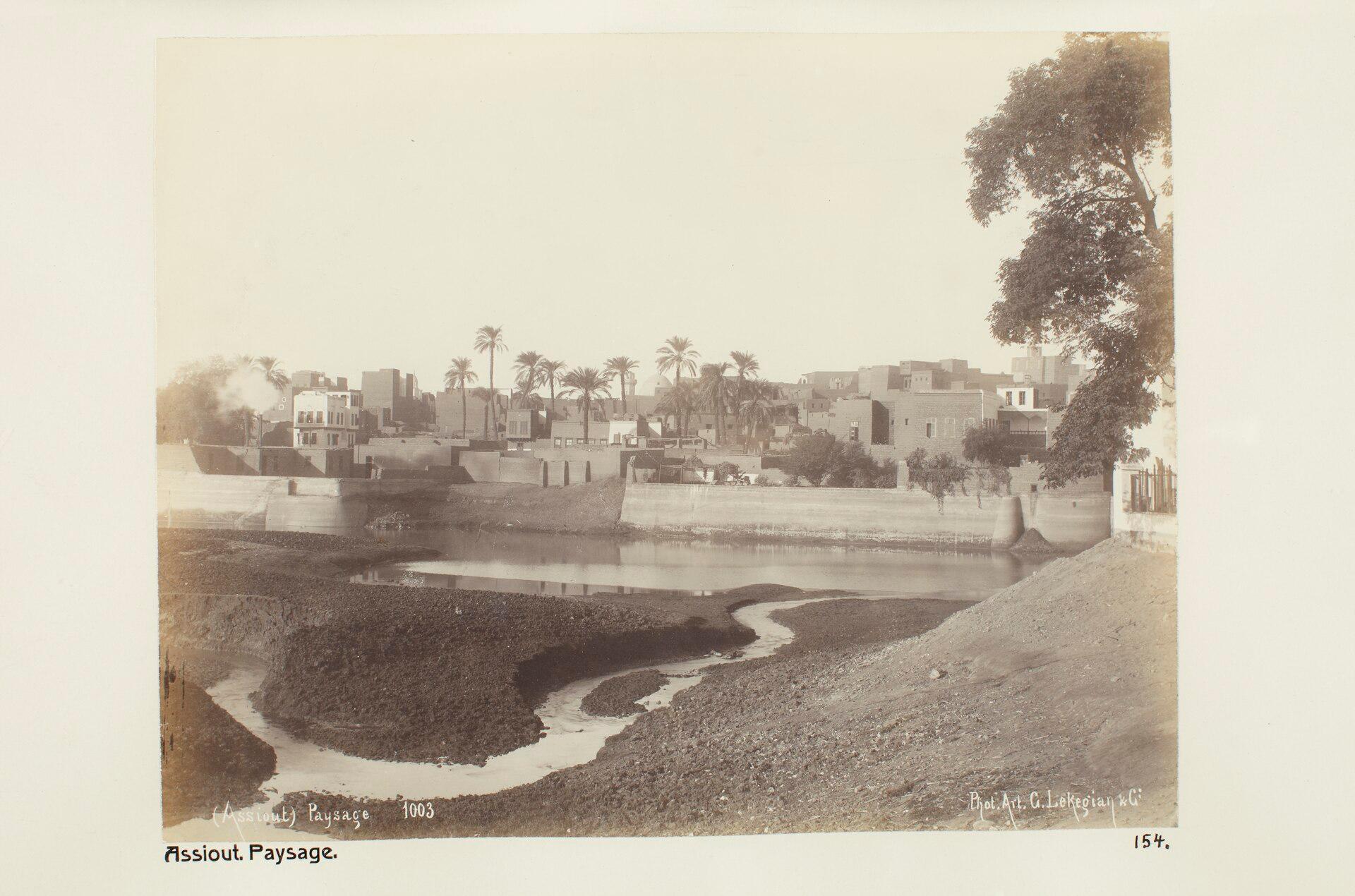
G. Lekegian and Co., Assiout. Paysage (1900 or 1901), public domain
Florida and Assiout, 1887 to 1961 · Person · Featured Study
Lillian Trasher
She was an American Pentecostal missionary who kept an orphanage at Assiout in Upper Egypt from 1911 until her death in 1961.
- Born
- 27 September 1887
- Died
- 17 December 1961
- Places
- Jacksonville, Marion, Assiout
She sailed to preach in Egypt and became mother to its orphans for half a century.
Pure and undefiled religion before our God and Father is this: to care for orphans and widows in their distress, and to keep oneself from being polluted by the world.
Summary
Lillian Trasher was born in Florida in 1887 and sailed for Egypt in 1910. At Assiout, on the Nile in Upper Egypt, she took in a baby whose mother had just died. The orphanage grew from that child. She stayed fifty-one years and is buried in its cemetery.
- She gave up an engagement to a young minister to go to Egypt.
- In the rising of March 1919 the government sent every foreigner away from Assiout. She went to America for a time.
- By 1923 The Pentecostal Evangel called her one of the General Council's missionaries.
The Texts of Her House
James 1 names the care of orphans, and Psalm 68 calls God the father of the fatherless.
The question of this life is how one woman kept an orphanage for half a century on gifts. Her letters, the notice of her death and an archivist's account of 1984 are the witnesses.
A father of the fatherless, and a defender of the widows, is God in His holy habitation.Her children called her Mama, and she took the place of the parents they had lost.
The Life in Order
Each date stands with the paper that printed it.
Her fifty-one years in Egypt began with one child.
- 27 September 1887She was born at Jacksonville, FloridaThe Pentecostal Evangel, 11 February 1962, page 15
- 8 October 1910She sailed for EgyptThe Pentecostal Evangel, 11 February 1962, page 15
- 10 February 1911She took a baby girl whose mother had just died into her homeWayne Warner, Assemblies of God Heritage, Winter 1984 to 1985, page 2
- August 1917The orphanage held more than eighty childrenThe Pentecostal Evangel, 17 November 1917
- 28 March 1919The general ordered her onto the boats leaving AssioutThe Latter Rain Evangel, September 1919, page 18
- 1923The orphanage held about three hundredThe Pentecostal Evangel, 25 August 1923
- December 1924The Assemblies of God listed her among its ministersMinisters Directory of the General Council, December 1924
- 1955She visited the United States for the first time in twenty-five yearsAssemblies of God Heritage, Winter 1984 to 1985, page 2
- 17 December 1961She died at six in the evening, a SundayThe Pentecostal Evangel, 11 February 1962, page 15
Each step of the life stands with its witness.
December 1924, 1955, 17 December 1961
From Florida to the Nile
She went from a Catholic childhood and an orphanage in North Carolina to a house at Assiout.
She grew up a Catholic. As a girl she followed the sound of singing to a tent meeting, and a few nights later she gave her life to Christ.
Jerome Beatty wrote in 1939 that she worked in an orphanage at Marion, North Carolina, after high school. The Latter Rain Evangel wrote in 1924 that she was engaged to a young minister and gave him up for the call to Egypt.
She sailed in October 1910, and Beatty says her older sister went with her as a chaperon. Her parents would give her no money for the voyage, and she gathered it from church people.
In February 1911 a dying mother left a baby girl, and the father could not care for her. She took the child into her home, and the orphanage began from that one child.
In March 1919 men from the villages looted Assiout and burned houses. A farmer of the neighbourhood stood at her door and turned a mob away from "our own orphans". The authorities sent every foreigner away on steamers, and the Evangel reported in June that she was on her way to America.
She came back, and the house kept growing. A visitor reported in 1928 that she housed 478 orphans, and in 1929 a report called the place a village of 523 people.
Her grave is in the orphanage cemetery at Assiout. The Evangel wrote that more than eight thousand children had passed through her care.
The House at Assiout
The orphanage lived from gifts from America and from Egypt, and it took widows as well as children.
The Evangel wrote in 1923 that no one had planned an orphanage at all. It grew one child at a time, and the first years were slow because people did not see what was being built.
She wrote in 1920 that God had always supplied their needs. In a later talk she said that the money came from Egypt when it did not come from America.
At her death the house held 1,400 children and widows. Muslims and Christians stood side by side as her body passed through the streets.
In Their Own Words
Three sayings from The Latter Rain Evangel, each read on the printed page.
Lillian Trasher (1887 to 1961)
Her letter, The Latter Rain Evangel, September 1920, page 10
A schoolgirl's wish
“When I was a young school-girl I used to say to myself, ‘Oh, if I only had the money I'd open an orphanage.’”
Pentecostal
About this saying1 paragraph
She looked back to her girlhood in a letter printed on page 10 of The Latter Rain Evangel for September 1920.
Lillian Trasher
It Shall Not Come Nigh Thy Dwelling, The Latter Rain Evangel, September 1919, page 18
I cannot leave these children
“Leave Assiout? I leave Assiout? Indeed I'll not do that. Why, can't you see that I cannot leave these children?”
Pentecostal
About this saying1 paragraph
She answered this in March 1919 when she was told she would have to leave, as her article on page 18 of the Evangel for September 1919 records.
Lillian Trasher
How do I manage them, The Latter Rain Evangel, September 1924, page 19
Why they obey
“The most of my children are obedient because they love me. They love me because I love them, and because I am kind and just toward them.”
Pentecostal
About this saying1 paragraph
She said this of her children in a talk printed on page 19 of the Evangel for September 1924.
The People Around Her
Her circle was her family at home, the people of Assiout and the missionaries who came to help.
The first child came from a dying mother.
| Person | Tie to Lillian Trasher | The witness |
|---|---|---|
| Her older sister | She expected her to give up within weeks | The American Magazine, 1939 |
| Sarah Smith | A missionary who joined the work and wrote home of it | Her letter home |
| A farmer of Assiout | He stood between the house and the looters | Her own account |
| Philip and Hazel Crouch | Missionaries who served with her from 1948 to 1955 | Philip Crouch's memoir |
| President Nasser | The president of Egypt, who sent a telegram at her death | Raymond Brock, 1962 |
The Places of Her Life
Her life ran from the American South to a town on the Nile in Upper Egypt.
She spent fifty-one of her seventy-four years at Assiout.
| Place | What the witnesses say | The witness |
|---|---|---|
| Jacksonville, Florida | Her birthplace | Brock's notice |
| Marion, North Carolina | Where she learned the care and feeding of infants | Beatty |
| Assiout, Egypt | Her orphanage stood there from 1911, and she is buried there | Warner and Brock |
| Walledeah | A village by the river between the orphanage and the town, bombed from the air in March 1919 | Her account of the rising |
| Springfield, Missouri | A crowd of three hundred met her there in January 1955 | A photograph caption of 1984 |
What Her House Taught
She ruled her house by love and told the plain work of it without shame.
She held that children are good by nature unless they are provoked or taught meanness. A new boy of six, she said, sees the clean and well-dressed children around him and wants to be like them.
The Evangel of 1924 records that she often said her work "may not read well on paper", for it was nursing crying babies and dressing sores. The writer of that piece answered that the destiny of a nation is often wrapped up in the life of a child.
How the Key Verse Was Taught
The Shepherd of Hermas, John Wesley and Pandita Ramabai read the care of orphans and widows.
Shepherd of Hermas (died 160)
Shepherd of Hermas, Similitude 1
The Shepherd of Hermas told the rich to buy afflicted souls in place of lands.
“Instead of lands, therefore, buy afflicted souls, according as each one is able, and visit widows and orphans, and do not overlook them; and spend your wealth and all your preparations, which ye received from the Lord, upon such lands and houses. For to this end did the Master make you rich, that you might perform these services unto Him.”
on James 1:27Patristic
John Wesley (1703 to 1791)
Explanatory Notes upon the New Testament
John Wesley called the visiting of the fatherless and widows the only true religion in the sight of God.
“The only true religion in the sight of God, is this, to visit - With counsel, comfort, and relief. The fatherless and widows - Those who need it most.”
on James 1:27Evangelical
Pandita Ramabai (1858 to 1922)
The High-Caste Hindu Woman, chapter 7, The Appeal, page 119
Pandita Ramabai appealed in 1887 for the widows of India.
“I beg you, friends and benefactors, educators and philanthropists, all who have any interest in or compassion for your fellow-creatures, let the cry of India's daughters, feeble though it be, reach your ears and stir your hearts.”
Indian Christian
What the Record Leaves Open
The sources differ on the year the orphanage began and on the church of her youth.
When the orphanage beganWayne Warner; Lillian Trasher; Christ's Ambassadors Herald
Wayne Warner, director of the Assemblies of God Archives, gives the day in February 1911 when the first child came. Her letter of mid 1920 looks back over nine and a half years, which fits early 1911. Christ's Ambassadors Herald in 1929 set her coming and the opening of the orphanage together under 1910.
The church of her youthLillian Trasher; Jerome Beatty
She wrote in 1920 that she had grown up a Catholic, knowing nothing of salvation. Beatty, in a magazine story of 1939, calls her a devout church member, and the profile of 1924 tells of her conversion at a tent meeting as a girl.
Books to Read Next
The Latter Rain Evangel, September 1924
The Stone Church, Chicago · 1924
This issue prints a profile of her and her own account of how she raised her children.
Read The Latter Rain Evangel free at the Flower Pentecostal Heritage CenterAssemblies of God Heritage, Winter 1984 to 1985
Wayne Warner, editor · 1984
The issue gives her life, reprints Beatty's story of 1939 and adds a memoir by Philip Crouch.
Read Assemblies of God Heritage free in the Flower Pentecostal archiveLady on a Donkey
Beth Prim Howell · 1960
The Evangel named this book in 1962 as the telling of her story.
In print: find it wherever books are sold.
What Lillian Trasher Left
She left an orphanage that Warner wrote in 1984 was still a haven for orphans and widows, by then named for her. The Egyptian papers called her "The Saint of the twentieth century".
Sources
Scripture is the Berean Standard Bible.
- The Holy Bible, Berean Standard Bible (read 2026)
- Raymond T. Brock, Mama Lillian and Her Children, The Pentecostal Evangel, 11 February 1962, page 15.
- Wayne Warner, The Heritage Letter, and Jerome Beatty, Nile Mother (The American Magazine, June 1939), reprinted in Assemblies of God Heritage, Winter 1984 to 1985.
- Lillian Trasher, It Shall Not Come Nigh Thy Dwelling, The Latter Rain Evangel, September 1919, pages 14 to 18; her letter in the issue of June 1919, page 11.
- Lillian Trasher, letter, The Latter Rain Evangel, September 1920, page 10.
- The Latter Rain Evangel, August 1924, an interview, and September 1924, pages 17 to 19, a profile and her own account.
- The Pentecostal Evangel, 17 November 1917, 28 June 1919, 25 August 1923 and 5 November 1927; The Latter Rain Evangel, September 1928 and October 1929.
- Ministers Directory of the General Council of the Assemblies of God, December 1924; Christ's Ambassadors Herald, August 1929.
- The Shepherd of Hermas, Similitude 1, on James 1:27.
- John Wesley, Explanatory Notes upon the New Testament (1755), on James 1:27.
- Pandita Ramabai, The High-Caste Hindu Woman (1887), chapter 7.
Keep Studying
People and groups3