
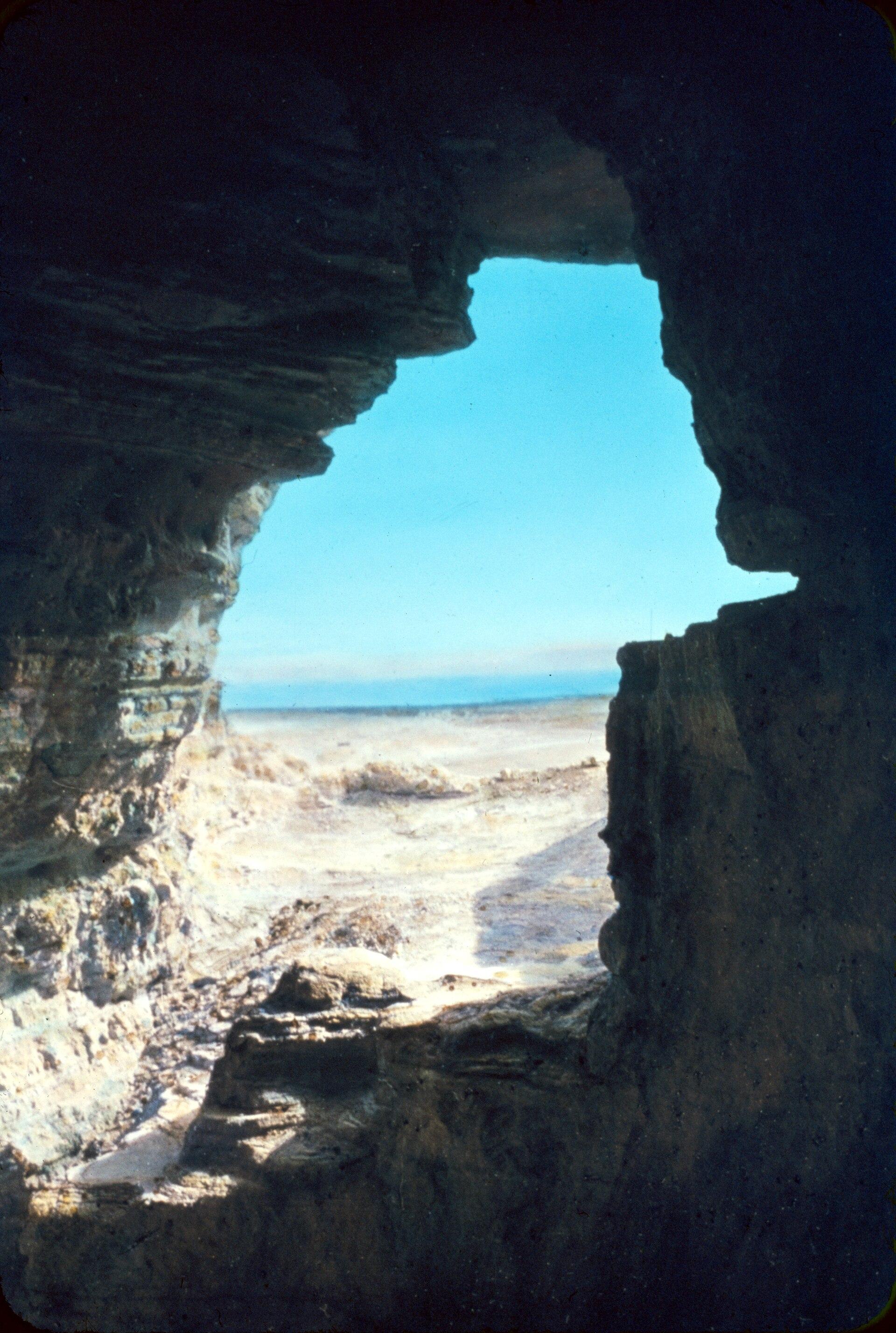
Eric Matson, Qumran, 1947 to 1961. Public domain.
Luke 4:17 and Isaiah 40:8 · Subject · Featured Study
The Dead Sea Scrolls
The Dead Sea Scrolls are Jewish manuscripts found from 1947 to 1956 in eleven caves near Qumran, on the northwest shore of the Dead Sea.
Seven scrolls from one cave began a search that lasted nearly a decade.
the scroll of the prophet Isaiah was handed to Him. Unrolling it, He found the place where it was written:
the scroll of the prophet Isaiah was handed to Him. Unrolling it, He found the place where it was written:
- Books
- Luke, Isaiah
- Hold in memory
- Isaiah 40:8
Summary
They hold copies of the Bible's books made before and in the time of Jesus.
- Every Old Testament book but Esther is in them, says Israel's office of antiquities.
- They show the text kept with care, with small changes here and there.
- They also hold other Jewish books from the same years.
What the Dead Sea Scrolls Are
Three institutions count the scrolls, and the Authority dates them and names their languages.
The Israel Antiquities Authority counts tens of thousands of fragments from over 900 manuscripts in its digital library, read in 2026. The Israel Museum's digital edition gives some 950 scrolls. The Library of Congress exhibit of 1993 gave almost one thousand works.
The Authority dates the scrolls from the third century BC to the first century AD, before the destruction of the Temple in AD 70. Most are dated by their handwriting, and some by carbon-14.
Hebrew is the most used language. The Authority puts about 15 percent of the scrolls in Aramaic and several in Greek.
Most are written on parchment and some on papyrus. The text of one is cut into copper.
Albert Barnes, in his Notes on the Gospels, observes from Luke 4:17 that the books of Scripture were kept as separate rolls.
The Great Isaiah Scroll, 1QIsaᵃ, is such a roll.
The Bible Among the Scrolls
The caves held books of Scripture, books of the Apocrypha and writings of their own.
The Authority counts about 230 manuscripts as biblical scrolls, and the Library of Congress gave the same count of books in 1993.
The Museum gives approximately two hundred copies, most of them very fragmentary, and names Nehemiah as missing beside Esther.
Five scrolls of Scripture from the Qumran caves, each with its siglum, its cave, its date and where it is kept.
| Siglum | Scroll | Cave | Dated | Kept at |
|---|---|---|---|---|
| 1QIsaᵃ | the Great Isaiah Scroll | Cave 1 | late second century BC, about 125 BC | the Shrine of the Book |
| 1QIsaᵇ | the Second Isaiah Scroll | Cave 1 | first century BC, commonly about 50 to 25 BC | the Shrine of the Book |
| 4Q22 | the Palaeo-Hebrew Exodus Scroll | Cave 4 | about 100 to 25 BC | the Antiquities Authority |
| 4QSamᵃ | the Samuel Scroll | Cave 4 | about 50 to 25 BC | the Antiquities Authority |
| 11Q5 | the Great Psalms Scroll | Cave 11 | first half of the first century AD, about AD 1 to 50 | the Shrine of the Book |
Three books of the Apocrypha were also found: Ben Sira, also called Sirach, Tobit and the Epistle of Jeremiah.
Other writings, among them Jubilees and 1 Enoch, had been known before only in ancient translations.
The Authority labels about a quarter of the writings outside the Bible sectarian. They include rules such as the Community Rule and the Damascus Document, hymns called the Hodayot, and commentaries on the prophets called pesharim.
The Museum describes such works as composed by members of an isolated community. Its identity is set out with its holders on the page on the Essenes.
How the Scrolls Were Found
Bedouin found the first cave, archaeologists joined the search, and two buyers divided the first seven scrolls.
Bedouin of the Ta'amra tribe found the first seven scrolls by chance, in the cave later named Cave 1. The Authority names the goatherds Jum'a and Muhammed ed-Dib as the men who claimed the find.
Of the eleven caves that yielded writing, Bedouin found five and archaeologists six. Cave 11 was the last. Cave 4 alone held some 15,000 fragments, by the count of the Museum's digital edition.
Three of the first seven went to Eliezer Lipa Sukenik, who purchased them for the Hebrew University. They were the War Scroll, the Thanksgiving Scroll and a second copy of Isaiah, 1QIsaᵇ.
The other four went to Mar Athanasius Samuel, the Syrian Orthodox Metropolitan in Jerusalem. They were the complete Isaiah, the Community Rule, a commentary on Habakkuk and the scroll later named the Genesis Apocryphon.
He offered them for sale in the Wall Street Journal on 1 June 1954. Sukenik's son Yigael Yadin purchased the four for the State of Israel.
The seven have been kept in the Shrine of the Book at the Israel Museum in Jerusalem since its dedication on 20 April 1965.
What the Scrolls Show About the Old Testament Text
What agrees with the Hebrew of the Middle Ages, and what differs from it.
The Israel Museum finds 1QIsaᵃ generally in agreement with the Masoretic Text, the Hebrew copied in medieval books such as the Aleppo Codex.
The same page says the scroll has many variant readings, other spellings, scribal errors and corrections. The museum's digital edition, read in 2026, counts well over 2,600 textual variants, from a single letter up to whole verses.
The Authority writes that many biblical scrolls closely resemble the Masoretic Text and that some differ from it in language and spelling.
The manuscript record of 4QSamᵃ, a copy of Samuel from Cave 4, notes that it often agrees with the Septuagint, the ancient Greek translation, where the Masoretic Text differs.
After the anguish of His soul, He will see the light of life and be satisfied. By His knowledge My righteous Servant will justify many, and He will bear their iniquities.Two Isaiah scrolls from the caves and the Septuagint read that the Servant will see light, and the Berean text follows them.
The medieval Hebrew text of this verse lacks the word light. The variant's page sets out both readings with their witnesses.
The Word of Our God
The prophet's line on the word of God stands in 1QIsaᵃ, copied by hand before the time of Jesus.
The grass withers and the flowers fall, but the word of our God stands forever.”Isaiah's word on what outlasts the grass of the field.
Sources
Scripture is the Berean Standard Bible.
- Israel Antiquities Authority, The Leon Levy Dead Sea Scrolls Digital Library: Introduction; Discovery and Publication; Discovery Sites; Scrolls Content; Languages and Scripts.
- The Israel Museum, Jerusalem, The Digital Dead Sea Scrolls: Discovery; Significance; The Shrine of the Book; The Great Isaiah Scroll.
- Library of Congress, Scrolls from the Dead Sea, an exhibit of 1993.
- Manuscript records of the Great Isaiah Scroll, the Second Isaiah Scroll, the Palaeo-Hebrew Exodus Scroll, the Samuel Scroll from Cave 4, the Great Psalms Scroll and the Aleppo Codex.
- The variant at Isaiah 53:11, its witnesses and readings.
- Albert Barnes, Notes, Explanatory and Practical, on the Gospels, on Luke 4:17.
Keep Studying
Studies7
People and groups3