
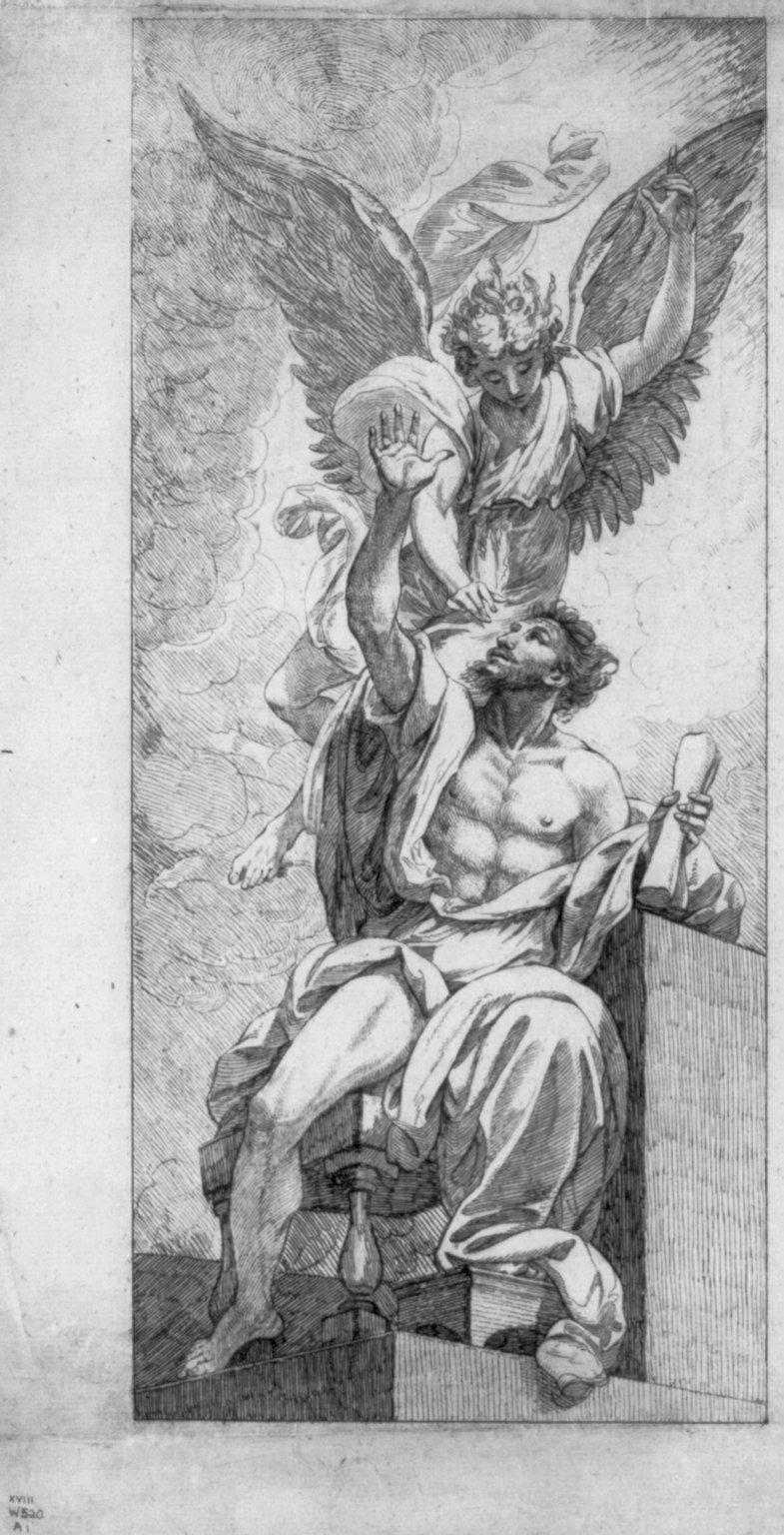
Benjamin West, The calling of Isaiah, 1780. Public domain.
Isaiah 6:2 · Group · Featured Study
The Seraphim
Isaiah saw six-winged seraphim above the LORD's throne, and Scripture gives serpents the same Hebrew name.
Only one chapter of Scripture names the seraphim as beings beside God.
Above Him stood seraphim, each having six wings: With two wings they covered their faces, with two they covered their feet, and with two they were flying.
Above Him stood seraphim, each having six wings: With two wings they covered their faces, with two they covered their feet, and with two they were flying.
- Began
- First named in Isaiah's vision in the year King Uzziah died (Isaiah 6:1 to 2)
Summary
They call the LORD holy. Strong's lexicon, the numbered word list of the Hebrew Bible, takes their name from a verb that means to burn.
- Five of the seven uses of the word saraph in Scripture name serpents.
- Readers since Origen have disagreed over how many seraphim there are and how they rank.
- Cyril of Alexandria read their threefold holy as the Trinity.
The Seraphim in Isaiah's Vision
Isaiah saw the seraphim in the year King Uzziah died.
In the year that King Uzziah died, I saw the Lord seated on a throne, high and exalted; and the train of His robe filled the temple.The vision opens on the throne before the seraphim are named.
Isaiah 6 gives the seraphim three acts. They cover themselves before the LORD, they call to one another, and one of them flies to the prophet. The coal, the altar and the prophet's call have their own study.
The Word Saraph in Seven Verses
The Hebrew word saraph stands in seven verses, two of the seraphim and five of serpents.
Saraph names the beings of Isaiah's vision in two verses and serpents in five.
- Numbers 21:6venomous snakes, The snakes sent among Israel in the wilderness
- Numbers 21:8a fiery serpent, The bronze figure of Numbers 21:9
- Deuteronomy 8:15venomous snakes, The snakes of the wilderness journey
- Isaiah 6:2seraphim, The beings of the vision
- Isaiah 6:6one of the seraphim, The one who flies to the prophet
- Isaiah 14:29a flying serpent, A figure in the oracle against Philistia
- Isaiah 30:6flying serpent, A creature of the Negev in the oracle against the beasts
Seven cells for the seven verses of saraph in the order of the canon, each with the Berean rendering and what the word names there.
Strong's lexicon glosses saraph as burning, used figuratively of a poisonous serpent. Brown, Driver and Briggs give the word two senses, a serpent and the six-winged beings of Isaiah 6.
Matthew Henry gives a reason the wilderness serpents bear the name.
“Justly are those made to feel God's judgments that are not thankful for his mercies. These serpents are called fiery, from their colour, or from their rage, or from the effects of their bitings, inflaming the body, putting it immediately into a high fever, scorching it with an insatiable thirst.”
Matthew Henry · Commentary on the Whole Bible · on Numbers 21:6Puritan
Six Wings in Three Pairs
Four of each seraph's wings cover it, and two carry it.
Isaiah 6:6 shows the flying pair at work, when one seraph flies to the prophet. John Chrysostom, in his homilies Against the Anomoeans, reads the covered faces as a sign. God dwells in unapproachable light, even for the powers above.
“Let us bring our discourse back to our earlier proposition and let us show that God, even by the accommodation of condescension, cannot be seen by the powers above. Tell me this. Why do the seraphim stretch forth their wings? There is no other reason than the statement made by the apostle: ‘Who dwells in unapproachable light.’ And these heavenly virtues, who are showing this by their very actions, are not the only ones. There are powers higher than the seraphim, namely, the cherubim. The seraphim stood near; the cherubim are the throne of God. They are not called this because God has need of a throne but so that you may learn how great is the dignity of these very powers.”
John Chrysostom · Against the Anomoeans 3:24 · on Isaiah 6:2Patristic
The four-winged creatures of Ezekiel's visions are studied on their own page.
What Scripture Leaves Unsaid
Two silences stand in Isaiah's account of the seraphim.
No seraph is given a name.
Isaiah describes the seraphim's wings, faces and feet, and one seraph's hand, and gives no other feature of their form.
Holy, Holy, Holy
The seraphim call the LORD holy three times, and Cyril of Alexandria read the cry of the Trinity.
And they were calling out to one another: “Holy, holy, holy is the LORD of Hosts; all the earth is full of His glory.” At the sound of their voices the doorposts and thresholds shook, and the temple was filled with smoke.The cry of the seraphim is the centre of the vision.
The seraphim call to one another, so the praise passes back and forth between them. Cyril of Alexandria reads the threefold holy and the one title, Lord of hosts, as the one Godhead in three persons.
“The mouths of the seraphim are filled with blessings. They offer a doxology in turn, not in my opinion because they are tired but because they show respect to one another, both receiving and giving the doxology. They say ‘holy’ three times and then conclude with ‘Lord of hosts.’ This demonstrates that the Holy Trinity exists in one divine essence. All hold and confess that the Father exists, along with the Son and the Spirit. Nothing divides those who are named nor separates them into different natures. Just the opposite is true. We recognize one Godhead in three persons.”
Cyril of Alexandria · Commentary on Isaiah 1:4 · on Isaiah 6:3Patristic
A Voice on the Seraphim
Henry reads the name of burning as love and zeal.
Matthew Henry (1662 to 1714)
Matthew Henry, in his Commentary on the Whole Bible of 1710, reads the seraphim's name as their character.
“They burn in love to God, and zeal for his glory and against sin, and he makes use of them as instruments of his wrath when he is a consuming fire to his enemies. Whether they were only two or four, or (as I rather think) an innumerable company of angels, that Isaiah saw, is uncertain; see Dan. vii.”
Matthew Henry · Commentary on the Whole Bible · on Isaiah 6:2Puritan
How Many, and How High?
Readers since Origen disagree over the number of the seraphim and their rank beside the cherubim.
Many seraphim round the throneEusebius of Caesarea; Matthew Henry
Eusebius of Caesarea, in his Commentary on Isaiah, reads the seraphim as a guard all round the throne. Matthew Henry rather thinks they were an innumerable company.
“Some think there are two seraphim, but I, based on the idea expounded by the sacred Scripture, which says, ‘the seraphim stood round about him,’ think there are many, and they are bodyguards, as it were, like a crown from all sides, surrounding his throne with light and enlivened by him.”
Eusebius of Caesarea · Commentary on Isaiah 6:2 · on Isaiah 6:2Patristic
The objection: Isaiah gives no number, and the Berean text says only that seraphim stood above Him.
Two seraphim, read as the Son and the SpiritOrigen's Hebrew teacher
Origen, in On First Principles, reports the reading of a Hebrew teacher of his.
“My Hebrew master used to say that the two seraphim, which are described in Isaiah as having six wings each and as crying one to another and saying, ‘Holy, holy, holy is the Lord of hosts,’ were to be understood to mean the only-begotten Son of God and the Holy Spirit.”
Origen of Alexandria · On First Principles 1:3 · on Isaiah 6:3Patristic
The objection: Isaiah 6:2 sets the seraphim above the One on the throne, as beings who cover their faces before Him.
The seraphim first among the ordersDionysius the Areopagite
The Celestial Hierarchy, written under the name of Dionysius the Areopagite, counts nine orders of heavenly beings in three ranks. In chapter 7 it sets the seraphim, the cherubim and the thrones in the first rank. It reads the name seraphim as kindling or burning.
The objection: Scripture gives no list of nine orders.
The cherubim higher than the seraphimJohn Chrysostom
John Chrysostom, in the same work Against the Anomoeans, ranks the cherubim higher. The seraphim stood near, he says, and the cherubim are the throne of God.
The objection: Isaiah 6 sets no rank among heavenly beings and names no cherubim.
The Serpent Lifted Up
The fiery serpent Moses mounted on a pole bears the seraphim's Hebrew name. Jesus took that pole as a picture of His own lifting up.
Just as Moses lifted up the snake in the wilderness, so the Son of Man must be lifted up, that everyone who believes in Him may have eternal life.Jesus reads the bronze serpent of Numbers 21 as a sign of the cross.
Sources
Scripture is the Berean Standard Bible.
- Strong's lexicon, H8314 saraph, with its occurrence count.
- Brown, Driver and Briggs, A Hebrew and English Lexicon of the Old Testament, the entry for saraph.
- Matthew Henry, Commentary on the Whole Bible, 1710, on Isaiah 6:2 and Numbers 21:6.
- Eusebius of Caesarea, Commentary on Isaiah, on Isaiah 6:2.
- Origen of Alexandria, On First Principles 1.3.
- John Chrysostom, Against the Anomoeans 3.
- Cyril of Alexandria, Commentary on Isaiah, on Isaiah 6:3.
- Dionysius the Areopagite, The Celestial Hierarchy, chapters 6 and 7, in the Works of 1899.
Keep Studying
Studies1
People and groups5
Symbols1