
2 Samuel 12:1
in 2 Samuel 12Then the LORD sent Nathan to David, and when he arrived, he said, “There were two men in a certain city, one rich and the other poor.
BSB
The same verse in ASV and KJV ▾
ASV
And Jehovah sent Nathan unto David. And he came unto him, and said unto him, There were two men in one city; the one rich, and the other poor.
KJV
And the Lord sent Nathan unto David. And he came unto him, and said unto him, There were two men in one city; the one rich, and the other poor.
⋯
This verse in 2 Samuel 12
Commentary
11 notes on this verseA commentator
Gregory the DialogistThe Book of Pastoral Rule, Part 3, Chapter 2 · Written before 604.
But sometimes, when the powerful of this world are taken to task, they are first to be searched by certain similitudes, as on a matter not concerning them; and, when they have pronounced a right sentence as against another man, then in fitting ways they are to be smitten with regard to their own guilt; so that the mind puffed up with temporal power may in no wise lift itself up against the reprover, having by its own judgment trodden on the neck of pride, and may not try to defend itself, being bound by the sentence of its own mouth.
This site's exposition
There were two men in one city
on 2 Samuel 12:1-3
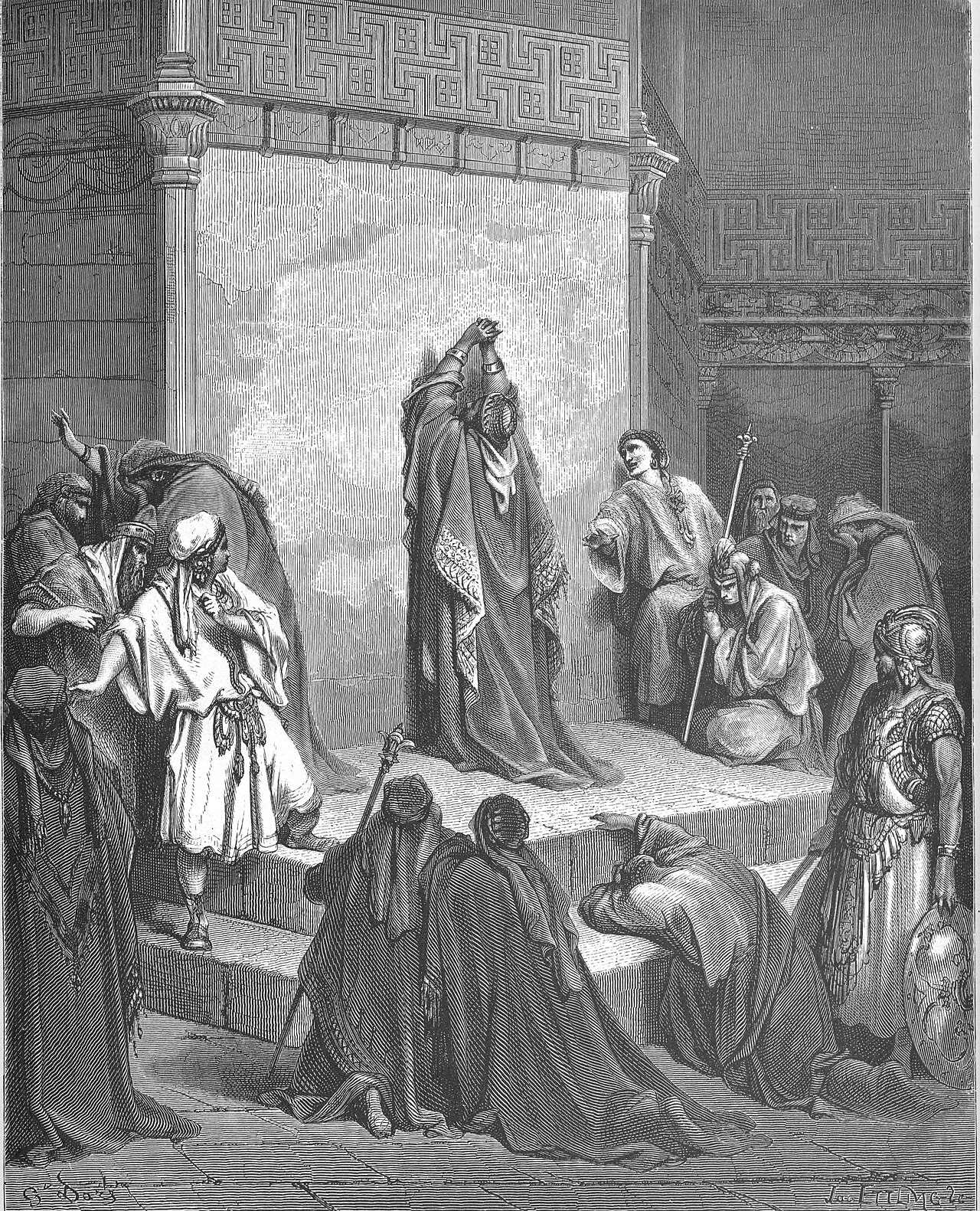
Nathan comes to David as a judge is asked to judge, laying out a case rather than an accusation, and David never suspects that he sits as the accused. The poor man's one ewe lamb, fed from his own dish and carried in his bosom like a daughter, gives the rich man's crime its full weight before David hears a single name. Matthew Henry notes that Nathan does not shrink from a king's rank any more than Uriah's low rank shielded him from the king's hand. The parable's method, drawing a right verdict from the very mouth that will be condemned by it, sets the pattern for the chapter that follows.
The record, by era
The Church Fathers3 voices
For I admit my wrongdoing, and my offense confronts me all the time. "I have not thrust my deed behind my back; I do not look askance at others while forgetting myself; I do not presume to extract a speck of straw from my brother's eye while there is a timber in my own; my sin is in front of me, not behind my back. It was behind me until the prophet was sent to me and put to me the parable of the poor man's sheep." What the prophet Nathan said to David was this: There was a certain rich man who had a large flock of sheep. His neighbor was a poor man who had only one little ewe lamb; she rested in his arms and was fed from his own dish. Then a guest arrived at the rich man's house. The rich man took nothing from his flock; what he wanted was the little ewe lamb that belonged to his neighbor, so he slaughtered that for his guest. What does he deserve? Angrily David pronounced sentence. Obviously the king was unaware of the trap into which he had fallen, and he decreed that the rich man deserved to die and must make fourfold restitution for the sheep. It was a very severe view, and entirely just. But his own sin was not yet before his eyes; what he had done was still behind his back. He did not yet admit his own iniquity and hence would not remit another's. But the prophet had been sent to him for this purpose. He brought the sin out from behind David's back and held it before his eyes, so that he might see that the severe sentence had been passed on himself. To cut away diseased tissue in David's heart and heal the wound there, Nathan used David's tongue as a knife.
A commentator
John ChrysostomHOMILIES ON REPENTANCE AND ALMSGIVING 2.2.9 · Written in the 5th century.
proposed
Therefore, Nathan went to David and wove a dramatic act for judgment. And what did he say? "My king, I want your judgment. There was a certain rich man and a certain poor one. The rich person possessed herds of cattle and many other flocks; and the poor one had one ewe that drank from his glass, ate from his table and slept in his embrace." Here Nathan revealed the genuine bond between a husband and wife. "When a certain stranger arrived, the rich man desired to keep his own animals, and he took the poor man's ewe and slaughtered her." Here, do you see how Nathan wove the dramatic act, mysteriously concealing the weapon in the glands of David's throat? Then what did the king say? Thinking that he had to pass judgment against someone else, he decided most severely. For such are human beings. When it concerns other people, they gladly and abruptly render decisions and publicize them. And what did David say? "As the Lord lives, the man who did this thing is worthy of death. And he shall restore the lamb fourfold." Therefore, what did Nathan reply? He did not allow the wound to be relieved for many hours; rather, he quickly stripped it naked and sharply embedded the knife deeply into it, so as not to rob it of the painful sensation. "You are the man, my king." What did the king say? "I have sinned against the Lord." He did not say, "Who are you who censures me? Who sent you to speak with such boldness? With what daring did you prevail?" He did not say anything of the sort; rather, he perceived the sin. And what did he say? "I have sinned against the Lord." Therefore, what did Nathan say to him? "And the Lord remitted your sin." You condemned yourself; I [God] remit your sentence. You confessed prudently; you annulled the sin. You appropriated a condemnatory decision against yourself; I repealed the sentence. […]
And with what moderation and self-restraint those men used their wives appears chiefly in this, that when this same king, carried away by the heat of passion and by temporal prosperity, had taken unlawful possession of one woman, whose husband also he ordered to be put to death, he was accused of his crime by a prophet, who, when he had come to show him his sin, set before him the parable of the poor man who had but one ewe lamb, and whose neighbor, though he had many, yet when a guest came to him, refused to take of his own flock but set his poor neighbor's one lamb before his guest to eat. And David's anger being kindled against the man, he commanded that he should be put to death and the lamb restored fourfold to the poor man; thus unwittingly condemning the sin he had wittingly committed. And when he had been shown this, and God's punishment had been announced against him, he wiped out his sin in deep penitence. But yet in this parable it was the adultery only that was indicated by the poor man's ewe lamb. About the killing of the woman's husband—that is, about the murder of the poor man himself who had the one ewe lamb—nothing is said in the parable, so that the sentence of condemnation is pronounced against the adultery alone. And hence we may understand with what temperance he possessed a number of wives when he was forced to punish himself for transgressing in regard to one woman. But in his case the immoderate desire did not take up its abode with him but was only a passing guest. On this account the unlawful appetite is called even by the accusing prophet, a guest. For he did not say that he took the poor man's ewe lamb to make a feast for his king, but for his guest. In the case of his son Solomon, however, this lust did not come and pass away like a guest but reigned as a king. […]
The Puritans and the Awakening2 voices
The Lord sent - When the ordinary means did not awaken David to repentance, God takes an extraordinary course. Thus the merciful God pities and prevents him who had so horribly forsaken God.
And the Lord sent Nathan unto David,....
4 more voices on this verse
The Puritans and the Awakening1 voice
Nathan was obedient to the heavenly vision, and went on God's errand to David. He did not say, "David has sinned, I will not come near him." No; count him not an enemy, but admonish him as a brother, 2 Thess. iii. He did not say, "David is a king, I dare not reprove him." No; if God sends him, he sets his face like a flint, Isa. l.
The Nineteenth Century3 voices
A commentator
Albert Barnes1798–1870
Notes, Explanatory and Practical, on the Old and New Testaments (1832-1869)
Nathan came to David as if to ask his judicial decision on the case about to be submitted to him (compare 2Sa 14:2-11; 1Ki 20:35-41). The circumstances of the story are exquisitely contrived to heighten the pity of David for the oppressed, and his indignation against the oppressor 1Sa 25:13, 1Sa 25:22.
A commentator
Jamieson, Fausset & Brown1802–1910
Commentary Critical and Explanatory on the Whole Bible (1871)
proposed
the Lord sent Nathan unto David--The use of parables is a favorite style of speaking among Oriental people, especially in the conveyance of unwelcome truth. This exquisitely pathetic parable was founded on a common custom of pastoral people who have pet lambs, which they bring up with their children, and which they address in terms of endearment.
quarantine:debris (2026-07-29) — starts-lowercase
There were two men in one city - See a discourse on fables at the end of Jdg 9:56 (note), and a discourse on parabolic writing at the end of the thirteenth chapter of Matthew. There is nothing in this parable that requires illustration; its bent is evident; and it was construed to make David, unwittingly, pass sentence on himself. It was in David’s hand, what his own letters were in the hands of the brave but unfortunate Uriah.
The words behind it
19 Hebrew wordsEvery Hebrew word of this verse in the order it stands, with what it means and the door to its own study. The last column counts the times a word stands in the whole Bible: the rarer the word, the more the places it appears belong together.
| Hebrew | Sound | Meaning | Word study | In the Bible |
|---|---|---|---|---|
| וַיִּשְׁלַ֧ח | vaiyishlach | and he sent | H7971 → | 845 times |
| יְהוָ֛ה | yahweh | Yahweh | H3068 → | 6520 times |
| אֶת־ | ʾet- | <obj.> | H853 → | 10935 times |
| נָתָ֖ן | natan | Nathan | H5416 → | 41 times |
| אֶל־ | ʾel- | to | H413 → | 5510 times |
| דָּוִ֑ד | david | David | H1732 → | 999 times |
| וַיָּבֹ֣א | vaiyavo' | and he came | H935 → | 2568 times |
| אֵלָ֗יו | ʾelav | to him | H413 → | 5510 times |
| וַיֹּ֤אמֶר | vaiyomer | and he said | H559 → | 5305 times |
| לוֹ֙ | lo | to <the> him | ||
| שְׁנֵ֣י | shenei | two | H8147 → | 768 times |
| אֲנָשִׁ֗ים | ʾanashim | men | H582 → | 566 times |
| הָיוּ֙ | hayu | they were | H1961 → | 3559 times |
| בְּעִ֣יר | beir | in a city | H5892 → | 1090 times |
| אֶחָ֔ת | ʾechat | one | H259 → | 971 times |
| אֶחָ֥ד | ʾechad | one | H259 → | 971 times |
| עָשִׁ֖יר | ʾashir | [was] rich | H6223 → | 23 times |
| וְאֶחָ֥ד | veechad | and one | H259 → | 971 times |
| רָֽאשׁ׃ | rash | [was] poor | H7326 → | 24 times |
וַיִּשְׁלַ֧חand he sent
vaiyishlachH7971 →845 times
יְהוָ֛הYahweh
yahwehH3068 →6520 times
אֶת־<obj.>
ʾet-H853 →10935 times
נָתָ֖ןNathan
natanH5416 →41 times
אֶל־to
ʾel-H413 →5510 times
דָּוִ֑דDavid
davidH1732 →999 times
וַיָּבֹ֣אand he came
vaiyavo'H935 →2568 times
אֵלָ֗יוto him
ʾelavH413 →5510 times
וַיֹּ֤אמֶרand he said
vaiyomerH559 →5305 times
לוֹ֙to <the> him
lo
שְׁנֵ֣יtwo
sheneiH8147 →768 times
אֲנָשִׁ֗יםmen
ʾanashimH582 →566 times
הָיוּ֙they were
hayuH1961 →3559 times
בְּעִ֣ירin a city
beirH5892 →1090 times
אֶחָ֔תone
ʾechatH259 →971 times
אֶחָ֥דone
ʾechadH259 →971 times
עָשִׁ֖יר[was] rich
ʾashirH6223 →23 times
וְאֶחָ֥דand one
veechadH259 →971 times
רָֽאשׁ׃[was] poor
rashH7326 →24 times
A shaded row is a word that stands 400 times or fewer in the Bible.
The walk
4 stopsEach card is a verse this one points to, and under it the verses that one points to in turn. Where several paths arrive at the same place, that place is listed first: the text keeps returning to it.
Through
2 Samuel 7:17So Nathan relayed to David all the words of this entire vision.
it leads to
- 1 Chronicles 17:15
So Nathan relayed to David all the words of this entire vision.
- Acts 20:20
I did not shrink back from declaring anything that was helpful to you as I taught you publicly and from house to house,
- Acts 20:27
For I did not shrink back from declaring to you the whole will of God.
- 1 Corinthians 15:3
For what I received I passed on to you as of first importance: that Christ died for our sins according to the Scriptures,
- 1 Chronicles 17:15
Where this verse is studied
About 2 Samuel
Who and where
2 names in this verse with a page on the site.
- PersonUnited MonarchyDavidSecond king of united Israel, shepherd-turned-monarch, ancestor of the Messiah, and traditional author of many Psalms.
- PersonUnited monarchyNathanThe prophet at David's court who carried the covenant promise of 2 Samuel 7 and later the parable of the ewe lamb — "thou art the…
This page draws on 11 works. Open the list of works
This page draws on Adam Clarke, Commentary on the Bible; Albert Barnes, Notes, Explanatory and Practical, on the Old and New Testaments (1832-1869); Augustine of Hippo, EXPLANATIONS OF THE PSALMS 50; Augustine of Hippo, CHRISTIAN INSTRUCTION 3.21; Gregory the Dialogist, The Book of Pastoral Rule, Part 3, Chapter 2; Jamieson, Fausset & Brown, Commentary Critical and Explanatory on the Whole Bible; John Chrysostom, HOMILIES ON REPENTANCE AND ALMSGIVING 2.2.9; John Gill, Exposition of the Old Testament; John Gill, Exposition of the Old Testament (1748-1763); John Wesley, Explanatory Notes upon the Old Testament and Matthew Henry, Commentary on the Whole Bible.