
Matthewchapter 3
17 verses · Matthew, by tradition · AD 50 to 65 · The Gospels
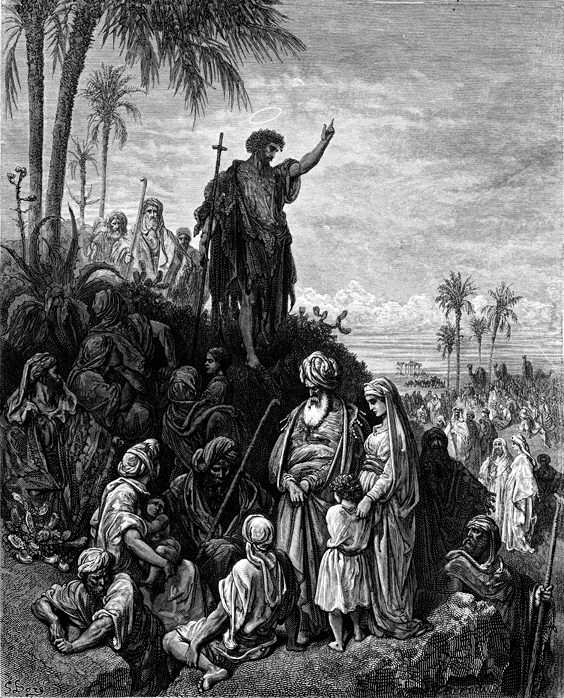
John wore a garment of camel’s hair, with a leather belt around his waist. His food was locusts and wild honey.
Introduction
Matthew, by tradition, The Gospels, Matthew Overview.
Some thirty years pass between the second chapter and the third. This chapter introduces a prophet after centuries in which Israel had heard none. John comes out of the desert dressed like Elijah and speaks to a nation that trusted in its descent from Abraham. Listen for the difference between a washing that marks a change of heart and a pedigree that guarantees nothing. Then listen for the first time the Gospel lets heaven speak for itself, and notice that the Father, the Son and the Spirit are all present in one scene.
Context
- Who
- Jewish readers who knew what a washing meant and who the Pharisees and Sadducees were
- What
- The preaching and baptism of John the Baptist, his warning to the religious leaders, and the baptism of Jesus in the Jordan.
- Where
- The wilderness of Judea and the banks of the Jordan River.
- When
- About AD 28 or 29, a date commonly fixed from the fifteenth year of Tiberius Caesar named in the Gospel of Luke.
- Why
- To show that John prepared the way for the Messiah as the prophets foretold, and that God Himself declared Jesus to be His Son.
Historical context
The Judean wilderness is a stretch of bare, folded hills falling away east of Jerusalem toward the Jordan valley, hot, almost treeless, dropping to the lowest land on earth. A man could live there off wild honey and locusts, which the Law lists among the few insects Israelites were permitted to eat. Camel-hair clothing and a leather belt deliberately echoed the prophet Elijah.
Show the rest of the historical context, 3 more paragraphs
Ritual washing was ordinary Jewish life. Step-down stone baths called mikva'ot have been excavated all over first-century Judea, including outside the temple, and a person immersed himself for purity before worship. What was strange about John was that he immersed other people, once, as a turning point, and demanded it of Jews, not just of Gentiles converting in.
The two groups he confronts were rivals. The Pharisees were popular teachers who built careful rules around the Law and expected a resurrection. The Sadducees were the wealthy priestly families who ran the temple, worked with Rome, and rejected the resurrection. That both came out to the river shows how large the stir had grown.
A community of separatists also lived near the Dead Sea in these same years, keeping strict washings and quoting the same verse from Isaiah about preparing a way in the wilderness. Their library, found at Qumran in 1947, shows John was not the only Jew who thought God was about to act.
Significance
Matthew's readers had been told all their lives that being Abraham's children secured them. John says God can raise children of Abraham out of the stones on the riverbank. Ancestry gets you nothing without fruit.
Show the rest of the significance, 1 more paragraph
Then the last prophet of the old order steps aside for a man he says he is not fit to serve as a slave. For readers arguing with their synagogue about who Jesus is, that testimony, from a preacher the whole nation respected, was worth a great deal.
The heads below are this chapter's scenes. The numbered points under each are its verses.
A Voice in the Wilderness Calling for Repentance
Matthew 3:1-3
preaching in the wilderness of Judea: John's ministry opens with "In those days," some three decades after chapter 2. His message is "Repent, for the kingdom of heaven is near": metanoeo names a change of mind and direction. Kingdom of heaven is Matthew's phrase where Mark and Luke write kingdom of God.
Matthew 3:1
“In those days--of Christ's secluded life at Nazareth, where the last chapter left Him. came John the Baptist, preaching--about six months before his Master. in the wilderness of Judea--the desert valley of the Jordan, thinly peopled and bare in pasture, a little north of Jerusalem.”
Jamieson, Fausset & Brown · Commentary Critical and Explanatory on the Whole Bible (1871)reformed
3 more voices on this verseWhat preachers and commentators have said about this verse, in their own words.
Matthew 3:1
“In those days, in the time appointed of the Father for the beginning of the gospel, when the fulness of time was come, which was often thus spoken of in the Old Testament, In those days. Now the last of Daniel's weeks began, or rather, the latter half of the week, when the Messiah was to confirm the covenant with many, Dan. ix. Christ's appearances are all in their season.”
Matthew Henry · Commentary on the Whole Bible (1707-1721)puritan
Matthew 3:1
These verses describe the ministry of John the Baptist, the forerunner of our Lord Jesus Christ: it is a ministry that deserves close attention. Few preachers ever produced such effects as John the Baptist: “There went out to him Jerusalem and all Judea and all the region round about Jordan.”None ever received such praise from the great head of the church: Jesus called him “a burning and a shining light” ( John 5:35 ); the great Bishop of souls Himself declared, that “among them that are born of women there hath not risen a greater than John the Baptist.”
J.C. Ryle · Expository Thoughts on the Gospels: Matthew (1856)Reformed Evangelical
Matthew 3:1
“In those days - The days here referred to cannot be those mentioned in the preceding chapter, for John was but six months older than Christ.”
John Wesley reads the nearness as God about to set up the kingdom Daniel foretold in Daniel 2:44 and 7:13 and 14. Jamieson, Fausset and Brown reason that a kingdom prepared for by repentance must be spiritual. Jerome notes that John is the first to preach it.
Matthew 3:2
“John Baptist is the first to preach the Kingdom of Heaven, that the forerunner of the Lord may have this honourable privilege.”
Jerome · written before 420 · Catena Aurea by Aquinaspatristic
2 more voices on this verse
Matthew 3:2
“Is at hand - As if he had said, God is about to erect that kingdom, spoken of by Daniel, Dan. ii, 44; vii, 13, 14; the kingdom of the God of heaven. It properly signifies here, the Gospel dispensation, in which subjects were to be gathered to God by his Son, and a society to be formed, which was to subsist first on earth, and afterward with God in glory.”
John Wesley · Explanatory Notes upon the New Testament (1755)evangelical
Matthew 3:2
“A kingdom for which repentance was the proper preparation behooved to be essentially spiritual. Deliverance from sin, the great blessing of Christ's kingdom (Mt 1:21), can be valued by those only to whom sin is a burden (Mt 9:12). John's great work, accordingly, was to awaken this feeling and hold out the hope of a speedy and precious remedy.”
Jamieson, Fausset & Brown · Commentary Critical and Explanatory on the Whole Bible (1871)reformed
Augustine leaves open whether Matthew or John speaks. John Gill takes them as the evangelist's, while noting that in John 1:23 the Baptist speaks the prophecy of himself. Adam Clarke explains the picture from eastern kings, who sent men to prepare the way and open the passes through desert country.
Matthew 3:3
“The voice of one crying in the wilderness--(See on Lu 3:2); the scene of his ministry corresponding to its rough nature. Prepare ye the way of the Lord, make his paths straight--This prediction is quoted in all the four Gospels, showing that it was regarded as a great outstanding one, and the predicted forerunner as the connecting link between the old and the new economies.”
Jamieson, Fausset & Brown · Commentary Critical and Explanatory on the Whole Bible (1871)reformed
2 more voices on this verse
Matthew 3:3
“For this is he that was spoken of,.... These are not the words of the Baptist himself, as in Joh 1:23 but of the Evangelist, who cites and applies to John a passage in the Prophet Isaiah, Isa 40:3 and that very pertinently, since that "chapter" is a prophecy of the Messiah. The consolations spoken of in Isa 40:3, were to be in the days of the king Messiah, as a writer of note (y) among the Jews observes.”
Matthew 3:3
“The prophet Esaias - The prophet Isaiah. Esaias is the Greek mode of writing the name. This passage is taken from Isa 40:3. It is here said to have been spoken in reference to John, the forerunner of Christ. The language is such as was familiar to the Jews. and such as they would understand. It was spoken at first with reference to the return from the captivity at Babylon.”
Cross references
Matthew 3:3
- QuotingIsaiah 40:3“A voice of one calling: “Prepare the way for the LORD in the wilderness; make a straight highway for our God in the desert.”
'voice of one crying in the wilderness' applied to John the Baptist
ConnectionsIsaiah 40:3
a garment of camel’s hair: John's "garment of camel’s hair, with a leather belt around his waist" presents him as the Elijah of Malachi 4:5-6. Locusts are permitted food under Leviticus 11:22. With wild honey they make the diet of a man who owns nothing and lives on what the wilderness provides.
Matthew 3:4
“And the same John had his raiment of camel's hair--woven of it. and a leathern girdle about his loins--the prophetic dress of Elijah (2Ki 1:8; and see Zec 13:4). and his meat was locusts--the great, well-known Eastern locust, a food of the poor (Le 11:22). and wild honey--made by wild bees (1Sa 14:25, 26).”
Jamieson, Fausset & Brown · Commentary Critical and Explanatory on the Whole Bible (1871)reformed
1 more voice on this verse
Matthew 3:4
“His raiment of camel’s hair - A sort of coarse or rough covering, which, it appears, was common to the prophets, Zec 13:4. In such a garment we find Elijah clothed, 2Ki 1:8. And as John had been designed under the name of this prophet, Mal 4:5, whose spirit and qualifications he was to possess, Luk 1:17, he took the same habit and lived in the same state of self-denial.”
Adam Clarke · Commentary on the Bible (1810-1826)evangelical
Matthew 3:5-6
from Jerusalem and all Judea: People went out "from Jerusalem and all Judea and the whole region around the Jordan," a response without match since the earlier prophets. John's washing stands apart from the proselyte baptism of Gentile converts and the washings at Qumran, since here Israelites confess their sins in public.
Matthew 3:5
“Jerusalem - The people of Jerusalem. All Judea - Many people from Judea. It does not mean that literally all the people went, but that great multitudes went. It was general. Jerusalem was in the part of the country called Judea. Judea was situated on the west side of the Jordan. See the notes at Mat 2:22. Region about Jordan - On the east and west side of the river. Near to Jordan.”
2 more voices on this verse
Matthew 3:5
“Then went out to him Jerusalem,.... The uncommon appearance of this person, the oddness of his dress, the austerity of his life, together with the awfulness and importance of his doctrine, and the novelty of the ordinance of baptism he administered, and the Jews having had no prophet for some hundreds of years, and imagining he might be the Messiah, quickly drew large numbers of people to him. Some copies read "all Jerusalem": that is, the inhabitants of that city, a very large number of them; and "all Judea", a great number of people from all parts of that country.”
Matthew 3:5
“The preacher of Christ is clad in the skins of unclean beasts, to which the Gentiles are compared, and so by the Prophets' dress is sanctified whatever in them was useless or unclean. The girdle is a thing of much efficacy to every good work, that we may be girt for every ministry of Christ.”
Hilary of Poitiers · written before 367 · Catena Aurea by Aquinaspatristic
Confessing their sins: Jamieson, Fausset and Brown think the people confessed aloud, so the rite became a public seal of their readiness to welcome the Deliverer. John Gill records the Jewish account of the river's name as the one that descends from Dan. Matthew Henry holds that confession of sin comes before pardon.
Matthew 3:6
“And were baptized of him in Jordan, confessing their sins--probably confessing aloud. This baptism was at once a public seal of their felt need of deliverance from sin, of their expectation of the coming Deliverer, and of their readiness to welcome Him when He appeared. The baptism itself startled, and was intended to startle, them.”
Jamieson, Fausset & Brown · Commentary Critical and Explanatory on the Whole Bible (1871)reformed
4 more voices on this verse
Matthew 3:6
They who are about to enter baptism ought to pray with repeated prayers, fasts, and bendings of the knee, and vigils all the night through, and with the confession of all by- gone sins, that they may express the meaning even of the baptism of John: "They were baptized," saith (the Scripture), "confessing their own sins."
Tertullian · written before 220 · On Baptismpatristic
Matthew 3:6
And were baptized of him,.... The place where they were baptized of him was, "in Jordan"; some copies read, "in the river Jordan", as in Mar 1:5. As to the name of this river, and the etymology of it, the Jews say (l) it was so called, שיורד מדן "because it descended" from Dan, i.e. Leshem Dan, or Pamias, which they say is a cave at the head of it. It was in John's time and long after a considerable river, a river to swim in; we (m) read that "Resh Lakish הוה סחי בירדנא was swimming in Jordan."
Matthew 3:6
“Were baptized - In what form baptism was originally administered, has been deemed a subject worthy of serious dispute. Were the people dipped or sprinkled? for it is certain βαπτω and βαπτιζω mean both. They were all dipped, say some. Can any man suppose that it was possible for John to dip all the inhabitants of Jerusalem and Judea, and of all the country round about the Jordan? Were both men and women dipped, for certainly both came to his baptism? This could never have comported either with safety or with decency. Were they dipped in their clothes?”
Adam Clarke · Commentary on the Bible (1810-1826)evangelical
Matthew 3:6
“Note, A penitent confession of sin is required in order to peace and pardon; and those only are ready to receive Jesus Christ as their Righteousness, who are brought with sorrow and shame to their own guilt, 1 John i. The benefits of the kingdom of heaven, now at hand, were thereupon sealed to them by baptism.”
Matthew Henry · Commentary on the Whole Bible (1707-1721)puritan
Matthew 3:7-10
"You brood of vipers" is John's name for Pharisees and Sadducees, rival parties joined by one presumption: "We have Abraham as our father." John answers that "out of these stones God can raise up children for Abraham," so sonship is proved by fruit.
Matthew 3:7
“They were a viperous gang, they were all alike; though enemies to one another, yet confederate in mischief. Note, A wicked generation is a generation of vipers, and they ought to be told so; it becomes the ministers of Christ to be bold in showing sinners their true character. The alarm he gives them is, Who has warned you to flee from the wrath to come?”
Matthew Henry · Commentary on the Whole Bible (1707-1721)puritan
3 more voices on this verse
Matthew 3:7
“Pharisees and Sadducees - The Jews were divided into three great sects - the Pharisees, the Sadducees, and the Essenes. In addition to these, some smaller sects are mentioned in the New Testament and by Josephus: the Herodians, probably political friends of Herod; the Galileans, a branch of the Pharisees; and the Therapeutae, a branch of the Essenes, but converts from the Greeks. The three principal sects are supposed to have originated about 150 years before Christ, as they are mentioned by Josephus at that time in his history.”
Matthew 3:7
“What an expression is this, "The wrath to come!" God's "wrath," in Scripture, is His righteous displeasure against sin, and consequently against all in whose skirts sin is found, arising out of the essential and eternal opposition of His nature to all moral evil.”
Jamieson, Fausset & Brown · Commentary Critical and Explanatory on the Whole Bible (1871)reformed
Matthew 3:7
“The Pharisees were a very ancient sect among the Jews. They took their name from a Hebrew word, which signifies to separate, because they separated themselves from all other men. They were outwardly strict observers of the law, fasted often, made long prayers, rigorously kept the Sabbath, and paid all tithe, even of mint, anise, and cummin.”
John Wesley · Explanatory Notes upon the New Testament (1755)evangelical
Produce fruit, then, in keeping with repentance: Chrysostom reads the fruit as good deeds that answer the sins, so one who has seized the goods of others gives away his own. John Gill joins the phrase to Acts 26:20, where Paul calls for the same works. Gill adds that works show repentance as fruit shows the tree.
Matthew 3:8
“One might say that the fruits of repentance are, by way of anticipation, faith in Christ. They are also the evangelical society that exists "in newness of life," changed from the present dullness of the letter.”
Cyril of Alexandria · written before 444 · FRAGMENT 20.15patristic
3 more voices on this verse
Matthew 3:8
“Bring forth therefore fruits,.... That is, if you are truly penitent, if you have a proper sense of sin, and true repentance for it, do such works as are suitable to it, and will show the genuineness of it; for fruits meet for repentance are the same as "works meet for repentance", Act 26:20 and as a tree is known by its fruit, so repentance is known by good works; these are the fruits and effects of repentance, and which are proofs with men of the sincerity of it.”
Matthew 3:8
“Bring forth therefore fruits ... - That is, the proper fruits of reformation; the proper evidence that you are sincere. Do not bring your cunning and dissimulation to this work; do not carry your hypocrisy into your professed repentance, but evince your sincerity by forsaking sin, and thus give evidence that this coming to Jordan to be baptized is not an act of dissimulation. No discourse could have been more appropriate or more cutting. Fruits - Conduct. See Mat 7:16-19. Meet for repentance - Fit for repentance; appropriate to it the proper expression of repentance.”
Matthew 3:8
“Repentance is of two sorts; that which is termed legal, and that which is styled evangelical repentance. The former (which is the same that is spoken of here) is a thorough conviction of sin. The latter is a change of heart (and consequently of life) from all sin to all holiness.”
John Wesley · Explanatory Notes upon the New Testament (1755)evangelical
ConnectionsGalatians 5:22
out of these stones God can raise up children for Abraham: Chrysostom hears an echo of Isaiah 51:1, where Israel is pointed back to the rock it came from. Isaac's birth to Sarah was the same kind of wonder. Jerome adds that the God who made all things from nothing can make sons from the hardest stone.
Matthew 3:9
“And think not to say ... - They regarded it as sufficient righteousness that they were descended from so holy a man as Abraham. Compare Joh 8:33-37, Joh 8:53. John assured them that this was a matter of small consequence in the sight of God. Of the very stones of the Jordan he could raise up children to Abraham.”
3 more voices on this verse
Matthew 3:9
“And say not confidently - The word in the original, vulgarly rendered, Think not, seems here, and in many places, not to diminish, but rather add to the force of the word with which it is joined. We have Abraham to our father - It is almost incredible, how great the presumption of the Jews was on this their relation to Abraham.”
John Wesley · Explanatory Notes upon the New Testament (1755)evangelical
Matthew 3:9
“He intimates God's great power, who, as he made all things out of nothing, can make men out of the hardest stone. These stones signify the Gentiles because of their hardness of heart. See Ezekiel, I will take away from you the heart of stone, and give you the heart of flesh. Stone is emblematic of hardness, flesh of softness. Or, the preaching of the Gospel is meant, as the Prophet Jeremiah also compares the Word of the Lord to an axe cleaving the rock. (Jer. 23:29.)”
Jerome · written before 420 · Catena Aurea by Aquinaspatristic
Matthew 3:9
“What their pretence was; " We have Abraham to our father; we are not sinners of the Gentiles; it is fit indeed that they should be called to repent; but we are Jews, a holy nation, a peculiar people, what is this to us?" Note, The word does us no good, when we will not take it as it is spoken to us, and belonging to us.”
Matthew Henry · Commentary on the Whole Bible (1707-1721)puritan
The axe lies ready at the root of the trees: Chrysostom notes that the axe is laid at the root and has not struck, so the outcome rests with the hearers. Such fruit, he adds, grows at once where there is will. Adam Clarke recalls that the prophets pictured doomed nations as forests marked for felling, as in Jeremiah 46:22.
Matthew 3:10
“But the axe also already lieth - That is, there is no room for such idle pretenses. Speedy execution is determined against all that do not repent. The comparison seems to be taken from a woodman that has laid down his axe to put off his coat, and then immediately goes to work to cut down the tree.”
John Wesley · Explanatory Notes upon the New Testament (1755)evangelical
1 more voice on this verse
Matthew 3:10
“What a strength, too, of just indignation is in that word "cast" or "flung into the fire!" The third Gospel here adds the following important particulars in Lu 3:10-16. Lu 3:10: And the people--the multitudes. asked him, saying, What shall we do then?--that is, to show the sincerity of our repentance.”
Jamieson, Fausset & Brown · Commentary Critical and Explanatory on the Whole Bible (1871)reformed
Matthew 3:11-12
One more powerful than I: John sets his baptism beside a greater one to come, "with the Holy Spirit and with fire," and is unworthy to carry its giver's sandals. The fire in both halves is read together, the Spirit's purifying fire of Acts 2 and the fire of judgment.
Matthew 3:11
“He shall baptize you with the Holy Ghost and with fire - He shall fill you with the Holy Ghost, inflaming your hearts with that fire of love, which many waters cannot quench. And this was done, even with a visible appearance as of fire, on the day of pentecost.”
John Wesley · Explanatory Notes upon the New Testament (1755)evangelical
2 more voices on this verse
Matthew 3:11
“Whose shoes I am not worthy to bear - The word translated here as “shoes” has a signification different from what it has in our language. At first, in order to keep the feet from the sharp stones or the burning sand, small pieces of wood were fastened to the soles of the feet, called “sandals.” Leather, or skins of beasts dressed, afterward were used. The foot was not covered at all, but the sandal, or piece of leather or wood, was bound by thongs.”
Matthew 3:11
“In the other Gospels it is, whose shoe latchet I am not worthy to loose. Here his humility, there his ministry is intended; Christ is the Bridegroom, and John is not worthy to loose the Bridegroom's shoe, that his house be not called according to the Law of Moses and the example of Ruth, The house of him that hath his shoe loosed. (Deut. 25:10.)”
Jerome · written before 420 · Catena Aurea by Aquinaspatristic
His winnowing fork is in His hand: Albert Barnes explains the tool as a winnowing shovel that threw threshed grain into the air, so the wind carried the chaff away. For John Wesley the floor is the church, still mixed. Chrysostom finds hope in the picture, since chaff can become wheat while the floor is being worked.
Matthew 3:12
“Whose fan is in his hand - The Romans are here termed God’s fan, as, in Mat 3:10, they were called his axe, and, in Mat 22:7, they are termed his troops or armies. The winnowing fan of the Hindoos is square, made of split bamboo; and the corn is winnowed by waving the fan backwards with both hands - “Whose fan is in his hand.” His floor - Does not this mean the land of Judea, which had been long, as it were, the threshing-floor of the Lord?”
Adam Clarke · Commentary on the Bible (1810-1826)evangelical
1 more voice on this verse
Matthew 3:12
“Whose fan - That is, the word of the Gospel. His floor - That is, his Church, which is now covered with a mixture of wheat and chaff. He will gather the wheat into the garner - Will lay up those who are truly good in heaven.”
John Wesley · Explanatory Notes upon the New Testament (1755)evangelical
Jesus Baptized and Heaven Opened
Matthew 3:13-15
Jesus came from Galilee: Jesus comes for a baptism meant for repentant sinners. John's protest, "I need to be baptized by You," names the problem: the sinless receives a sign of sin. Jesus answers "to fulfill all righteousness," and the fulfilling is identification: the Messiah numbers himself with the people he came to save.
Matthew 3:13
“Then cometh Jesus - The Saviour is now introduced as about to enter on his work, or as about to be solemnly set apart to his great office of Messiah and Redeemer. The expression “cometh” implies that the act was voluntary on his part; that he went for that purpose and for no other. He left the part of Galilee - Nazareth - where he had lived for nearly 30 years, and went to the vicinity of the Jordan, where John was baptizing the people in great numbers, that he might be set apart to his work.”
2 more voices on this verse
Matthew 3:13
“We have here the account of our Lord Jesus Christ’s baptism. This was his first step when he entered on his ministry. When the Jewish priests took up their office they were washed with water ( Exodus 29:4 ), and when our great High Priest begins the great work he came into the world to accomplish he is publicly baptized. We should notice firstly in these verses the honour placed upon the sacrament of baptism . An ordinance of which the Lord Jesus himself partook is not to be lightly esteemed.”
J.C. Ryle · Expository Thoughts on the Gospels: Matthew (1856)Reformed Evangelical
Matthew 3:13
Thus, as He rode into Jerusalem upon an ass "whereon yet never man sat" (Lu 19:30), and lay in a sepulchre "wherein was never man yet laid" (Joh 19:41), so in His baptism, too. He would be "separate from sinners."
Jamieson, Fausset & Brown · Commentary Critical and Explanatory on the Whole Bible (1871)reformed
John tried to prevent Him: Adam Clarke reads the verb as earnest and pressing resistance. Matthew Henry hears in John's words the same humility his mother Elizabeth showed toward Mary in Luke 1. Albert Barnes explains the need John names as the baptism of the Spirit that Jesus would give.
Matthew 3:14
“Note, It is no disparagement to the greatest of men, to confess that they are undone without Christ and his grace. [5.] John was Christ's forerunner, and yet owns that he had need to be baptized of him.”
Matthew Henry · Commentary on the Whole Bible (1707-1721)puritan
2 more voices on this verse
Matthew 3:14
“John rejects Him from baptism as God; He teaches him, that it ought to be performed on Him as man.”
Hilary of Poitiers · written before 367 · Catena Aurea by Aquinaspatristic
Matthew 3:14
“John forbad him - Earnestly and pressingly opposed him: this is the proper import of the words διεκωλευεν αυτον. I have observed that δια, in composition, most frequently, if not always, strengthens the signification in classic authors. - Wakefield.”
Adam Clarke · Commentary on the Bible (1810-1826)evangelical
Jerome fastens on the word now. John baptizes Jesus with water at this moment, and John himself must later be baptized by Christ with the Spirit. Adam Clarke renders the phrase as every righteous ordinance, and Albert Barnes notes that no precept of the Old Testament required this act.
Matthew 3:15
“Thus it becometh us - It is suitable and proper. And though you may feel yourself unworthy, yet it is proper it should be done. All righteousness - There was no particular precept in the Old Testament requiring this, but he chose to give the sanction of his example to the baptism of John, as to a divine ordinance. The phrase “all righteousness,” here, is the same as a righteous institution or appointment. Jesus had no sin. But he was about to enter on his great work.”
2 more voices on this verse
Matthew 3:15
“It becometh us to fulfil all righteousness - It becometh every messenger of God to observe all his righteous ordinances. But the particular meaning of our Lord seems to be, that it becometh us to do (me to receive baptism, and you to administer it) in order to fulfil, that is, that I may fully perform every part of the righteous law of God, and the commission he hath given me.”
John Wesley · Explanatory Notes upon the New Testament (1755)evangelical
Matthew 3:15
“The import of circumcision and of baptism seems to be radically the same. And if our remarks on the circumcision of our Lord (see on Lu 2:21-24) are well founded, He would seem to have said, "Thus do I impledge Myself to the whole righteousness of the Law--thus symbolically do enter on and engage to fulfil it all." Let the thoughtful reader weigh this.”
Jamieson, Fausset & Brown · Commentary Critical and Explanatory on the Whole Bible (1871)reformed
Matthew 3:16-17
the Spirit of God descending like a dove: All three persons appear: the Son in the water, "the Spirit of God descending like a dove and resting on Him," and the Father's voice. "This is My beloved Son, in whom I am well pleased" joins the royal decree of Psalm 2:7 to the chosen servant of Isaiah 42:1.
Matthew 3:16
“The heavens were opened unto him - That is, to John the Baptist - and he, John, saw the Spirit of God - lighting upon him, i.e. Jesus. There has been some controversy about the manner and form in which the Spirit of God rendered itself visible on this occasion.”
Adam Clarke · Commentary on the Bible (1810-1826)evangelical
2 more voices on this verse
Matthew 3:16
“Not by an actual cleaving of the visible element, but to the spiritual eye, as Ezekiel also in the beginning of his book relates that he saw them. It sate on the head of Jesus, that none might suppose the voice of the Father spoken to John, and not to the Lord.”
Jerome · written before 420 · Catena Aurea by Aquinaspatristic
Matthew 3:16
"My dove, my undefiled is one," says the Song of Solomon (So 6:9). Again, "Be ye harmless as doves," says Christ Himself (Mt 10:16). This is the same thing, in the form of inoffensiveness towards men.
Jamieson, Fausset & Brown · Commentary Critical and Explanatory on the Whole Bible (1871)reformed
Chrysostom observes that the voice says only this, and a crowd might have taken it to mean the honoured Baptist. The dove resting on Jesus directed the words to him, and Jerome gives the same reason for its coming. Albert Barnes notes that the voice returns at 17:5.
ConnectionsPsalms 2:7
Keep studying
Studies15
Places1
Words12
Subjects1
Sources for this chapter
The summary
Jamieson, Fausset & Brown, Commentary Critical and Explanatory; John Calvin, Commentaries; John Wesley, Explanatory Notes Upon the New Testament and Matthew Henry, Complete Commentary.
The exposition
Adam Clarke, Commentary on the Bible; Albert Barnes; Augustine of Hippo, Catena Aurea by Aquinas; Jamieson, Fausset & Brown, Commentary Critical and Explanatory on the Whole Bible; Jerome; John Chrysostom; John Gill, Exposition of the New Testament; John Wesley, Explanatory Notes upon the New Testament and Matthew Henry, Commentary on the Whole Bible.
The painting
John the Baptist Preaching in the Wilderness, Gustave Doré (engraving), public domain