
Matthew 3:3
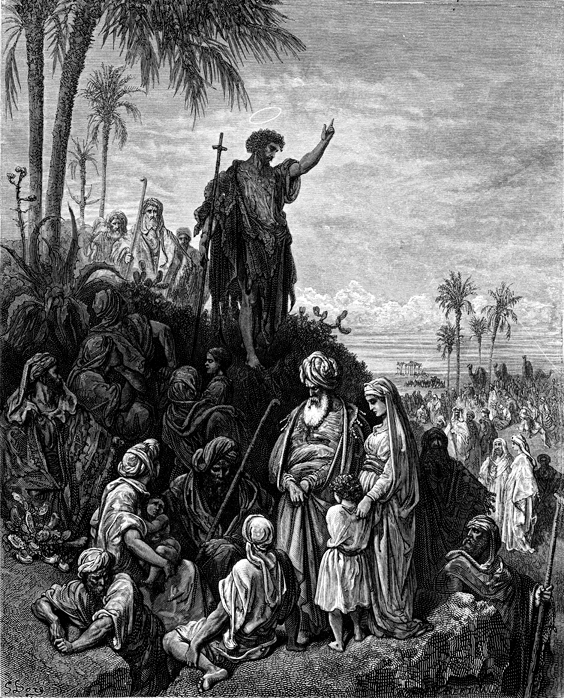
in Matthew 3This is he who was spoken of through the prophet Isaiah: “A voice of one calling in the wilderness, ‘Prepare the way for the Lord, make straight paths for Him.’”
BSB
The same verse in ASV and KJV ▾
ASV
For this is he that was spoken of through Isaiah the prophet, saying, The voice of one crying in the wilderness, Make ye ready the way of the Lord, Make his paths straight.
KJV
For this is he that was spoken of by the prophet Esaias, saying, The voice of one crying in the wilderness, Prepare ye the way of the Lord, make his paths straight.
⋯
This verse in Matthew 3
Commentary
29 notes on this verse(Verse 3.) For this is he who is spoken of by the prophet Isaiah, saying: 'The voice of one crying out in the wilderness, prepare the way of the Lord, make straight his paths.' He was preparing the souls of the believers, in whom the Lord was going to walk, to walk in the purest ways, saying: 'I will dwell in them and walk among them, and I will be their God, and they shall be my people' (Leviticus 26:12).
This site's exposition
preaching in the wilderness of Judea
on Matthew 3:1-3
John's ministry opens with "In those days," some three decades after chapter 2. His message is "Repent, for the kingdom of heaven is near": metanoeo names a change of mind and direction. Kingdom of heaven is Matthew's phrase where Mark and Luke write kingdom of God.
This site's exposition
A voice of one calling in the wilderness
Augustine leaves open whether Matthew or John speaks. John Gill takes them as the evangelist's, while noting that in John 1:23 the Baptist speaks the prophecy of himself. Adam Clarke explains the picture from eastern kings, who sent men to prepare the way and open the passes through desert country.
The record, by era
The Church Fathers5 voices
Hence John prepared these ways of mercy and truth, faith and justice. Concerning them, Jeremiah also declared, "Stand by the roads, and look, and ask for the ancient paths, where the good way is, and walk in it." Because the heavenly kingdom is found along …
In these words we have not only time, place, and person, respecting St. John, but also his office and employment. First the time, generally; "In those days.". The man is mentioned in the words "came John," that is, showed himself, having abodeso long in obscurity. …
Though as far as historical fact is concerned, he chose the desert, to be removed from the crowds of people. What the purport of his cry was is insinuated, when he adds, Make ready the way of the Lord.
Thus, too, does the angel, the witness of baptism, "make the paths straight" for the Holy Spirit, who is about to come upon us, by the washing away of sins, which faith, sealed in (the name of) the Father, and the Son, and the Holy Spirit, obtains.
(In. Is. 40:3.) Consider how the salvation of God, and the glory of the Lord, is preached not in Jerusalem, but in the solitude of the Church, in the wilderness to multitudes.
21 more voices on this verse
The Church Fathers3 voices
The voice is a confused sound, discovering no secret of the heart, only signifying that he who utters it desires to say somewhat; it is the word that is the speech that openeth the mystery of the heart. Voice is common to men and other animals, word peculiar to man. John then is called the voice and not the word, because God did not discover His counsels through him, but only signified that He was about to do something among men; but afterwards by His Son he fully opened the mystery of his will. As a great King going on a progress is preceded by couriers to cleanse what is foul, repair what is broken down; so John preceded the Lord to cleanse the human heart from the filth of sin, by the besom of repentance, and to gather by an ordinance of spiritual precepts those things which had been scattered abroad.
Conceive, for example, how great a thing it was to see a man after thirty years coming down from the wilderness, being the son of a chief priest, who had never known the common wants of men, and was on every account venerable, and had Isaiah with him. For he too was present proclaiming him, and saying, "This is he who I said should come crying, and preaching throughout the whole wilderness with a clear voice." For so great was the earnestness of the prophets touching these things, that not their own Lord only, but him also who was to minister unto Him, they proclaimed a long time beforehand, and they not only mentioned him, but the place too in which he was to abide, and the manner of the doctrine which he had to teach when he came, and the good effect that was produced by him. See, at least, how both the prophet and the Baptist go upon the same ideas, although not upon the same words. Thus the prophet saith that he shall come saying, "Prepare ye the way of the Lord, make his paths straight." And he himself when he was come said, "Bring forth fruits meet for repentance," which corresponds with, "Prepare ye the way of the Lord." Seest thou that both by the words of the prophet, and by his own preaching, this one thing is manifested alone; that he was come, making a way and preparing beforehand, not bestowing the gift, which was the remission, but ordering in good time the souls of such as should receive the God of all? But Luke expresses somewhat further: not repeating the exordium, and so passing on, but setting down likewise all the prophecy. "For every valley," saith he, "shall be filled; and every mountain and hill shall be brought low; and the crooked shall be made straight, and the rough ways smooth; and all flesh shall see the salvation of God." Dost thou perceive how the prophet hath anticipated all by his words; the concourse of the people. […]
(De Cons. Ev. ii. 12.) The other Evangelists omit these words of John. What follows, This is He, &c. it is not clear whether the Evangelist speaks them in his own person, or whether they are part of John's preaching, and the whole from Repent ye, to Esaias the prophet, is to be assigned to John. It is of no importance that he says, This is he, and not, I am he; for Matthew speaking of himself says, He found a man sitting at the toll-office; (Mat. 9:9.) not He found me. Though when asked what he said of himself, he answered, as is related by John the Evangelist, I am the voice of one crying in the wilderness.
The Medieval Church10 voices
"I am the voice of one crying in the wilderness: Make straight the way of the Lord, as Isaiah the prophet said." You know, dearest brothers, that the only-begotten Son is called the Word of the Father, as John testifies when he says: "In the beginning was the Word, and the Word was with God, and the Word was God." And from your own manner of speaking you recognize that the voice sounds first, so that the word may afterward be heard. Therefore John asserts that he is the voice, because he precedes the Word. And so, going before the coming of the Lord, he is called a voice, because through his ministry the Word of the Father is heard by men. He also cries out in the wilderness, because he announces the comfort of the Redeemer to abandoned and forsaken Judea. But what he cries out he indicates when he adds: "Make straight the way of the Lord." The way of the Lord is made straight to the heart when the word of truth is humbly heard. The way of the Lord is made straight to the heart when one's life is prepared according to his commandment.
As it is written in the book of the words of Isaiah the prophet: The voice of one crying in the wilderness, Prepare the way of the Lord, make his paths straight. Indeed, the same John the Baptist, when asked who he was, answered, saying: I am the voice of one crying in the wilderness. He, as was said by us before, was called a voice by the prophet because he preceded the Word. But what he cried out is revealed when it is added: Prepare the way of the Lord, make his paths straight. Everyone who preaches right faith and good works, what else does he do but prepare a way for the coming Lord into the hearts of his hearers? So that the power of grace may penetrate, so that the light of truth may illuminate, so that he may make straight paths for God, while he forms pure thoughts in the mind through the word of good preaching.
(Hom. in Ev. i. 7. 2.) It is well known that the Only-begotten Son is called the Word of the Father; as in John, In the beginning was the Word. (John 1:1.) But it is by our own speech that we are known; the voice sounds that the words may be heard. Thus John the forerunner of the Lord's coming is called, The voice, because by his ministry the voice of the Father is heard by men.
(Hom. in Ev. i. 7. 2.) Crying in the desert, because he shows to deserted and forlorn Judæa the approaching consolation of her Redeemer.
(Hom. in Ev. i. 20. 3.) Every one who preacheth right faith and good works, prepares the Lord's way to the hearts of the hearers, and makes His paths straight, in cleansing the thoughts by the word of good preaching.
Then this preaching is confirmed: "This is he who was spoken of by the prophet Isaiah..." And, as Augustine says, this can be explained in two ways: first, so that the words, "This is he who was spoken of," are the words of the evangelist; …
(Gloss. ord. in cap. iv. 1.) In like manner has He cried from the beginning through the voice of all who have spoken aught by inspiration. And yet is John only called, The voice; because that Word which others showed afar off, he declares as nigh.
He is rightly called, The voice of one crying, on account of the loud sound of his preaching. Three things cause a man to speak loud; when the person he speaks to is at a distance, or is deaf, or if the speaker be angry; and all these three were then found in the human race.
(ord.) John then is, as it were, the voice of the word crying. The word is heard by the voice, that is, Christ by John. (interlin.) Or, faith is the way by which the word reaches the heart; when the life is amended the paths are made straight.
For this is he that was spoken of by the prophet Isaiah, saying, The voice of one crying in the wilderness, Prepare ye the way of the Lord, make His paths straight (Is. 40:3). "The way," that is, the highway, means the Gospel. The "paths" …
The Puritans and the Awakening3 voices
For this is he that was spoken of,.... These are not the words of the Baptist himself, as in Joh 1:23 but of the Evangelist, who cites and applies to John a passage in the Prophet Isaiah, Isa 40:3 and that very pertinently, since that "chapter" is a prophecy of the Messiah. The consolations spoken of in Isa 40:3, were to be in the days of the king Messiah, as a writer of note (y) among the Jews observes.
Gates of brass must be broken, and bars of iron cut asunder, ere the everlasting doors be opened for the King of glory to come in. The way of sin and Satan is a crooked way; to prepare a way for Christ, the paths must be made straight, Heb. xii. The garb in which he appeared, the figure he made, and the manner of his life,
This is he that was spoken of in the beginning of that part of the prophecy of Esaias, which is mostly evangelical, and which points at gospel-times and gospel-grace; see Isa. xl.
The Nineteenth Century5 voices
A commentator
Albert Barnes1798–1870
Notes, Explanatory and Practical, on the Old and New Testaments (1832-1869)
The prophet Esaias - The prophet Isaiah. Esaias is the Greek mode of writing the name. This passage is taken from Isa 40:3. It is here said to have been spoken in reference to John, the forerunner of Christ. The language is such as was familiar to the Jews. and such as they would understand. It was spoken at first with reference to the return from the captivity at Babylon.
These verses describe the ministry of John the Baptist, the forerunner of our Lord Jesus Christ: it is a ministry that deserves close attention. Few preachers ever produced such effects as John the Baptist: “There went out to him Jerusalem and all Judea and all the region round about Jordan.”None ever received such praise from the great head of the church: Jesus called him “a burning and a shining light” ( John 5:35 ); the great Bishop of souls Himself declared, that “among them that are born of women there hath not risen a greater than John the Baptist.”
A commentator
Jamieson, Fausset & Brown1802–1910
Commentary Critical and Explanatory on the Whole Bible (1871)
The voice of one crying in the wilderness--(See on Lu 3:2); the scene of his ministry corresponding to its rough nature. Prepare ye the way of the Lord, make his paths straight--This prediction is quoted in all the four Gospels, showing that it was regarded as a great outstanding one, and the predicted forerunner as the connecting link between the old and the new economies.
These verses describe the ministry of John the Baptist, the forerunner of our Lord Jesus Christ: it is a ministry that deserves close attention. Few preachers ever produced such effects as John the Baptist: “There went out to him Jerusalem and all Judea and all the region round about Jordan.”None ever received such praise from the great head of the church: Jesus called him “a burning and a shining light” ( John 5:35 ); the great Bishop of souls Himself declared, that “among them that are born of women there hath not risen a greater than John the Baptist.” Let us then study the leading features of his ministry. John the Baptist spoke plainly about sin . He taught the absolute necessity of repentance before anyone can be saved; he preached that repentance must be proved by its “fruits”he warned men not to rest on outward privileges, or outward union with the church. This is just the teaching that we all need. We are naturally dead, and blind, and asleep in spiritual things; we are ready to content ourselves with a mere formal religion and to flatter ourselves that if we go to church we shall be saved: we need to be told that, except we “repent and are converted” we shall all perish. John the Baptist spoke plainly about our Lord Jesus Christ . He taught people that one “mightier than himself” was coming among them. He was nothing more than a servant: the coming one was the King. He himself could only baptize with water: the coming one could “baptize with the Holy Ghost,” take away sins, and would one day judge the world. This again is the very teaching that human nature requires. We need to be sent direct to Christ: we are all ready to stop short of this; we want to rest in our union with the church, our regular use of the sacraments, and our diligent attendance on an established ministry. We need to be told the absolute necessity of union with Christ himself by faith.
The voice of one crying in the wilderness - Or, A voice of a crier in the wilderness. This is quoted from Isa 40:3, which clearly proves that John the Baptist was the person of whom the prophet spoke. The idea is taken from the practice of eastern monarchs, who, whenever they entered upon an expedition, or took a journey through a desert country, sent harbingers before them, to prepare all things for their passage; and pioneers to open the passes, to level the ways, and to remove all impediments. The officers appointed to superintend such preparations were called by the Latins, stratores. Diodorus’s account of the march of Semiramis into Media and Persia, will give us a clear notion of the preparation of the way for a royal expedition. “In her march to Ecbatane, she came to the Zarcean mountain, which, extending many furlongs, and being full of craggy precipices and deep hollows, could not be passed without making a great compass about. Being therefore desirous of leaving an everlasting memorial of herself, as well as shortening the way, she ordered the precipices to be digged down, and the hollows to be filled up; and, at a great expense, she made a shorter and more expeditious road, which, to this day, is called from her, The road of Semiramis. Afterwards she went into Persia, and all the other countries of Asia, subject to her dominion; and, wherever she went, she ordered the mountains and precipices to be leveled, raised causeways in the plain country, and, at a great expense, made the ways passable.” Diod. Sic. lib. ii. and Bp. Lowth. The Jewish Church was that desert country, to which John was sent, to announce the coming of the Messiah. It was destitute at that time of all religious cultivation, and of the spirit and practice of piety; and John was sent to prepare the way of the Lord, by preaching the doctrine of repentance. […]
The words behind it
24 Greek wordsEvery Greek word of this verse in the order it stands, with what it means and the door to its own study. The last column counts the times a word stands in the whole Bible: the rarer the word, the more the places it appears belong together.
| Greek | Sound | Meaning | Word study | In the Bible |
|---|---|---|---|---|
| οὗτος | houtos | This | G3778 → | 1381 times |
| γάρ | gar | for | G1063 → | 1039 times |
| ἐστιν | estin | is | G1510 → | 2333 times |
| ὁ | ho | the [One] | G3588 → | 19766 times |
| ῥηθεὶς | rhetheis | having been spoken of | G2046 → | 47 times |
| διὰ | dia | through | G1223 → | 664 times |
| Ἠσαΐου | esaiou | Isaiah | G2268 → | 22 times |
| τοῦ | tou | the | G3588 → | 19766 times |
| προφήτου | prophetou | prophet | G4396 → | 144 times |
| λέγοντος· | legontos | saying; | G3004 → | 1325 times |
| φωνὴ | phone | [The] voice | G5456 → | 139 times |
| βοῶντος | boontos | of one crying | G994 → | |
| ἐν | en | in | G1722 → | 2738 times |
| τῇ | tea | the | G3588 → | 19766 times |
| ἐρήμῳ | eremo | wilderness | G2048 → | 48 times |
| ἑτοιμάσατε | hetoimasate | do prepare | G2090 → | 40 times |
| τὴν | ten | the | G3588 → | 19766 times |
| ὁδὸν | hodon | way | G3598 → | 101 times |
| κυρίου, | kuriou | of [the] Lord, | G2962 → | 711 times |
| εὐθείας | eutheias | straight | G2117 → | |
| ποιεῖτε | poieite | do make | G4160 → | 569 times |
| τὰς | tas | the | G3588 → | 19766 times |
| τρίβους | tribous | paths | G5147 → | |
| αὐτοῦ.¶ | autou | of Him. | G846 → | 5565 times |
οὗτοςThis
houtosG3778 →1381 times
γάρfor
garG1063 →1039 times
ἐστινis
estinG1510 →2333 times
ὁthe [One]
hoG3588 →19766 times
ῥηθεὶςhaving been spoken of
rhetheisG2046 →47 times
διὰthrough
diaG1223 →664 times
ἨσαΐουIsaiah
esaiouG2268 →22 times
τοῦthe
touG3588 →19766 times
προφήτουprophet
prophetouG4396 →144 times
λέγοντος·saying;
legontosG3004 →1325 times
φωνὴ[The] voice
phoneG5456 →139 times
βοῶντοςof one crying
boontosG994 →
ἐνin
enG1722 →2738 times
τῇthe
teaG3588 →19766 times
ἐρήμῳwilderness
eremoG2048 →48 times
ἑτοιμάσατεdo prepare
hetoimasateG2090 →40 times
τὴνthe
tenG3588 →19766 times
ὁδὸνway
hodonG3598 →101 times
κυρίου,of [the] Lord,
kuriouG2962 →711 times
εὐθείαςstraight
eutheiasG2117 →
ποιεῖτεdo make
poieiteG4160 →569 times
τὰςthe
tasG3588 →19766 times
τρίβουςpaths
tribousG5147 →
αὐτοῦ.¶of Him.
autouG846 →5565 times
A shaded row is a word that stands 400 times or fewer in the Bible.
The walk
8 stopsEach card is a verse this one points to, and under it the verses that one points to in turn. Where several paths arrive at the same place, that place is listed first: the text keeps returning to it.
Through
Isaiah 40:3A voice of one calling: “Prepare the way for the LORD in the wilderness; make a straight highway for our God in the desert.
it leads to
- Malachi 3:1
“Behold, I will send My messenger, who will prepare the way before Me. Then the Lord whom you seek will suddenly come to His temple—the Messenger of the covenant, in whom you delight—see, He…
Reached by 2 separate paths from here.
- John 1:23
John replied in the words of Isaiah the prophet: “I am a voice of one calling in the wilderness, ‘Make straight the way for the Lord.’”
Reached by 2 separate paths from here.
- Mark 1:2–5
As it is written in Isaiah the prophet: “Behold, I will send My messenger ahead of You, who will prepare Your way.”
- Matthew 3:1–3
In those days John the Baptist came, preaching in the wilderness of Judea
- Luke 1:16–17
Many of the sons of Israel he will turn back to the Lord their God.
- Malachi 3:1
Through
John 1:23John replied in the words of Isaiah the prophet: “I am a voice of one calling in the wilderness, ‘Make straight the way for the Lord.’”
it leads to
- Isaiah 40:3–5
A voice of one calling: “Prepare the way for the LORD in the wilderness; make a straight highway for our God in the desert.
Reached by 3 separate paths from here.
- Luke 3:4–6
as it is written in the book of the words of Isaiah the prophet: “A voice of one calling in the wilderness, ‘Prepare the way for the Lord, make straight paths for Him.
Reached by 2 separate paths from here.
- Isaiah 40:3–5
Through
Malachi 3:1“Behold, I will send My messenger, who will prepare the way before Me. Then the Lord whom you seek will suddenly come to His temple—the Messenger of the covenant, in whom you delight—see, He…
it leads to
- Mark 1:2–3
As it is written in Isaiah the prophet: “Behold, I will send My messenger ahead of You, who will prepare Your way.”
Reached by 2 separate paths from here.
- Mark 1:2–3
Where this verse is studied
On this page
Studies14
On this verse
On this chapter
About Matthew
Who and where
1 name in this verse with a page on the site.
This page draws on 24 works. Open the list of works
This page draws on Adam Clarke, Commentary on the Bible; Albert Barnes, Notes, Explanatory and Practical, on the Old and New Testaments (1832-1869); Augustine of Hippo, Catena Aurea by Aquinas; Bede, Catena Aurea by Aquinas; Chromatius of Aquileia, TRACTATE ON MATTHEW 8.1.14; Glossa Ordinaria, Catena Aurea by Aquinas; Gregory the Dialogist, Forty Gospel Homilies, Homily 7; Gregory the Dialogist, Forty Gospel Homilies, Homily 20; Gregory the Dialogist, Catena Aurea by Aquinas; J.C. Ryle, Expository Thoughts on the Gospels: Matthew; Jamieson, Fausset & Brown, Commentary Critical and Explanatory on the Whole Bible; Jerome, Commentary on Matthew; Jerome, Catena Aurea by Aquinas; John Chrysostom, Homily on the Gospel of Matthew 10; John Gill, Exposition of the New Testament; John Gill, Exposition of the New Testament (1746-1748); Matthew Henry, Commentary on the Whole Bible; Pseudo-Chrysostom, Catena Aurea by Aquinas; Rabanus Maurus, Catena Aurea by Aquinas; Remigius of Rheims, Commentary (church-history corpus); Remigius of Rheims, Catena Aurea by Aquinas; Tertullian, On Baptism; Theophylact of Ohrid, Commentary on Matthew and Thomas Aquinas, Commentary on Matthew.