
Matthew 3:9
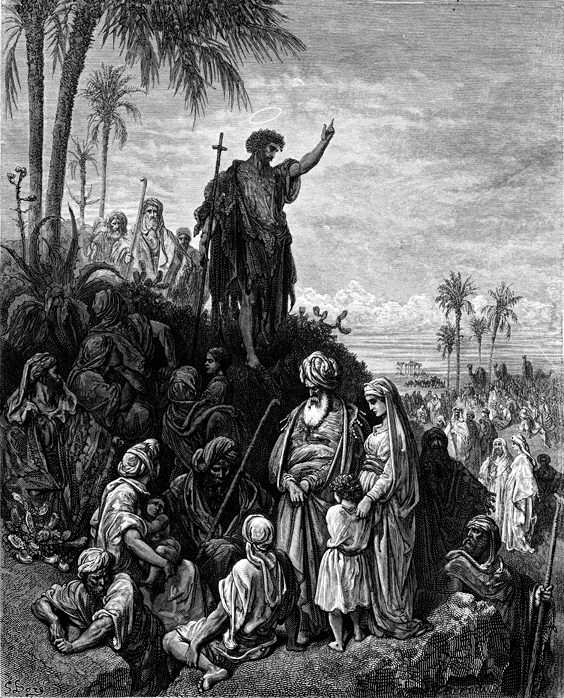
in Matthew 3And do not presume to say to yourselves, ‘We have Abraham as our father.’ For I tell you that out of these stones God can raise up children for Abraham.
BSB
The same verse in ASV and KJV ▾
ASV
and think not to say within yourselves, We have Abraham to our father: for I say unto you, that God is able of these stones to raise up children unto Abraham.
KJV
And think not to say within yourselves, We have Abraham to our father: for I say unto you, that God is able of these stones to raise up children unto Abraham.
⋯
This verse in Matthew 3
Commentary
25 notes on this verseHe intimates God's great power, who, as he made all things out of nothing, can make men out of the hardest stone. These stones signify the Gentiles because of their hardness of heart. See Ezekiel, I will take away from you the heart of stone, and give you the heart of flesh. Stone is emblematic of hardness, flesh of softness. Or, the preaching of the Gospel is meant, as the Prophet Jeremiah also compares the Word of the Lord to an axe cleaving the rock. (Jer. 23:29.)
This site's exposition
O generation of vipers
on Matthew 3:7-10
Generation of vipers is John's own name for two parties usually opposed to each other, Pharisees and Sadducees, united here only by a common presumption on descent, we have Abraham to our father. John answers that God is able of these stones to raise up children unto Abraham, a claim the bench reads as already opening the door Jesus will walk through with Gentile faith later in the book, since sonship runs on fruit rather than blood. The axe already laid unto the root and the fire already ready name a judgment poised rather than merely threatened, and bring forth fruits meet for repentance demands a changed life, not water alone.
The record, by era
The Church Fathers5 voices
If from "stones children are given to Abraham," this is not by their possessing his flesh and spirit but by their sharing his virtue. Therefore the people of God are able to call Abraham "father." How so? Consider the following: Stones are employed by the …
There is a tradition, that John preached at that place of the Jordan, where the twelve stones taken from the bed of the river had been set up by command of God. He might then be pointing to these, when he said, Of these stones.
With a view, however, to re lute the argument whereby you thought you were going to clinch your proposition, I here contend: If Matter had always been good, why should it not have still wanted a change for the better? Does that which is good never desire, never wish, never feel able to advance, so as to change its good for a better? And in like manner, if Matter had been by nature evil, why might it not have been changed by God as the more powerful Being, as able to convert the nature of stones into children of Abraham? Surely by such means you not only compare the Lord with Matter, but you even put Him below it, since you affirm that the nature of Matter could not possibly be brought under control by Him, and trained to something better.
Because, as is evident, if nature admits of change from evil to good in Matter, it can be changed from good to evil in God. Here some man will say, Then will "children not be raised up to Abraham from the stones? " Will "generations of vipers not bring forth the fruit of repentance? " And "children of wrath" fail to become sons of peace, if nature be unchangeable? Your reference to such examples as these, my friend, is a thoughtless one. For things which owe their existence to birth such as stones and vipers and human beings-are not apposite to the case of Matter, which is unborn; since their nature, by possessing a beginning, may have also a termination.
In like manner, too, if you have involved yourself in digamy, you are not the son of that Abraham whose "faith" preceded in monogamy. For albeit it is subsequently that he is called "a father of many nations," still it is of those (nations) who, as the fruit of the "faith" which precedes digamy, had to be accounted "sons of Abraham."
18 more voices on this verse
The Church Fathers5 voices
For, in coming to the High Priest of the Father-Christ-all impediments must first be taken away, in the space of a week, that the house which remains, the flesh and the soul, may be clean; and when the Word of God has entered it, and has found "stains of red and green," forthwith must the deadly and sanguinary passions "be extracted" and "cast away" out of doors-for the Apocalypse withal has set "death" upon a "green horse," but a "warrior" upon a "red" -and in their stead must be under-strewn stones polished and apt for conjunction, and firm,-such as are made (by God) into (sons) of Abraham, -that thus the man may be fit for God.
(Verse. 9.) God is able to raise up children of Abraham from these stones. He calls them ethnic stones because of the hardness of the heart. Read Ezekiel: I will take away the heart of stone from you and give you a heart of flesh (Ezek. XXXVI, 26). In the stone, hardness is shown, in the flesh, softness is shown. Or it simply indicates the power of God, that he who created everything out of nothing can also create a people from the hardest stones.
What avails noble birth to him whose life is disgraceful? Or, on the other hand, what hurt is a low origin to him who has the lustre of virtue? It is fitter that the parents of such a son should rejoice over him, than he over his parents. So do not you pride yourselves on having Abraham for your father, rather blush that you inherit his blood, but not his holiness. He who has no resemblance to his father is possibly the offspring of adultery. These words then only exclude boasting on account of birth. Stone is hard to work, but when wrought to some shape, it loses it not; so the Gentiles were hardly brought to the faith, but once brought they abide in it for ever.
(Hom. xi.) He does not forbid them to say they are his, but to trust in that, neglecting virtues of the soul. That men should be made out of stones, is like Isaac coming from Sarah's womb; Look into the rock, says Isaiah, whence ye were hewn. Reminding them thus of this prophecy, he shows that it is possible that the like might even now happen. By saying Every, he cuts off all privilege of nobility: as much as to say, Though thou be the son of Abraham, if thou abide fruitless thou shalt suffer the punishment.
A commentator
John ChrysostomHomily on the Gospel of Matthew 11 · Written in the 5th century.
proposed
And these things he said, not as forbidding them to say that they were sprung from those holy men, but as forbidding them to put confidence in this, while they were neglecting the virtue of the soul; at once bringing forward publicly what was in their minds, and foretelling things to come. Because after this they are found to say, "We have Abraham to our father, and were never in bondage to any man." Since then it was this, which most of all lifted them up with pride and ruined them, he first puts it down. And see how with his honor paid to the patriarch he combines his correction touching these things. Namely, having said, "Think not to say, We have Abraham to our father," he said not, "for the patriarch shall not be able to profit you anything," but somehow in a more gentle and acceptable manner he intimated the self-same thing, by saying, "For God is able of these stones to raise up children to Abraham." Now some say, that concerning the Gentiles he saith these things, calling them stones, metaphorically; but I say, that the expression hath also another meaning. But of what kind is this? Think not, saith he, that if you should perish, you would make the patriarch childless. This is not, this is not so. For with God it is possible, both out of stones to bring them to that relationship; since at the beginning also it was so done. For it was like the birth of men out of stones, when a child came forth from that hardened womb. This accordingly the prophet also was intimating, when he said, "Look unto the hard rock, whence ye are hewn, and to the hole of the pit, whence ye are digged: look unto Abraham your father, and unto Sarah that bare you." Now of this prophecy, you see, he reminds them, showing that if at the beginning he made him a father, as marvellously as if he had made him so out of stones, it was possible for this now also to come to pass. […]
The Medieval Church6 voices
But the Jews, glorying in the nobility of their lineage, were unwilling to acknowledge themselves as sinners for this reason: that they had descended from the stock of Abraham. To them it is rightly said: "And do not begin to say, 'We have Abraham as our father'; for I say to you that God is able from these stones to raise up children to Abraham." For what were the stones but the hearts of the Gentiles, insensible to the understanding of Almighty God? As it is also said to certain ones among the Jews: "I will take away the heart of stone from your flesh." Nor is it undeserved that the Gentiles were signified by the name of stones, because they worshipped stones. Whence it is written: "Let those who make them become like them, and all who trust in them." From these stones, indeed, children of Abraham were raised up, because when the hard hearts of the Gentiles believed in the seed of Abraham, that is, in Christ, they became children of him to whose seed they were united. Whence also it is said to these same Gentiles through the outstanding preacher: "But if you are Christ's, then you are Abraham's seed." If therefore we, through faith in Christ, are now the seed of Abraham, the Jews on account of their unbelief have ceased to be children of Abraham. That indeed on that day of the dreadful judgment good parents cannot benefit wicked children, the prophet testifies who says: "If Noah, Daniel, and Job were in the midst of them, as I live, says the Lord God, they shall deliver neither son nor daughter, but they themselves shall deliver their own souls by their righteousness." And again, that good children profit wicked parents nothing, but rather the goodness of children increases the guilt of wicked parents, the Truth Himself says to the unbelieving Jews: "If I cast out demons by Beelzebub, by whom do your sons cast them out? Therefore they shall be your judges."
The Jews who gloried in their race, would not own themselves sinners because they were Abraham's seed. Say not among yourselves we are Abraham's seed.
And think not to say within yourselves, We have Abraham as our father. This was to their destruction, that they put their trust in their noble lineage. For I say unto you, that God is able of these stones to raise up children unto Abraham. …
Otherwise; the Gentiles may be meant who worshipped stones. Of stones there were sons raised up to Abraham; forasmuch as the Gentiles by believing in Christ, who is Abraham's seed, became his sons to whose seed they were united.
(ord.) It is faith's first lesson to believe that God is able to do whatever He will.
Then he excludes the obstacle to repentance, when he says, "And do not presume to say to yourselves: 'We have Abraham as our father.'" The obstacle to repentance is twofold: presuming on oneself and despair about the divine judgment. First, he removes the first; secondly, …
The Puritans and the Awakening3 voices
And say not confidently - The word in the original, vulgarly rendered, Think not, seems here, and in many places, not to diminish, but rather add to the force of the word with which it is joined. We have Abraham to our father - It is almost incredible, how great the presumption of the Jews was on this their relation to Abraham.
What their pretence was; " We have Abraham to our father; we are not sinners of the Gentiles; it is fit indeed that they should be called to repent; but we are Jews, a holy nation, a peculiar people, what is this to us?" Note, The word does us no good, when we will not take it as it is spoken to us, and belonging to us.
And think not to say within yourselves,.... John knew the sentiments of their minds, and the prevailing opinion they had given into, against which he cautions them; as, that because they were Abraham's seed, they were in a state of salvation, in the favour of God, and had a right to all privileges and ordinances: this they trusted in, and boasted of, and would often think of it within themselves, pleasing themselves with the thoughts of it, and speak of it to others; we have Abraham for our father.
The Nineteenth Century4 voices
A commentator
Albert Barnes1798–1870
Notes, Explanatory and Practical, on the Old and New Testaments (1832-1869)
And think not to say ... - They regarded it as sufficient righteousness that they were descended from so holy a man as Abraham. Compare Joh 8:33-37, Joh 8:53. John assured them that this was a matter of small consequence in the sight of God. Of the very stones of the Jordan he could raise up children to Abraham.
These verses describe the ministry of John the Baptist, the forerunner of our Lord Jesus Christ: it is a ministry that deserves close attention. Few preachers ever produced such effects as John the Baptist: “There went out to him Jerusalem and all Judea and all the region round about Jordan.”None ever received such praise from the great head of the church: Jesus called him “a burning and a shining light” ( John 5:35 ); the great Bishop of souls Himself declared, that “among them that are born of women there hath not risen a greater than John the Baptist.”
A commentator
Jamieson, Fausset & Brown1802–1910
Commentary Critical and Explanatory on the Whole Bible (1871)
proposed
Though the stern speaker may have pointed as he spoke to the pebbles of the bare clay hills that lay around (so STANLEY'S Sinai and Palestine), it was clearly the calling of the Gentiles--at that time stone-dead in their sins, and quite as unconscious of it--into the room of unbelieving and disinherited Israel that he meant thus to indicate (see Mt 21:43;
quarantine:debris (2026-07-29) — unbalanced-parens
These verses describe the ministry of John the Baptist, the forerunner of our Lord Jesus Christ: it is a ministry that deserves close attention. Few preachers ever produced such effects as John the Baptist: “There went out to him Jerusalem and all Judea and all the region round about Jordan.”None ever received such praise from the great head of the church: Jesus called him “a burning and a shining light” ( John 5:35 ); the great Bishop of souls Himself declared, that “among them that are born of women there hath not risen a greater than John the Baptist.” Let us then study the leading features of his ministry. John the Baptist spoke plainly about sin . He taught the absolute necessity of repentance before anyone can be saved; he preached that repentance must be proved by its “fruits”he warned men not to rest on outward privileges, or outward union with the church. This is just the teaching that we all need. We are naturally dead, and blind, and asleep in spiritual things; we are ready to content ourselves with a mere formal religion and to flatter ourselves that if we go to church we shall be saved: we need to be told that, except we “repent and are converted” we shall all perish. John the Baptist spoke plainly about our Lord Jesus Christ . He taught people that one “mightier than himself” was coming among them. He was nothing more than a servant: the coming one was the King. He himself could only baptize with water: the coming one could “baptize with the Holy Ghost,” take away sins, and would one day judge the world. This again is the very teaching that human nature requires. We need to be sent direct to Christ: we are all ready to stop short of this; we want to rest in our union with the church, our regular use of the sacraments, and our diligent attendance on an established ministry. We need to be told the absolute necessity of union with Christ himself by faith.
How the passage was read
On Matthew 3:7-10On Matthew 3:7-10
Who the Pharisees and Sadducees were
Their first appearance in the New Testament is the place to say plainly who they were. The Pharisees were a lay renewal movement, about six thousand strong in the historian Josephus's count (Antiquities of the Jews, book 17, written about AD 93), whose program was to extend the Temple's holiness into ordinary life: the ordinary table kept as carefully as a priest's, the whole Torah kept in detail by the whole people. They held that alongside the written Torah an oral Torah had come down from Sinai teacher to teacher; the Mishnah's ethics tractate opens with that chain: “Moses received the Torah at Sinai and transmitted it to Joshua, Joshua to the elders...” (Pirkei Avot 1:1). The Sadducees were the priestly aristocracy centered on the Temple: they accepted the written Torah but rejected the oral tradition and denied the resurrection of the dead (Acts 23:8 says so directly). After the Temple fell in AD 70 the Sadducees vanished; the rabbinic Judaism that survives to this day descends from the Pharisaic side.
Two cautions keep the reader honest for every scene that follows. “Pharisee” is not a synonym for hypocrite: the movement's aim was devotion, its ranks included honest seekers (Nicodemus, Gamaliel, and Paul, who says “I am a Pharisee” in the present tense, Acts 23:6), and on the resurrection its doctrine stands with Christian confession against the Sadducees. And the Gospel collisions are arguments WITHIN first-century Judaism about how the Torah is rightly kept, not a contest between Jesus and Judaism.
This section is reception history: how the passage was read and kept in the Jewish tradition. Where a reading parts from an essential of the Christian faith, the section says so at that point.
Sources: Pirkei Avot 1:1 (the chain of tradition) · Mishnah Sanhedrin 10:1 (the resurrection affirmed as core doctrine)
The words behind it
25 Greek wordsEvery Greek word of this verse in the order it stands, with what it means and the door to its own study. The last column counts the times a word stands in the whole Bible: the rarer the word, the more the places it appears belong together.
| Greek | Sound | Meaning | Word study | In the Bible |
|---|---|---|---|---|
| καὶ | kai | And | G2532 → | 9120 times |
| μὴ | me | not | G3361 → | 1066 times |
| δόξητε | doxete | may you presume | G1380 → | 62 times |
| λέγειν | legein | to say | G3004 → | 1325 times |
| ἐν | en | within | G1722 → | 2738 times |
| ἑαυτοῖς· | he'autois | yourselves; | G1438 → | 322 times |
| πατέρα | patera | [As] father | G3962 → | 410 times |
| ἔχομεν | echomen | we have | G2192 → | 707 times |
| τὸν | ton | <the> | G3588 → | 19766 times |
| Ἀβραάμ· | abraam | Abraham; | G11 → | 73 times |
| λέγω | lego | I say | G3004 → | 1325 times |
| γὰρ | gar | for | G1063 → | 1039 times |
| ὑμῖν | humin | to you | G4771 → | 2973 times |
| ὅτι | hoti | that | G3754 → | 1292 times |
| δύναται | dunatai | able is | G1410 → | 207 times |
| ὁ | ho | <the> | G3588 → | 19766 times |
| θεὸς | theos | God | G2316 → | 1312 times |
| ἐκ | ek | out of | G1537 → | 911 times |
| τῶν | ton | <the> | G3588 → | 19766 times |
| λίθων | lithon | stones | G3037 → | 58 times |
| τούτων | touton | these | G3778 → | 1381 times |
| ἐγεῖραι | egeirai | to raise up | G1453 → | 142 times |
| τέκνα | tekna | children | G5043 → | 99 times |
| τῷ | to | <the> | G3588 → | 19766 times |
| Ἀβραάμ.¶ | abraam | to Abraham. | G11 → | 73 times |
καὶAnd
kaiG2532 →9120 times
μὴnot
meG3361 →1066 times
δόξητεmay you presume
doxeteG1380 →62 times
λέγεινto say
legeinG3004 →1325 times
ἐνwithin
enG1722 →2738 times
ἑαυτοῖς·yourselves;
he'autoisG1438 →322 times
πατέρα[As] father
pateraG3962 →410 times
ἔχομενwe have
echomenG2192 →707 times
τὸν<the>
tonG3588 →19766 times
Ἀβραάμ·Abraham;
abraamG11 →73 times
λέγωI say
legoG3004 →1325 times
γὰρfor
garG1063 →1039 times
ὑμῖνto you
huminG4771 →2973 times
ὅτιthat
hotiG3754 →1292 times
δύναταιable is
dunataiG1410 →207 times
ὁ<the>
hoG3588 →19766 times
θεὸςGod
theosG2316 →1312 times
ἐκout of
ekG1537 →911 times
τῶν<the>
tonG3588 →19766 times
λίθωνstones
lithonG3037 →58 times
τούτωνthese
toutonG3778 →1381 times
ἐγεῖραιto raise up
egeiraiG1453 →142 times
τέκναchildren
teknaG5043 →99 times
τῷ<the>
toG3588 →19766 times
Ἀβραάμ.¶to Abraham.
abraamG11 →73 times
A shaded row is a word that stands 400 times or fewer in the Bible.
The walk
8 stopsEach card is a verse this one points to, and under it the verses that one points to in turn. Where several paths arrive at the same place, that place is listed first: the text keeps returning to it.
Through
Luke 3:8Produce fruit, then, in keeping with repentance. And do not begin to say to yourselves, ‘We have Abraham as our father.’ For I tell you that out of these stones God can raise up…
it leads to
- Ezekiel 18:27–31
But if a wicked man turns from the wickedness he has committed and does what is just and right, he will save his life.
- Acts 26:20
First to those in Damascus and Jerusalem, then to everyone in the region of Judea, and then to the Gentiles, I declared that they should repent and turn to God, performing deeds worthy of…
- Isaiah 1:16–18
Wash and cleanse yourselves. Remove your evil deeds from My sight. Stop doing evil!
- Matthew 21:43
Therefore I tell you that the kingdom of God will be taken away from you and given to a people who will produce its fruit.
- Galatians 5:22–24
But the fruit of the Spirit is love, joy, peace, patience, kindness, goodness, faithfulness,
- Ezekiel 18:27–31
Through
Romans 4:1What then shall we say that Abraham, our forefather, has discovered?
it leads to
- Isaiah 51:2
Look to Abraham your father, and to Sarah who gave you birth. When I called him, he was but one; then I blessed him and multiplied him.
- Romans 4:16
Therefore, the promise comes by faith, so that it may rest on grace and may be guaranteed to all Abraham’s offspring—not only to those who are of the law, but also to those who…
- Isaiah 51:2
Through
John 8:33“We are Abraham’s descendants,” they answered. “We have never been slaves to anyone. How can You say we will be set free?”
it leads to
- John 8:39
“Abraham is our father,” they replied. “If you were children of Abraham,” said Jesus, “you would do the works of Abraham.
- John 8:39
Where this verse is studied
About Matthew
Who and where
1 name in this verse with a page on the site.
This page draws on 22 works. Open the list of works
This page draws on Albert Barnes, Notes, Explanatory and Practical, on the Old and New Testaments (1832-1869); Glossa Ordinaria, Catena Aurea by Aquinas; Gregory the Dialogist, Forty Gospel Homilies, Homily 20; Gregory the Dialogist, Catena Aurea by Aquinas; J.C. Ryle, Expository Thoughts on the Gospels: Matthew; Jamieson, Fausset & Brown, Commentary Critical and Explanatory on the Whole Bible; Jerome, Catena Aurea by Aquinas; Jerome, Commentary on Matthew; John Chrysostom, Catena Aurea by Aquinas; John Chrysostom, Homily on the Gospel of Matthew 11; John Gill, Exposition of the New Testament (1746-1748); John Wesley, Explanatory Notes upon the New Testament; Matthew Henry, Commentary on the Whole Bible; Pseudo-Chrysostom, Catena Aurea by Aquinas; Rabanus Maurus, Catena Aurea by Aquinas; Remigius of Rheims, Catena Aurea by Aquinas; Tertullian, Against Hermogenes; Tertullian, On Monogamy; Tertullian, On Modesty; Theodore of Heraclea, FRAGMENTS 15-16; Theophylact of Ohrid, Commentary on Matthew and Thomas Aquinas, Commentary on Matthew.