
Matthew 3:2
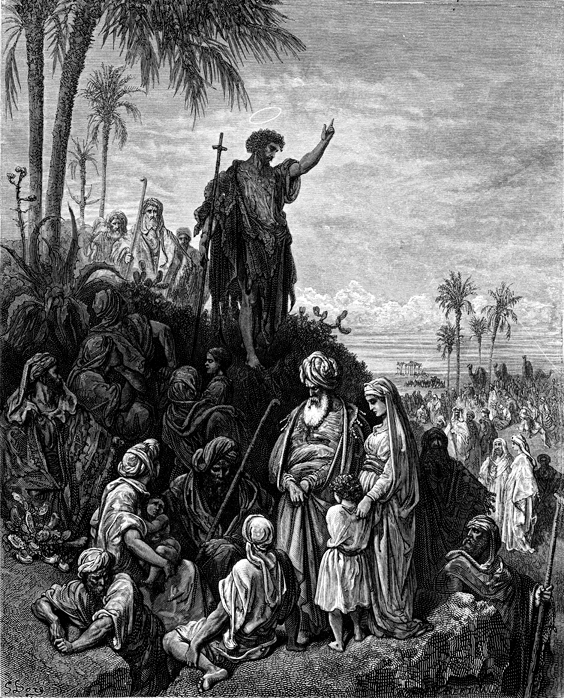
in Matthew 3and saying, “Repent, for the kingdom of heaven is near.”
BSB
The same verse in ASV and KJV ▾
ASV
Repent ye; for the kingdom of heaven is at hand.
KJV
And saying, Repent ye: for the kingdom of heaven is at hand.
⋯
This verse in Matthew 3
Commentary
24 notes on this verseJohn Baptist is the first to preach the Kingdom of Heaven, that the forerunner of the Lord may have this honourable privilege.
This site's exposition
preaching in the wilderness of Judea
on Matthew 3:1-3
John's ministry opens with "In those days," some three decades after chapter 2. His message is "Repent, for the kingdom of heaven is near": metanoeo names a change of mind and direction. Kingdom of heaven is Matthew's phrase where Mark and Luke write kingdom of God.
This site's exposition
the kingdom of heaven is near
John Wesley reads the nearness as God about to set up the kingdom Daniel foretold in Daniel 2:44 and 7:13 and 14. Jamieson, Fausset and Brown reason that a kingdom prepared for by repentance must be spiritual. Jerome notes that John is the first to preach it.
The record, by era
The Church Fathers5 voices
(Serm.) Unless one repent him of his former life, he cannot begin a new life.
He therefore preaches repentance when the Kingdom of Heaven approaches; by which we return from error, we escape from sin, and after shame for our faults, we make profession of forsaking them.
A commentator
Philoxenus of Mabbug13 Ascetic Discourses, Discourse 11 -- On Abstinence · Written before 523.
proposed
"The kingdom of God is within you," and in another place the Book saith, "Repent, for the kingdom of heaven is at hand," and two things are certain: the kingdom of heaven which the righteous shall inherit at the end of the world, above the …
In the very commencement he shows himself the messenger of a merciful Prince; he comes not with threats to the offender, but with offers of mercy. It is a custom with kings to proclaim a general pardon on the birth of a son, but first they send throughout their kingdom officers to exact severe fines. But God willing at the birth of His Son to give pardon of sins, first sends His officer proclaiming, Repent ye. O exaction which leaves none poor, but makes many rich! For even when we pay our just debt of righteousness we do God no service, but only gain our own salvation. Repentance cleanses the heart, enlightens the sense, and prepares the human soul for the reception of Christ, as he immediately adds, For the Kingdom of Hearen is at hand.
The kingdom of heaven? This refers to justification by faith and sanctification by the Spirit. This is why it says elsewhere, "the kingdom [of heaven] is within you."
16 more voices on this verse
The Church Fathers4 voices
Now that on this account Christ came to His baptism, is from this evident. But wherefore was this baptism devised for Him? For that not of himself did the son of Zacharias proceed to this, but of God who moved him, this Luke also declares, when he saith, "The word of the Lord came unto him," that is, His commandment. And he himself too saith, "He that sent me to baptize with water, the same said to me, upon whom thou shalt see the Spirit descending like a dove, and remaining on Him, the same is He which baptizeth with the Holy Ghost." Wherefore then was he sent to baptize? The Baptist again makes this also plain to us, saying, "I knew Him not, but that He should be made manifest to Israel, therefore am I come baptizing with water." And if this was the only cause, how saith Luke, that "he came into the county about Jordan, preaching the baptism of repentance for the remission of sins?" And yet it had not remission, but this gift pertained unto the baptism that was given afterwards; for in this "we are buried with Him," and our old man was then crucified with Him, and before the cross there doth not appear remission anywhere; for everywhere this is imputed to His blood. […]
"But what is this to the Jews?" one may say, "for they know not even what thou sayest." "Why, for this cause," saith he, "do I so speak, in order that being roused by the obscurity of my words, they may proceed to seek Him, whom I preach." In point of fact, he so excited them with good hopes when they came near, that even many publicans and soldiers inquired what they should do, and how they should direct their own life; which was a sign of being thenceforth set free from all worldly things, and of looking to other greater objects, and of forebodings things to come. Yea, for all, both the sights and the words of that time, led them unto lofty thoughts.
The Kingdom of Heaven has a fourfold meaning. It is said, of Christ, as The Kingdom of God is within you. (Luke 17:21.) Of Holy Scripture, as, The Kingdom of God shall be taken from you, and shall be given to a nation bringing forth the fruits thereof. (Mat. 21:43.) Of the Holy Church, as, The Kingdom of Heaven is like unto ten virgins. (Mat. 25.) Of the abode above, as, Many shall come from the East and the West, and shall sit down in the Kingdom of Heaven. (Mat. 8:11.) And all these significations may be here understood.
And in those days came John the Baptist preaching in the wilderness of Judaea and saying, Repent, for the kingdom of heaven is at hand; as if he said, the mansion in the heavens is now ready to be revealed, as the Christ is now …
The Medieval Church4 voices
He continues with "Do penance..." John announces a new life, as Augustine says in the book On Penance: "No one who is made arbiter of his own will can begin a new life, unless he repents of his former life." Therefore, first he warns them …
A commentator
Symeon the New TheologianCommentary (church-history corpus) · Written before 1022.
proposed
We are naturally obliged to state our opinion clearly to such people, and to reply: O, you! Why do you reason to your own perdition rather than your salvation? And why do you pick out for yourselves the obscure passages of inspired Scripture and then …
Preaching in the wilderness of Judea, and saying, Repent ye. The Jews were arrogant, and so he urges them to repent. For the kingdom of heaven is at hand. The kingdom of heaven means the first and second comings of Christ, and also the virtuous …
(ord.) The Kingdom of Heaven shall come nigh you; for if it approached not, none would be able to gain it; for weak and blind they had not the way, which was Christ.
The Puritans and the Awakening3 voices
Is at hand - As if he had said, God is about to erect that kingdom, spoken of by Daniel, Dan. ii, 44; vii, 13, 14; the kingdom of the God of heaven. It properly signifies here, the Gospel dispensation, in which subjects were to be gathered to God by his Son, and a society to be formed, which was to subsist first on earth, and afterward with God in glory.
And saying, repent ye,....
It is a kingdom of which Christ is the Sovereign, and we must be the willing, loyal subjects of it. It is a kingdom of heaven, not of this world, a spiritual kingdom: its original from heaven, its tendency to heaven.
The Nineteenth Century5 voices
Repent - Μετανοειτε. This was the matter of the preaching. The verb μετανοεω is either compounded of μετα, after, and νοειν to understand, which signifies that, after hearing such preaching, the sinner is led to understand, that the way he has walked in was the way of misery, death, and hell.
These verses describe the ministry of John the Baptist, the forerunner of our Lord Jesus Christ: it is a ministry that deserves close attention. Few preachers ever produced such effects as John the Baptist: “There went out to him Jerusalem and all Judea and all the region round about Jordan.”None ever received such praise from the great head of the church: Jesus called him “a burning and a shining light” ( John 5:35 ); the great Bishop of souls Himself declared, that “among them that are born of women there hath not risen a greater than John the Baptist.”
A commentator
Jamieson, Fausset & Brown1802–1910
Commentary Critical and Explanatory on the Whole Bible (1871)
A kingdom for which repentance was the proper preparation behooved to be essentially spiritual. Deliverance from sin, the great blessing of Christ's kingdom (Mt 1:21), can be valued by those only to whom sin is a burden (Mt 9:12). John's great work, accordingly, was to awaken this feeling and hold out the hope of a speedy and precious remedy.
These verses describe the ministry of John the Baptist, the forerunner of our Lord Jesus Christ: it is a ministry that deserves close attention. Few preachers ever produced such effects as John the Baptist: “There went out to him Jerusalem and all Judea and all the region round about Jordan.”None ever received such praise from the great head of the church: Jesus called him “a burning and a shining light” ( John 5:35 ); the great Bishop of souls Himself declared, that “among them that are born of women there hath not risen a greater than John the Baptist.” Let us then study the leading features of his ministry. John the Baptist spoke plainly about sin . He taught the absolute necessity of repentance before anyone can be saved; he preached that repentance must be proved by its “fruits”he warned men not to rest on outward privileges, or outward union with the church. This is just the teaching that we all need. We are naturally dead, and blind, and asleep in spiritual things; we are ready to content ourselves with a mere formal religion and to flatter ourselves that if we go to church we shall be saved: we need to be told that, except we “repent and are converted” we shall all perish. John the Baptist spoke plainly about our Lord Jesus Christ . He taught people that one “mightier than himself” was coming among them. He was nothing more than a servant: the coming one was the King. He himself could only baptize with water: the coming one could “baptize with the Holy Ghost,” take away sins, and would one day judge the world. This again is the very teaching that human nature requires. We need to be sent direct to Christ: we are all ready to stop short of this; we want to rest in our union with the church, our regular use of the sacraments, and our diligent attendance on an established ministry. We need to be told the absolute necessity of union with Christ himself by faith.
A commentator
Albert Barnes1798–1870
Notes, Explanatory and Practical, on the Old and New Testaments (1832-1869)
proposed
Repent ye - Repentance implies sorrow for past offences 2Co 7:10; a deep sense of the evil of sin as committed against God Psa 51:4; and a full purpose to turn from transgression and to lead a holy life. A true penitent has sorrow for sin, not only because it is ruinous to his soul, but chiefly because it is an offence against God, and is that abominable thing which he hates, Jer 44:4. It is produced by seeing the great danger and misery to which it exposes us; by seeing the justice and holiness of God Job 42:6; and by seeing that our sins have been committed against Christ, and were the cause of his death, Zec 12:10; Luk 22:61-62. There are two words in the New Testament translated “repentance,” one of which denotes a change of mind, or a reformation of life; and the other, sorrow or regret that sin has been committed. The word used here is the former, calling the Jews to a change of life, or a reformation of conduct. In the time of John, the nation had become extremely wicked and corrupt, perhaps more so than at any preceding period. Hence, both he and Christ began their ministry by calling the nation to repentance. The kingdom of heaven is at hand - The phrases kingdom of heaven, kingdom of Christ, kingdom of God, are of frequent occurrence in the Bible. They all refer to the same thing. The expectation of such a kingdom was taken from the Old Testament, and especially from Daniel, Dan 7:13-14. The prophets had told of a successor to David that should sit on his throne 1Ki 2:4; 1Ki 8:25; Jer 33:17. The Jews expected a great national deliverer. […]
The words behind it
9 Greek wordsEvery Greek word of this verse in the order it stands, with what it means and the door to its own study. The last column counts the times a word stands in the whole Bible: the rarer the word, the more the places it appears belong together.
| Greek | Sound | Meaning | Word study | In the Bible |
|---|---|---|---|---|
| καὶ | kai | and | G2532 → | 9120 times |
| λέγων· | legon | saying; | G3004 → | 1325 times |
| μετανοεῖτε· | metanoeite | do repent; | G3340 → | 34 times |
| ἤγγικεν | engiken | has drawn near | G1448 → | 42 times |
| γὰρ | gar | for | G1063 → | 1039 times |
| ἡ | he | the | G3588 → | 19766 times |
| βασιλεία | basileia | kingdom | G932 → | 162 times |
| τῶν | ton | of the | G3588 → | 19766 times |
| οὐρανῶν. | ouranon | heavens. | G3772 → | 272 times |
καὶand
kaiG2532 →9120 times
λέγων·saying;
legonG3004 →1325 times
μετανοεῖτε·do repent;
metanoeiteG3340 →34 times
ἤγγικενhas drawn near
engikenG1448 →42 times
γὰρfor
garG1063 →1039 times
ἡthe
heG3588 →19766 times
βασιλείαkingdom
basileiaG932 →162 times
τῶνof the
tonG3588 →19766 times
οὐρανῶν.heavens.
ouranonG3772 →272 times
A shaded row is a word that stands 400 times or fewer in the Bible.
The walk
8 stopsEach card is a verse this one points to, and under it the verses that one points to in turn. Where several paths arrive at the same place, that place is listed first: the text keeps returning to it.
Through
Matthew 4:17From that time on Jesus began to preach, “Repent, for the kingdom of heaven is near.”
it leads to
- Acts 2:38
Peter replied, “Repent and be baptized, every one of you, in the name of Jesus Christ for the forgiveness of your sins, and you will receive the gift of the Holy Spirit.
Reached by 2 separate paths from here.
- Mark 1:14–15
After the arrest of John, Jesus went into Galilee and proclaimed the gospel of God.
- Acts 2:38
Through
Matthew 6:10Your kingdom come, Your will be done, on earth as it is in heaven.
it leads to
- Hebrews 10:36
You need to persevere, so that after you have done the will of God, you will receive what He has promised.
- Matthew 26:42
A second time He went away and prayed, “My Father, if this cup cannot pass unless I drink it, may Your will be done.”
- Matthew 12:50
For whoever does the will of My Father in heaven is My brother and sister and mother.”
- John 4:34
Jesus explained, “My food is to do the will of Him who sent Me and to finish His work.
- 1 Thessalonians 5:18
Give thanks in every circumstance, for this is God’s will for you in Christ Jesus.
- Hebrews 10:36
Through
Mark 1:15“The time is fulfilled,” He said, “and the kingdom of God is near. Repent and believe in the gospel!”
it leads to
- Acts 20:21
testifying to Jews and Greeks alike about repentance to God and faith in our Lord Jesus Christ.
Reached by 2 separate paths from here.
- Acts 20:21
Where this verse is studied
By subject
Kingdom of God35 verses
On this page
Studies14
On this verse
On this chapter
About Matthew
This page draws on 20 works. Open the list of works
This page draws on Adam Clarke, Commentary on the Bible; Albert Barnes, Notes, Explanatory and Practical, on the Old and New Testaments (1832-1869); Augustine of Hippo, Catena Aurea by Aquinas; Cosmas Indicopleustes, The Christian Topography, Book 5; Cyril of Alexandria, FRAGMENT 17.4; Glossa Ordinaria, Catena Aurea by Aquinas; Hilary of Poitiers, Catena Aurea by Aquinas; J.C. Ryle, Expository Thoughts on the Gospels: Matthew; Jamieson, Fausset & Brown, Commentary Critical and Explanatory on the Whole Bible; Jerome, Catena Aurea by Aquinas; John Chrysostom, Homily on the Gospel of Matthew 10; John Gill, Exposition of the New Testament (1746-1748); John Wesley, Explanatory Notes upon the New Testament; Matthew Henry, Commentary on the Whole Bible; Philoxenus of Mabbug, 13 Ascetic Discourses, Discourse 11 -- On Abstinence; Pseudo-Chrysostom, Catena Aurea by Aquinas; Remigius of Rheims, Catena Aurea by Aquinas; Symeon the New Theologian, Commentary (church-history corpus); Theophylact of Ohrid, Commentary on Matthew and Thomas Aquinas, Commentary on Matthew.