
Matthew 3:10
in Matthew 3The axe lies ready at the root of the trees, and every tree that does not produce good fruit will be cut down and thrown into the fire.
BSB
The same verse in ASV and KJV ▾
ASV
And even now the axe lieth at the root of the trees: every tree therefore that bringeth not forth good fruit is hewn down, and cast into the fire.
KJV
And now also the axe is laid unto the root of the trees: therefore every tree which bringeth not forth good fruit is hewn down, and cast into the fire.
⋯
This verse in Matthew 3
Commentary
29 notes on this verseAnd now also the axe is laid - Or, Even now the axe lieth. As if he had said, There is not a moment to spare - God is about to cut off every impenitent soul - you must therefore either turn to God immediately, or be utterly and finally ruined. It was customary with the prophets to represent the kingdoms, nations, and individuals, whose ruin they predicted, under the notion of forests and trees, doomed to be cut down. See Jer 46:22, Jer 46:23; Eze 31:3, Eze 31:11, Eze 31:
This site's exposition
You brood of vipers
on Matthew 3:7-10
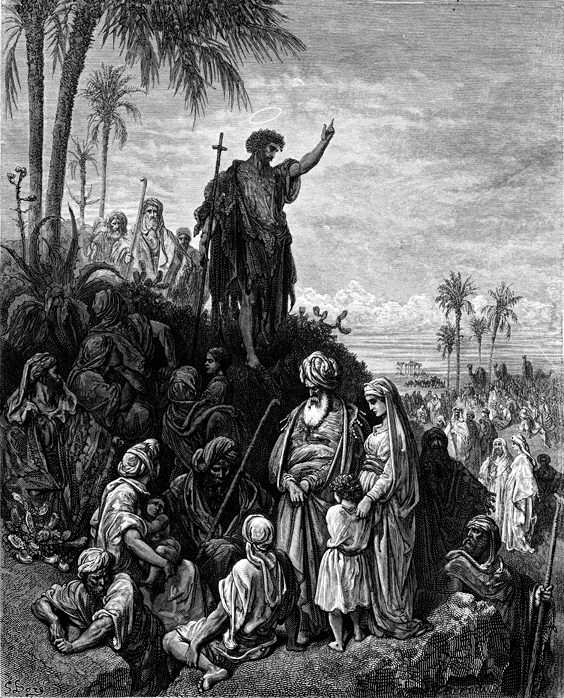
"You brood of vipers" is John's name for Pharisees and Sadducees, rival parties joined by one presumption: "We have Abraham as our father." John answers that "out of these stones God can raise up children for Abraham," so sonship is proved by fruit.
This site's exposition
The axe lies ready at the root of the trees
Chrysostom notes that the axe is laid at the root and has not struck, so the outcome rests with the hearers. Such fruit, he adds, grows at once where there is will. Adam Clarke recalls that the prophets pictured doomed nations as forests marked for felling, as in Jeremiah 46:22.
The record, by era
The Church Fathers5 voices
(Verse 10, 11.) For now the axe is laid to the root of the trees. Every tree therefore that does not bear good fruit will be cut down and thrown into the fire. I indeed baptize you with water for repentance, but he who is coming after me is mightier than I. The preaching of the Gospel word, which is sharp on both sides, is called an axe, according to the prophet Jeremiah, who compares the word of the Lord to an axe cutting through a rock (Jeremiah 46). Whose shoes I am not worthy to bear.
The axe laid at the roots of the trees witnesses to the power present in Christ. The cutting down and burning of the trees signifies the destruction of barren faithlessness that is being prepared for the fire of judgment.
There is no doubt this axe signifies the power of the divine word, for God says through Jeremiah the prophet: "Is not my word like fire, says the Lord, and like a hammer which breaks the rock in pieces?" Therefore this axe which is laid …
A commentator
Philoxenus of Mabbug13 Ascetic Discourses, Discourse 1 -- Prologue · Written before 523.
proposed
And He shall come of Whom it is said, "He holdeth His fan in His hand and He will purify His threshing-floors; and He will gather His wheat into the garner, but the straw He will burn up with unquenchable fire." And the Husbandman who …
There the blood of the Lord serves for your purple robe, and your broad stripe is His own cross; there the axe is already laid to the trunk of the tree; there is the branch out of the root of Jesse.
21 more voices on this verse
The Church Fathers9 voices
Seize the opportunity of unexpected felicity: that you, who sometime were in God's sight nothing but "a drop of a bucket," and "dust of the threshing-floor," and "a potter's vessel," may thenceforward become that "tree which is sown beside the waters, is perennial in leaves, bears fruit at its own time," and shall not see fire," nor "axe.
Seize the opportunity of unexpected felicity: that you, who sometime were in God's sight nothing but "a drop of a bucket," and "dust of the threshing-floor," and "a potter's vessel," may thenceforward become that "tree which is sown beside the waters, is perennial in leaves, bears fruit at its own time," and shall not see fire," nor "axe." Having found "the truth," repent of errors; repent of having loved what God loves not: even we ourselves do not permit our slave-lads not to hate the things which are offensive to us; for the principle of voluntary obedience consists in similarity of minds.
The wood was the old order, which is being pruned down by the new Gospel, in which withal "the axe has been laid at the roots." So, too, "Eye for eye, and tooth for tooth," has now grown old, ever since "Let none render evil for evil" grew young.
The axe is that most sharp fury of the consummation of all things, that is to hew down the whole world. But if it be already laid, how hath it not yet cut down? Because these trees have reason and free power to do good, or leave undone; so that when they see the axe laid to their root, they may fear and bring forth fruit. This denunciation of wrath then, which is meant by the laying of the axe to the root, though it have no effect on the bad, yet will sever the good from the bad.
He calls Christ an axe "sharper than a two-edged sword," which was to cut off the unbelieving Jews and dissociate them from the honor and communion of the patriarchs. Those spoken of as "the root" are the fathers of old who remained well pleasing to God, those who with Abraham and as with many people in former times were holy. The unbelievers who sprang from them were cut off as fruitless branches. But the root remained, onto which those of the believing Gentiles were engrafted. And as Irenaeus reminds us, God's Word is like an axe in accordance with Jeremiah's saying: the word of the Lord is "like a pickaxe chopping stone." Why am I saying that you are going to fall away? God did not spare the root.
(Hom. xi.) He does not forbid them to say they are his, but to trust in that, neglecting virtues of the soul. That men should be made out of stones, is like Isaac coming from Sarah's womb; Look into the rock, says Isaiah, whence ye were hewn. Reminding them thus of this prophecy, he shows that it is possible that the like might even now happen. By saying Every, he cuts off all privilege of nobility: as much as to say, Though thou be the son of Abraham, if thou abide fruitless thou shalt suffer the punishment.
Mark then how by what follows also he increases their alarm, and adds intensity to their agonizing fear. For having said that "God is able of these stones to raise up children unto Abraham," he added, "And now also the axe is laid unto the root of the trees," by all means making his speech alarming. For as he from his way of life had much freedom of speech, so they needed his severe rebuke, having been left barren now for a long time. For "why do I say" (such are his words) "that ye are on the point of falling away from your relationship to the patriarch and of seeing other, even those that are of stones, brought in to your preeminence? Nay, not to this point only will your penalty reach, but your punishment will proceed further. For now," saith he, "the axe is laid unto the root of the trees." There is nothing more terrible than this turn of his discourse. For it is no longer "a flying sickle," nor "the taking down of a hedge," nor "the treading under foot of the vineyard;" but an axe exceeding sharp, and what is worse, it is even at the doors. For inasmuch as they continually disbelieved the prophets, and used to say, "Where is the day of the Lord:" and "let the counsel of the Holy One of Israel come, that we may know it," by reason that it was many years before what they said came to pass; to lead them off from this encouragement also, he sets the terrors close to them. And this he declared by saying "now," and by his putting it to "the root." "For the space between is nothing now," saith he, "but it is laid to the very root." And he said not, "to the branches," nor "to the fruits," but "to the root." Signifying, that if they were negligent, they would have incurable horrors to endure, and not have so much as a hope of remedy. […]
Yet, although he hath terrified them again, he suffers them not to fall into despair; but as before he said not "He hath raised up," but "He is able to raise up children to Abraham" (at once both alarming and comforting them); even so here also he did not say that "it hath touched the root," but "it is laid to the root, and is now hard by it, and shows signs of no delay." However, even though He hath brought it so near, He makes its cutting depend upon you. For if ye change and become better men, this axe will depart without doing anything; but if ye continue in the same ways, He will tear up the tree by the roots. And therefore, observe, it is neither removed from the root, nor applied as it is doth it cut at all: the one, that ye may not grow supine, the other to let you know that it is possible even in a short time to be changed and saved. Wherefore he doth also from all topics heighten their fear, thoroughly awakening and pressing them on to repentance. Thus first their falling away from their forefathers; next, others being introduced instead; lastly, those terrors being at their doors, the certainty of suffering incurable evils (both which he declared by the root and the axe), was sufficient to rouse thoroughly those even that were very supine, and to make them full of anxiety. I may add, that Paul too was setting forth the same, when he said, "A short word will the Lord make upon the whole world." But be not afraid; or rather, be afraid, but despair not. For thou hast yet a hope of change; the sentence is not quite absolute, neither did the axe come to cut (else what hindered it from cutting, close as it was to the root?); but on purpose by this fear to make thee a better man, and to prepare thee to bring forth fruit. […]
"And how," saith one, "shall we be able to bring forth fruit, when the edge is being applied, and the time so strait, and the appointed season cut short." "Thou wilt be able," saith he, "for this fruit is not of the same kind as that of common trees, waiting a long time, and in bondage to the necessities of seasons, and requiring much other management; but it is enough to be willing, and the tree at once hath put forth its fruit. For not the nature of the root only, but also the skill of the husbandman contributes the most to that kind of fruit-bearing."
The Medieval Church5 voices
And now also the axe is laid unto the root of the trees. The axe means the judgement of Christ, and the trees stand for each one of us. Therefore he who has not believed, and thus is rooted only in himself, is now and …
There follows: "For now the axe is laid to the root of the tree. For every tree not producing good fruit will be cut down and cast into the fire." The tree of this world is the entire human race. The axe, however, is our Redeemer, who is held as if by a handle and iron through His humanity, but cuts through His divinity. This axe is now laid to the root of the tree because, although He waits through patience, it is nevertheless seen what He is about to do. "For every tree not producing good fruit will be cut down and cast into the fire," because every perverse person more quickly finds the prepared burning of Gehenna who scorns to produce the fruit of good work here. And it should be noted that he says the axe is laid not beside the branches, but to the root. For when the children of the wicked are taken away, what else is done but the branches of an unfruitful tree are cut off? But when an entire lineage together with the parent is taken away, the unfruitful tree is cut off from the root, so that nothing may remain from which a wicked offspring might grow again.
(Hom. in Ev. xx. 9.) Or, the axe signifies the Redeemer, who as an axe of haft and blade, so consisting of the Divine and human nature, is held by His human, but cuts by His Divine nature. And though this axe be laid at the root of the tree waiting in patience, it is yet seen what it will do; for each obstinate sinner who here neglects the fruit of good works, finds the fire of hell ready for him. Observe, the axe is laid to the root, not to the branches; for that when the children of wickedness are removed, the branches only of the unfruitful tree are cut away. But when the whole offspring with their parent is carried off, the unfruitful tree is cut down by the root, that there remain not whence the evil shoots should spring up again. Therefore every tree that bringeth not forth good fruit shall be cut down, and cast into the fire, because he who here neglects to bring forth the fruit of good works finds a fire in hell prepared for him.
"Even now the axe is laid to the root of the tree." For they could say: "We do not believe that any anger will come upon us"; therefore, he removes this by saying, "Even now..." First, he presents the judgment; secondly, the meaning of the …
There are four sorts of trees; the first totally withered, to which the Pagans may be likened; the second, green but unfruitful, as the hypocrites; the third, green and fruitful, but poisonous, such are heretics; the fourth, green and bringing forth good fruit, to which are like the good Catholics.
The Puritans and the Awakening3 voices
But the axe also already lieth - That is, there is no room for such idle pretenses. Speedy execution is determined against all that do not repent. The comparison seems to be taken from a woodman that has laid down his axe to put off his coat, and then immediately goes to work to cut down the tree.
And now also the axe is laid,....
"Now look about you, now that the kingdom of God is at hand, and be made sensible." 1. How strict and short your trial is; Now the axe is carried before you, now it is laid to the root of the tree, now you are upon your good behavior, and are to be so but a while; now you are marked for ruin, and cannot avoid it but by a speedy and sincere repentance.
The Nineteenth Century4 voices
These verses describe the ministry of John the Baptist, the forerunner of our Lord Jesus Christ: it is a ministry that deserves close attention. Few preachers ever produced such effects as John the Baptist: “There went out to him Jerusalem and all Judea and all the region round about Jordan.”None ever received such praise from the great head of the church: Jesus called him “a burning and a shining light” ( John 5:35 ); the great Bishop of souls Himself declared, that “among them that are born of women there hath not risen a greater than John the Baptist.”
A commentator
Jamieson, Fausset & Brown1802–1910
Commentary Critical and Explanatory on the Whole Bible (1871)
What a strength, too, of just indignation is in that word "cast" or "flung into the fire!" The third Gospel here adds the following important particulars in Lu 3:10-16. Lu 3:10: And the people--the multitudes. asked him, saying, What shall we do then?--that is, to show the sincerity of our repentance.
These verses describe the ministry of John the Baptist, the forerunner of our Lord Jesus Christ: it is a ministry that deserves close attention. Few preachers ever produced such effects as John the Baptist: “There went out to him Jerusalem and all Judea and all the region round about Jordan.”None ever received such praise from the great head of the church: Jesus called him “a burning and a shining light” ( John 5:35 ); the great Bishop of souls Himself declared, that “among them that are born of women there hath not risen a greater than John the Baptist.” Let us then study the leading features of his ministry. John the Baptist spoke plainly about sin . He taught the absolute necessity of repentance before anyone can be saved; he preached that repentance must be proved by its “fruits”he warned men not to rest on outward privileges, or outward union with the church. This is just the teaching that we all need. We are naturally dead, and blind, and asleep in spiritual things; we are ready to content ourselves with a mere formal religion and to flatter ourselves that if we go to church we shall be saved: we need to be told that, except we “repent and are converted” we shall all perish. John the Baptist spoke plainly about our Lord Jesus Christ . He taught people that one “mightier than himself” was coming among them. He was nothing more than a servant: the coming one was the King. He himself could only baptize with water: the coming one could “baptize with the Holy Ghost,” take away sins, and would one day judge the world. This again is the very teaching that human nature requires. We need to be sent direct to Christ: we are all ready to stop short of this; we want to rest in our union with the church, our regular use of the sacraments, and our diligent attendance on an established ministry. We need to be told the absolute necessity of union with Christ himself by faith.
A commentator
Albert Barnes1798–1870
Notes, Explanatory and Practical, on the Old and New Testaments (1832-1869)
proposed
The axe is laid at the root of the tree - Laying the axe at the root of a tree is intended to denote that the tree is to be cut down. It was not merely to be trimmed, or to be cut about the limbs, but the very tree itself was to be struck. That is, a searching, trying kind of preaching has been commenced. A kingdom of justice is to be set up. Principles and conduct are to be investigated. No art, no dissimulation, will be successful: People are to be tried by their lives, not by birth or profession. They who are not found to bear this test are to be rejected. The very root shall feel the blow, and the fruitless tree shall fall. This is a beautiful and very striking figure of speech, and a very direct threatening of future wrath. John regarded them as making a fair and promising profession, as trees in blossom do. But he told them, also, that they should bear fruit as well as flowers. Their professions of repentance were not enough. They should show, by a holy life, that their profession was genuine.
How the passage was read
On Matthew 3:7-10On Matthew 3:7-10
Who the Pharisees and Sadducees were
Their first appearance in the New Testament is the place to say plainly who they were. The Pharisees were a lay renewal movement, about six thousand strong in the historian Josephus's count (Antiquities of the Jews, book 17, written about AD 93), whose program was to extend the Temple's holiness into ordinary life: the ordinary table kept as carefully as a priest's, the whole Torah kept in detail by the whole people. They held that alongside the written Torah an oral Torah had come down from Sinai teacher to teacher; the Mishnah's ethics tractate opens with that chain: “Moses received the Torah at Sinai and transmitted it to Joshua, Joshua to the elders...” (Pirkei Avot 1:1). The Sadducees were the priestly aristocracy centered on the Temple: they accepted the written Torah but rejected the oral tradition and denied the resurrection of the dead (Acts 23:8 says so directly). After the Temple fell in AD 70 the Sadducees vanished; the rabbinic Judaism that survives to this day descends from the Pharisaic side.
Two cautions keep the reader honest for every scene that follows. “Pharisee” is not a synonym for hypocrite: the movement's aim was devotion, its ranks included honest seekers (Nicodemus, Gamaliel, and Paul, who says “I am a Pharisee” in the present tense, Acts 23:6), and on the resurrection its doctrine stands with Christian confession against the Sadducees. And the Gospel collisions are arguments WITHIN first-century Judaism about how the Torah is rightly kept, not a contest between Jesus and Judaism.
This section is reception history: how the passage was read and kept in the Jewish tradition. Where a reading parts from an essential of the Christian faith, the section says so at that point.
Sources: Pirkei Avot 1:1 (the chain of tradition) · Mishnah Sanhedrin 10:1 (the resurrection affirmed as core doctrine)
The words behind it
22 Greek wordsEvery Greek word of this verse in the order it stands, with what it means and the door to its own study. The last column counts the times a word stands in the whole Bible: the rarer the word, the more the places it appears belong together.
| Greek | Sound | Meaning | Word study | In the Bible |
|---|---|---|---|---|
| Ἤδη | ede | Already | G2235 → | 61 times |
| δὲ | de | now | G1161 → | 2765 times |
| ἡ | he | the | G3588 → | 19766 times |
| ἀξίνη | axine | ax | G513 → | |
| πρὸς | pros | to | G4314 → | 700 times |
| τὴν | ten | the | G3588 → | 19766 times |
| ῥίζαν | rhizan | root | G4491 → | 17 times |
| τῶν | ton | of the | G3588 → | 19766 times |
| δένδρων | dendron | trees | G1186 → | 25 times |
| κεῖται. | keitai | is applied. | G2749 → | 23 times |
| πᾶν | pan | every | G3956 → | 1235 times |
| οὖν | oun | therefore | G3767 → | 497 times |
| δένδρον | dendron | tree | G1186 → | 25 times |
| μὴ | me | not | G3361 → | 1066 times |
| ποιοῦν | poioun | producing | G4160 → | 569 times |
| καρπὸν | karpon | fruit | G2590 → | 66 times |
| καλὸν | kalon | good | G2570 → | 101 times |
| ἐκκόπτεται | ekkoptetai | is cut down | G1581 → | 10 times |
| καὶ | kai | and | G2532 → | 9120 times |
| εἰς | eis | into | G1519 → | 1755 times |
| πῦρ | pur | [the] fire | G4442 → | 70 times |
| βάλλεται. | balletai | is thrown. | G906 → | 121 times |
ἬδηAlready
edeG2235 →61 times
δὲnow
deG1161 →2765 times
ἡthe
heG3588 →19766 times
ἀξίνηax
axineG513 →
πρὸςto
prosG4314 →700 times
τὴνthe
tenG3588 →19766 times
ῥίζανroot
rhizanG4491 →17 times
τῶνof the
tonG3588 →19766 times
δένδρωνtrees
dendronG1186 →25 times
κεῖται.is applied.
keitaiG2749 →23 times
πᾶνevery
panG3956 →1235 times
οὖνtherefore
ounG3767 →497 times
δένδρονtree
dendronG1186 →25 times
μὴnot
meG3361 →1066 times
ποιοῦνproducing
poiounG4160 →569 times
καρπὸνfruit
karponG2590 →66 times
καλὸνgood
kalonG2570 →101 times
ἐκκόπτεταιis cut down
ekkoptetaiG1581 →10 times
καὶand
kaiG2532 →9120 times
εἰςinto
eisG1519 →1755 times
πῦρ[the] fire
purG4442 →70 times
βάλλεται.is thrown.
balletaiG906 →121 times
A shaded row is a word that stands 400 times or fewer in the Bible.
The walk
8 stopsEach card is a verse this one points to, and under it the verses that one points to in turn. Where several paths arrive at the same place, that place is listed first: the text keeps returning to it.
Through
John 15:2He cuts off every branch in Me that bears no fruit, and every branch that does bear fruit, He prunes to make it even more fruitful.
it leads to
- Hebrews 12:10–11
Our fathers disciplined us for a short time as they thought best, but God disciplines us for our good, so that we may share in His holiness.
- Matthew 15:13
But Jesus replied, “Every plant that My heavenly Father has not planted will be pulled up by its roots.
- Revelation 3:19
Those I love, I rebuke and discipline. Therefore be earnest and repent.
- John 15:8
This is to My Father’s glory, that you bear much fruit, proving yourselves to be My disciples.
- Luke 13:7–9
So he said to the keeper of the vineyard, ‘Look, for the past three years I have come to search for fruit on this fig tree and haven’t found any. Therefore cut it down!…
- Hebrews 12:10–11
Through
John 15:6If anyone does not remain in Me, he is like a branch that is thrown away and withers. Such branches are gathered up, thrown into the fire, and burned.
it leads to
- Matthew 7:19
Every tree that does not bear good fruit is cut down and thrown into the fire.
Reached by 2 separate paths from here.
- Hebrews 6:7–8
For land that drinks in the rain often falling on it and that produces a crop useful to those for whom it is tended receives the blessing of God.
- Matthew 13:41
The Son of Man will send out His angels, and they will weed out of His kingdom every cause of sin and all who practice lawlessness.
- Matthew 7:19
Where this verse is studied
On this page
About Matthew
This page draws on 23 works. Open the list of works
This page draws on Adam Clarke, Commentary on the Bible; Albert Barnes, Notes, Explanatory and Practical, on the Old and New Testaments (1832-1869); Chromatius of Aquileia, TRACTATE ON MATTHEW 11.1.32; Cyril of Alexandria, FRAGMENT 24; Gregory the Dialogist, Forty Gospel Homilies, Homily 20; Gregory the Dialogist, Catena Aurea by Aquinas; Hilary of Poitiers, Commentary on Matthew 2.4; J.C. Ryle, Expository Thoughts on the Gospels: Matthew; Jamieson, Fausset & Brown, Commentary Critical and Explanatory on the Whole Bible; Jerome, Commentary on Matthew; John Chrysostom, Homily on the Gospel of Matthew 11; John Chrysostom, Catena Aurea by Aquinas; John Gill, Exposition of the New Testament (1746-1748); John Wesley, Explanatory Notes upon the New Testament; Matthew Henry, Commentary on the Whole Bible; Philoxenus of Mabbug, 13 Ascetic Discourses, Discourse 1 -- Prologue; Pseudo-Chrysostom, Catena Aurea by Aquinas; Rabanus Maurus, Catena Aurea by Aquinas; Tertullian, De Corona; Tertullian, On Repentance; Tertullian, On Exhortation to Chastity; Theophylact of Ohrid, Commentary on Matthew and Thomas Aquinas, Commentary on Matthew.