
Matthew 3:5
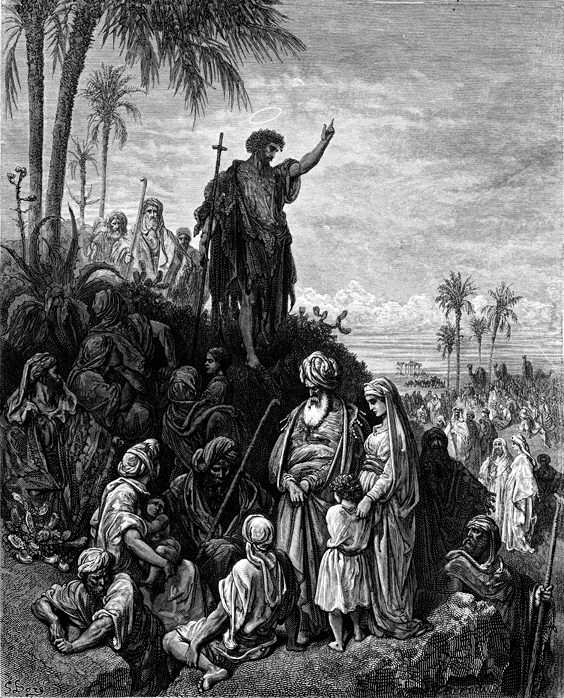
in Matthew 3People went out to him from Jerusalem and all Judea and the whole region around the Jordan.
BSB
The same verse in ASV and KJV ▾
ASV
Then went out unto him Jerusalem, and all Judæa, and all the region round about the Jordan;
KJV
Then went out to him Jerusalem, and all Judea, and all the region round about Jordan,
⋯
This verse in Matthew 3
Commentary
17 notes on this verseThe preacher of Christ is clad in the skins of unclean beasts, to which the Gentiles are compared, and so by the Prophets' dress is sanctified whatever in them was useless or unclean. The girdle is a thing of much efficacy to every good work, that we may be girt for every ministry of Christ.
This site's exposition
from Jerusalem and all Judea
on Matthew 3:5-6
People went out "from Jerusalem and all Judea and the whole region around the Jordan," a response without match since the earlier prophets. John's washing stands apart from the proselyte baptism of Gentile converts and the washings at Qumran, since here Israelites confess their sins in public, entering the river Joshua crossed into the land. The scale of the response shows how deeply the nation felt the silence of prophecy since Malachi.
The record, by era
The Church Fathers4 voices
The baptism of John bare a figure of the catechumens. As children are only catechized that they may become meet for the sacrament of Baptism; so John baptized, that they who were thus baptized might afterwards by a holy life become worthy of coming to Christ's baptism. He baptized in Jordan, that the door of the Kingdom of Heaven might be there opened, where an entrance had been given to the children of Israel into the earthly kingdom of promise.
Having described the preaching of John, he goes on to say, There went out to him, for his severe life preached yet more loudly in the desert than the voice of his crying. Compared with the holiness of John, who is there that can think himself righteous? As a white garment if placed near snow would seem foul by the contrast; so compared with John every man would seem impure; therefore they confessed their sins. Confession of sin is the testimony of a conscience fearing God. And perfect fear takes away all shame. But there is seen the shame of confession where there is no fear of the judgment to come. But as shame itself is a heavy punishment, God therefore bids us confess our sins that we may suffer this shame as punishment; for that itself is a part of the judgment.
A commentator
John ChrysostomHomily on the Gospel of Matthew 10 · Written in the 5th century.
proposed
"Then went out to him all Judea, and Jerusalem, and all the region round about Jordan, and were baptized of him, confessing their sins." Seest thou how great power was in the coming of the prophet? how he stirred up all the people; how he led them to a consideration of their own sins? For it was indeed worthy of wonder to behold him in human form showing forth such things and using so great freedom of speech, and rising up in condemnation of all as children, and having his great grace beaming out from his countenance. And, moreover, the appearance of a prophet after the great interval of time contributed to their amazement, because the gift had failed them, and returned to them after a long time. And the nature of his preaching too was strange and unusual. For they heard of none of those things to which they were accustomed; such as wars and battles and victories below, and famine and pestilence, and Babylonians and Persians, and the taking of the city, and the other things with which they were familiar, but of Heaven and of the kingdom there, and of the punishment in hell. And it was for this cause, let me add, that although they that committed revolt in the wilderness, those in the company of Judas, and of Theudas, had been all of them slain no great while before, yet they were not the more backward to go out thither. For neither was it for the same objects that he summoned them, as for dominion, or revolt, or revolution; but in order to lead them by the hand to the kingdom on high. […]
When the crowds heard of his manner of life, far surpassing normal human life, they longed to see him. For this reason, when they heard that John was nearby, they all simultaneously ran to him, as to "a man sent from God." They confessed their …
The Medieval Church1 voice
Rightly are they who are to be baptized said to go out to the Prophet; for unless one depart from sin, and renounce the pomp of the Devil, and the temptations of the world, he cannot receive a healing baptism. Rightly also in Jordan, which means their descent, because they descended from the pride of life to the humility of an honest confession. Thus early was an example given to them that are to be baptized of confessing their sins and professing amendment.
10 more voices on this verse
The Medieval Church3 voices
(interlin.) This baptism was only a forerunning of that to come, and did not forgive sinsd.
Then went out to him Jerusalem, and all Judea, and all the region round about Jordan. And they were baptized by him in the Jordan, confessing their sins. They were baptized, but the baptism of John did not have the power to forgive sins; for …
Then he treats of baptism; hence he says, "then went out to him." And he touches on three things: first, how he is visited by the crowds; secondly, how they are baptized; thirdly, how they confessed their sins. In regard to the first it should …
The Puritans and the Awakening2 voices
Then went out to him Jerusalem,.... The uncommon appearance of this person, the oddness of his dress, the austerity of his life, together with the awfulness and importance of his doctrine, and the novelty of the ordinance of baptism he administered, and the Jews having had no prophet for some hundreds of years, and imagining he might be the Messiah, quickly drew large numbers of people to him. Some copies read "all Jerusalem": that is, the inhabitants of that city, a very large number of them; and "all Judea", a great number of people from all parts of that country.
This gave John a great opportunity of doing good, and was an evidence that God was with him. Now people began to crowd and press into the kingdom of heaven ( Luke xvi. 16 ); and a blessed sight it was, to see the dew of the youth dropping from the womb of the gospel-morning ( Ps. cx.
quarantine:debris (2026-07-29) — unbalanced-parens
The Nineteenth Century5 voices
A commentator
Albert Barnes1798–1870
Notes, Explanatory and Practical, on the Old and New Testaments (1832-1869)
Jerusalem - The people of Jerusalem. All Judea - Many people from Judea. It does not mean that literally all the people went, but that great multitudes went. It was general. Jerusalem was in the part of the country called Judea. Judea was situated on the west side of the Jordan. See the notes at Mat 2:22. Region about Jordan - On the east and west side of the river. Near to Jordan.
These verses describe the ministry of John the Baptist, the forerunner of our Lord Jesus Christ: it is a ministry that deserves close attention. Few preachers ever produced such effects as John the Baptist: “There went out to him Jerusalem and all Judea and all the region round about Jordan.”None ever received such praise from the great head of the church: Jesus called him “a burning and a shining light” ( John 5:35 ); the great Bishop of souls Himself declared, that “among them that are born of women there hath not risen a greater than John the Baptist.”
A commentator
Jamieson, Fausset & Brown1802–1910
Commentary Critical and Explanatory on the Whole Bible (1871)
proposed
Then went out to him Jerusalem, and all Judea, and all the region round about Jordan--From the metropolitan center to the extremities of the Judean province the cry of this great preacher of repentance and herald of the approaching Messiah brought trooping penitents and eager expectants.
These verses describe the ministry of John the Baptist, the forerunner of our Lord Jesus Christ: it is a ministry that deserves close attention. Few preachers ever produced such effects as John the Baptist: “There went out to him Jerusalem and all Judea and all the region round about Jordan.”None ever received such praise from the great head of the church: Jesus called him “a burning and a shining light” ( John 5:35 ); the great Bishop of souls Himself declared, that “among them that are born of women there hath not risen a greater than John the Baptist.” Let us then study the leading features of his ministry. John the Baptist spoke plainly about sin . He taught the absolute necessity of repentance before anyone can be saved; he preached that repentance must be proved by its “fruits”he warned men not to rest on outward privileges, or outward union with the church. This is just the teaching that we all need. We are naturally dead, and blind, and asleep in spiritual things; we are ready to content ourselves with a mere formal religion and to flatter ourselves that if we go to church we shall be saved: we need to be told that, except we “repent and are converted” we shall all perish. John the Baptist spoke plainly about our Lord Jesus Christ . He taught people that one “mightier than himself” was coming among them. He was nothing more than a servant: the coming one was the King. He himself could only baptize with water: the coming one could “baptize with the Holy Ghost,” take away sins, and would one day judge the world. This again is the very teaching that human nature requires. We need to be sent direct to Christ: we are all ready to stop short of this; we want to rest in our union with the church, our regular use of the sacraments, and our diligent attendance on an established ministry. We need to be told the absolute necessity of union with Christ himself by faith.
Jordan - Many of the best MSS. and versions, with Mar 1:5, add ποταμω, the river Jordan; but the definitive article, with which the word is generally accompanied, both in the Hebrew and the Greek, is, sufficient; and our article the, which should ever be used in the translation, expresses the force of the other.
The words behind it
15 Greek wordsEvery Greek word of this verse in the order it stands, with what it means and the door to its own study. The last column counts the times a word stands in the whole Bible: the rarer the word, the more the places it appears belong together.
| Greek | Sound | Meaning | Word study | In the Bible |
|---|---|---|---|---|
| Τότε | tote | At that time | G5119 → | 160 times |
| ἐξεπορεύετο | exeporeueto | were going out | G1607 → | 33 times |
| πρὸς | pros | to | G4314 → | 700 times |
| αὐτὸν | auton | him | G846 → | 5565 times |
| Ἱεροσόλυμα | hi'erosoluma | Jerusalem | G2414 → | 62 times |
| καὶ | kai | and | G2532 → | 9120 times |
| πᾶσα | pasa | all | G3956 → | 1235 times |
| ἡ | he | <the> | G3588 → | 19766 times |
| Ἰουδαία | ioudaia | Judea | G2449 → | 44 times |
| καὶ | kai | and | G2532 → | 9120 times |
| πᾶσα | pasa | all | G3956 → | 1235 times |
| ἡ | he | the | G3588 → | 19766 times |
| περίχωρος | perichoros | region around | G4066 → | |
| τοῦ | tou | the | G3588 → | 19766 times |
| Ἰορδάνου, | iordanou | Jordan, | G2446 → | 15 times |
ΤότεAt that time
toteG5119 →160 times
ἐξεπορεύετοwere going out
exeporeuetoG1607 →33 times
πρὸςto
prosG4314 →700 times
αὐτὸνhim
autonG846 →5565 times
ἹεροσόλυμαJerusalem
hi'erosolumaG2414 →62 times
καὶand
kaiG2532 →9120 times
πᾶσαall
pasaG3956 →1235 times
ἡ<the>
heG3588 →19766 times
ἸουδαίαJudea
ioudaiaG2449 →44 times
καὶand
kaiG2532 →9120 times
πᾶσαall
pasaG3956 →1235 times
ἡthe
heG3588 →19766 times
περίχωροςregion around
perichorosG4066 →
τοῦthe
touG3588 →19766 times
Ἰορδάνου,Jordan,
iordanouG2446 →15 times
A shaded row is a word that stands 400 times or fewer in the Bible.
The walk
8 stopsEach card is a verse this one points to, and under it the verses that one points to in turn. Where several paths arrive at the same place, that place is listed first: the text keeps returning to it.
Through
Luke 16:16The Law and the Prophets were proclaimed until John. Since that time, the gospel of the kingdom of God is being preached, and everyone is forcing his way into it.
it leads to
- Matthew 11:9–14
What then did you go out to see? A prophet? Yes, I tell you, and more than a prophet.
- Matthew 21:32
For John came to you in a righteous way and you did not believe him, but the tax collectors and prostitutes did. And even after you saw this, you did not repent and believe…
- Acts 3:24–25
Indeed, all the prophets from Samuel on, as many as have spoken, have proclaimed these days.
- Matthew 3:2
and saying, “Repent, for the kingdom of heaven is near.”
- Luke 7:26–29
What then did you go out to see? A prophet? Yes, I tell you, and more than a prophet.
- Matthew 11:9–14
Through
Luke 3:7Then John said to the crowds coming out to be baptized by him, “You brood of vipers, who warned you to flee from the coming wrath?
it leads to
- Matthew 23:33
You snakes! You brood of vipers! How will you escape the sentence of hell?
- Matthew 23:33
Through
John 5:35John was a lamp that burned and gave light, and you were willing for a season to bask in his light.
it leads to
- 2 Peter 1:19
We also have the word of the prophets as confirmed beyond doubt. And you will do well to pay attention to it, as to a lamp shining in a dark place, until the day…
- 2 Peter 1:19
Through
Mark 1:5People went out to him from all of Jerusalem and the countryside of Judea. Confessing their sins, they were baptized by him in the Jordan River.
it leads to
- Leviticus 26:40–42
But if they will confess their iniquity and that of their fathers in the unfaithfulness that they practiced against Me, by which they have also walked in hostility toward Me—
- Leviticus 26:40–42
Where this verse is studied
On this page
Studies5
On this verse
About Matthew
Who and where
1 name in this verse with a page on the site.
This page draws on 16 works. Open the list of works
This page draws on Adam Clarke, Commentary on the Bible; Albert Barnes, Notes, Explanatory and Practical, on the Gospels; Albert Barnes, Notes, Explanatory and Practical, on the Old and New Testaments (1832-1869); Glossa Ordinaria, Catena Aurea by Aquinas; Hilary of Poitiers, Catena Aurea by Aquinas; J.C. Ryle, Expository Thoughts on the Gospels: Matthew; Jamieson, Fausset & Brown, Commentary Critical and Explanatory on the Whole Bible; John Chrysostom, Homily on the Gospel of Matthew 10; John Gill, Exposition of the New Testament (1746-1748); Matthew Henry, Commentary on the Whole Bible; Pseudo-Chrysostom, Catena Aurea by Aquinas; Rabanus Maurus, Catena Aurea by Aquinas; Remigius of Rheims, Catena Aurea by Aquinas; Theodore of Heraclea, FRAGMENT 13.28; Theophylact of Ohrid, Commentary on Matthew and Thomas Aquinas, Commentary on Matthew.