
Judgeschapter 4
24 verses · BSBJudges book hub →
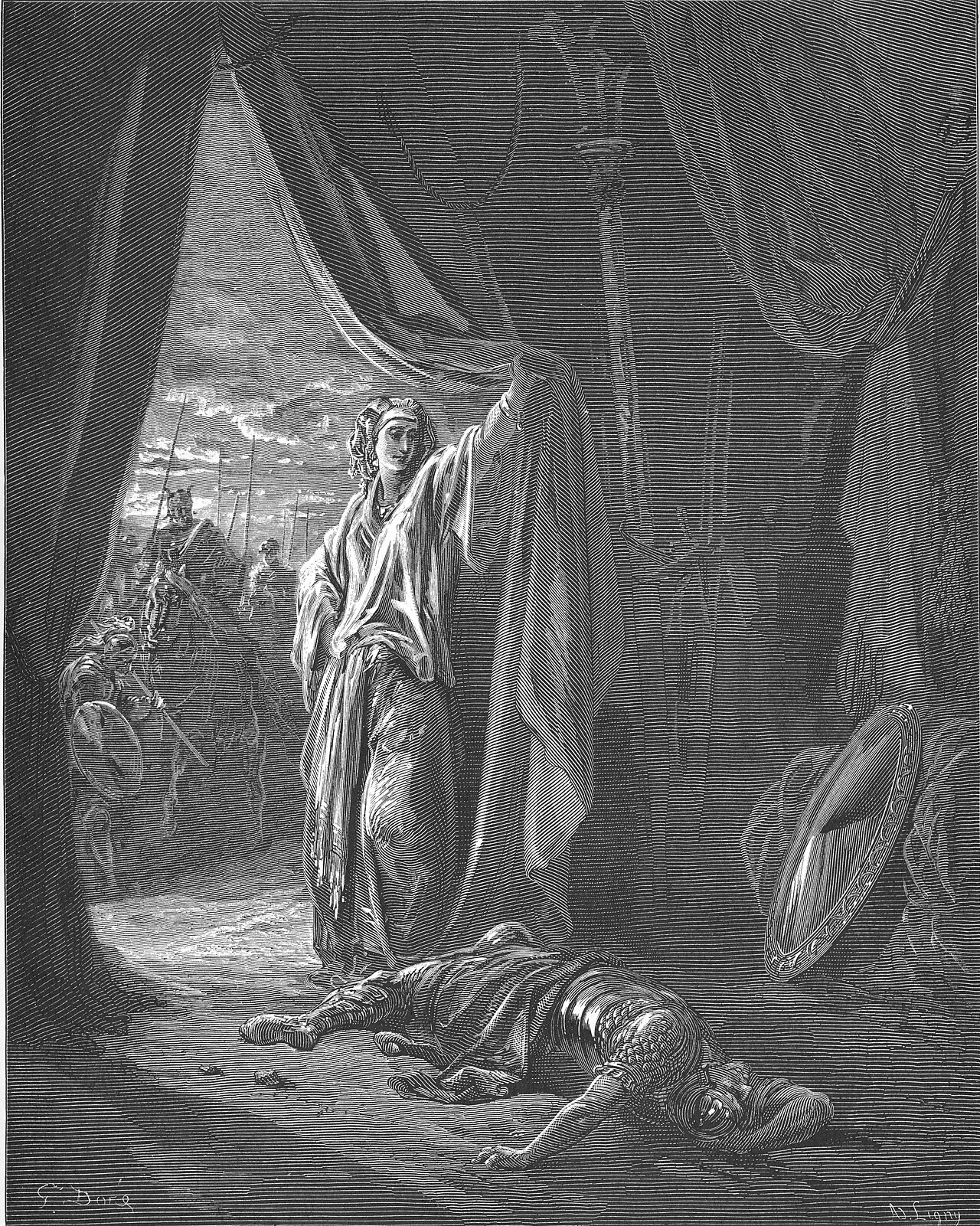
Jael Kills Sisera, Gustave Doré, Doré's English Bible (1866), public domain
Key verse
Now Deborah, a prophetess, the wife of Lappidoth, was judging Israel at that time.
It stands in scene A of the chapter, verses 1 to 10.
The chapter
Chapter summary
Jabin of Hazor oppresses Israel with nine hundred chariots of iron, and Deborah, a prophetess, is judging Israel under her palm tree between Ramah and Bethel. She summons Barak with a word already given: draw ten thousand to Mount Tabor, and Jehovah will draw Sisera to the river Kishon. Barak answers, 'If thou wilt go with me, then I will go; but if thou wilt not go with me, I will not go', and Deborah grants it with a warning that the honor of the day will go to a woman. Sisera's host is discomfited before the sword; he flees on foot to the tent of Jael, who gives him milk, covers him, and drives the tent-pin through his temples.
Context
History · Samuel · Judges overview
Where the chapter sits
Judges 4 falls in The twelve judges (chapters 3–16). Othniel, Ehud, Shamgar, Deborah, Gideon, Tola, Jair, Jephthah, Ibzan, Elon, Abdon, Samson (and Abimelech as anti-judge). Seven oppression-deliverance cycles.
Deborah, Barak, Jael. The prophetess judge; Sisera fleeing on foot; Jael with the tent-peg.
Before it: Incomplete conquest; programmatic cycle, chapters 1–2. After it: Appendix: diagnosis of Israel, chapters 17–21.
The whole shape of Judges→The world behind this chapter
Judges 4The history
The valley of Jezreel is the flat heart of the north, the corridor every army between Egypt and Mesopotamia used. It is also the one place in Israel where chariots could be used to full effect. Sisera's nine hundred iron-fitted chariots were not a garrison; they were a field army, and they made the valley a no-go zone for a people who fought on foot.
The rest of the history, and what it meant to them
Deborah sits under a palm and people come up to her for judgment. That is an open-air court: no building, no bench, a known landmark on a known road, with a recognized arbitrator hearing disputes in public where the whole town could see whether the ruling was fair. Her second role, prophetess, is the one that summons Barak.
Mount Tabor is a round, steep hill rising abruptly out of the plain, and it is the whole tactic. Chariots cannot climb it. Ten thousand men on its slopes are a threat Sisera has to answer, and the only way to answer is to draw up along the Kishon at its foot.
The Kishon is a seasonal stream. Most of the year it is a dry, cracked bed; in a downpour it becomes a bog that swallows wheels to the axle. Chapter 5 will say the stars fought and the torrent swept them away, the chariot advantage turned into a chariot trap.
Jael's tent is not a bystander's tent. Kenite metalworkers moved with the clans, and among nomads the women pitched and struck the tents, which is why a woman had a mallet in her hand and knew exactly how hard to drive a peg. Offering a fugitive milk and a covering placed him under the household's protection, which is what makes what follows a violation of the deepest rule of the desert.
What it meant to them
For hearers in the north this was the day the valley was opened. Twenty years of being confined to the hills ended in a single afternoon storm.
The chapter also puts two women at the center of a war story, one who summons the general and one who kills the enemy commander, while the man with the army has to be talked into going. Barak gets his victory but not the honor, exactly as he was warned.
Sources cited
- Yigael Yadin, The Art of Warfare in Biblical Lands in the Light of Archaeological Study
- John H. Walton, Victor H. Matthews, and Mark W. Chavalas, The IVP Bible Background Commentary: Old Testament
A. Deborah sends for Barak; he will not go alone
1. (vv. 1-3)
a.This is the fourth of the seven times the book says it, at 2:11, 3:7, 3:12, 4:1, 6:1, 10:6 and 13:1. The oppressor reigns in Hazor, the city Joshua 11:10-11 says Joshua took and burnt with fire, and readers differ over whether Jabin is a throne name carried by a later king or a house rebuilt on the old ground, with Adam Clarke taking the second man for a descendant of the first. Nine hundred chariots of iron answers Judges 1:19, where Judah could not drive out the valley because the inhabitants had chariots of iron, and the phrase falls four times in the whole Bible, at Joshua 17:16, Judges 1:19, and twice in this chapter. The cry of verse 3 is the third of six in the book, after 3:9 and 3:15.
Judges 4:1, 1 voiceWhat preachers and commentators have said about this verse, in their own words.
Judges 4:1
“When Ehud was dead - Why not when Shamgar was dead? Does this not intimate that Shamgar was not reckoned in the number of the judges?”
Adam Clarke· Commentary on the Bible (1810-1826)evangelical
Judges 4:2, 2 voices
Judges 4:2
“Jabin king of Canaan - Probably a descendant of the Jabin mentioned Jos 11:1, etc., who had gathered together the wrecks of the army of that Jabin defeated by Joshua. Calmet supposes that these Canaanites had the dominion over the tribes of Naphtali, Zebulun, and Issachar; while Deborah judged in Ephraim, and Shamgar in Judah.”
Adam Clarke· Commentary on the Bible (1810-1826)evangelical
Judges 4:2
“Of the Gentiles - So called, because it was much frequented and inhabited by the Gentiles; either by the Canaanites, who being beaten out of their former possessions, seated themselves in those northern parts; or by other nations coming there for traffick, whence Galilee, where this was, is called Galilee of the Gentiles.”
John Wesley· Explanatory Notes upon the Old Testament (1765)evangelical
Judges 4:3, 1 voice
Judges 4:3
“Oppressed - The same word is used Exo 3:9 of the oppression of Israel by the Egyptians. If they were put to task-work in hewing timber, their condition was very like that of their ancestors making bricks.”
2. (vv. 4-5)
a.Deborah, a prophetess, the wife: Deborah is the second woman in Scripture called a prophetess, after Miriam at Exodus 15:20, and like Miriam she sings the victory in the chapter that follows. She is the one judge in the book shown doing what the word ordinarily means, since the people come up to her for judgment before any deliverer is raised. Her palm stands between Ramah and Bethel in mount Ephraim, which is the hill country in the middle of the land, while the man she summons and the war she sends him to are both far north. Genesis 35:8 buries another Deborah, the nurse of Rebekah, under an oak at that same Bethel.
Judges 4:4, 2 voices
Judges 4:4
“Because these nations have come as enemies against your people, let us hear what judgment the psalmist calls down upon them. "Deal with them as with Midian; as with Sisera." You have read the book of Judges; this is that Midian whom Gideon defeated. "As with Sisera and Jabin." Jabin and Sisera are the foes whom Deborah and Barak conquered. "At the torrent Kishon, who perished at Endor." Deborah and Barak destroyed Sisera, the general of the army. So much for what Scripture says; learn now what it means.”
Jerome· written before 420· HOMILIES ON THE PSALMS 15 (Ps 82)patristic
Judges 4:4
“Deborah, a prophetess - One on whom the Spirit of God descended, and who was the instrument of conveying to the Israelites the knowledge of the Divine will, in things sacred and civil. She judged Israel - This is, I believe, the first instance of gynaecocrasy, or female government, on record. Deborah seems to have been supreme both in civil and religious affairs; and Lapidoth, her husband, appears to have had no hand in the government. But the original may as well be translated a woman of Lapidoth, as the wife of Lapidoth.”
Adam Clarke· Commentary on the Bible (1810-1826)evangelical
Judges 4:5, 1 voice
Judges 4:5
“She dwelt - Rather, “she sat,” namely, to judge the people Jdg 4:10, but not in the usual place, “the gate” Rth 4:1-2; Pro 22:22. It suited her character, and the wild unsafe times better, that she should sit under a palm-tree in the secure heights of Mount Ephraim, between Ramah and Bethel (Jdg 20:33 note). This verse shows that the Judges exercised the civil as well as military functions of rulers 1Sa 7:15-17.”
3. (vv. 6-7)
a.Deborah gives Barak no new order and instead asks whether he already has one, hath not the Lord God of Israel commanded, so the word had reached him and had not moved him. The two tribes called are Naphtali and Zebulun, and Isaiah 9:1 names the land of Zebulun and the land of Naphtali as the country first afflicted, which Matthew 4:15 quotes as Zabulon and Nephthalim of the ground where Christ began to preach. Tabor is a hill and the Kishon is a riverbed, and the plan puts the footmen on the high ground and draws the chariots down to the low.
Judges 4:6, 2 voices
Judges 4:6
“Hath not the Lord God of Israel commanded?--a Hebrew form of making an emphatic communication. Go and draw toward mount Tabor--an isolated mountain of Galilee, northeast corner of the plain of Esdraelon. It was a convenient place of rendezvous, and the enlistment is not to be considered as limited to ten thousand, though a smaller force would have been inadequate.”
Jamieson, Fausset & Brown· Commentary Critical and Explanatory on the Whole Bible (1871)reformed
Judges 4:6
“Kedesh Naphtali - So called, to distinguish it from other places of that name, one in Judah, and another in Issachar. Hath not the Lord, &c. - That is, assuredly God hath commanded thee; this is not the fancy of a weak woman, which peradventure thou mayst despise; but the command of the great God by my mouth.”
John Wesley· Explanatory Notes upon the Old Testament (1765)evangelical
Judges 4:7, 1 voice
Judges 4:7
“The brook or stream Kishon (Nahr Mukutta), so called from its winding course, caused by the dead level of the plain of Esdraelon through which it flows, rises, in respect to one of its sources or feeders, in Mount Tabor, and flows nearly due west through the plain, under Mount Carmel, and into the Bay of Acre.”
4. (vv. 8-9)
a.Barak will go only if she goes, and the readings of that condition are old and they differ. Jamieson, Fausset and Brown take the request for an eastern commander carrying what he most trusts into the field, while Albert Barnes reads a weakness of faith at the start and sets Barak beside Gideon, Moses and Peter, who each asked for a sign. Hebrews 11:32 names Barak in the roll of faith and says nothing of the condition. Deborah grants it and names the cost, that the honour of the day goes to a woman, and her verb is sell, the same word verse 2 used when the Lord sold Israel into the hand of Jabin.
Judges 4:8, 2 voices
Judges 4:8
And lastly, her son Barak shows the chief part of the victory was in the hands of a woman when he said, "If you will not go with me I will not go, because I do not know on what day the Lord will send his angel with me." How great, then, was the might of that woman to whom the leader of the army says, "If you will not go I will not go."
Ambrose of Milan· written before 397· Concerning Widows 8.43-46patristic
Judges 4:8
“I will not go - His offer to go with her, shews the truth of his faith, for which he is praised, Hebrew xi, 32, but his refusal to go without her, shews the weakness of his faith, that he could not trust God's bare word, as he ought to have done, without the pledge of the presence of his prophetess.”
John Wesley· Explanatory Notes upon the Old Testament (1765)evangelical
Judges 4:9, 1 voice
Judges 4:9
“Mark the unhesitating faith and courage of Deborah, and the rebuke to Barak’s timidity, “the Lord shall sell Sisera into the hand of a woman” (Jael, Jdg 4:22). For a similar use of a weak instrument, that the excellency of the power might be of God, compare the history of Gideon and his 300, David and his sling, Shamgar and his ox-goad, Samson and the jawbone of the ass. (See 1Co 1:26, 1Co 1:31.) Barak would probably think the woman must be Deborah. The prophecy was only explained by its fulfillment.”
5. (v. 10)
Judges 4:10-11
a.The ten thousand go up at his feet, which is footmen against nine hundred chariots on ground the chariots own. Heber is planted before he is needed, and the narrator stops the march to pitch one tent by Kedesh. He is a Kenite of the children of Hobab, the father in law of Moses, so the household that ends this war descends from the kin who came into the land with Judah at Judges 1:16 and then moved north alone.
Judges 4:10, 1 voice
Judges 4:10
“Ten thousand at his feet - That is, who followed him; possibly he intimates that they were all foot-men; and so this is emphatically added, to signify by what contemptible means God overthrew Sisera's great host.”
John Wesley· Explanatory Notes upon the Old Testament (1765)evangelical
B. Nine hundred chariots of iron swept away
1. (v. 11)
Judges 4:11, 2 voices
Judges 4:11
“Now Heber the Kenite,.... A descendant of Kain, a principal man among the Midianites; the Targum calls him the Salmaean: which was of the children of Hobab the father in law of Moses; who came along with the children of Israel through the wilderness into the land of Canaan, and first settled about Jericho, and then removed into the wilderness of Judah, Jdg 1:16, had severed himself from the Kenites; which dwelt in the said wilderness; to whom he belonged when this separation was made, and on what account is not certain.”
Judges 4:11
“Read, “Heber the Kenitc had severed himself from the Kenites which were of the children of Hobab,” etc., “unto the oak (or terebinth tree) in Zaanaim” (or Bitzaanaim, which Conder identifies with Bessum, twelve miles southeast of Tabor, and near Kedesh on the Sea of Galilee). This migration of Heber the Kenite, with a portion of his tribe, from the south of Judah to the north of Naphtali, perhaps caused by Philistine oppression, had clearly taken place recently.”
2. (vv. 12-13)
a.Sisera hears and brings every chariot he has down from Harosheth to the Kishon, which puts iron wheels into a riverbed at the foot of Tabor. The prose account gives no reason for what becomes of them, and the song in chapter 5 gives two: 5:20 says the stars in their courses fought against Sisera, and 5:21 says the river of Kishon swept them away. Both accounts of the one battle stand in the book, the narrative keeping the mechanism out of sight while the poem names it.
3. (vv. 14-16)
a.Deborah gives the order as a report rather than a promise, this is the day in which the Lord hath delivered Sisera into thine hand, with the verb already past. The word discomfited at verse 15 falls nine times in the King James Bible, and the Lord is its subject at Joshua 10:10 and 1 Samuel 7:10, where great stones from heaven and a great thunder do the work. Barak goes down off the hill to meet chariots on the flat, which is the ground Judah could not hold at 1:19, and verse 16 says there was not a man left. The man with nine hundred chariots finishes the day on foot.
Judges 4:14, 2 voices
Judges 4:14
“Up; for this is the day - This is exactly the purpose for which the Septuagint state, Jdg 4:8, that Barak wished Deborah to accompany him. “I know not,” says he, “The Day in which God will send his angel to give me prosperity: come thou with we that thou mayest direct me in this respect.” She went, and told him the precise time in which he was to make the attack: Up, for This is the Day in which the Lord hath delivered Sisera into thine hand.”
Adam Clarke· Commentary on the Bible (1810-1826)evangelical
Judges 4:14
“Barak went down from mount Tabor--It is a striking proof of the full confidence Barak and his troops reposed in Deborah's assurance of victory, that they relinquished their advantageous position on the hill and rushed into the plain in face of the iron chariots they so much dreaded.”
Jamieson, Fausset & Brown· Commentary Critical and Explanatory on the Whole Bible (1871)reformed
Judges 4:15, 3 voices
Judges 4:15
“Lighted down off his chariot - Probably his chariot stuck in the morass (see the note at Jdg 4:7); or he might leave his chariot in order to mislead his pursuers, and in hope of gaining a place of safety while they were following the track of the chariot-wheels and the bulk of the host.”
Judges 4:15
“Discomfited - With great terror and noise, as the word signifies, probably with thunder and lightning, and hail-stones, poured upon them from heaven, as is implied, chap. v, 20. Edge of the sword - That is, by the sword of Barak and his army, whose ministry God used; but so, that they had little else to do, but to kill those whom God by more powerful arms had put to flight.”
John Wesley· Explanatory Notes upon the Old Testament (1765)evangelical
Judges 4:15
“Josephus says that a violent storm of hail which beat in their faces gave them this rout, disabled them, and drove them back; so that they became a very easy prey to the army of Israel, and Deborah's words were made good: " The Lord has delivered them into thy hand; it is now in thy power to do what thou wilt with them." V.”
Matthew Henry· Commentary on the Whole Bible (1707-1721)puritan
Judges 4:16, 2 voices
Judges 4:16
“But Barak pursued after the chariots, and after the host, unto Harosheth of the Gentiles,.... The place from whence they came, and to which they endeavoured to escape: but he followed them, so close all that way, and made such havoc of them, that all the host of Sisera fell upon the edge of the sword, and there was not a man left; no, not one, excepting Sisera, as in Jdg 4:17; or "even to one" (l), as in the original text; not one escaped to Hazor to acquaint Jabin of the loss of his army.”
Judges 4:16
“What with the overflowing of the Kishon Jdg 5:21, by which numbers were drowned, and the panic which had seized the defeated army, and made them an easy prey to the sword of the pursuing Israelites, Sisera’s whole force was cut to pieces and broken up.”
C. A tent peg through the temples
1. (vv. 17-18)
a.to the tent of Jael: The peace between Jabin and the house of Heber is stated before Sisera reaches the tent, so the reader is told why he runs to that door. Adam Clarke notes that a man would not enter the women's quarters without leave, which made it the one place a pursuer would pass by. Jael goes out to meet him, tells him to fear not, and covers him with a mantle, which is what a host does for a guest.
Judges 4:17, 1 voice
Judges 4:17
“Sisera fled . . . to the tent of Jael--According to the usages of nomadic people, the duty of receiving the stranger in the sheik's absence devolves on his wife, and the moment the stranger is admitted into his tent, his claim to be defended or concealed from his pursuers is established.”
Jamieson, Fausset & Brown· Commentary Critical and Explanatory on the Whole Bible (1871)reformed
Judges 4:18, 1 voice
Judges 4:18
“Jael went out to meet Sisera - He preferred the woman’s tent because of secrecy; for, according to the etiquette of the eastern countries, no person ever intrudes into the apartments of the women. And in every dwelling the women have a separate apartment.”
Adam Clarke· Commentary on the Bible (1810-1826)evangelical
2. (vv. 19-21)
a.a little water to drink: He asks for water and is given milk, which 5:25 tells again as butter in a lordly dish, and Adam Clarke observes that giving more than was asked increased his confidence. The nail and the hammer are the gear of the tent, and pitching and striking a tent was women's work in a nomad camp, so the weapon is what was already in her hand. Serious readers stand apart on the act itself: Jamieson, Fausset and Brown call the taking of his life murder, Matthew Henry holds that she acted under a divine impulse as Ehud did in the chapter before, and Albert Barnes weighs the treachery of that age against her faith in Israel's right and gives her the praise he thinks due. Judges 5:24 blesses her above women in the tent, and this chapter reports the deed and passes no sentence on it.
Judges 4:19, 1 voice
Judges 4:19
“She opened a bottle of milk - She gave more than he requested; and her friendship increased his confidence and security.”
Adam Clarke· Commentary on the Bible (1810-1826)evangelical
Judges 4:20, 1 voice
Judges 4:20
“And he said unto her, stand in the door of the tent,.... This he said, not in an imperious way, as some think, but by entreaty: and it shall be, when any man shall come and inquire of thee; seeing her at the door, and where he desired she would stand to prevent their coming into the tent: and say, is there any man here? any besides what belongs to the family? or any of Sisera's army? that thou shalt say, no; there is no man; but to this she made no answer that is recorded.”
Judges 4:21, 3 voices
Judges 4:21
“If we can overlook the treachery and violence which belonged to the morals of the age and country, and bear in mind Jael’s ardent sympathies with the oppressed people of God, her faith in the right of Israel to possess the land in which they were now slaves, her zeal for the glory of Yahweh as against the gods of Canaan, and the heroic courage and firmness with which she executed her deadly purpose, we shall be ready to yield to her the praise which is her due. See Jdg 3:30 note.”
Judges 4:21
“Then Jael took a nail of the tent--most probably one of the pins with which the tent ropes are fastened to the ground. Escape was almost impossible for Sisera. But the taking of his life by the hand of Jael was murder.”
Jamieson, Fausset & Brown· Commentary Critical and Explanatory on the Whole Bible (1871)reformed
Judges 4:21
“A nail of the tent - Wherewith they used to fasten the tent, which consequently was long and sharp. This might seem a very bold attempt, but it must be considered, that she was encouraged to it, by observing that the heavens and all the elements conspired against him, as one devoted to destruction.”
John Wesley· Explanatory Notes upon the Old Testament (1765)evangelical
3. (vv. 22-24)
a.Barak arrives to be shown the man he came for, and the word of verse 9 is discharged in front of him. Albert Barnes holds that Barak would have taken the woman of that prophecy for Deborah, and that the saying was explained only by its fulfilment. Verse 23 makes God the subject of the victory, and verses 23 and 24 name Jabin three times in two sentences as the twenty years of verse 3 are worked off. The formula the land had rest is withheld until 5:31, where it falls for the third and last time in the book and never returns.
Judges 4:22, 1 voice
Judges 4:22
“Behold, Sisera lay dead - What impression this made on the victorious Barak is not said: it could not give him much pleasure, especially when he learned the circumstances of his death.”
Adam Clarke· Commentary on the Bible (1810-1826)evangelical
Judges 4:24, 1 voice
Judges 4:24
“The hand of the children of Israel prospered - ותלך הלוך vattelech haloch, it went, going - they followed up this victory, and the consequence was, they utterly destroyed Jabin and his kingdom. It will naturally be expected that something should be said to justify the conduct of Jael: it must be owned that she slew Sisera in circumstances which caused the whole transaction to appear exceedingly questionable. They are the following: - 1. There was peace between her family and the king of Canaan.”
Adam Clarke· Commentary on the Bible (1810-1826)evangelical
The text of this chapter
This page carries no textual note on Judges 4. Where this site has examined a place the manuscripts differ, the examination is in the manuscripts room. Every place this site examines →
This page draws on 9 works. Open for the list.
This page draws on Adam Clarke; Albert Barnes; Ambrose of Milan, Concerning Widows 8.43-46; Jamieson, Fausset & Brown; Jerome, HOMILIES ON THE PSALMS 15 (Ps 82); John Gill; John Wesley, Explanatory Notes upon the Old Testament (1765); Keil and Delitzsch, Biblical Commentary on the Old Testament: Joshua, Judges, Ruth and Matthew Henry.
Keep studying
On this page
Studies4
On this book