
Judges 4:21
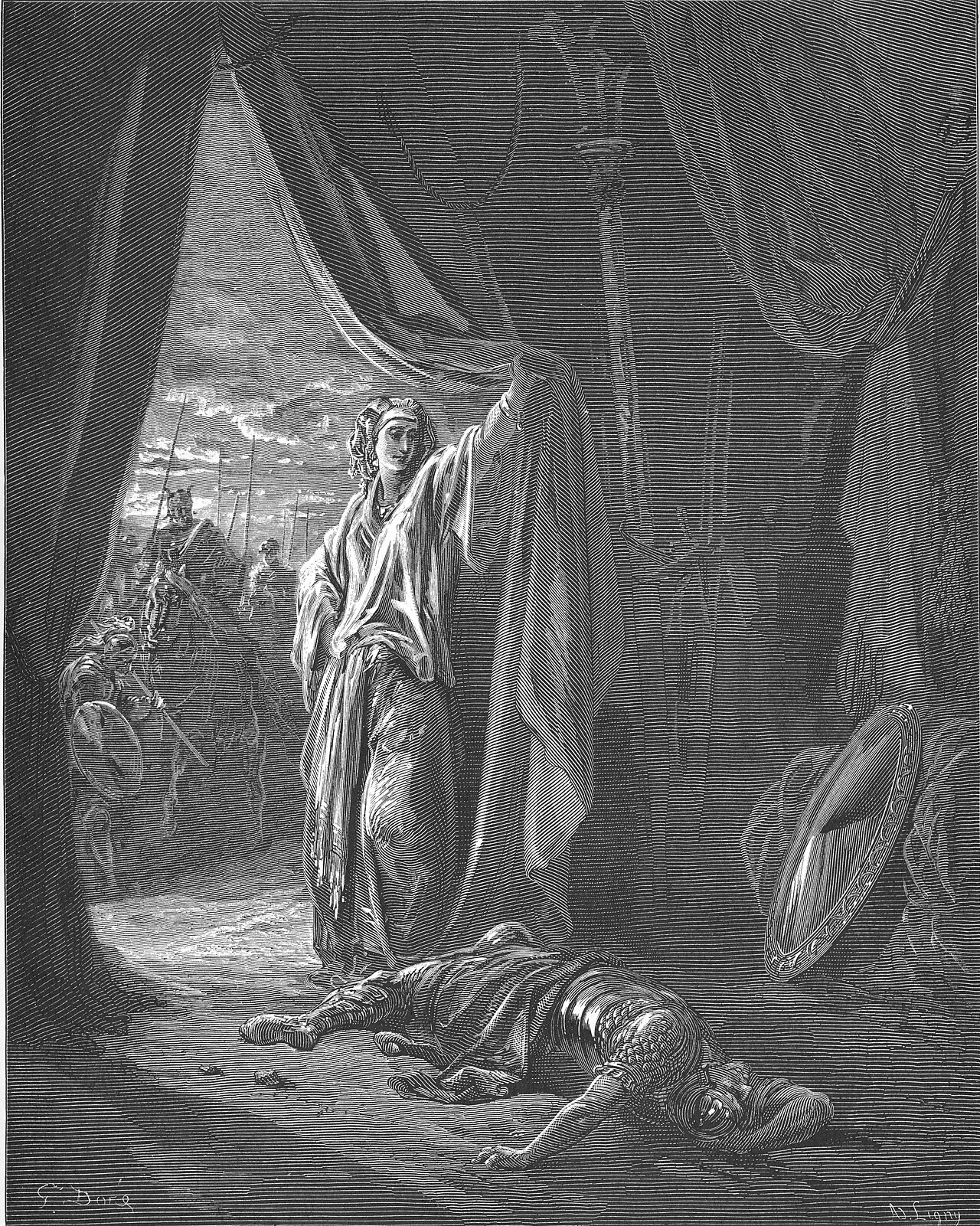
in Judges 4But as he lay sleeping from exhaustion, Heber’s wife Jael took a tent peg, grabbed a hammer, and went silently to Sisera. She drove the peg through his temple and into the ground, and he died.
BSB
The same verse in ASV and KJV ▾
ASV
Then Jael Heber’s wife took a tent-pin, and took a hammer in her hand, and went softly unto him, and smote the pin into his temples, and it pierced through into the ground; for he was in a deep sleep; so he swooned and died.
KJV
Then Jael Heber’s wife took a nail of the tent, and took an hammer in her hand, and went softly unto him, and smote the nail into his temples, and fastened it into the ground: for he was fast asleep and weary. So he died.
⋯
This verse in Judges 4
Commentary
10 notes on this verseA commentator
Albert Barnes1798–1870
Notes, Explanatory and Practical, on the Old and New Testaments (1832-1869)
If we can overlook the treachery and violence which belonged to the morals of the age and country, and bear in mind Jael’s ardent sympathies with the oppressed people of God, her faith in the right of Israel to possess the land in which they were now slaves, her zeal for the glory of Yahweh as against the gods of Canaan, and the heroic courage and firmness with which she executed her deadly purpose, we shall be ready to yield to her the praise which is her due. See Jdg 3:30 note.
This site's exposition
a little water to drink
on Judges 4:19-21
He asks for water and is given milk, which 5:25 tells again as butter in a lordly dish, and Adam Clarke observes that giving more than was asked increased his confidence. The nail and the hammer are the gear of the tent, and pitching and striking a tent was women's work in a nomad camp, so the weapon is what was already in her hand. Serious readers stand apart on the act itself: Jamieson, Fausset and Brown call the taking of his life murder, Matthew Henry holds that she acted under a divine impulse as Ehud did in the chapter before, and Albert Barnes weighs the treachery of that age against her faith in Israel's right and gives her the praise he thinks due. Judges 5:24 blesses her above women in the tent, and this chapter reports the deed and passes no sentence on it.
The record, by era
The Church Fathers3 voices
What, therefore, does the web of all this mystical history show us? The woman Jael, that foreigner about whom Deborah's prophecy said that victory would be had "through the hand of a woman," symbolizes the church, which was assembled from foreign nations. But Jael's name means "ascent," for truly there is no route whereby one may ascend into heaven except "through the church of the manifold wisdom of God." She, therefore, while ascending from the corporeal to the spiritual and from the earthly to the heavenly, killed Sisera, who, as we have already said above, symbolizes the man of carnal or animal vices, for Sisera's name means "vision of a horse," concerning which Scripture teaches: "Do not become like horses and mules, in which there is no understanding." She killed him with a stake, then, which is to say that she overthrew him by the power and cunning of the wood of the cross. Nor is it without reason that the stake is described as having pierced his jaws, for that mouth which spoke of carnal things and that doctrine which preferred the glory of the flesh, deceiving and persuading the human race, by secular wisdom and by the idolatry of comfort, to live for selfish delights and pleasure, that very mouth, I say, is pierced and penetrated by the wood of the cross, in as much as the "broad and easy way" of pleasure which is preached by philosophy has been exposed by Christ, who showed that the "way of our salvation is narrow and difficult." [Thus], Jael the church sent Sisera the king of vices to his everlasting sleep covered with skins, that is, lulled to sleep by the mortification of his members.
We read that when God wished it clearly understood that great deeds were done by him, they were done through a few or through the lowliest, lest the work of his heavenly hand be attributed to human strength. In this way the leader Sisera, before …
So, then, Deborah foretold the event of the battle. Barak, as he was bidden, led forth the army; Jael carried off the triumph, for the prophecy of Deborah fought for her, who in a mystery revealed to us the rising of the church from among the Gentiles, for whom should be found a triumph over Sisera, that is, over the powers opposed to her. For us, then, the oracles of the prophets fought, for us those judgments and arms of the prophets won the victory.
The Puritans and the Awakening2 voices
A nail of the tent - Wherewith they used to fasten the tent, which consequently was long and sharp. This might seem a very bold attempt, but it must be considered, that she was encouraged to it, by observing that the heavens and all the elements conspired against him, as one devoted to destruction.
Then Jael, Heber's wife, took a nail of the tent,....
3 more voices on this verse
The Puritans and the Awakening1 voice
And, as to this act of Jael (like that of Ehud in the chapter before), we have reason to think she was conscious of such a divine impulse upon her spirit to do it as did abundantly satisfy herself (and it ought therefore to satisfy us) that it was well done. God's judgments are a great deep.
The Nineteenth Century2 voices
A commentator
Jamieson, Fausset & Brown1802–1910
Commentary Critical and Explanatory on the Whole Bible (1871)
Then Jael took a nail of the tent--most probably one of the pins with which the tent ropes are fastened to the ground. Escape was almost impossible for Sisera. But the taking of his life by the hand of Jael was murder.
A nail of the tent - One of the spikes by which they fasten to the ground the cords which are attached to the cloth or covering. He was fast asleep and weary - As he lay on one side, and was overwhelmed with sleep through the heat and fatigues of the day, the piercing of his temples must have in a moment put him past resistance.
The words behind it
24 Hebrew wordsEvery Hebrew word of this verse in the order it stands, with what it means and the door to its own study. The last column counts the times a word stands in the whole Bible: the rarer the word, the more the places it appears belong together.
| Hebrew | Sound | Meaning | Word study | In the Bible |
|---|---|---|---|---|
| וַתִּקַּ֣ח | vatikach | and she took | H3947 → | 966 times |
| יָעֵ֣ל | yael | Jael | H3278 → | 6 times |
| אֵֽשֶׁת־ | ʾeshet- | [the] wife of | H802 → | 781 times |
| חֶ֠בֶר | chever | Heber | H2268 → | 11 times |
| אֶת־ | ʾet- | <obj.> | H853 → | 10935 times |
| יְתַ֨ד | yetad | [the] peg of | H3489 → | 25 times |
| הָאֹ֜הֶל | haohel | the tent | H168 → | 345 times |
| וַתָּ֧שֶׂם | vatasem | and she put | H7760 → | 584 times |
| אֶת־ | ʾet- | <obj.> | H853 → | 10935 times |
| הַמַּקֶּ֣בֶת | hamakevet | the hammer | H4718 → | |
| בְּיָדָ֗הּ | beyadah | in hand her | H3027 → | 1618 times |
| וַתָּב֤וֹא | vatavo' | and she went | H935 → | 2568 times |
| אֵלָיו֙ | ʾelav | to him | H413 → | 5510 times |
| בַּלָּ֔אט | balat | in <the> secrecy | H3814 → | |
| וַתִּתְקַ֤ע | vatitka' | and she drove | H8628 → | 69 times |
| אֶת־ | ʾet- | <obj.> | H853 → | 10935 times |
| הַיָּתֵד֙ | haiyated | the peg | H3489 → | 25 times |
| בְּרַקָּת֔וֹ | berakato | in temple his | H7541 → | 5 times |
| וַתִּצְנַ֖ח | vatitznach | and it went down | H6795 → | |
| בָּאָ֑רֶץ | baaretz | in the ground | H776 → | 2504 times |
| וְהֽוּא־ | vehu'- | and he | H1931 → | 1879 times |
| נִרְדָּ֥ם | nirdam | [was] sleeping | H7290 → | |
| וַיָּ֖עַף | vaiyaaf | and he was weary | H5888 → | |
| וַיָּמֹֽת׃ | vaiyamot | and he died | H4191 → | 839 times |
וַתִּקַּ֣חand she took
vatikachH3947 →966 times
יָעֵ֣לJael
yaelH3278 →6 times
אֵֽשֶׁת־[the] wife of
ʾeshet-H802 →781 times
חֶ֠בֶרHeber
cheverH2268 →11 times
אֶת־<obj.>
ʾet-H853 →10935 times
יְתַ֨ד[the] peg of
yetadH3489 →25 times
הָאֹ֜הֶלthe tent
haohelH168 →345 times
וַתָּ֧שֶׂםand she put
vatasemH7760 →584 times
אֶת־<obj.>
ʾet-H853 →10935 times
הַמַּקֶּ֣בֶתthe hammer
hamakevetH4718 →
בְּיָדָ֗הּin hand her
beyadahH3027 →1618 times
וַתָּב֤וֹאand she went
vatavo'H935 →2568 times
אֵלָיו֙to him
ʾelavH413 →5510 times
בַּלָּ֔אטin <the> secrecy
balatH3814 →
וַתִּתְקַ֤עand she drove
vatitka'H8628 →69 times
אֶת־<obj.>
ʾet-H853 →10935 times
הַיָּתֵד֙the peg
haiyatedH3489 →25 times
בְּרַקָּת֔וֹin temple his
berakatoH7541 →5 times
וַתִּצְנַ֖חand it went down
vatitznachH6795 →
בָּאָ֑רֶץin the ground
baaretzH776 →2504 times
וְהֽוּא־and he
vehu'-H1931 →1879 times
נִרְדָּ֥ם[was] sleeping
nirdamH7290 →
וַיָּ֖עַףand he was weary
vaiyaafH5888 →
וַיָּמֹֽת׃and he died
vaiyamotH4191 →839 times
A shaded row is a word that stands 400 times or fewer in the Bible.
The walk
8 stopsEach card is a verse this one points to, and under it the verses that one points to in turn. Where several paths arrive at the same place, that place is listed first: the text keeps returning to it.
Through
1 Corinthians 1:27But God chose the foolish things of the world to shame the wise; God chose the weak things of the world to shame the strong.
it leads to
- James 2:5
Listen, my beloved brothers: Has not God chosen the poor of this world to be rich in faith and to inherit the kingdom He promised those who love Him?
- Matthew 11:25
At that time Jesus declared, “I praise You, Father, Lord of heaven and earth, because You have hidden these things from the wise and learned, and revealed them to little children.
- 1 Corinthians 1:20
Where is the wise man? Where is the scribe? Where is the philosopher of this age? Has not God made foolish the wisdom of the world?
- Psalms 8:2
From the mouths of children and infants You have ordained praise on account of Your adversaries, to silence the enemy and avenger.
- Luke 21:15
For I will give you speech and wisdom that none of your adversaries will be able to resist or contradict.
- James 2:5
Through
Psalms 3:7Arise, O LORD! Save me, O my God! Strike all my enemies on the jaw; break the teeth of the wicked.
it leads to
- Psalms 58:6
O God, shatter their teeth in their mouths; O LORD, tear out the fangs of the lions.
- Job 29:17
I shattered the fangs of the unjust and snatched the prey from his teeth.
- Job 16:10
They open their mouths against me and strike my cheeks with contempt; they join together against me.
- Psalms 58:6
Where this verse is studied
On this page
Studies4
On this verse
About Judges
This page draws on 10 works. Open the list of works
This page draws on Adam Clarke, Commentary on the Bible; Albert Barnes, Notes, Explanatory and Practical, on the Old and New Testaments (1832-1869); Albert Barnes, Notes on the Old Testament; Ambrose of Milan, Concerning Widows 8.47-50; Jamieson, Fausset & Brown, Commentary Critical and Explanatory on the Whole Bible; John Gill, Exposition of the Old Testament (1748-1763); John Wesley, Explanatory Notes upon the Old Testament; Matthew Henry, Commentary on the Whole Bible; Origen of Alexandria, HOMILIES ON JUDGES 5.5 and Salvian the Presbyter, THE GOVERNANCE OF GOD 7.8.