
Judges 4:20
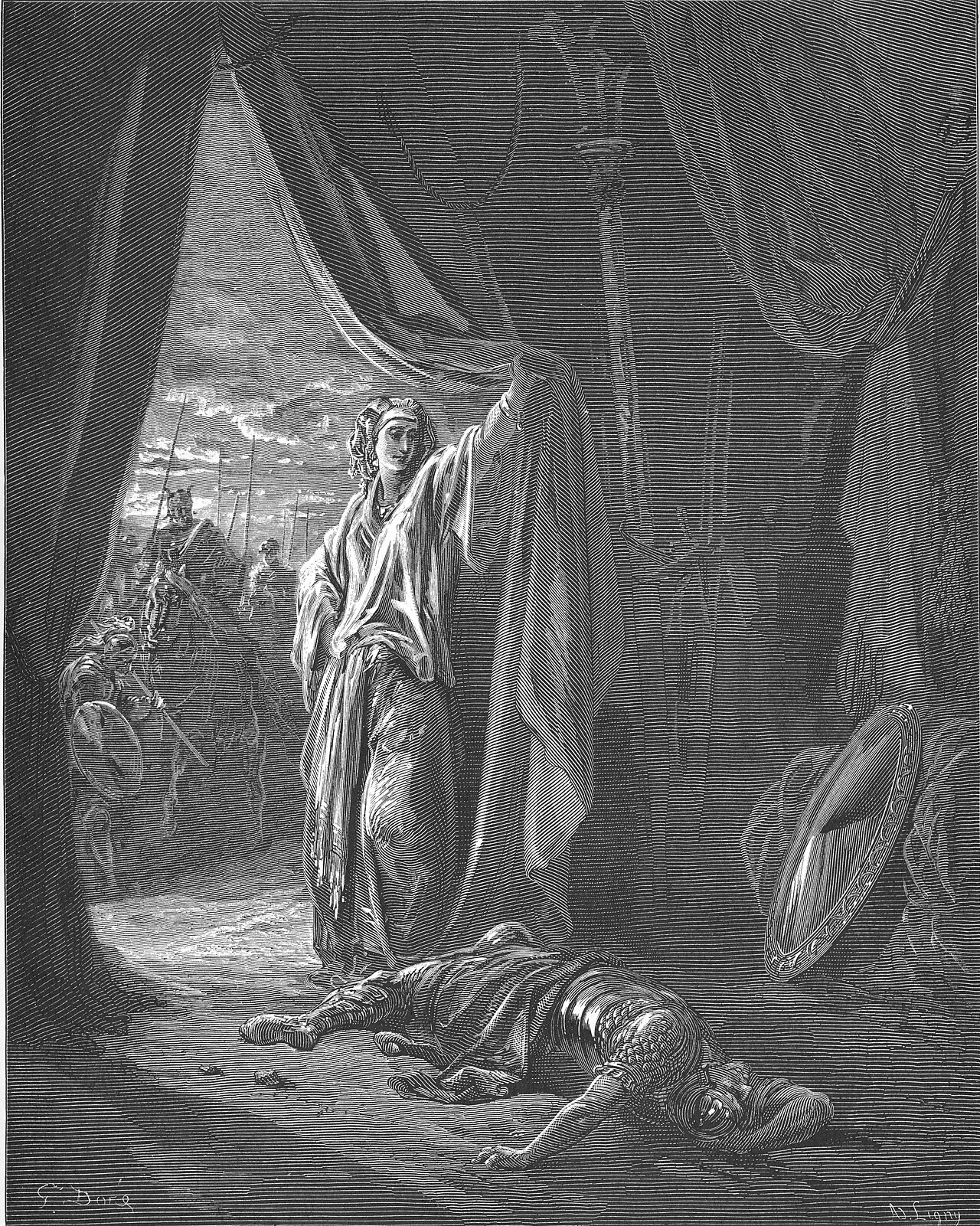
in Judges 4“Stand at the entrance to the tent,” he said, “and if anyone comes and asks you, ‘Is there a man here?’ say, ‘No.’”
BSB
The same verse in ASV and KJV ▾
ASV
And he said unto her, Stand in the door of the tent, and it shall be, when any man doth come and inquire of thee, and say, Is there any man here? that thou shalt say, No.
KJV
Again he said unto her, Stand in the door of the tent, and it shall be, when any man doth come and enquire of thee, and say, Is there any man here? that thou shalt say, No.
⋯
This verse in Judges 4
Commentary
7 notes on this verseAnd he said unto her, stand in the door of the tent,.... This he said, not in an imperious way, as some think, but by entreaty: and it shall be, when any man shall come and inquire of thee; seeing her at the door, and where he desired she would stand to prevent their coming into the tent: and say, is there any man here? any besides what belongs to the family? or any of Sisera's army? that thou shalt say, no; there is no man; but to this she made no answer that is recorded.
This site's exposition
Please give me a little water to drink
on Judges 4:19-21
He asks for water and is given milk, which 5:25 tells again as curds "In a magnificent bowl". Jamieson, Fausset and Brown call the act murder, Matthew Henry holds she acted under a divine impulse as Ehud did, and Albert Barnes weighs that age's treachery against her faith and gives her due praise. Judges 5:24 calls her "Most blessed among women", and this chapter passes no sentence.
This site's exposition
Stand at the entrance to the tent
John Gill hears the request as a plea. He notes that Jael gives no recorded answer to it. When a man does come in verse 22, Jael shows him the man he is seeking.
The record, by era
The Puritans and the Awakening1 voice
We must not sin against God, no, not to oblige those we would show ourselves most observant of. Lastly, We must suppose she kept her tent as quiet as she could, and free from noise, that he might sleep the sooner and the faster. And now was Sisera least safe when he was most secure.
The Nineteenth Century3 voices
A commentator
Jamieson, Fausset & Brown1802–1910
Commentary Critical and Explanatory on the Whole Bible (1871)
proposed
he said unto her, . . . when any man doth come and enquire of thee and say, Is there any man here? that thou shalt say, No--The privacy of the harem, even in a tent, cannot be intruded on without express permission.
quarantine:debris (2026-07-29) — starts-lowercase
Stand in the door of the tent - As no man would intrude into the women’s apartment without permission, her simply saying, there is no man in my tent, would preclude all search.
A commentator
Albert Barnes1798–1870
Notes, Explanatory and Practical, on the Old and New Testaments (1832-1869)
proposed
Stand in the door ... - The characteristic duplicity of the Oriental character, both in Sisera and Joel, is very forcibly depicted in this narrative. It is only by the light of the Gospel that the law of truth is fully revealed.
The words behind it
16 Hebrew wordsEvery Hebrew word of this verse in the order it stands, with what it means and the door to its own study. The last column counts the times a word stands in the whole Bible: the rarer the word, the more the places it appears belong together.
| Hebrew | Sound | Meaning | Word study | In the Bible |
|---|---|---|---|---|
| וַיֹּ֣אמֶר | vaiyomer | and he said | H559 → | 5305 times |
| אֵלֶ֔יהָ | ʾeleiha | to her | H413 → | 5510 times |
| עֲמֹ֖ד | ʾamod | stand | H5975 → | 521 times |
| פֶּ֣תַח | petach | [the] opening of | H6607 → | 164 times |
| הָאֹ֑הֶל | haohel | the tent | H168 → | 345 times |
| וְהָיָה֩ | vehayah | and it will be | H1961 → | 3559 times |
| אִם־ | ʾim- | if | H518 → | 1069 times |
| אִ֨ישׁ | ʾish | anyone | H376 → | 1663 times |
| יָב֜וֹא | yavo' | he will come | H935 → | 2568 times |
| וּשְׁאֵלֵ֗ךְ | usheelekh | and he will ask you | H7592 → | 171 times |
| וְאָמַ֛ר | veamar | and he will say | H559 → | 5305 times |
| הֲיֵֽשׁ־ | hayesh- | ¿ [is] there | H3426 → | 140 times |
| פֹּ֥ה | poh | here | H6311 → | 82 times |
| אִ֖ישׁ | ʾish | anyone | H376 → | 1663 times |
| וְאָמַ֥רְתְּ | veamart | and you will say | H559 → | 5305 times |
| אָֽיִן׃ | ʾayin | no | H369 → | 789 times |
וַיֹּ֣אמֶרand he said
vaiyomerH559 →5305 times
אֵלֶ֔יהָto her
ʾeleihaH413 →5510 times
עֲמֹ֖דstand
ʾamodH5975 →521 times
פֶּ֣תַח[the] opening of
petachH6607 →164 times
הָאֹ֑הֶלthe tent
haohelH168 →345 times
וְהָיָה֩and it will be
vehayahH1961 →3559 times
אִם־if
ʾim-H518 →1069 times
אִ֨ישׁanyone
ʾishH376 →1663 times
יָב֜וֹאhe will come
yavo'H935 →2568 times
וּשְׁאֵלֵ֗ךְand he will ask you
usheelekhH7592 →171 times
וְאָמַ֛רand he will say
veamarH559 →5305 times
הֲיֵֽשׁ־¿ [is] there
hayesh-H3426 →140 times
פֹּ֥הhere
pohH6311 →82 times
אִ֖ישׁanyone
ʾishH376 →1663 times
וְאָמַ֥רְתְּand you will say
veamartH559 →5305 times
אָֽיִן׃no
ʾayinH369 →789 times
A shaded row is a word that stands 400 times or fewer in the Bible.
The walk
5 stopsEach card is a verse this one points to, and under it the verses that one points to in turn. Where several paths arrive at the same place, that place is listed first: the text keeps returning to it.
Through
2 Samuel 17:20When Absalom’s servants came to the woman at the house, they asked, “Where are Ahimaaz and Jonathan?” “They have crossed over the brook,” she replied. The men searched but did not find them, so…
it leads to
- Exodus 1:19
The midwives answered Pharaoh, “The Hebrew women are not like the Egyptian women, for they are vigorous and give birth before a midwife arrives.”
- 1 Samuel 27:11–12
David did not leave a man or woman alive to be brought to Gath, for he said, “Otherwise they will report us, saying, ‘This is what David did.’” And this was David’s custom the…
- 1 Samuel 21:2
“The king has given me a mission,” David replied. “He told me no one is to know about the mission or charge. And I have directed my young men to meet me at a…
- 1 Samuel 19:12–17
So Michal lowered David from the window, and he ran away and escaped.
- Joshua 2:22–23
So the spies went out into the hill country and stayed there three days, until their pursuers had returned without finding them, having searched all along the road.
- Exodus 1:19
Where this verse is studied
About Judges
This page draws on Adam Clarke, Commentary on the Bible; Albert Barnes, Notes on the Old Testament; Albert Barnes, Notes, Explanatory and Practical, on the Old and New Testaments (1832-1869); Jamieson, Fausset & Brown, Commentary Critical and Explanatory on the Whole Bible; John Gill, Exposition of the Old Testament (1748-1763); John Gill, Exposition of the Old Testament and Matthew Henry, Commentary on the Whole Bible.