
Judgeschapter 2
23 verses · BSBJudges book hub →
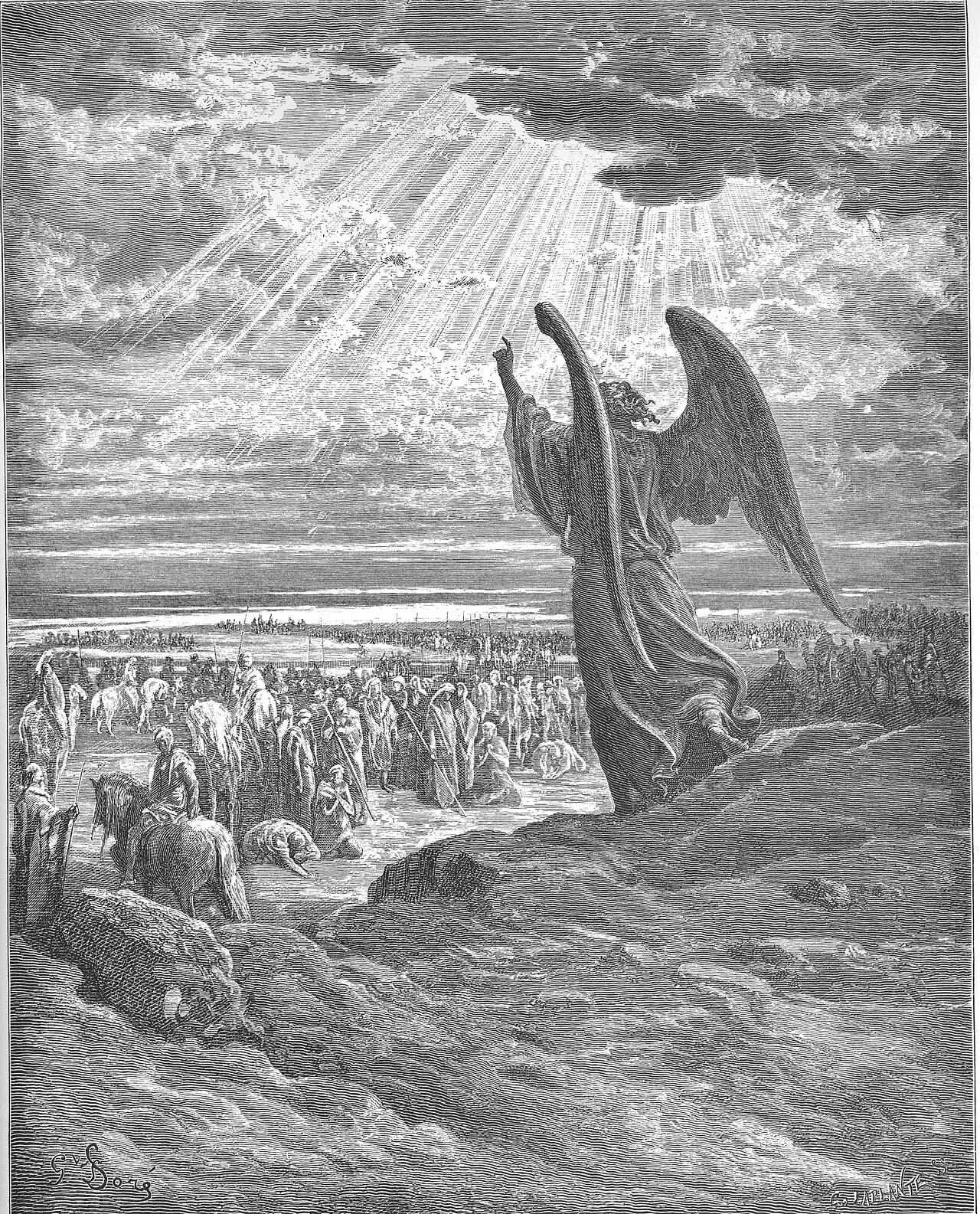
An Angel Appears to the Israelites, Gustave Doré, Doré's English Bible (1866), public domain
Key verse
Now the angel of the LORD went up from Gilgal to Bochim and said, “I brought you up out of Egypt and led you into the land that I had promised to your fathers, and I said, ‘I will never break My covenant with you,
It stands in scene A of the chapter, verses 1 to 5.
The chapter
Chapter summary
The angel of Jehovah goes up from Gilgal to Bochim and delivers the verdict on chapter 1: because Israel made covenants with the land's inhabitants and did not break down their altars, 'they shall be as thorns in your sides, and their gods shall be a snare unto you.' The people weep, hence Bochim, weepers. Joshua's generation is buried, and there arises another generation that knew not Jehovah nor his work. Here the book states its own machinery: they served the Baalim and the Ashtaroth, Jehovah gave them into the hand of spoilers, he raised up judges to save them, and when the judge died they turned back and dealt more corruptly than their fathers.
Context
History · Samuel · Judges overview
Where the chapter sits
Judges 2 falls in Incomplete conquest; programmatic cycle (chapters 1–2). The tribes fail to drive out the Canaanites; the angel at Bochim; the deuteronomic cycle announced as the book's structuring logic.
The cycle announced. ‘There arose another generation after them, which knew not the LORD.’ The deuteronomic cycle made programmatic.
After it: The twelve judges, chapters 3–16.
The whole shape of Judges→The world behind this chapter
Judges 2The history
The angel who goes up from Gilgal to Bochim is retracing the nation's own steps. Gilgal was the camp where Israel first stood in the land after crossing the Jordan, where the men were circumcised and the first Passover in Canaan was eaten. To come from Gilgal with a rebuke is to come from the place where the covenant promises were freshly sworn.
The rest of the history, and what it meant to them
The gods named here were not abstractions. Baal was the storm god who was believed to bring the rain that made barley grow; the Ashtaroth were goddesses of fertility in field, flock, and womb. Farmers in a land with no Nile, dependent entirely on rain that either came in October or did not, had a permanent practical temptation to hedge their bets. Excavated Canaanite shrines from these centuries are full of small figurines and standing stones.
The word usually translated judge covers far more than a courtroom. These men and women were deliverers first, local war leaders raised for a crisis, and arbitrators second. None of them ruled the whole nation, none founded a dynasty except by force, and most acted in one region while the rest of Israel farmed on undisturbed.
The chapter states the pattern the book will repeat: the people abandon the LORD, he hands them to raiders, they cry out, he raises a deliverer, there is rest, and when the deliverer dies they go back and behave worse than before. It is written as a spiral, not a circle.
What it meant to them
For the first hearers this chapter answered the hardest question of their national life: if God gave us this land, why are we constantly overrun in it? The answer given is not that God was weak or that the promise failed, but that the covenant had terms and the terms were being broken.
The line about a generation that did not know the LORD or the work he had done for Israel is aimed straight at parents. One generation failed to hand the story on, and the whole book of disasters follows from it.
Sources cited
- Keil and Delitzsch, Biblical Commentary on the Old Testament: Joshua, Judges, Ruth
- Eugene H. Merrill, Kingdom of Priests: A History of Old Testament Israel
A. The angel at Bochim, the place of weeping
1. (vv. 1-3)
a.The messenger comes from Gilgal, which is where Joshua 5 put the circumcision and the passover, so the rebuke starts from the place the obedience started. He speaks in the first person throughout, I made you to go up out of Egypt, and says I will never break my covenant with you, and then asks a question nobody answers: why have ye done this. The sentence at verse 3 is the exact wording of the warning at Numbers 33:55 and Joshua 23:13, thorns in your sides and their gods a snare, so what falls on Israel is what it was told would fall.
Judges 2:1, 3 voicesWhat preachers and commentators have said about this verse, in their own words.
Judges 2:1
“The angel of the Lord (not an angel). - The phrase is used nearly 60 times to designate the Angel of God’s presence. See Gen 12:7 note. In all cases where “the angel of the Lord” delivers a message, he does it as if God Himself were speaking, without the intervening words “Thus saith the Lord,” which are used in the case of prophets. (Compare Jdg 6:8; Jos 24:2.)”
Judges 2:1
“Bochim - A place so called by anticipation; it seems to be no other than Shiloh, where it is probable, the people were met together upon some solemn festival. I said - That is, I promised upon condition of your keeping covenant with me.”
John Wesley· Explanatory Notes upon the Old Testament (1765)evangelical
Judges 2:1
“The learned bishop Patrick is clearly of opinion that this was not a created angel, but the Angel of the covenant, the same that appeared to Joshua as captain of the hosts of the Lord, who was God himself. Christ himself, says Dr. Lightfoot; who but God and Christ could say, I made you to go up out of Egypt?”
Matthew Henry· Commentary on the Whole Bible (1707-1721)puritan
Judges 2:2, 1 voice
Judges 2:2
“The two articles of the covenant here specified (compare margin references) are those which the Israelites had at this time broken. The other important prohibition Deu 7:3 is not specified by the Angel, and this is an indication that at the time the Angel spoke, intermarriages with the pagan spoken of Jdg 3:6 had not taken place; and this again is another evidence of the early date of this occurrence.”
Judges 2:3, 1 voice
Judges 2:3
“Wherefore I also said” - Rather because ye have done the things mentioned in Jdg 2:2, “I have now said (i. e. I now protest and declare) that I will not drive them out from before you” (compare Jdg 19:29). And it was the annonncement of this resolution by the Angel that caused the people to weep. The word thorns in this verse is supplied by the King James Version from the similar passage in Joshua (see the marginal reference).
2. (vv. 4-5)
a.They weep and they sacrifice, and the place is named Bochim, which means weepers. Nothing is said about throwing down an altar or breaking a league, which is what verse 2 charged them with failing to do. The book's first recorded response to God is grief without amendment, and chapter 3 begins the cycle anyway.
Judges 2:4, 1 voice
Judges 2:4
“Let us consider where he has set his ascent: "In the valley of tears, in the place that he has appointed." We have read in the book of Judges that when the angel came and preached repentance to the people, saying, "You have abandoned the Lord, and the Lord shall abandon you," the Israelites wept aloud when they heard the threat; and that place was called the valley of tears. We have called attention to ancient history in order to avoid heresy.”
Jerome· written before 420· HOMILIES ON THE PSALMS, ALTERNATE SERIES 63 (Ps 83)patristic
Judges 2:5, 1 voice
Judges 2:5
“Bochim - i. e. weepers. It was near Shechem, but the site is unknown. Compare the names given to places for similar reasons in Gen 35:8; Gen 50:11.”
B. A generation arises that knew not Jehovah
1. (vv. 6-7)
a.The narrative reaches back before chapter 1 and repeats Joshua 24:28-31 almost word for word, so the reader is taken to the start again and shown the same events from a different angle. What it adds is the measure of how long the obedience lasted: all the days of Joshua, and all the days of the elders that outlived him. The thing that held them was men who had seen the works with their own eyes.
Judges 2:6, 1 voice
Judges 2:6
“When Joshua had let the people go - The author of this book is giving here a history of the people, from the division of the land by Joshua to the time in which the angel speaks. Joshua divided the land to them by lot; recommended obedience to God, which they solemnly promised: and they continued faithful during his life, and during the lives of those who had been his contemporaries, but who had survived him.”
Adam Clarke· Commentary on the Bible (1810-1826)evangelical
Judges 2:7, 3 voices
Judges 2:7
“It mentions "the days of the elders who knew all the works of the Lord." Who is the person who "knows all the works of the Lord," except the one who does them himself?”
Origen of Alexandria· written before 253· HOMILIES ON JUDGES 1.4patristic
Judges 2:7
“And the people served the Lord all the days of Joshua, and all the days of the elders that outlived Joshua, who had seen all the great works of the Lord that he did for Israel. In Egypt, at the Red sea, in the wilderness, at the river Jordan, and in the land of Canaan; See Gill on Jos 24:31. The Jews (a) say, the elders died on the fifth of Shebet, which answers to part of January and part of February, on which account a fast was kept on that day. (a) Schulchan Aruch, par. 1. c. 580. sect.”
Judges 2:7
“If Joshua was about 80 at the entrance into Canaan, 30 years would bring us to the close of his life. The “elders” would be all that were old enough to take part in the wars of Canaan Jdg 3:1-2; and therefore, reckoning from the age of 20 to 70, a period of about 50 years may be assigned from the entrance into Canaan to the death of the elders, or 20 years after the death of Joshua. The great works of the Lord - The overthrow of the Canaanite nations.”
2. (vv. 8-9)
a.He dies at a hundred and ten, which is the age Genesis 50:26 gives for Joseph and no other man in Scripture. Both men are buried in the same country and Joshua 24:32 records Joseph's bones going into the ground at Shechem in the chapter before this one. The title given him here is the servant of the LORD, which the book of Joshua had reserved for Moses until its last chapter.
Judges 2:8, 2 voices
Judges 2:8
“Joshua's death is also recounted for us. But it is nothing unusual that he who was the "son of Nun" died, for everything that is owed to nature gets paid. Yet, because we have established that what is read here about the son of Nun must be seen as referring to our Lord Jesus Christ, we need to ask how is it befitting to say that "Jesus died." It is my opinion, though speaking according to the authority of Scripture, that Jesus lives in certain persons and is dead in other persons.”
Origen of Alexandria· written before 253· HOMILIES ON JUDGES 2.1patristic
Judges 2:8
“The servant of the Lord - This is a title especially given to Moses Deu 34:5; Jos 1:1. In later books, the phrase “the servant of God” is used 1Ch 6:49; Neh 10:29; Dan 9:11; Rev 15:3. It is applied to Joshua only here and in Jos 24:29. It is spoken of David (Ps. 18, title), and generally of the prophets; and, like the analogous phrase, “man of God,” is transferred by Paul to the ministers of Christ under the New Testament 2Ti 2:24; Jas 1:1.”
Judges 2:9, 1 voice
Judges 2:9
“Yet so much sense they had of their obligations to him that they did him honour at his death, and buried him in Timnath-heres; so it is called here, not, as in Joshua, Timnath-serah. Heres signifies the sun, a representation of which, some think, was set upon his sepulchre, and gave name to it, in remembrance of the sun's standing still at his word.”
Matthew Henry· Commentary on the Whole Bible (1707-1721)puritan
3. (v. 10)
a.One sentence carries the whole distance between Joshua 24 and the rest of this book. There arose another generation after them, which knew not the LORD, nor yet the works which he had done for Israel, and the failure named is not rebellion but ignorance. Deuteronomy 6:7 and Joshua 4:21-24 had both laid the remedy on the parents, and this verse reports what happened where it was not done.
Judges 2:10, 1 voice
Judges 2:10
“And so he comes to give us a general idea of the series of things in Israel during the time of the judges, the same repeated in the same order. The people of Israel forsook the God of Israel, and gave that worship and honour to the dunghill deities of the Canaanites which was due to him alone.”
Matthew Henry· Commentary on the Whole Bible (1707-1721)puritan
C. The cycle named: sin, oppression, cry, deliverer
1. (vv. 11-13)
a.This is the first of seven times the book says it, at 2:11, 3:7, 3:12, 4:1, 6:1, 10:6 and 13:1, and three of those read did evil again, so a reader counting the shorter phrase finds only four. The gods named are Baalim and Ashtaroth, the storm god and the goddess of the surrounding towns, so what draws them is the religion of the neighbours rather than an argument. The verb forsook falls twice in three verses.
Judges 2:11, 2 voices
Judges 2:11
“And the children of Israel - Here begins the narrative of what really did happen “after the death of Joshua,” but of which Judg. 1 conveys no hint. Israel served the Lord all the days of Joshua Jdg 2:7. But when Joshua was dead ... “the children of Israel did evil in the sight of the Lord, and served Baalim, and forsook the God of their fathers.” And then follows from Jdg 2:14 to the end of the chapter, a summary of the whole contents of the book.”
Judges 2:11
“An attentive consideration of them, therefore, is of the greatest importance to a right understanding of the strange and varying phases of Israelitish history, from the death of Joshua till the establishment of the monarchy. served Baalim--The plural is used to include all the gods of the country.”
Jamieson, Fausset & Brown· Commentary Critical and Explanatory on the Whole Bible (1871)reformed
Judges 2:12, 1 voice
Judges 2:12
“As long as a people serves God, they are not "delivered into the hands of plunderers." But when they "abandon the Lord" and begin to serve their own passions, then it is said of them that "God gave them over to shameful passions" and, again, "He gave them over to a reprobate mind, that they would do unsuitable things." Why? Because, he says, "they were filled with every iniquity, wickedness, fornication, greed" and all other evils.”
Origen of Alexandria· written before 253· HOMILIES ON JUDGES 2.5patristic
Judges 2:13, 2 voices
Judges 2:13
“Served Baal and Ashtaroth - In a general way, probably, Baal and Ashtaroth mean the sun and moon; but in many cases Ashtaroth seems to have been the same among the Canaanites as Venus was among the Greeks and Romans, and to have been worshipped with the same obscene rites.”
Adam Clarke· Commentary on the Bible (1810-1826)evangelical
Judges 2:13
“Baal and Ashtaroth - That is, the sun and moon, whom many Heathens worshipped, tho' under divers names; and so they ran into that error which God had so expressly warned them against, Deut. iv, 19. Baalim signifies lords, and Ashtaroth, blessed ones, he-gods and she-gods.”
John Wesley· Explanatory Notes upon the Old Testament (1765)evangelical
2. (vv. 14-15)
a.He sold them into the hands of their enemies, and the word sold treats the nation as property changing owner rather than as an army losing. Verse 15 says the hand of the LORD was against them for evil, as the LORD had said, and as the LORD had sworn, which points back to the curses of Deuteronomy 28 rather than to bad fortune. Their defeats are read as the covenant working exactly as written.
Judges 2:14, 1 voice
Judges 2:14
“The hands of spoilers - Probably marauding parties of the Canaanites, making frequent incursions in their lands, carrying away cattle, spoiling their crops, etc.”
Adam Clarke· Commentary on the Bible (1810-1826)evangelical
3. (vv. 16-17)
a.The word nevertheless is the turn the whole book runs on, and it arrives before anyone has repented. The judges of this book are deliverers rather than men who sit and hear cases, and the text says God raised them up rather than that Israel chose them. Verse 17 adds the thing that makes the pattern worse than a simple cycle: they would not hearken unto their judges either, so the rescue is refused while it is happening.
Judges 2:16, 1 voice
Judges 2:16
“Judges - Supreme magistrates, whose office it was, under God, and by his particular direction, to govern the commonwealth of Israel by God's laws, and to protect and save them from their enemies, to preserve and purge religion, and to maintain the liberties of the people against all oppressors.”
John Wesley· Explanatory Notes upon the Old Testament (1765)evangelical
Judges 2:17, 1 voice
Judges 2:17
“Went a whoring after other gods - Idolatry, or the worship of strange gods, is frequently termed adultery, fornication, and whoredom, in the sacred writings. As many of their idolatrous practices were accompanied with impure rites, the term was not only metaphorically but literally proper.”
Adam Clarke· Commentary on the Bible (1810-1826)evangelical
4. (vv. 18-19)
a.The reason given for the rescue is their groaning rather than their repentance, which the verse says plainly, it repented the LORD because of their groanings. Deliverance lasts exactly as long as the judge lives and no longer. Verse 19 is where the cycle becomes a descent, since they corrupted themselves more than their fathers, so each round starts lower than the last and the book is built on that slope.
Judges 2:18, 1 voice
Judges 2:18
“The Lord was with the judge - God himself was king, and the judge was his representative. It repented the Lord - He changed his purpose towards them: he purposed to destroy them because of their sin; they repented and turned to him, and he changed this purpose. The purpose was to destroy them if they did not repent; when they did repent, his not destroying them was quite consistent with his purpose.”
Adam Clarke· Commentary on the Bible (1810-1826)evangelical
Judges 2:19, 2 voices
Judges 2:19
“When the judge was dead - It appears that in general the office of the judge was for life. Their stubborn way - Their hard or difficult way. Most sinners go through great tribulation, in order to get to eternal perdition; they would have had less pain in their way to heaven.”
Adam Clarke· Commentary on the Bible (1810-1826)evangelical
Judges 2:19
“Returned - To their former, and usual course. Their fathers - In Egypt, or in the wilderness. Their own doings - That is, from their evil practices, which he calls their own, because they were agreeable to their own natures, which in all mankind are deeply and universally corrupted, and because they were familiar and customary to them.”
John Wesley· Explanatory Notes upon the Old Testament (1765)evangelical
5. (vv. 20-23)
a.The nations Joshua left are now left on purpose, and two reasons are given in four verses: as a sentence at verse 21, and as a test at verse 22, that through them I may prove Israel. Joshua 21:45 said there failed not ought of any good thing which the LORD had spoken, and 2:23 says he left those nations and did not deliver them into the hand of Joshua. Both statements stand in the canon, and the readings that hold them together, that God gave what he promised while Israel did not take what was given, or that Joshua speaks of the land as granted rather than as occupied, are old and are named without a verdict.
Judges 2:21, 1 voice
Judges 2:21
“Divine grace ever stirs up the will of human beings, not so as to protect and defend it in all things in such a way as to cause it not to fight by its own efforts against its spiritual adversaries, the victor over whom may set it down to God's grace, and the vanquished to his own weakness, and thus learn that his hope is always not in his own courage but in the divine assistance and that he must ever fly to his Protector.”
John Cassian· written before 435· CONFERENCE 13.14patristic
Judges 2:22, 1 voice
Judges 2:22
“That through them I may prove Israel - There appeared to be no other way to induce this people to acknowledge the true God, but by permitting them to fall into straits from which they could not be delivered but by his especial providence.”
Adam Clarke· Commentary on the Bible (1810-1826)evangelical
Judges 2:23, 2 voices
Judges 2:23
“Without driving them out hastily - Had God expelled all the ancient inhabitants at once, we plainly see, from the subsequent conduct of the people, that they would soon have abandoned his worship, and in their prosperity forgotten their deliverer. He drove out at first as many as were necessary in order to afford the people, as they were then, a sufficiency of room to settle in; as the tribes increased in population, they were to extend themselves to the uttermost of their assigned borders, and expel all the remaining inhabitants.”
Adam Clarke· Commentary on the Bible (1810-1826)evangelical
Judges 2:23
“Our Lord Jesus, though he spoiled principalities and powers, yet did not complete his victory at first. We see not yet all things put under him; there are remains of Satan's interest in the church, as there were of the Canaanites in the land; but our Joshua lives for ever, and will in the great day perfect his conquest.”
Matthew Henry· Commentary on the Whole Bible (1707-1721)puritan
The text of this chapter
This page carries no textual note on Judges 2. Where this site has examined a place the manuscripts differ, the examination is in the manuscripts room. Every place this site examines →
This page draws on 10 works. Open for the list.
This page draws on Adam Clarke; Albert Barnes; Jamieson, Fausset & Brown, Commentary Critical and Explanatory on the Whole Bible (1871); Jerome, HOMILIES ON THE PSALMS, ALTERNATE SERIES 63 (Ps 83); John Cassian, CONFERENCE 13.14; John Gill; John Wesley, Explanatory Notes upon the Old Testament (1765); Keil and Delitzsch, Biblical Commentary on the Old Testament: Joshua, Judges, Ruth; Matthew Henry and Origen of Alexandria.
Keep studying
On this page