
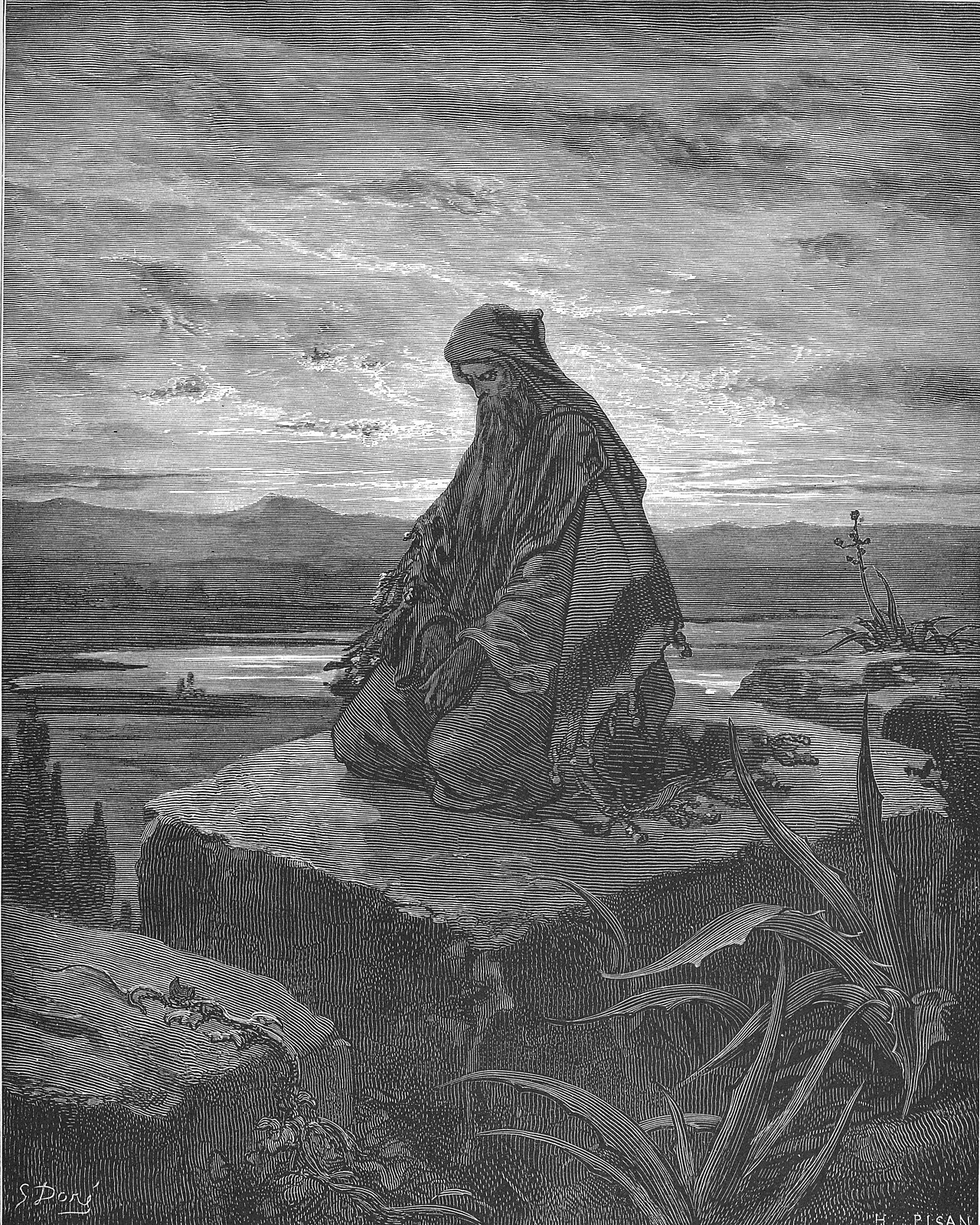
Isaiahchapter 30
33 verses · Isaiah · 8th century BC · The Prophets
This is the burden against the beasts of the Negev: Through a land of hardship and distress, of lioness and lion, of viper and flying serpent, they carry their wealth on the backs of donkeys and their treasures on the humps of camels, to a people of no profit to them.
Introduction
Isaiah, The Prophets, Isaiah Overview.
Isaiah spoke this chapter while Judah's envoys were on the road south to buy help from Egypt. The court had made its plan without asking God, and the public had grown tired of hearing about Him. The prophet was told to write his message down so it could be checked later against what happened. Listen for the offer of rest that the people refused, and for the promise of a teacher who will be heard. The chapter moves between rebuke and mercy several times, and it ends on a fire prepared for Assyria.
Context
- Who
- A government sending envoys, and a public that wanted comfortable preaching
- What
- A woe on the embassy to Egypt, a written witness against a people who wanted pleasant preaching, and a promise of grace that follows the judgment.
- Where
- Jerusalem, and the caravan road south through the Negev to Egypt.
- When
- About 705 to 701 BC, while Hezekiah's court sought an alliance with Egypt against Assyria.
- Why
- To show that trust in Egypt would end in shame, that safety lay in returning to God, and that He still meant to be gracious to His people.
Historical context
The road to Egypt is described by a man who had seen it. It runs south through the Negev, and Isaiah calls it the land of trouble and anguish, of the lioness and the roaring lion, of the viper and the flying serpent, the last being the local name for a fast-striking desert snake. Along it go donkeys with treasure on their backs and camels with valuables on their humps, all of it going to a people who cannot help. That treasure was Judah's gold, on its way to buy a promise.
Show the rest of the historical context, 4 more paragraphs
Isaiah gives Egypt a nickname: Rahab who sits still, or roughly, the loud monster who does nothing. Egypt in these years talked a great deal about what it would do against Assyria and delivered very little.
He is told to write it on a tablet and inscribe it in a book so it will last for the time to come, as a witness forever. Two media, one message, the durable public notice and the archive copy. Prophets did this so that when the thing happened, the date on the record could not be argued with.
The public's request is quoted directly, and it is the most modern-sounding line in the book: do not prophesy to us right things; speak to us smooth things, prophesy deceits, get out of the way, let us hear no more about the Holy One of Israel. That was said out loud, to a preacher's face.
The chapter ends with two burnings. The idols get thrown away like a filthy rag, the plated images with their gold and silver overlay, discarded with disgust. And Topheth is prepared for the king: the burning place in the valley on the south side of Jerusalem, where children had once been offered in fire, now described with its fire pit deep and wide and the breath of the LORD kindling it.
Significance
The heart of the chapter is a sentence the first hearers refused: in returning and rest you shall be saved, in quietness and confidence shall be your strength, and you would not. Then Isaiah adds the detail that makes it sting. They said they would flee on horses, and they would; they said they would ride on swift ones, and their pursuers would be swifter.
Show the rest of the significance, 1 more paragraph
But between the two rebukes sits a promise about a teacher who will not hide anymore, and a voice behind you saying, this is the way, walk in it, when you turn to the right hand or to the left. A nation that would not listen is told that God still intends to be heard.
This chapter in Jewish lifeWhat this chapter is in Jewish life and reading.
What is done
No part of this chapter is read aloud in the synagogue. The site's own table in src/lib/hebraic/readings.ts printed parashot 0 and haftarah uses 0 for Isaiah 30, and no festival reading for the book. The table records Isaiah only as a source of Haftarot, and none of the Haftarot it records reaches this chapter.
The chapter is met instead in the study of the weekly portions, and the corpus names the doors. Under the ninth verse it carries Midrash Tanchuma, Yitro 4:3. Under the seventeenth verse it carries Midrash Tanchuma Buber, Vayera 43:1. Under the twenty-eighth verse it carries Midrash Tanchuma Buber, Pekudei 8:5. Each of those locators is named for the Torah portion whose study it belongs to.
How it is read
Rashi is quoted here from The Judaica Press complete Tanach with Rashi, translated by A. J. Rosenberg, which Sefaria reports as CC-BY, and Ibn Ezra from the Commentary of Ibn Ezra on Isaiah translated by M. Friedlander in 1873, which Sefaria reports as public domain. Rashi fixes the chapter in history at its second verse. Those who go down to Egypt are Hoshea son of Elah and his envoys to So, king of Egypt, as 2 Kings 17:4 records (Rashi on Isaiah 30:2:1). The burden of the beasts of the Negev is the caravan of bribes carried through the desert. The nations mocked it: "See these people, whose burdens of money are laden on their beasts to transport bribes to Egypt for nothing" (Rashi on Isaiah 30:6:1).
The fifteenth verse is the centre of the chapter in his reading. God had told them long before that they need not seek Egypt's strength, "for with tranquility and restfulness you shall have salvation, without any toil, if you listen to Me" (Rashi on Isaiah 30:15:1). Their answer was to buy swift horses in order to flee (Rashi on Isaiah 30:16:1).
The promise that follows reverses the rebuke point by point. The people who told the prophets not to prophesy true things will have ears bent to hear a word behind them, telling them the way (Rashi on Isaiah 30:21:1). The bread of adversity he reads as an end to the feasting that Amos 6:6 condemns (Rashi on Isaiah 30:20:1). Ibn Ezra's one note on the chapter explains the form of the Hebrew noun for trust (Ibn Ezra on Isaiah 30:3:1). The corpus carries twenty-four commentary entries on this chapter, and they reach the twenty-fourth of its thirty-three verses.
What the rabbis say
The corpus carries forty rabbinic locators on this chapter and the text of none, so each is cited by ref here and none is quoted or paraphrased. On the first verse it holds Midrash Lekach Tov, Deuteronomy 29:18:1 and Midrash Tannaim on Deuteronomy 11:17:33. On the second verse it holds Ein Yaakov (Glick Edition), Sotah 7:7. On the third verse it holds Midrash Lekach Tov on Lamentations 4:17:1. On the fourth verse it holds Ein Yaakov (Glick Edition), Ketubot 13:20 and Ein Yaakov, Ketubbot 13:15. On the sixth verse it holds Avot DeRabbi Natan 39:2 and Ein Yaakov, Sanhedrin 11:28.
On the eighth verse it holds Midrash Tehillim 72:2. On the ninth verse it holds Midrash Tanchuma, Yitro 4:3. On the tenth verse it holds Midrash Sekhel Tov, Bereshit 31:7:1 and Midrash Sekhel Tov, Shemot 8:25:6. On the thirteenth verse it holds Otzar Midrashim, Hashkem, Midrash Hashkem ('Arise Early') 16. On the fourteenth verse it holds Bereshit Rabbati, Parashat Vayechi 65 and Esther Rabbah 7:10.
On the fifteenth verse it holds Bamidbar Rabbah 7:10 and Ein Yaakov (Glick Edition), Sanhedrin 11:46. On the sixteenth verse it holds Otzar Midrashim, Baraita of The 32 Midot of Aggadah 1:32 and Shemot Rabbah 18:11. On the seventeenth verse it holds Midrash Tanchuma Buber, Vayera 43:1 and Sifrei Devarim 47:9. On the eighteenth verse it holds Bamidbar Rabbah 11:1 and Bereshit Rabbati, Parashat Bereshit 5. On the nineteenth verse it holds Bamidbar Rabbah 11:6 and Eikhah Rabbah 1:23.
On the twentieth verse it holds Aggadat Bereshit 70:2 and Avot DeRabbi Natan, Recension B 43:17. On the twenty-first verse it holds Aggadat Bereshit 6:1 and Eikhah Rabbah 1:57. On the twenty-second verse it holds Avodah Zarah 47b:3 and Ein Yaakov (Glick Edition), Shabbat 9:1. On the twenty-third verse it holds Bereshit Rabbah 75:8 and Bereshit Rabbah 89:4. On the twenty-fourth verse it holds Jerusalem Talmud Maasrot 1:4:6.
On the twenty-fifth verse it holds Bamidbar Rabbah 14:2. On the twenty-sixth verse it holds Bamidbar Rabbah 13:12. On the twenty-eighth verse it holds Midrash Tanchuma Buber, Pekudei 8:5. On the twenty-ninth verse it holds Aggadat Bereshit 60:1. On the thirty-second verse it holds Pesikta DeRav Kahana 8:4.
On the thirty-third verse it holds Bereshit Rabbah 1:6. What each of them teaches is a saying of the rabbis, and it is reported as theirs wherever this site quotes one. The quotations wait on a fetch that carries the text.
Sources: Rashi, Rashi on Isaiah 30:1:1 to 30:24:1, The Judaica Press complete Tanach with Rashi, translated by A. J. Rosenberg, reported CC-BY; Ibn Ezra, Ibn Ezra on Isaiah 30:3:1 to 30:3:1, Commentary of Ibn Ezra on Isaiah, translated by M. Friedlander, 1873, reported public domain; The Sefaria corpus, scripts/data/sources/sefaria/isaiah/30.json, the 40 Talmud and Midrash locators of this chapter; The site's own files, src/lib/hebraic/readings.ts, printing no portion, no Haftarah and no festival reading for this chapter, and src/data/bible/chapter-verse-counts.json for the verse count.
The heads below are this chapter's scenes. The numbered points under each are its verses.
Rahab That Sitteth Still: Egypt's Useless Help
Isaiah 30:1-3
The woe falls on "rebellious children" who "form an alliance, but against My will". Matthew Henry counted two sins, a treaty made and a God not consulted, for they went down to Egypt "without asking My advice". The shelter they sought in Pharaoh ends as "your shame".
Isaiah 30:1
“Wo, - (see the note at Isa 18:1). To the rebellious children - To those whom he had nourished as children, and who had rebelled against him (see the note at Isa 1:23). That take counsel, but not of me - They look to Egypt, and depend on a human arm. And that cover with a covering - The idea here, according to our translation, is, that they seek protection or a covering from the impending calamity.”
2 more voices on this verseWhat preachers and commentators have said about this verse, in their own words.
Isaiah 30:1
“Cover - That seek protection. But not - Not such as by my spirit, speaking in my word, I have required them to do. That they may add - That unto all their sins, they may add distrust of my power and mercy, and put confidence in an arm of flesh.”
John Wesley · Explanatory Notes upon the Old Testament (1765)evangelical
Isaiah 30:1
“And those that had abused God's mercies to them, making them the fuel of their lusts, abused their afflictions too, making them an excuse for their distrust of God; and so they make bad worse, and add sin to sin; and those that do so, as they make their own chain heavy, so it is just with God to make their plagues wonderful.”
Matthew Henry · Commentary on the Whole Bible (1707-1721)puritan
without asking My advice: The road to Egypt is always a going down in Scripture, from Abraham's famine to the grain bought by Jacob's sons. Barnes took the travellers here to be Judah's envoys, the princes found at Zoan in verse 4. The first fault named is the question never asked.
Isaiah 30:2
“That walk to go down to Egypt - Hebrew, ‘Going in the descent to Egypt.’ That is, they do it by their ambassadors Isa 30:4. The journey to Egypt from Palestine is always represented as going down Gen 12:10; Gen 42:3; Gen 43:15; Num 20:15; Deu 10:22. To strengthen themselves in the strength of Pharaoh - To form an alliance with Pharaoh, that thus they might be able to repel the threatened invasion. Pharaoh was the general name of the kings of Egypt, in the same manner as Caesar was the common name of the emperors of Rome.”
1 more voice on this verse
Isaiah 30:2
“That walk to go down into Egypt,.... That walk out of their own land to go thither; who sent messengers thither to form an alliance, and get help and assistance, or went in person, to secure themselves from present danger. Jarchi refers this to the times of Hoshea, the son of Elah, king of Israel, who sent messengers to So, king of Egypt, 2Ki 17:4. Jerom to the times of Jeremiah, to the history in his prophecy, Jer 41:17 and others to Zedekiah.”
will become your shame: The shelter Judah bought becomes the thing that disgraces it. Barnes saw two ways this could fall out: Egypt might refuse the treaty, or sign it and then fail to defend. Either road ends in the same reproach.
Isaiah 30:3
“And he sets out the effect: and the strength of Pharaoh shall be to your confusion: I will change their glory into shame (Hos 4:7).”
Thomas Aquinas · written before 1274 · Commentary on Isaiahpatristic
1 more voice on this verse
Isaiah 30:3
“Therefore shall the strength of Pharaoh be your shame - (see the note at Isa 20:5). Your confusion - Hebrew, ‘For reproach.’ It would either occur that the Egyptians “would” not enter into an alliance; or that if they did, they “could” not defend them, and in either case it would be the source of deep regret and shame.”
Isaiah 30:4-5
their princes are at Zoan: Judah’s embassy has reached Egypt, for "their princes are at Zoan and their envoys have arrived in Hanes". Everyone in it "will be put to shame because of a people useless to them". The words "have arrived" show, as Albert Barnes noted, that the embassy was already on the road.
Isaiah 30:4
“Hanes - Six MSS. of Kennicott’s, and perhaps six others, with four of De Rossi’s, read חנם chinnam, in vain, for הנס Hanes; and so also the Septuagint, who read likewise יגעו yageu, labored, for יגיעו yaggiu, arrived at.”
Adam Clarke · Commentary on the Bible (1810-1826)evangelical
1 more voice on this verse
Isaiah 30:4
“West of the Nile, in central Egypt: Egyptian Hnes; the Greek Heracleopolis: perhaps the Anysis of HERODOTUS (2.137); according to GROTIUS, Tahpanhes contracted (Jer 43:7-9); the seat of a reigning prince at the time, as was Zoan, hence the Jewish ambassadors go to both.”
Jamieson, Fausset & Brown · Commentary Critical and Explanatory on the Whole Bible (1871)reformed
a people useless to them: Everyone who shared in the embassy shares its shame. Matthew Henry set Egypt beside God as a broken reed beside the Rock of Ages. Hope placed in God keeps its footing, while trust in a creature turns to reproach sooner or later.
Isaiah 30:5
“Those that trust in God, in his power, providence, and promise, are never made ashamed of their hope; but those that put confidence in any creature will sooner or later find it a reproach to them. God is true, and may be trusted, but every man a liar, and must be suspected. The Creator is a rock of ages, the creature a broken reed.”
Matthew Henry · Commentary on the Whole Bible (1707-1721)puritan
1 more voice on this verse
Isaiah 30:5
“And he shows their lack of hope: they were all confounded: put not your trust in princes: in the children of men, in whom there is no salvation (Ps 145:2–3[146:3]).”
Thomas Aquinas · written before 1274 · Commentary on Isaiahpatristic
Isaiah 30:6-7
the burden against the beasts of the Negev: The caravan crosses a desert "of lioness and lion, of viper and flying serpent", carrying wealth "on the backs of donkeys". All of it goes "to a people of no profit to them". The LORD calls Egypt’s help "futile and empty" and names her "Rahab Who Sits Still".
Isaiah 30:6
“The burden - משא massa seems here to be taken in its proper sense; the load, not the oracle. The same subject is continued; and there seems to be no place here for a new title to a distinct prophecy. Does not burden of the beasts of the South in this place relate to the presents sent by Hoshea king of Israel to the South - to Egypt, which lay south of Judea, to engage the Egyptians to succor him against the king of Assyria?”
Adam Clarke · Commentary on the Bible (1810-1826)evangelical
1 more voice on this verse
Isaiah 30:6
“They load the beasts of the south (horses fetched from Egypt, which lay south from Judea) with their riches, fancying, as it is common with people in a fright, that they were safer any where than where they were.”
Matthew Henry · Commentary on the Whole Bible (1707-1721)puritan
Rahab Who Sits Still: Rahab is a name for Egypt at Psalm 87:4 and Isaiah 51:9, and it carries the sense of arrogance. The title mocks a boaster. Jamieson, Fausset & Brown read it of a nation that promised help and then sat still when the test came.
Isaiah 30:7
"Egypt is vanity, and to no purpose will they help" [G. SMITH]. strength--Hebrew, Rabah, a designation for Egypt (Isa 51:9; Ps 87:4), implying her haughty fierceness; translate, "Therefore I call her Arrogance that sitteth still." She who boasted of the help she would give, when it came to the test, sat still (Isa 36:6).
Jamieson, Fausset & Brown · Commentary Critical and Explanatory on the Whole Bible (1871)reformed
1 more voice on this verse
Isaiah 30:7
“For the Egyptians shall help in vain - That is, if they enter into the alliance, they shall not be able to defend you from the invader. The other member of the sentence would seem to imply that they would make promises of aid, and would even boast of being able to deliver them, but that they would fail in their promises. Therefore have I cried - Therefore have I the prophet cried, that is, I do call her so. Concerning this - Concerning this country; that is, Egypt.”
Speak Unto Us Smooth Things, Prophesy Deceits
Isaiah 30:8-9
write it on a tablet in their presence: Isaiah is told to "write it on a tablet in their presence". The reason follows at once: "These are rebellious people, deceitful children, children unwilling to obey the LORD’s instruction". John Gill took the written record as proof for a later generation that the warning had been given.
Isaiah 30:8
“For ever and ever “For a testimony for ever” - לעד leed. So the Syriac, Chaldee, Vulgate, and Septuagint, in MSS. Pachom. and 1. D. 2: εις μαρτυριον, which two words have been lost out of the other copies of the Septuagint.”
Adam Clarke · Commentary on the Bible (1810-1826)evangelical
1 more voice on this verse
Isaiah 30:8
“Let it be written, that it may not be lost; their children may profit by it, though they will not. To justify God in the judgments he was about to ring upon them; people will be tempted to think he was too hard upon them, and over-severe, unless they know how very bad they were, how very provoking, and what fair means God tried with them before he brought it to this extremity.”
Matthew Henry · Commentary on the Whole Bible (1707-1721)puritan
rebellious people, deceitful children: This verse gives the reason the warning of verse 8 had to be written down. Barnes read deceitful children as a charge of broken promise, for Israel had sworn in covenant to take the LORD as its God. Their lie was a vow unkept.
Isaiah 30:9
“That this is a rebellious people - (see the note at Isa 1:2). Lying children - They had promised in solemn covenant to take Yahweh as their God, but they had been unfaithful to their vows.”
Isaiah 30:10-11
Speak to us pleasant words: The people tell the prophets, "Do not prophesy to us the truth", and ask them to "Speak to us pleasant words; prophesy illusions". They go further and tell the prophets to rid them of "the Holy One of Israel". The demand ends with God’s own title removed from their hearing.
Isaiah 30:10
The chief priests and the Pharisees, through the agency of Pilate, sealed the tomb; but the women saw him who was risen.… The chief priests lacked understanding, but the women beheld with their own eyes. When the soldiers came into the city and told the chief priests what had happened, they said to the soldiers, "Say, his disciples came by night and stole him while we were sleeping." Well did Isaiah foretell this also, in their persons: "But tell us, and relate another error."
Cyril of Jerusalem · written before 386 · Catechetical Lecture 14:14patristic
1 more voice on this verse
Isaiah 30:10
No man, professedly, wished to be deceived; but many seek a kind of teaching which is deceit; and which, if they would examine, they might know to be such (1Ki 22:13). The Jews desired success to be foretold as the issue of their league with Egypt, though ill had been announced by God's prophet as the result; this constituted the "deceits."
Jamieson, Fausset & Brown · Commentary Critical and Explanatory on the Whole Bible (1871)reformed
Rid us of the Holy One: The way and the road stand for the true teaching, and in Acts 19 the faith is called the Way. The people ask the seers to leave it. Jamieson, Fausset & Brown observed that God's holiness is what troubles sinners most, so His name is what they most want silenced.
Isaiah 30:11
“Get ye out of the way - Or, rather, ‘Recede from the way;’ or ‘Turn aside from the way.’ The words “way” and “path” are used to denote the true religion, or the true doctrines of God Mat 7:14; Mat 22:16; Joh 14:4; Act 18:26; Act 19:9, Act 19:23; 2Pe 2:15. The request here was that the true prophets would recede from the stern and true precepts of religion, and turn to the ways of falsehood and deceit.”
1 more voice on this verse
Isaiah 30:11
“Depart from the true "way" (so in Ac 19:9, 23) of religion. cause . . . to cease--Let us hear no more of His name. God's holiness is what troubles sinners most.”
Jamieson, Fausset & Brown · Commentary Critical and Explanatory on the Whole Bible (1871)reformed
Isaiah 30:12-14
trusting in oppression and relying on deceit: The people are charged with "trusting in oppression and relying on deceit". Their iniquity becomes "a bulge in a high wall, whose collapse will come suddenly". It breaks like a "potter’s jar", leaving no shard "to scoop the coals from a hearth or to skim the water from a cistern".
Isaiah 30:12
“Observe, [1.] Who it is that gives judgment upon them: Thus saith the Holy One of Israel. That title of God which they particularly excepted against the prophet makes use of. Faithful ministers will not be driven from using such expressions as are proper to awaken sinners, though they be displeasing.”
Matthew Henry · Commentary on the Whole Bible (1707-1721)puritan
1 more voice on this verse
Isaiah 30:12
“In oppression “In obliquity” - בעקש beakesh, transposing the two last letters of בעשק beoshek, in oppression, which seems not to belong to this place: a very probable conjecture of Houbigant.”
Adam Clarke · Commentary on the Bible (1810-1826)evangelical
a bulge in a high wall: The iniquity is the Egypt alliance of verses 1 and 2. Barnes pictured a wall that swells outward for a long time and then gives way all at once. The ruin looks slow and arrives in an instant.
Isaiah 30:13
“Therefore this iniquity - That is, this refusing to trust in Yahweh, and this intention to seek the alliance of Egypt. The general sense of the figure here is, that their depending on Egypt would involve them ultimately in complete and awful ruin - ruin that should come upon them as suddenly as when a wall that had been long swelling out gives way. As a breach ready to fall - Like a breaking forth, or a bursting in a wall.”
shattered so that no fragment can be found: The collapsing wall of verse 13 now becomes a clay jar smashed to bits. Every piece is too small to carry a coal. Barnes read the figure as the whole nation broken, scattered and beyond repair.
Isaiah 30:14
“And he shall break it as the breaking - That is, its breaking shall be like the breaking of a potter’s vessel. The Septuagint reads it, ‘And its fall (τὸ πτῶμα to ptōma) shall be like the breaking of an earthen vessel,’ As the breaking of the potter’s vessel - That is, as an earthen, fragile vessel, which is easily dashed to pieces. The image here is all drawn from the bursting forth, or the complete ruin of the swelling wall; but the sense is, that the Jewish republic would be entirely broken, scattered, demolished.”
Isaiah 30:15-17
The Lord GOD sets His own way: "By repentance and rest you would be saved", and then comes "but you were not willing". The people chose horses, and the LORD answers their own words, "Therefore you will flee". They are left "like a pole on a mountaintop".
Isaiah 30:15
“For thus saith the Lord God - The design of this verse is to give a reason for the destruction that should come upon them. That reason was, that God had indicated to them the path of truth and safety, but they chose not to follow it, and refused to put confidence in him. In returning - In returning to God; that is, if you are converted to him. And rest - That is, by calmly reposing on God for assistance, and not seeking the alliance of Egypt (see Exo 14:13).”
1 more voice on this verse
Isaiah 30:15
“The God that knew them, and knew what was proper for them, and desired their welfare, gave them this prescription; and it is recommended to us all. [1.] Would we be saved from the evil of every calamity, guarded against the temptation of it and secured from the curse of it, which are the only evil things in it?”
Matthew Henry · Commentary on the Whole Bible (1707-1721)puritan
The LORD turns their own word back on them. They meant to ride fast to Egypt for help, and Matthew Henry saw their sin become their punishment, for now they will flee in earnest. Their pursuers will be faster still.
Isaiah 30:16
“But ye said, No - Ye who proposed an alliance with Egypt. For we will flee upon horses - The word ‘flee’ (נוּס nûc), usually signifies to flee before or from any person or thing. But here it seems to have the notion of making a rapid motion in general, and not to refer to the fact that they expected to flee “from” their enemy, for it does not seem to have been a part of their expectation.”
A thousand will flee: The numbers are round on purpose. Barnes took a thousand to mean the whole host and one to mean a force too small to count. What is left of Judah stands alone, as bare as a pole on a mountaintop.
Isaiah 30:17
“When Moses fought against Amalek, it was not with the sword but with prayer that he prevailed. Therefore, if we wish to be lifted up, we must first prostrate ourselves.… We do not understand the prophet's words: "One thousand shall flee at the rebuke of one." We do not cut away the causes of the disease, as we must do to remove the disease itself. Else we should soon see the enemies' arrows give way to our javelins, their caps to our helmets, their saddle horses to our chargers.”
Jerome · written before 420 · LETTER 60.17patristic
This Is the Way, Walk Ye in It
Isaiah 30:18-19
the LORD longs to be gracious to you: After the refusal, "the LORD longs to be gracious to you", for He is "a just God". Albert Barnes noted that His justice and His mercy are named in the same breath. The promise turns concrete for the "people in Zion", "when He hears, He will answer you".
Isaiah 30:18
“And therefore will he be exalted “Even for this shall he expect in silence” - For ירום yarum, he shall be exalted, which belongs not to this place, Houbigant reads ידום yadum, he shall be silent: and so it seems to be in a MS. Another MS. instead of it reads ישוב yashub, he shall return. The mistakes occasioned by the similitude of the letters ד daleth and ר resh are very frequent, as the reader may have already observed.”
Adam Clarke · Commentary on the Bible (1810-1826)evangelical
you will weep no more: The turn from verse 18 is sudden. The same people who refused rest in verse 15 are promised an answer the moment they cry. John Wesley saw a first fulfilment in the return from Babylon and a fuller one in the gospel age.
Isaiah 30:19
“Shall dwell - After a set time, they shall return to Jerusalem, and have a fixed abode. This was in part accomplished upon their return from Babylon; but more fully in the times of the gospel, when many of them were, and the whole body of them shall be brought into Christ's church.”
John Wesley · Explanatory Notes upon the Old Testament (1765)evangelical
Isaiah 30:20-21
The LORD gives "the bread of adversity and the water of affliction", and with it the promise that "your Teacher will no longer hide Himself". Whether they "turn to the right or to the left", a word from behind them says, "This is the way".
Isaiah 30:20
“And though the Lord give you the bread of adversity, and the water of affliction,.... Either at this present time, when the city was besieged by Sennacherib; or when it should be besieged by the Chaldeans, when adversity was their bread, and affliction their water; or when they had only bread and water in their adversity and affliction; or a famine of bread and water, as is common in times of a siege.”
1 more voice on this verse
Isaiah 30:20
“Though the Lord “Though Jehovah” - For אדני Adonai, sixteen MSS. and three editions have יהוה Yehovah, many of De Rossi’s have the same reading; all my own have יהוה Yehovah.”
Adam Clarke · Commentary on the Bible (1810-1826)evangelical
hear this command behind you: The voice comes from behind, like a guide who follows a traveller about to stray. Barnes read it as a warning given whenever the people began to drift from the right path. The Teacher of verse 20 now speaks.
Isaiah 30:21
“And thine ears shall hear a word - A command or admonition. You shall not be left without spiritual guides and directors. Behind thee - That is, says Vitringa, the voice of conscience, as an “invisible” guide, shall admonish you. The idea, however, seems to be that if they were ignorant of the way, or if they were inclined to err, they should be admonished of the true path which they ought to pursue.”
throw them away like menstrual cloths: Once the people turn to the LORD, they desecrate their "silver-plated idols" and "gold-plated images" and throw them away "like menstrual cloths", saying, "Be gone". John Gill noted that the figure takes its force from the uncleanness the law attached to such cloths. So the idols are treated with revulsion.
Isaiah 30:22
Ye shall defile “Ye shall treat as defiled” - The very prohibition of Moses, Deu 7:25, only thrown out of the prose into the poetical form: “The graven images of their gods ye shall burn with fire: thou shalt not desire the silver or the gold that is on them; nor take it unto thee, lest thou be snared therein; for it is an abomination to Jehovah thy God.”
Adam Clarke · Commentary on the Bible (1810-1826)evangelical
2 more voices on this verse
Isaiah 30:22
“Defile - To shew your contempt of it. Covering - The leaves or plates wherewith their images were frequently covered. Ornament - It was a costly and glorious robe.”
John Wesley · Explanatory Notes upon the Old Testament (1765)evangelical
Isaiah 30:22
“It was fulfilled in the body of the Jewish nation at their return from their captivity in Babylon, for they abhorred idols ever after; and it is accomplished daily in the conversion of souls, by the power of divine grace, from spiritual idolatry to the fear and love of God. Those that join themselves to the Lord must abandon every sin, and say unto it, Get thee hence.”
Matthew Henry · Commentary on the Whole Bible (1707-1721)puritan
Isaiah 30:23-26
He will send rain for the seed: The blessing is drawn from farm life: "rain for the seed that you have sown", food "rich and plentiful", cattle in "open pastures". Streams flow from every high hill "in the day of great slaughter, when the towers fall", and the sun’s light becomes "seven times brighter".
Isaiah 30:23
“Then shall he give the rain of thy seed - That is, he shall send rain on the seed which is sown. You will be allowed to cultivate the soil without molestation, and God will give you fruitful seasons and abundant harvests. This is a poetic description of a happy or golden age, when there would be peace and prosperity (compare the notes at Isa 11:6-7). And bread of the increase of the earth - And bread which the ground shall produce.”
2 more voices on this verse
Isaiah 30:23
“Observe, How man's industry and God's blessing concur to the good things we enjoy relating to the life that now is: Thou shalt sow the ground, that is thy part, and then God will give the rain of thy seed, that is his part. It is so in spiritual fruit; we must take pains with our hearts and then wait on God for his grace.”
Matthew Henry · Commentary on the Whole Bible (1707-1721)puritan
Isaiah 30:23
“Bread - Which shall be the fruit of thy own land and labour: and excellent for quality, which is called, fat, Deut. xxxii, 14, and abundant for quantity.”
John Wesley · Explanatory Notes upon the Old Testament (1765)evangelical
will eat salted fodder: Donkeys worked the ground beside oxen in Israel's fields. Salted fodder was a treat for working animals, and Jamieson, Fausset & Brown quote an Arab proverb that calls it sweets for camels. Even the beasts share the plenty.
Isaiah 30:24
“Asses were employed in tillage, as well as oxen (De 22:10). clean--rather, salted provender [GESENIUS]. The Arab proverb is, "Sweet provender is as bread to camels--salted provender as confectionery." The very cattle shall share the coming felicity.”
Jamieson, Fausset & Brown · Commentary Critical and Explanatory on the Whole Bible (1871)reformed
in the day of great slaughter: Water breaks out even on the high dry hills. In Barnes's reading the towers that fall belong to the enemy, most likely the Assyrian army destroyed before Jerusalem. The streams flow once the slaughter is past.
Isaiah 30:25
“In the day of the great slaughter - When the enemies of the people of God shall have been destroyed - probably in a time subsequent to the slaughter of the army of the Assyrians. When the towers fall - The towers of the enemy; perhaps referring here to the towers of Babylon. After they should fall, the Jews would be favored with the time of prosperity to which the prophet here refers.”
1 more voice on this verse
Isaiah 30:25
“Even the otherwise barren hills shall then be well-watered (Isa 44:3). the day, &c.--when the disobedient among the Jews shall have been slain, as foretold in Isa 30:16: "towers," that is, mighty men (Isa 2:15). Or else, the towers of the Assyrian Sennacherib, or of Babylon, types of all enemies of God's people.”
Jamieson, Fausset & Brown · Commentary Critical and Explanatory on the Whole Bible (1871)reformed
Seven marks completeness, so the light stands for a joy that lacks nothing. Adam Clarke took the words like the light of seven days as a margin note, for most copies of the Septuagint lack them. The wounds He heals are the ones He inflicted.
Isaiah 30:26
“Shall be sevenfold - The text adds כאור שבעת הימים keor shibath haiyamayim, “as the light of seven days, “a manifest gloss, taken in from the margin; it is not in most of the copies of the Septuagint. It interrupts the rhythmical construction, and obscures the sense by a false, or at least an unnecessary, interpretation. By moon, sun, light, are to be understood the abundance of spiritual and temporal felicity with which God should bless them in the days of the Messiah, which should be sevenfold, i.e. vastly exceed all that they had ever before possessed.”
Adam Clarke · Commentary on the Bible (1810-1826)evangelical
2 more voices on this verse
Isaiah 30:26
“Light shall increase; that is, knowledge shall increase (when the prophecies are accomplished they shall be fully understood) or rather triumph shall: the light of the joy that is sown for the righteous shall now come up with a great increase.”
Matthew Henry · Commentary on the Whole Bible (1707-1721)puritan
Isaiah 30:26
"Sevenfold" implies the perfection of that felicity, seven being the sacred number. It shall also be literally fulfilled hereafter in the heavenly city (Isa 60:19, 20; 22:5). breach--the wound, or calamity, sent by God on account of their sins (Isa 1:5).
Jamieson, Fausset & Brown · Commentary Critical and Explanatory on the Whole Bible (1871)reformed
The Name of the LORD Comes Burning; Topheth Is Prepared
Isaiah 30:27-28
the Name of the LORD comes from afar: The Name of the LORD is pictured coming "from afar, with burning anger and dense smoke", so that judgment is given a face. He comes "to sift the nations in a sieve of destruction". He bridles the jaws of the peoples "to lead them astray".
Isaiah 30:27
“He is a messenger of wrath, burning with his anger. God's lips are full of indignation at the blasphemy of Rabshakeh, who compared the God of Israel with the gods of the heathen; his tongue is as a devouring fire, for he can speak his proud enemies to ruin; his very breath comes with as much force as an overflowing stream, and with it he shall slay the wicked, ch. xi.”
Matthew Henry · Commentary on the Whole Bible (1707-1721)puritan
2 more voices on this verse
Isaiah 30:27
“Behold, the name of the Lord cometh - (compare the notes at Isa 19:1). The verses following, to the end of the chapter, are designed evidently to describe the destruction of the army of Sennacherib. This is expressly declared in Isa 30:31, and all the circumstances in the prediction accord with that event. There is no necessity of supposing that this is the commencement of a new prophecy, for it is connected with the main subject in the previous part of the chapter. The whole prophecy was composed evidently in view of that threatened invasion.”
Isaiah 30:27
“Behold, the name of the Lord cometh from far,.... From hence to the end of the chapter Isa 30:28 is a very full account, by way of prophecy, of the destruction of the Assyrian army by the Lord; and which is to be considered as a type of the destruction of antichrist, by and at the coming of the Lord Jesus. It is introduced with a "behold", as declaring something of moment and importance worthy of attention, and even wonderful.”
a sieve of destruction: A sieve keeps the grain and drops the dust. This one keeps nothing, and Matthew Henry saw every nation in it found to be chaff. He read the torrent up to the neck as the army drowned while its head, Sennacherib, escaped to fall in the house of his god.
Isaiah 30:28
“To sift the nations with a sieve of vanity “To toss the nations with the van of perdition” - The word להנפה lahanaphah is in its form very irregular. Kimchi says it is for להניף lehaniph. Houbigant supposes it to be a mistake, and shows the cause of it; the joining it to the ה he, which should begin the following word.”
Adam Clarke · Commentary on the Bible (1810-1826)evangelical
1 more voice on this verse
Isaiah 30:28
“The great God can sift nations, for they are all before him as the small dust of the balance; he will sift them, not to gather out of them any that should be preserved, but so as to shake them one against another, put them into great consternation, and shake them all away at last; for it is a sieve of vanity (which retains nothing) that they are shaken with, and they are found all chaff.”
Matthew Henry · Commentary on the Whole Bible (1707-1721)puritan
Isaiah 30:29-30
as on the night of a holy festival: For Judah the same event brings a song. Their hearts are glad like pilgrims going up with a flute "to the mountain of the LORD, to the Rock of Israel". The LORD makes "His majestic voice to be heard" and the anger that threatens Assyria becomes rescue for His people.
Isaiah 30:29
“A song - You shall have songs of praise. The night - He seems to have a particular respect to the solemnity of the passover, in which they spent some considerable part of the night in rejoicing, and singing psalms before the Lord. As when - Like the joy of one that is going up to the solemn feasts with musick.”
John Wesley · Explanatory Notes upon the Old Testament (1765)evangelical
1 more voice on this verse
Isaiah 30:29
“Ye shall have a song,.... That is, the Jews should have a song, and sing it upon the ruin of the Assyrian army; as the Israelites had, when Pharaoh and his host were drowned in the Red Sea; and so will the Christian church have one, at the fall of Babylon, Rev 15:1, as in the night, when a holy solemnity is kept; and gladness of heart, the Jewish feasts always began, the even preceding, and were ushered in with singing songs, and psalms; especially the feast of the passover, which it is thought is alluded to here.”
His majestic voice to be heard: The voice and the arm come together. Matthew Henry observed that angry men often threaten and do nothing, while the voice of the LORD is followed by the blow of His arm. The storm and hail picture the stroke that shatters Assyria in verse 31.
Isaiah 30:30
“The Lord shall cause his glorious voice to be heard - Kimchi understands this of the great destruction of the Assyrian host by the angel of the Lord.”
Adam Clarke · Commentary on the Bible (1810-1826)evangelical
Isaiah 30:31-33
Assyria will be shattered: Assyria falls "at the voice of the LORD". For the king, "Topheth has long been prepared", its pyre "deep and wide, with plenty of fire and wood". Adam Clarke and Albert Barnes noted that the power Judah fled to Egypt to escape stood under a judgment prepared long ago.
Isaiah 30:31
“For through the voice of the - Lord By the command of the Lord; that is, his voice going forth in the manner specified in Isa 30:30. Which smote with a rod - Who was accustomed to smite as with a rod; that is, his government was tyrannical and severe. As he had been accustomed to smite in that manner, so he would now meet the proper reward of his oppression of the nations.”
the tambourines and lyres will sound: Each blow on Assyria is matched by music among the rescued, picking up the festival song of verse 29. Wesley read the rod as one fixed by God's settled purpose. Battle and celebration run side by side.
Isaiah 30:32
“Margin and MAURER construe, "Every passing through (infliction, Isa 28:15) of the appointed rod, which, &c., shall be with tabrets," that is, accompanied with joy on the part of the rescued peoples. battles of shaking--that is, shock of battles (Isa 19:16; compare "sift . . . sieve," Isa 30:28). with it--namely, Assyria.”
Jamieson, Fausset & Brown · Commentary Critical and Explanatory on the Whole Bible (1871)reformed
2 more voices on this verse
Isaiah 30:32
“The rod - Hebrew. the founded rod, the judgment of God, called a founded rod, because it was firmly established, by God's immutable purpose. With harps - Their destruction shall be celebrated by God's people, with joy and musick, and songs of praise. Of shaking - Or, shaking of the hand, of which kind of shaking this Hebrew word is constantly used.”
John Wesley · Explanatory Notes upon the Old Testament (1765)evangelical
Isaiah 30:32
“The grounded staff “The rod of his correction” - For מוסדה musadah, the grounded staff, of which no one yet has been able to make any tolerable sense, Le Clerc conjectured מוסרה musarah, of correction; (see Pro 22:15); and so it is in two MSS., (one of them ancient), and seems to be so in the Bodleian MS.”
Adam Clarke · Commentary on the Bible (1810-1826)evangelical
Topheth has long been prepared: Topheth lay in the Valley of Hinnom, where children had been burned to Molech. Wesley noted that the place came to stand for hell itself. The pyre made ready for the king of Assyria is lit by the breath of the LORD.
Isaiah 30:33
“It may be put, for any place of torment; and particularly it is put for hell. For the king - For the king of Assyria. Fire - He alludes to the ancient custom, of burning sacrifices, and particularly of burning children to Moloch.”
John Wesley · Explanatory Notes upon the Old Testament (1765)evangelical
1 more voice on this verse
Isaiah 30:33
“Now as the prophet, in the foregoing promises, slides insensibly into the promises of gospel graces and comforts, so here, in the threatening of the ruin of Sennacherib's army, he points at the final and everlasting destruction of all impenitent sinners.”
Matthew Henry · Commentary on the Whole Bible (1707-1721)puritan
Keep studying
Sources for this chapter
The summary
Jamieson, Fausset & Brown, Commentary Critical and Explanatory; John Calvin, Commentaries; John Wesley, Notes on the Old Testament and Matthew Henry, Complete Commentary.
The exposition
Adam Clarke, Commentary on the Bible; Albert Barnes; Franz Delitzsch, Biblical Commentary on the Prophecies of Isaiah; Jamieson, Fausset & Brown, Commentary Critical and Explanatory on the Whole Bible; John Calvin, Commentary on the Book of the Prophet Isaiah; John Gill, Exposition of the Old Testament; John Wesley, Explanatory Notes upon the Old Testament; Matthew Henry, Commentary on the Whole Bible and Thomas Aquinas, Commentary on Isaiah.