
Genesischapter 21
34 verses · Moses, by tradition · 15th to 13th century BC · The Law
Then Sarah said, “God has made me laugh, and everyone who hears of this will laugh with me.”
Introduction
Moses, by tradition, The Law, Genesis Overview.
Moses, by tradition, Narrative, The Law, The Abraham cycle, Genesis Overview. Genesis was handed to Israel as the account of how their family began, and this chapter is the hinge of that account. For twenty five years the book has held a promise of a son against a barren tent. The first hearers were that son's descendants, a nation that existed because the promise was kept. The chapter keeps it and then counts the cost in the same household. Listen for the laughter that changes its meaning, for a mother and a boy alone with an empty water skin, and for a new name of God spoken beside a well.
Context
- Who
- Israel in the wilderness, a people who existed because this child was born
- What
- A narrative of the promised son's birth, the sending away of Hagar and Ishmael, and a treaty sworn over a well at Beersheba.
- Where
- Abraham's camp in the Negev, the wilderness of Beersheba and the well at Beersheba.
- When
- The patriarchal age, about 2066 BC on the traditional dating from the ages Genesis gives.
- Why
- To show God keeping His word at the time He had set, and caring for the son who was not the heir.
Historical context
The chapter belongs to four people: Abraham at a hundred, Sarah at ninety, Hagar, and two sons, one newborn and one about seventeen by the ages the book gives.
Show the rest of the historical context, 6 more paragraphs
The date is about 2066 BC on the traditional reckoning for the birth, with the rest of the chapter following over the next few years.
The places are Abraham's camp, the wilderness of Beersheba where Hagar wandered, the wilderness of Paran where Ishmael settled, and Beersheba itself at the edge of the Negev.
The occasion is the birth of the promised son, the feast at his weaning, and what that feast exposed in the household.
A first hearer knew why a weaning feast mattered. Children were commonly weaned at around three years, and a child who reached that point had survived the most dangerous part of infancy, so the feast marked a real achievement rather than a formality.
He also knew the inheritance law in the background of verse 10, since documents of the period deal with exactly this case, the son of a slave woman and the son of a wife, and what each may claim. Sending Hagar away with provisions rather than selling her follows the practice of freeing a slave, and the promise God attaches to Ishmael at verse 13 goes beyond what any custom required.
Water is the subject of the last third. Digging a well in the Negev was expensive labour and seizing another man's well was the standard local injustice, which is the complaint Abraham brings and the reason the seven lambs are set apart in front of witnesses.
Significance
The promise finally had a face. A man of a hundred and a woman of ninety held a son God had named a year before he was conceived.
Show the rest of the significance, 1 more paragraph
For Israel the tamarisk at Beersheba and the oath sworn there marked the first ground their family held by public agreement rather than by hope, after the well itself had been paid for.
This chapter in Jewish lifeWhat this chapter is in Jewish life and reading.
What is done
This chapter is heard inside the fourth portion of the annual cycle, in the same sitting as the visit at the oaks and the binding of Isaac (src/lib/hebraic/readings.ts).
The circumcision of Isaac on the eighth day stands in the fourth verse, and the corpus carries a ruling of practice on it. Radak reports that the sages read the wording as laying the duty on the father. The father is the one commanded to have his son circumcised (Radak on Genesis 21:4:1, referring back to Genesis 17:12). The card above carries the portion and the prophetic reading set beside it.
How it is read
The corpus holds the English text of six comments on this chapter and the reference alone for eighteen more. Radak is quoted from the CC-BY translation of Eliyahu Munk, HaChut Hameshulash.
Radak reads the fifth verse as a check on the reckoning. The age of Abraham at the covenant and the year named for the birth already give the number, and the text sets it down again so that the count is certain (Radak on Genesis 21:5:1).
He reads the two promises about Ishmael as words of comfort. The son of the servant will not perish away from the house, and God says "I will make him develop into a great nation" for his father's sake (Radak on Genesis 21:13:1). At the well he reads the word to Hagar as a command to hold on to the boy, since he will not die of thirst (Radak on Genesis 21:18:1). On the opening of her eyes he gives two plain readings. The well may have stood there all along under a covering that hid it, or it may have been some way off (Radak on Genesis 21:19:1).
Rashi comments on sixteen verses of this chapter, and the corpus holds the text of none of them, because the licence Sefaria reports for that English version keeps it out. They run from Rashi on Genesis 21:1:1 on the visiting of Sarah to Rashi on Genesis 21:23:1 on the oath with Abimelech. They cover the laughter of the sixth verse, the feast at the weaning in the eighth and the mocking in the ninth. They cover the sending away in the fourteenth verse and the crying of the boy in the seventeenth. Ibn Ezra stands on the third verse at Ibn Ezra on Genesis 21:3:1.
What the rabbis say
The corpus records forty places where the Midrash and the Talmud cite this chapter, thirty seven under Midrash and three under Talmud, which is the lightest Talmud weight after Genesis 10. It carries the locator for each one with no text, so the references stand here and the sayings are read at the source.
Bereshit Rabbah reads the third verse at 53:7, the fourth at 60:5, the sixth at 53:8 and the eighth at 48:11. It reads the eleventh verse at 53:12, the fourteenth at 53:13, the twentieth at 53:15 and the twenty second at 54:1. It reads the twenty fourth verse at 54:3, the twenty seventh at 28:5 and the thirtieth at 54:5.
Aggadat Bereshit reads the first verse at 28:1 and 28:2, the second at 28:4 and 37:1, and the ninth at 61:2. It reads the tenth verse at 34:1, the twelfth at 22:2, the twenty first at 37:4 and the thirty third at 13:2. Bereshit Rabbati reads five places in Parashat Vayera and Parashat Lech Lecha, at 25, 23, 43, 22 and 19.
Bamidbar Rabbah reads the thirteenth verse at 19:3, the twenty third at 14:1 and the thirty first and thirty second at 9:47. Eikhah Rabbah reads the crying of the boy at 2:4. Midrash Sekhel Tov reads the eighteenth and thirty second verses at the locators of the same names, and Midrash Lekach Tov reads the third, twenty fifth and twenty sixth at theirs.
The three Talmud locators are Bava Metzia 87a:12 on the seventh verse, Avot DeRabbi Natan in its second recension at 47:6 on the sixteenth, and Jerusalem Talmud Taanit 4:5:19 on the well of the nineteenth.
Sources: Radak, Radak on Genesis 21:4:1, 21:5:1, 21:13:1, 21:18:1, 21:19:1 and 21:24:1, in HaChut Hameshulash, translated by Eliyahu Munk, CC-BY, about 1200; Rashi and Ibn Ezra, their eighteen comments on Genesis 21, cited by reference; the licence Sefaria reports for the English versions keeps the text out of the corpus; The Midrash and the Talmud, the forty locators on Genesis 21 in scripts/data/sources/sefaria/genesis/21.json; MannaFest, the annual cycle table at src/lib/hebraic/readings.ts, 2026.
The heads below are this chapter's scenes. The numbered points under each are its verses.
Isaac, the Son of Laughter
Genesis 21:1-2
the LORD attended to Sarah as He had said: The verse says it twice, as He had said and what He had promised. It stands right after the closed wombs of 20:18. She conceived and bore Abraham a son at the very time God had promised. Her barrenness stood at 11:30, one verse before the promise of descendants at 12:2.
Genesis 21:1
“Isaac was born according to the promise. The Lord visited Sarah in mercy, as he had said. Note, No word of God shall fall to the ground; for he is faithful that has promised, and God's faithfulness is the stay and support of his people's faith.”
Matthew Henry · Commentary on the Whole Bible (1707-1721)puritan
at the very time God had promised: Matthew Henry reads the very time as God keeping His own time, so what God promised came at the time He set, and Henry calls that the best time. Sarah conceived in her old age, and Henry ties it to Hebrews 11, where she received strength by faith. The promise gave the strength.
Genesis 21:2
“Note, God is always punctual to his time; though his promised mercies come not at the time we set, they will certainly come at the time he sets, and that is the best time. He was born by virtue of the promise: Sarah by faith received strength to conceive Heb. xi. God therefore by promise gave that strength.”
Matthew Henry · Commentary on the Whole Bible (1707-1721)puritan
Genesis 21:3-5
Abraham gave the name Isaac: God had given the name Isaac at 17:19, before there was a child. It means he laughs. Isaac is circumcised on the eighth day, as God had commanded at 17:12. Abraham was then a hundred, twenty-five years on from the call at 12:4.
Abraham circumcised him, as God had commanded him: The command was given at 17:12, every male circumcised at eight days old, and Isaac is the first child in Genesis circumcised on that day. Matthew Henry pairs this verse with verse 2. God kept time in keeping the promise, so Abraham keeps time in obeying the precept.
Genesis 21:4
“The covenant being established with him, the seal of the covenant was administered to him; and though a bloody ordinance, and he a darling, yet it must not be omitted, no, nor deferred beyond the eighth day. God had kept time in performing the promise, and therefore Abraham must keep time in obeying the precept.”
Matthew Henry · Commentary on the Whole Bible (1707-1721)puritan
Abraham was a hundred years old: The age is given as part of the wonder. At 17:17 Abraham laughed at the thought of a son born to a man of a hundred and to Sarah at ninety. Paul returns to the number at Romans 4:19, where Abraham, about a hundred years old, faced his own body without weakening in faith.
Genesis 21:5
“And Abraham was an hundred years old when son Isaac was born unto him.”
Genesis 21:6-8
Sarah laughed inside the tent at 18:12 and denied it. Here she says God has made her laugh, and calls everyone to laugh with her. She asks who told Abraham that Sarah would nurse children. The great feast comes on the day Isaac was weaned.
Genesis 21:6
“God hath made me to laugh - Sarah alludes here to the circumstance mentioned Gen 18:12; and as she seems to use the word to laugh in this place, not in the sense of being incredulous but to express such pleasure or happiness as almost suspends the reasoning faculty for a time, it justifies the observation on the above-named verse. See a similar case in Luk 24:41, where the disciples were so overcome with the good news of our Lord’s resurrection, that it is said, They believed not for joy.”
Adam Clarke · Commentary on the Bible (1810-1826)evangelical
Sarah asks who would have told Abraham that she would nurse children, and in Genesis the one who told him was God. Matthew Henry turns her question toward the gospel. He asks the same of God sending His Son to die for sinners.
Genesis 21:7
“Who would have said that God should send his Son to die for us, his Spirit to sanctify us, his angels to attend us? Who would have said that such great sins should be pardoned, such mean services accepted, and such worthless worms taken into covenant and communion with the great and holy God?”
Matthew Henry · Commentary on the Whole Bible (1707-1721)puritan
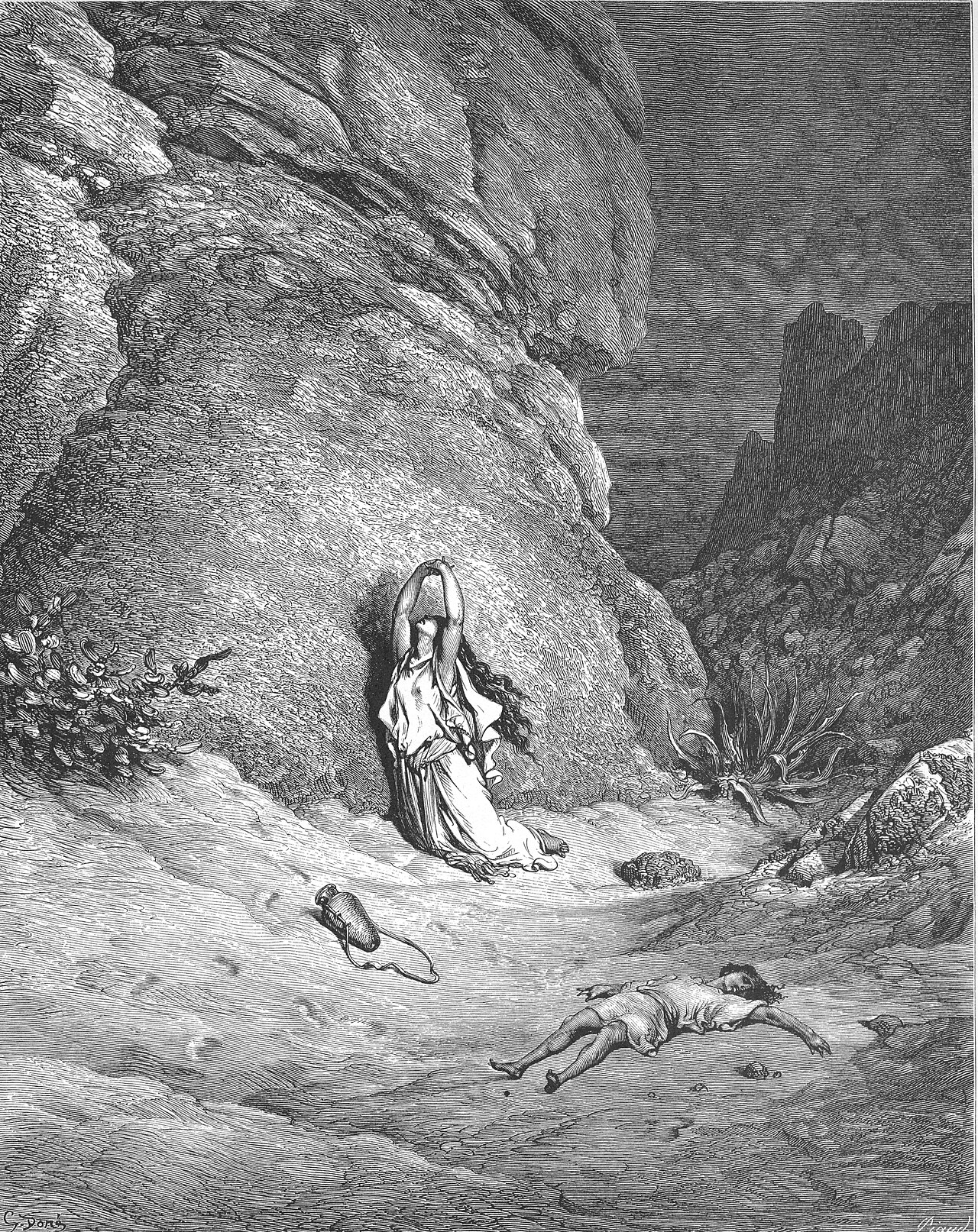
Hagar and Ishmael Sent Away
Abraham held a great feast: The child grew and was weaned, and Adam Clarke says the Hebrew word for weaned means turned from the breast to other food. Jerome reports Hebrew teachers setting the day a child was weaned anywhere from the fifth year to the twelfth. The great feast marks that day.
Genesis 21:8
Isaac, Scripture says, "grew" and became strong; that is, Abraham's joy grew as he looked not at those things "which are seen but at the things which are not seen." For Abraham did not rejoice about present things or about the riches of the world and the activities of the age. But do you wish to hear why Abraham rejoiced? Hear the Lord saying to the Jews: "Abraham your father desired to see my day, and he saw it and was glad." In this way, therefore, "Isaac grew."
Origen of Alexandria · written before 253 · HOMILIES ON GENESIS 10.1patristic
2 more voices on this verse
Genesis 21:8
“The child grew and was weaned - Anglo-Saxon Version. Now the child waxed and became weaned. We have the verb to wean from the Anglo-Saxon awendan, to convert, transfer, turn from one thing to another, which is the exact import of the Hebrew word גמל gamal in the text. Hence wenan, to wean, to turn the child from the breast to receive another kind of ailment.”
Adam Clarke · Commentary on the Bible (1810-1826)evangelical
Genesis 21:8
“Special notice is taken of this, though a thing of course, to intimate that the children of the promise are growing children. Those that are born of God shall increase of God, Col. ii.”
Matthew Henry · Commentary on the Whole Bible (1707-1721)puritan
Genesis 21:9-10
Hagar the Egyptian had borne to Abraham: Hagar is called the Egyptian here. Genesis gives what Ishmael did in one word, mocking. Paul calls it persecution at Galatians 4:29, and Clarke reads it as ridicule and warns against guessing past that. Sarah's demand is about the inheritance, that the slave woman's son will never share it with Isaac.
Genesis 21:9
“Sarah saw the son of Hagar . . . mocking--Ishmael was aware of the great change in his prospects, and under the impulse of irritated or resentful feelings, in which he was probably joined by his mother, treated the young heir with derision and probably some violence (Ga 4:29).”
Jamieson, Fausset & Brown · Commentary Critical and Explanatory on the Whole Bible (1871)reformed
1 more voice on this verse
Genesis 21:9
“Mocking - What was implied in this mocking is not known. St. Paul, Gal 4:29, calls it persecuting; but it is likely he meant no more than some species of ridicule used by Ishmael on the occasion, and probably with respect to the age of Sarah at Isaac’s birth, and her previous barrenness. Jonathan ben Uzziel and the Jerusalem Targum represent Ishmael as performing some idolatrous rite on the occasion, and that this had given the offense to Sarah. Conjectures are as useless as they are endless.”
Adam Clarke · Commentary on the Bible (1810-1826)evangelical
Adam Clarke notes that the verb for expel is also used for divorce, and he reads Sarah as asking for Hagar to be put away as a wife. Ephrem the Syrian says Sarah showed no envy in anything that touched herself and grew envious here for her son. Paul quotes the demand at Galatians 4:30.
Genesis 21:10
“Cast out this bondwoman and her son - Both Sarah and Abraham have been accused of cruelty in this transaction, because every word reads harsh to us. Cast out; גרש garash signifies not only to thrust out, drive away, and expel, but also to divorce; (see Lev 21:7); and it is in this latter sense the word should be understood here.”
Adam Clarke · Commentary on the Bible (1810-1826)evangelical
2 more voices on this verse
Genesis 21:10
“Then Sarah, who showed no envy in any matter that concerned herself, became envious in this matter concerning her son. She was not envious of Hagar whom she had given to her husband.”
Ephrem the Syrian · written before 373 · COMMENTARY ON GENESIS 18:2patristic
Genesis 21:10
“Wherefore she said unto Abraham, Cast out this bondwoman--Nothing but the expulsion of both could now preserve harmony in the household. Abraham's perplexity was relieved by an announcement of the divine will, which in everything, however painful to flesh and blood, all who fear God and are walking in His ways will, like him, promptly obey.”
Jamieson, Fausset & Brown · Commentary Critical and Explanatory on the Whole Bible (1871)reformed
Cross references
Genesis 21:10
- Quoted inGalatians 4:30But what does the Scripture say? “Expel the slave woman and her son, for the slave woman’s son will never share in the inheritance with the free woman’s son.”
'Cast out the bondwoman and her son' ('what saith the scripture?')
Genesis 21:11-13
this matter distressed Abraham greatly: Abraham is distressed over Ishmael, named here as his son. God tells him to listen to everything Sarah says, and that through Isaac his offspring will be reckoned. Paul quotes that clause at Romans 9:7 and Hebrews at 11:18. Verse 13 promises Ishmael a nation of his own.
Genesis 21:11
“It grieved him that Sarah insisted upon such a punishment. "Might it not suffice to correct him? would nothing less serve than to expel him?" Note, Even the needful extremities which must be used with wicked and incorrigible children are very grievous to tender parents, who cannot thus afflict willingly.”
Matthew Henry · Commentary on the Whole Bible (1707-1721)puritan
Listen to everything that Sarah tells you: God tells Abraham to listen to everything Sarah tells him, and He also answers the distress of verse 11 about the boy and the maidservant. Adam Clarke reads the word as God showing that Sarah was right. Jamieson, Fausset and Brown say it ended Abraham's distress.
Genesis 21:12
“In Isaac shall thy seed be called - Here God shows the propriety of attending to the counsel of Sarah; and lest Abraham, in whose eyes the thing was grievous, should feel distressed on the occasion, God renews his promises to Ishmael and his posterity.”
Adam Clarke · Commentary on the Bible (1810-1826)evangelical
Cross references
Genesis 21:12
- Quoted inHebrews 11:18even though God had said to him, “Through Isaac your offspring will be reckoned.”
'In Isaac shall thy seed be called' (Abraham's faith in offering Isaac)
- Quoted inRomans 9:7Nor because they are Abraham’s descendants are they all his children. On the contrary, “Through Isaac your offspring will be reckoned.”
'In Isaac shall thy seed be called' (election argument)
ConnectionsRomans 9:7
The reason given is Abraham, because he is your offspring. Matthew Henry draws a line here between the blessings of providence, which Ishmael receives, and the blessings of the covenant, which run through Isaac. He adds that the children of this world often fare better for their tie to the children of God.
Genesis 21:13
“And also of the son of the bondwoman will I make a nation,.... A great nation, as is promised, Gen 17:20; and such the Ishmaelites and Saracens have been, and the Turks now are, the descendants of Ishmael.”
Genesis 21:14-16
Early in the morning, Abraham got up: the same words that open 22:3 when he sets out for Moriah. Hagar wandered until the water in the skin was gone, left the boy under the bushes and sat about a bowshot away. She said she could not bear to watch the boy die. Jamieson, Fausset and Brown read Ishmael as a lad of about seventeen.
Genesis 21:14
“Took bread, and a bottle - By the word bread we are to understand the food or provisions which were necessary for her and Ishmael, till they should come to the place of their destination; which, no doubt, Abraham particularly pointed out. The bottle, which was made of skin, ordinarily a goat’s skin, contained water sufficient to last them till they should come to the next well; which, it is likely, Abraham particularly specified also. This well, it appears, Hagar missed, and therefore wandered about in the wilderness seeking more water, till all she had brought with her was expended.”
Adam Clarke · Commentary on the Bible (1810-1826)evangelical
2 more voices on this verse
Genesis 21:14
“It was also submissive; it was contrary to his judgment, at least to his own inclination, to do it; yet as soon as he perceives that it is the mind of God he makes no objections, but silently does as he is bidden, as one trained up to an implicit obedience.”
Matthew Henry · Commentary on the Whole Bible (1707-1721)puritan
Genesis 21:14
“Ishmael was a lad of seventeen years, and it is quite customary for Arab chiefs to send out their sons at such an age to do for themselves: often with nothing but a few days' provisions in a bag. wandered in the wilderness of Beer-sheba--in the southern border of Palestine, but out of the common direction, a wide extending desert, where they lost their way.”
Jamieson, Fausset & Brown · Commentary Critical and Explanatory on the Whole Bible (1871)reformed
left the boy under one of the bushes: With the water gone, Hagar left the boy under the bushes, and Adam Clarke reads the verb as sending him there for shade from the heat. Clarke adds that a boy tires sooner than a grown man. Jerome counts him thirteen when Isaac was born.
Genesis 21:15
“And she cast the child - ותשלך את הילד vattashlech eth haiyeled, and she sent the lad under one of the shrubs, viz., to screen him from the intensity of the heat. Here Ishmael appears to be utterly helpless, and this circumstance seems farther to confirm the opinion that he was now in a state of infancy; but the preceding observations do this supposition entirely away, and his present helplessness will be easily accounted for on this ground: 1. Young persons can bear much less fatigue than those who are arrived at mature age.”
Adam Clarke · Commentary on the Bible (1810-1826)evangelical
about a bowshot away: Adam Clarke holds that Hagar had missed the well Abraham pointed out and wandered until the water was spent. Her despair came beside water she could not see. Verse 19 says God opened her eyes, and only then did she see the well.
Genesis 21:16
“BRIEFLY LET US REHEARSE the circumstances. The child Isaac was, according to God’s word, to be the heir of Abraham. Ishmael, the elder son of Abraham, by the bondwoman Hagar, resided at home with his father till he was about eighteen years of age; but when he began to mock and scoff at the younger child whom God had ordained to be the heir, it became needful that he and his mother should be sent away from Abraham’s encampment.”
Genesis 21:17-19
God heard the voice of the boy: God heard the boy, though it was the mother who wept. Ishmael's name means God hears, and the angel gave it to her at 16:11. This is the second time Hagar meets God in a wilderness, and the second time a well is attached to it. God opened her eyes and she saw the well that was already there.
Genesis 21:17
“We read not of a word he said; but his sighs, and groans, and calamitous state, cried aloud in the ears of mercy. An angel was sent to comfort Hagar, and it was not the first time that she had met with God's comforts in a wilderness; she had thankfully acknowledged the former kind visit which God made his in such a case ( ch. xvi.”
Matthew Henry · Commentary on the Whole Bible (1707-1721)puritan
take him by the hand: Adam Clarke gives the Hebrew literally as make your hand strong on his behalf, so that the boy could reach the water. Matthew Henry notes that the help promised sets Hagar to work. The great nation promised to Abraham at 17:20 and in verse 13 is now spoken to Hagar herself.
Genesis 21:18
“Note, God's readiness to help us when we are in trouble must not slacken, but quicken, our endeavours to help ourselves. (2.) He repeats the promise concerning her son, that he should be a great nation, as a reason why she should bestir herself to help him.”
Matthew Henry · Commentary on the Whole Bible (1707-1721)puritan
she saw a well of water: Adam Clarke takes God opened her eyes to mean no more than God directing her to a well that was already near. The water was there before she saw it. The skin that ran dry in verse 15 is filled again, and the boy drinks.
Genesis 21:19
“God opened her eyes - These words appear to me to mean no more than that God directed her to a well, which probably was at no great distance from the place in which she then was; and therefore she is commanded, Gen 21:18, to support the lad, literally, to make her hand strong in his behalf - namely, that he might reach the well and quench his thirst.”
Adam Clarke · Commentary on the Bible (1810-1826)evangelical
Genesis 21:20-21
God was with the boy: , and the words are said of the son who was sent away. Genesis says the same of Isaac at 26:28 and of Joseph at 39:2. He settled in the wilderness and grew into a great archer. His mother got him a wife from the land of Egypt.
Genesis 21:20
“Became an archer - And by his skill in this art, under the continual superintendence of the Divine Providence, (for God was with the lad), he was undoubtedly enabled to procure a sufficient supply for his own wants and those of his parent.”
Adam Clarke · Commentary on the Bible (1810-1826)evangelical
the Wilderness of Paran: Adam Clarke places the Wilderness of Paran in Arabia Petraea, near Mount Sinai. Israel crosses the same wilderness at Numbers 10:12. Hagar the Egyptian takes a wife for her son from her own people, as Abraham will send to his own kin for Isaac in chapter 24.
Genesis 21:21
“He dwelt in the wilderness of Paran - This is generally allowed to have been a part of the desert belonging to Arabia Petraea, in the vicinity of Mount Sinai; and this seems to be its uniform meaning in the sacred writings.”
Adam Clarke · Commentary on the Bible (1810-1826)evangelical
The Oath at the Well of Beersheba
Genesis 21:22-24
Abimelech comes with Phicol, the commander of his army. His opening is what an outsider could see from the road, that God is with Abraham in all he does. This is the same Abimelech who questioned him in chapter 20, and he asks for an oath of good faith. Abraham answers in three words.
Genesis 21:22
“At that time - This may either refer to the transactions recorded in the preceding chapter, or to the time of Ishmael’s marriage, but most probably to the former. God is with thee - מימרא דיי meimera daiya, the Word of Jehovah; see before, Gen 15:1. That the Chaldee paraphrasts use this term, not for a word spoken, but in the same sense in which St. John uses the λογος του Θεου, the Word of God, (Joh 1:1), must be evident to every unprejudiced reader. See on Gen 15:1 (note).”
Adam Clarke · Commentary on the Bible (1810-1826)evangelical
1 more voice on this verse
Genesis 21:22
“Abimelech and Phichol--Here a proof of the promise (Ge 12:2) being fulfilled, in a native prince wishing to form a solemn league with Abraham. The proposal was reasonable, and agreed to [Ge 21:24].”
Jamieson, Fausset & Brown · Commentary Critical and Explanatory on the Whole Bible (1871)reformed
swear to me here before God: Abimelech asks for an oath covering three generations. Ephrem the Syrian says the king had seen God help Abraham in the war of the kings and knew of God's promise of the land to him. John Gill notes that the vision of chapter 15 put that possession four hundred years off.
Genesis 21:23
“Now therefore swear unto me - The oath on such occasions probably meant no more than the mutual promise of both the parties, when they slew an animal, poured out the blood as a sacrifice to God, and then passed between the pieces. See this ceremony, Gen 15:18 (note), and on Genesis 15 (note).”
Adam Clarke · Commentary on the Bible (1810-1826)evangelical
1 more voice on this verse
Genesis 21:23
“After these things, Abimelech and Phicol, the commander of his army, spoke to Abraham, for they saw that God was with him and had helped him in the wars of the kings and had also promised him the land of the Canaanites.”
Ephrem the Syrian · written before 373 · COMMENTARY ON GENESIS 19:1patristic
Matthew Henry reads the quick answer as the mark of an honest mind, since a man who means to be true has no fear of swearing to it. John Gill adds that Abraham remembered the kindness Abimelech had shown him. The complaint about the well follows the oath.
Genesis 21:24
“And Abraham said, I will swear. Sensible of the many favours he had received from Abimelech in times past, and was still indulged with, he very readily agreed to his proposal; and the rather, as he knew by the vision between the pieces, that it would be four hundred years before his posterity should be put into the possession of the land of Canaan; and therefore could take an oath that neither he, nor his son, nor his grandson, should be injured or dispossessed.”
Genesis 21:25-27
a well that Abimelech’s servants had seized: Abraham complained about a well Abimelech's servants had seized. Abimelech replied that he had not heard of it until that day. The grievance is on the table before the covenant is made. Water is the standing quarrel here, and the Philistines fight Isaac over wells at 26:15 to 26:22.
Genesis 21:25
“And Abraham reproved Abimelech because of a well--Wells were of great importance to a pastoral chief and on the successful operation of sinking a new one, the owner was solemnly informed in person.”
Jamieson, Fausset & Brown · Commentary Critical and Explanatory on the Whole Bible (1871)reformed
1 more voice on this verse
Genesis 21:25
“Note, If our brother trespass against us, we must, with the meekness of wisdom, tell him his fault, that the matter may be fairly accommodated and an end made of it, Matt. xviii.”
Matthew Henry · Commentary on the Whole Bible (1707-1721)puritan
Matthew Henry takes Abimelech at his word. The faults of servants, he says, are not charged to a master who did not know of them, and an honest man can only put right what he learns he has done wrong. Abimelech also turns the blame back on Abraham, who had not told him.
Genesis 21:26
“Many are suspected of injustice and unkindness that are perfectly innocent, and we ought to be glad when they clear themselves. The faults of servants must not be imputed to their masters, unless they know of them and justify them; and no more can be expected from an honest man than that he be ready to do right as soon as he knows that he has done wrong.”
Matthew Henry · Commentary on the Whole Bible (1707-1721)puritan
brought sheep and cattle and gave them: Adam Clarke reports the view that these animals were the covenant sacrifices, supplied by Abraham and given to Abimelech to offer. Elsewhere Clarke links such oaths to the cut animals of chapter 15. On that view Abraham bears the cost.
Genesis 21:27
“Took sheep and oxen - Some think that these were the sacrifices which were offered on the occasion, and which Abraham furnished at his own cost, and, in order to do Abimelech the greater honor, gave them to him to offer before the Lord.”
Adam Clarke · Commentary on the Bible (1810-1826)evangelical
Genesis 21:28-31
seven ewe lambs from the flock: These seven ewe lambs are the first lambs Genesis names. They buy a well and stand as Abraham's witness that he dug it. Isaac asks where the lamb is one chapter later, on the way up the mountain. Jerome gives both readings of Beersheba, the well of the seven and the well of the oath.
Genesis 21:28
“Seven ewe lambs - These were either given as a present, or they were intended as the price of the well; and being accepted by Abimelech, they served as a witness that he had acknowledged Abraham’s right to the well in question.”
Adam Clarke · Commentary on the Bible (1810-1826)evangelical
Abimelech's question lets Abraham name the purpose aloud. The lambs stand apart from the sheep and cattle of verse 27, which sealed the covenant. Adam Clarke weighs two readings of them, a present to the king or the price of the well.
Genesis 21:29
“And Abimelech said unto Abraham,.... Observing what he had done, and not knowing the design of it: what mean these seven ewe lambs which thou hast set by themselves? he understood what the sheep and oxen were for, that they were presents to him, at least some of them, and the rest were for the solemnizing and ratifying the covenant between them; but what these were for he could not devise.”
John Gill · Exposition of the Old Testament (1748-1763)Reformed Baptist
Abraham asks Abimelech to accept the seven ewe lambs as his witness that he dug the well. Adam Clarke holds that by accepting them Abimelech owned Abraham's right to it. Matthew Henry calls the sign both just and wise.
Genesis 21:30
“It is justice, as well as wisdom, to do thus, in perptuam rei memoriam--that the circumstance may be perpetually remembered.”
Matthew Henry · Commentary on the Whole Bible (1707-1721)puritan
So that place was called Beersheba: Adam Clarke takes the name literally as the well of the oath, confirmed by both men. The place later marks the southern edge of the land in the phrase from Dan to Beersheba, as at Judges 20:1. It begins as one well and a sworn right to it.
Genesis 21:31
“He called that place Beer-sheba - באר שבע Beer-shaba, literally, the well of swearing or of the oath, because they both sware there - mutually confirmed the covenant.”
Adam Clarke · Commentary on the Bible (1810-1826)evangelical
Genesis 21:32-33
After they had made the covenant at Beersheba: Abimelech and Phicol returned to the land of the Philistines. Abraham planted a tamarisk tree, the tree of a man who expects to stay. He called on the LORD there by a title Genesis uses here and nowhere earlier, the Eternal God. Beersheba becomes the family's southern ground, and Isaac swears his own oath there at 26:33.
planted a tamarisk tree in Beersheba: Abraham planted the tamarisk and called upon the name of the LORD there. Jamieson, Fausset and Brown read a grove of tamarisks, where offerings were made as in a temple open to the sky. Matthew Henry says the place became his house of prayer.
Genesis 21:33
“There he made, not only a constant practice, but an open profession, of his religion: There he called on the name of the Lord, the everlasting God, probably in the grove he planted, which was his oratory or house of prayer. Christ prayed in a garden, on a mountain. (1.) Abraham kept up public worship, to which, probably, his neighbours resorted, that they might join with him.”
Matthew Henry · Commentary on the Whole Bible (1707-1721)puritan
1 more voice on this verse
Genesis 21:33
“Abraham planted a grove--Hebrew, "of tamarisks," in which sacrificial worship was offered, as in a roofless temple.”
Jamieson, Fausset & Brown · Commentary Critical and Explanatory on the Whole Bible (1871)reformed
ConnectionsIsaiah 40:28
Abraham resided in the land of the Philistines: The chapter ends on the word resided, in the country the treaty had just secured. Everything Abraham holds in the land of promise he has paid for, this well for seven lambs. He lived there a long time. Gill notes that the Jewish writers reckon it at twenty-six years.
Genesis 21:34
“And Abraham sojourned in the Philistines' land many days. Even many years, days being sometimes put for years; having entered into covenant with Abimelech, the king of the country, and settled a good correspondence with him, and having his friendship and good will, which commanded respect from his subjects, Abraham sojourned very quietly and comfortably for many years, chiefly at Beersheba; the Jewish writers say (a) he sojourned here twenty six years. (a) Jarchi & Bereshit Rabba, sect. 54. fol. 48. 4.”
How this psalm is built
The form: A record of a promise kept on time, where no word of God falls to the ground, as Henry classes it.
The patterns in this chapter
| Device | What it does | Where to see it |
|---|---|---|
| Laughter, turned around | The name Isaac means he laughs, and God gave it at Genesis 17:19 before there was a child. Sarah had laughed inside the tent at Genesis 18:12 and denied it, and here she says God has made her laugh and calls everyone who hears to laugh with her. Adam Clarke marks the change of sense, that she uses the word in this place in a different way from the laugh of chapter 18.Adam Clarke, Commentary on the Bible, 1832, on Genesis 21:6. | Genesis 21:3, Genesis 21:6 |
| Beersheba, the well of the oath and the well of the seven | Adam Clarke reads Beer-shaba literally as the well of swearing or of the oath, because the two men swore there. The chapter also sets seven ewe lambs apart as the witness that Abraham dug the well, and the Hebrew for seven stands inside the name. Jerome gives both readings, the well of the seven and the well of the oath, and the chapter supplies a reason for each.Adam Clarke, Commentary on the Bible, 1832, on Genesis 21:31. | Genesis 21:28, Genesis 21:30, Genesis 21:31 |
| Hagar in the wilderness, for the second time | The scene repeats the one at Genesis 16:7 to 14 and changes what it can. Both times Hagar is in a desert, both times a well is there, both times a messenger speaks to her, and both times Ishmael is promised a great nation. The first time she was running and was sent back, and this time she was sent away and is told to take the boy by the hand. | Genesis 21:14, Genesis 21:17, Genesis 21:18, Genesis 21:19 |
| Early in the morning, Abraham got up | The same words open verse 14 here and verse 3 of the next chapter, and each time they begin the walk that costs Abraham a son. Matthew Henry reads the obedience at verse 14 as submissive, since it went against Abraham's own inclination and was done as soon as he saw it was the mind of God. The phrase is the chapter's link to Moriah.Matthew Henry, Commentary on the Whole Bible, 1710, on Genesis 21:14. | Genesis 21:14, Genesis 22:3 |
The New Testament's use
10 more paragraphs on the patterns
The clause at verse 12, that through Isaac the offspring will be reckoned, is quoted at Romans 9:7 and at Hebrews 11:18, and in both places it does the same work: it makes the line of promise a matter of God's choice rather than of birth order. Paul takes the whole household scene into Galatians 4, where Hagar and Sarah stand for two covenants, and calls Ishmael's mocking persecution at Galatians 4:29.
The debated concept
The first question is what Ishmael did at verse 9. Adam Clarke says plainly that what was implied in the mocking is not known, notes that Paul calls it persecuting at Galatians 4:29, and holds that Paul probably meant no more than some kind of ridicule. Jamieson, Fausset and Brown read it from Ishmael's position, that he was aware of the great change in his prospects and acted under the impulse of resentment. Genesis gives the act in one word and adds nothing.
The second is whether the expulsion was cruel. Adam Clarke records the charge against both Sarah and Abraham and answers that every word of the passage reads harsh to a later ear while the transaction followed the usage of that country. Jamieson, Fausset and Brown hold that nothing short of the expulsion of both could have preserved peace in the house. Matthew Henry keeps Abraham's grief in view and asks the question the chapter raises, whether correction would not have served instead of expulsion, and reads the obedience as submission to the mind of God once it was known.
The third is how old Ishmael was. Jamieson, Fausset and Brown reckon him a lad of seventeen from the chapter's own dates, since he was thirteen at Genesis 17:25 and Isaac is now weaned. Adam Clarke reads verse 15 against that, taking the Hebrew to mean that Hagar placed the lad under a shrub to screen him from the heat, and noting that young people bear fatigue worse than those of mature age. The two readings are working on the same words from different ends.
The fourth is what happened at verse 19. Adam Clarke holds that the words mean no more than that God directed her to a well which was probably no great distance from her. Jamieson, Fausset and Brown suppose a fountain close beside her, hidden in brushwood. Matthew Henry reads the opening of the eyes as the pattern of grace, that the well stands by and is of no use until the same God who opened her eyes opens ours.
The divine connection
The chapter puts two sons in the same frame and treats both. Isaac carries the covenant, and the reason is given in one clause at verse 12. Ishmael carries a promise of his own at verse 13, and the narrator records at verse 20 that God was with the boy, which is what Genesis will later say of Joseph at Genesis 39:2.
The hearing at verse 17 is exact. Hagar wept, and the text says God heard the voice of the boy, which is the meaning of the name the angel gave her at Genesis 16:11. The name was given thirteen years before it was needed and it holds when the water runs out.
The title Abraham uses at verse 33, the Eternal God, is new in Genesis, and he uses it in a place he has just paid for, beside a tree planted by a man who expects to stay.
Keep studying
Studies9
Words12
Trails1
Sources for this chapter
The summary
Jamieson, Fausset & Brown, Commentary Critical and Explanatory; John Calvin, Commentaries; John Wesley, Notes on the Old Testament and Matthew Henry, Complete Commentary.
The context
John Gill, Exposition of the Old Testament and Matthew Henry, Commentary on the Whole Bible.
The form and classifications
Adam Clarke, Commentary on the Bible, 1832, on Genesis 21:10; Jamieson, Fausset and Brown, Commentary Critical and Explanatory on the Whole Bible, 1871, on Genesis 21:22 and Matthew Henry.
The exposition
Adam Clarke, Commentary on the Bible; Ephrem the Syrian; Jamieson, Fausset & Brown, Commentary Critical and Explanatory on the Whole Bible; Jerome, Hebrew Questions on Genesis; John Calvin, Commentary on Genesis; John Gill, Exposition of the Old Testament and Matthew Henry, Commentary on the Whole Bible.