
Genesis 21:14
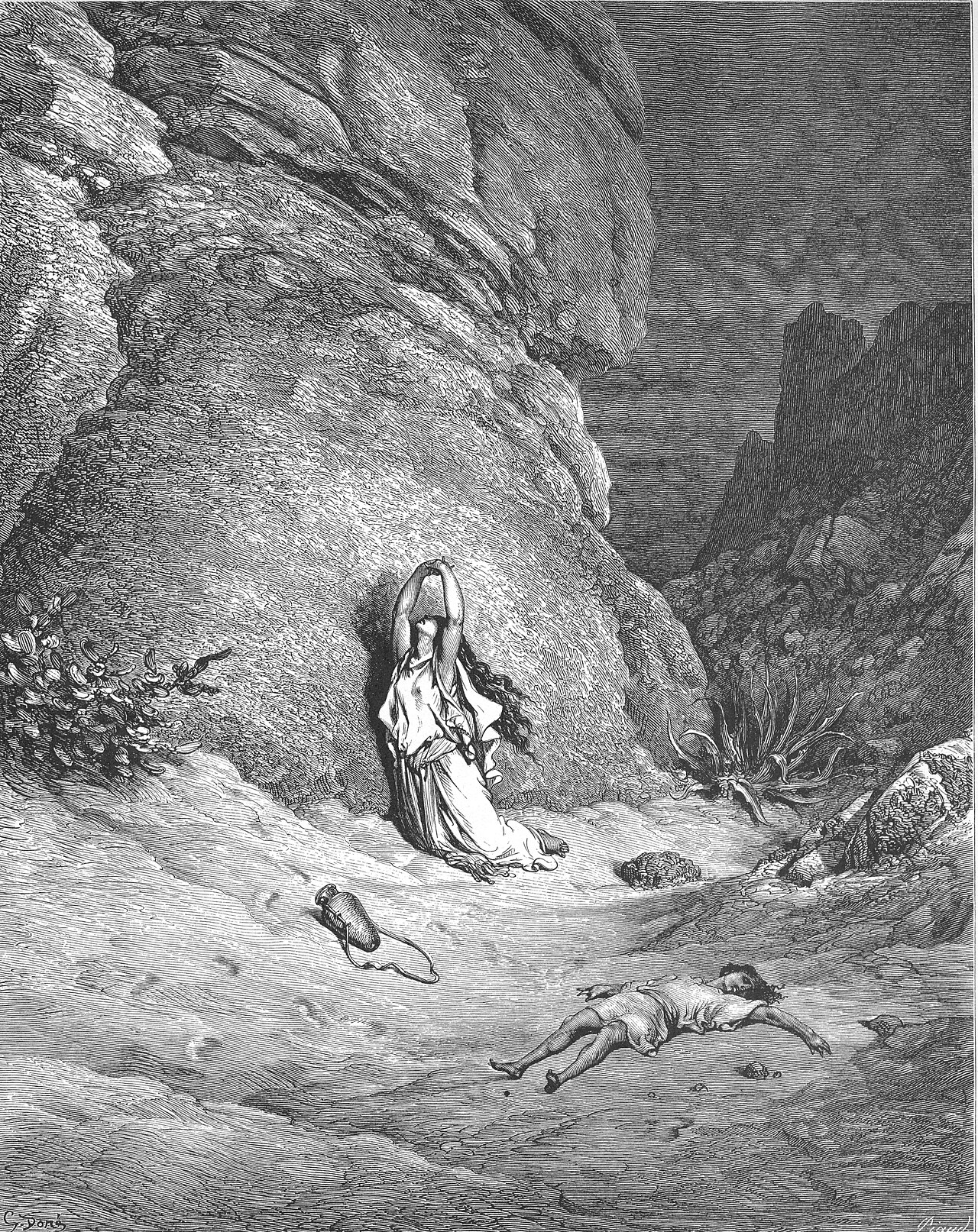
in Genesis 21Early in the morning, Abraham got up, took bread and a skin of water, put them on Hagar’s shoulders, and sent her away with the boy. She left and wandered in the Wilderness of Beersheba.
BSB
The same verse in ASV and KJV ▾
ASV
And Abraham rose up early in the morning, and took bread and a bottle of water, and gave it unto Hagar, putting it on her shoulder, and gave her the child, and sent her away: and she departed, and wandered in the wilderness of Beer-sheba.
KJV
And Abraham rose up early in the morning, and took bread, and a bottle of water, and gave it unto Hagar, putting it on her shoulder, and the child, and sent her away: and she departed, and wandered in the wilderness of Beer–sheba.
⋯
This verse in Genesis 21
Commentary
8 notes on this verse(Verse 14) And he took bread and a skin of water, and gave it to Hagar, putting it on her shoulder, along with the child, and sent her away. When Isaac was born, Ishmael was thirteen years old. And after he was weaned, he was expelled from the house with his mother. However, among the Hebrews, there are different opinions, with some claiming that the time for weaning is set at the fifth year, and others claiming the twelfth year.
This site's exposition
Early in the morning, Abraham got up
on Genesis 21:14-16
Early in the morning Abraham got up, the same words that open 22:3 when he sets out for Moriah. Hagar wandered until the water in the skin was gone, left the boy under the bushes and sat a bowshot away, saying she could not bear to watch the boy die. Jamieson, Fausset and Brown read Ishmael here as about seventeen.
The record, by era
The Church Fathers2 voices
But was the just Abraham inhumane in that he did not even supply Hagar and the boy with a donkey, with all the cattle he possessed?
Let us see what Abraham does meanwhile after Sarah is displeased. He casts out the bondwoman and her son, but nevertheless he gives him a bottle of water. For his mother does not have a well of living water, nor could the boy draw water from a well. Isaac has wells for which he also suffers strife against the Philistines, but Ishmael drinks water from a bottle. This bottle, as it is a bottle, fails, and therefore he is thirsty and does not find a well.But you, who are a son "of promise as Isaac," "drink water from your own fountains, and let not the waters flow forth from your wells, but let your waters run in your streets." But one "who is born according to the flesh" drinks water from a bottle, and the water itself fails him, and he lacks in many things. The bottle of the law is the letter, from which carnal people drink and thence receives understanding. This letter frequently fails them. It cannot extricate itself, for the historical understanding is defective in many things. But the church drinks from the evangelic and apostolic fountains that never fail but "run in its streets," because they always abound and flow in the breadth of spiritual interpretation. The church drinks also "from wells" when it draws and examines certain deeper things from the law. On account of this mystery also, I think, our Lord and Savior said to the Samaritan woman, when, as if he were speaking with Hagar herself he said, "Whoever shall drink of this water shall thirst again; but he who shall drink of the water which I give him shall not thirst forever." But she says to the Savior, "Sir, give me this water, that I may not thirst, nor come here to draw." After this the Lord says to her, "There shall come to be in him who believes in me a fountain of water springing up into life everlasting."
The Puritans and the Awakening2 voices
It was also submissive; it was contrary to his judgment, at least to his own inclination, to do it; yet as soon as he perceives that it is the mind of God he makes no objections, but silently does as he is bidden, as one trained up to an implicit obedience.
And Abraham rose up early in the morning,....
The Nineteenth Century1 voice
Took bread, and a bottle - By the word bread we are to understand the food or provisions which were necessary for her and Ishmael, till they should come to the place of their destination; which, no doubt, Abraham particularly pointed out. The bottle, which was made of skin, ordinarily a goat’s skin, contained water sufficient to last them till they should come to the next well; which, it is likely, Abraham particularly specified also. This well, it appears, Hagar missed, and therefore wandered about in the wilderness seeking more water, till all she had brought with her was expended.
1 more voice on this verse
The Nineteenth Century1 voice
A commentator
Jamieson, Fausset & Brown1802–1910
Commentary Critical and Explanatory on the Whole Bible (1871)
Ishmael was a lad of seventeen years, and it is quite customary for Arab chiefs to send out their sons at such an age to do for themselves: often with nothing but a few days' provisions in a bag. wandered in the wilderness of Beer-sheba--in the southern border of Palestine, but out of the common direction, a wide extending desert, where they lost their way.
How the passage was read
What the Jewish commentators add
This is to be understood in connection with the above: And he gave to Hagar [the bread and bottle of water]… and the child, for he gave her the child also to go with her wherever she will go.
This section is reception history: how the passage was read and kept in the Jewish tradition. Where a reading parts from an essential of the Christian faith, the section says so at that point.
Texts and citation data: Sefaria; each excerpt follows its version’s licence. 4 further sources are cited on this chapter that carry no English text this site may quote or only restate the verse.
The words behind it
21 Hebrew wordsEvery Hebrew word of this verse in the order it stands, with what it means and the door to its own study. The last column counts the times a word stands in the whole Bible: the rarer the word, the more the places it appears belong together.
| Hebrew | Sound | Meaning | Word study | In the Bible |
|---|---|---|---|---|
| וַיַּשְׁכֵּ֣ם | vaiyashkem | and he rose early | H7925 → | 65 times |
| אַבְרָהָ֣ם׀ | ʾavraham | Abraham | H85 → | 175 times |
| בַּבֹּ֡קֶר | baboker | in the morning | H1242 → | 214 times |
| וַיִּֽקַּֽח־ | vaiyikach- | and he took | H3947 → | 966 times |
| לֶחֶם֩ | lechem | food | H3899 → | 298 times |
| וְחֵ֨מַת | vechemat | and a skin of | H2573 → | 3 times |
| מַ֜יִם | mayim | water | H4325 → | 581 times |
| וַיִּתֵּ֣ן | vaiyiten | and he gave [them] | H5414 → | 2011 times |
| אֶל־ | ʾel- | to | H413 → | 5510 times |
| הָ֠גָר | hagor | Hagar | H1904 → | 12 times |
| שָׂ֧ם | sam | placing | H7760 → | 584 times |
| עַל־ | ʾal- | on | H5921 → | 5755 times |
| שִׁכְמָ֛הּ | shikhmah | shoulder her | H7926 → | 21 times |
| וְאֶת־ | veet | and <obj.> | H853 → | 10935 times |
| הַיֶּ֖לֶד | haiyeled | the boy | H3206 → | 89 times |
| וַֽיְשַׁלְּחֶ֑הָ | vayshalecheha | and he sent away her | H7971 → | 845 times |
| וַתֵּ֣לֶךְ | vatelekh | and she went | H1980 → | 1546 times |
| וַתֵּ֔תַע | vateta' | and she wandered | H8582 → | 50 times |
| בְּמִדְבַּ֖ר | bemidbar | in [the] wilderness of | H4057 → | 270 times |
| בְּאֵ֥ר | beer | Beer | H884 → | 68 times |
| שָֽׁבַע׃ | shava' | Sheba | H884 → | 68 times |
וַיַּשְׁכֵּ֣םand he rose early
vaiyashkemH7925 →65 times
אַבְרָהָ֣ם׀Abraham
ʾavrahamH85 →175 times
בַּבֹּ֡קֶרin the morning
babokerH1242 →214 times
וַיִּֽקַּֽח־and he took
vaiyikach-H3947 →966 times
לֶחֶם֩food
lechemH3899 →298 times
וְחֵ֨מַתand a skin of
vechematH2573 →3 times
מַ֜יִםwater
mayimH4325 →581 times
וַיִּתֵּ֣ןand he gave [them]
vaiyitenH5414 →2011 times
אֶל־to
ʾel-H413 →5510 times
הָ֠גָרHagar
hagorH1904 →12 times
שָׂ֧םplacing
samH7760 →584 times
עַל־on
ʾal-H5921 →5755 times
שִׁכְמָ֛הּshoulder her
shikhmahH7926 →21 times
וְאֶת־and <obj.>
veetH853 →10935 times
הַיֶּ֖לֶדthe boy
haiyeledH3206 →89 times
וַֽיְשַׁלְּחֶ֑הָand he sent away her
vayshalechehaH7971 →845 times
וַתֵּ֣לֶךְand she went
vatelekhH1980 →1546 times
וַתֵּ֔תַעand she wandered
vateta'H8582 →50 times
בְּמִדְבַּ֖רin [the] wilderness of
bemidbarH4057 →270 times
בְּאֵ֥רBeer
beerH884 →68 times
שָֽׁבַע׃Sheba
shava'H884 →68 times
A shaded row is a word that stands 400 times or fewer in the Bible.
The walk
8 stopsEach card is a verse this one points to, and under it the verses that one points to in turn. Where several paths arrive at the same place, that place is listed first: the text keeps returning to it.
Through
Ecclesiastes 9:10Whatever you find to do with your hands, do it with all your might, for in Sheol, where you are going, there is no work or planning or knowledge or wisdom.
it leads to
- Colossians 3:23
Whatever you do, work at it with your whole being, for the Lord and not for men,
- Ephesians 5:16
redeeming the time, because the days are evil.
- Romans 12:11
Do not let your zeal subside; keep your spiritual fervor, serving the Lord.
- Psalms 6:5
For there is no mention of You in death; who can praise You from Sheol?
- Ecclesiastes 11:6
Sow your seed in the morning, and do not rest your hands in the evening, for you do not know which will succeed, whether this or that, or if both will equally prosper.
- Colossians 3:23
Through
Psalms 119:60I hurried without hesitating to keep Your commandments.
it leads to
- Psalms 95:7–8
For He is our God, and we are the people of His pasture, the sheep under His care. Today, if you hear His voice,
- Ecclesiastes 9:10
Whatever you find to do with your hands, do it with all your might, for in Sheol, where you are going, there is no work or planning or knowledge or wisdom.
- Galatians 1:16
to reveal His Son in me so that I might preach Him among the Gentiles, I did not rush to consult with flesh and blood,
- Psalms 95:7–8
Where this verse is studied
About Genesis
Who and where
2 names in this verse with a page on the site.
- PersonPatriarchsAbrahamCalled out of Ur, the father of all who believe, justified by faith, and the friend of God through whose seed all nations are bles…
- PlaceThe NegevBeershebaThe well of the oath at the south of the land, where Abraham made his covenant with Abimelech and planted a tamarisk, where Isaac…
This page draws on Adam Clarke, Commentary on the Bible; Eusebius of Emesa, CATENA ON GENESIS 3.1216; Jamieson, Fausset & Brown, Commentary Critical and Explanatory on the Whole Bible; Jerome, Hebrew Questions on Genesis; John Gill, Exposition of the Old Testament (1748-1763); Matthew Henry, Commentary on the Whole Bible and Origen of Alexandria, HOMILIES ON GENESIS 7.5.