
Genesis 21:19
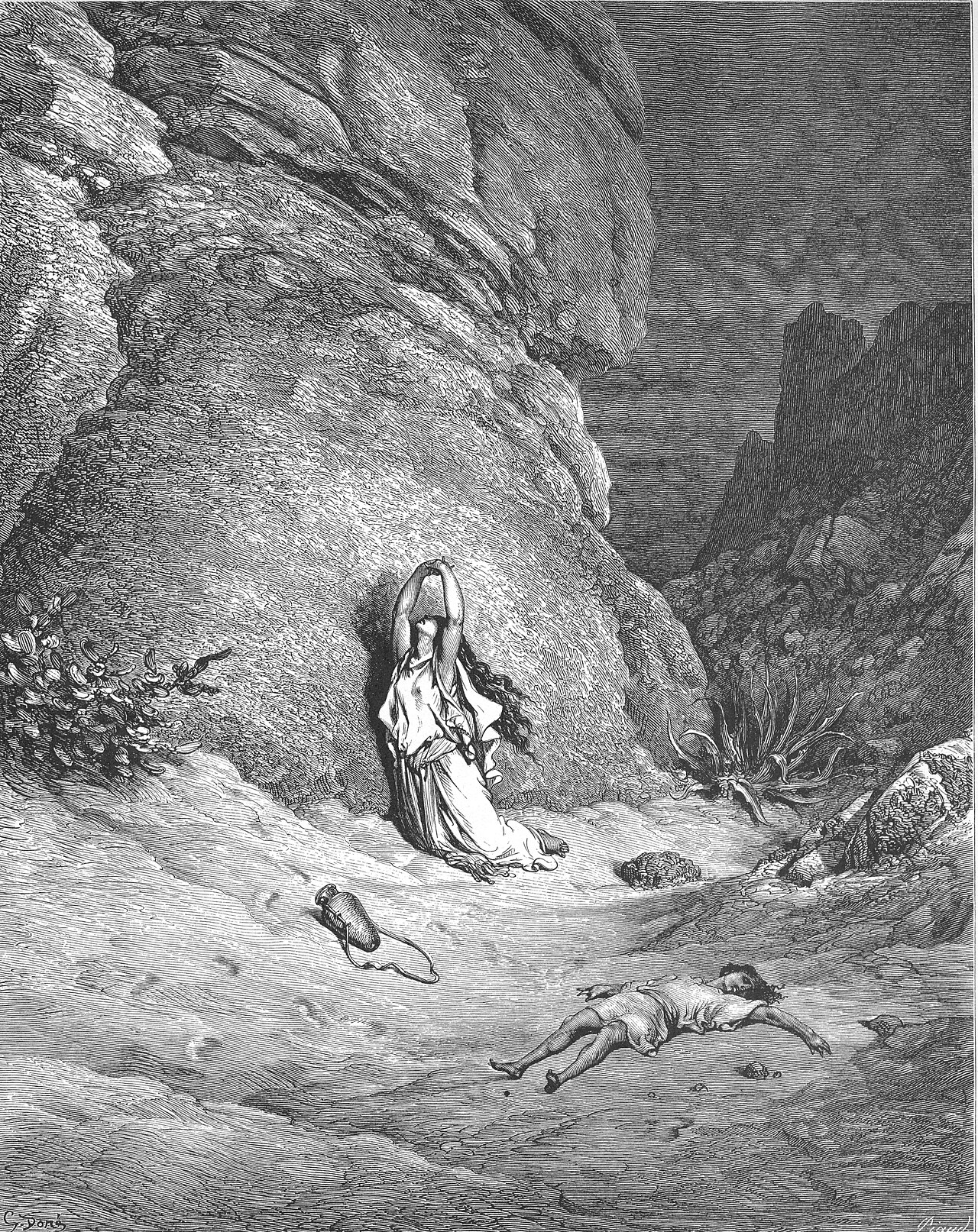
in Genesis 21Then God opened her eyes, and she saw a well of water. So she went and filled the skin with water and gave the boy a drink.
BSB
The same verse in ASV and KJV ▾
ASV
And God opened her eyes, and she saw a well of water; and she went, and filled the bottle with water, and gave the lad drink.
KJV
And God opened her eyes, and she saw a well of water; and she went, and filled the bottle with water, and gave the lad drink.
⋯
This verse in Genesis 21
Commentary
14 notes on this verseGod opened her eyes - These words appear to me to mean no more than that God directed her to a well, which probably was at no great distance from the place in which she then was; and therefore she is commanded, Gen 21:18, to support the lad, literally, to make her hand strong in his behalf - namely, that he might reach the well and quench his thirst.
This site's exposition
God heard the voice of the boy
on Genesis 21:17-19
God heard the boy, though it was the mother who wept. Ishmael's name means God hears, and the angel gave it to her at 16:11. This is the second time Hagar meets God in a wilderness, and the second time a well is attached to it. God opened her eyes and she saw the well that was already there.
This site's exposition
she saw a well of water
Adam Clarke takes God opened her eyes to mean no more than God directing her to a well that was already near. The water was there before she saw it. The skin that ran dry in verse 15 is filled again, and the boy drinks.
The record, by era
The Church Fathers4 voices
Mindful of this, let us, I beseech you, shun the harm of this passion and with all our might exterminate it from our own souls. This, after all, is more deadly than all other passions and undermines our very salvation, being in fact the invention of the wicked demon. Hence a certain sage also said, "Through the devil's envy death entered the world." What is meant by "through the devil's envy death entered the world"?You see, since this wicked beast saw that the first-formed human being was created immortal, by his characteristic wickedness he led him on to disobedience of the command and in that way caused him to bring on himself the penalty of death. So envy caused deception, deception caused disobedience, and disobedience caused death. Hence the text says, "Through the devil's envy death entered the world." Do you see the extent of the harm caused by this passion? It made the one given the privilege of immortality undergo death. The enemy of our salvation, however, introduced the envy characteristic of himself and caused the first-formed human being, immortal though he was, to come under sentence of death, whereas the caring and loving Lord by his own death once again bestowed upon us immortality, and so we found greater benefits than we had lost. The former took us out of paradise; the latter led us into heaven. The former caused us to be condemned to death; the latter bestowed upon us immortality. The former deprived us of the delights of paradise; the latter prepared for us the kingdom of heaven. Do you see the inventiveness of your Lord in that he directed against the devil's head his own weapons of malice against our salvation?
"He opened her eyes," the text goes on, not because she couldn't see before this but because even with her eyes open nothing was of any help to her before the visitation from on high. Hence, since his intention was to give evidence of care on his part, it says, "He opened her eyes," that is, he made clear to her in her ignorance, he activated her mind, he showed her the way to find the place flowing with springs of water. "She saw a well of running water," the text goes on, "and she went and filled the bag, and gave the boy to drink." In her neediness the Lord granted her means, and when she found herself so much at a loss and lacking all hope of survival, he gave evidence in her case of his characteristic generosity by consoling her and at the same time exercising care for the child.In like manner, whenever God wishes, even if we are utterly alone, even if we are in desperate trouble, even if we have no hope of survival, we need no other assistance, since God's grace is all we require. You see, if we win favor from him, no one will get the better of us, but rather we will prevail against anyone. "God was with the boy," the text goes on; "he grew up and lived in the desert." In similar fashion, whenever we have God on our side, even if we are utterly alone, we will live more securely than those who dwell in the cities. After all, the grace of God is the greatest security and the most impregnable fortification.
After this, when already he had been abandoned as dead and had wept, the angel of the Lord is present with him "and opened Hagar's eyes, and she saw a well of living water."How can these words be related to history? For when do we find that Hagar has closed eyes and they are later opened? Is not the spiritual and mystical meaning in these words clearer than light, that that people which is "according to the flesh" is abandoned and lies in hunger and thirst, suffering "not a famine of bread nor a thirst for water, but a thirst for the word of God," until the eyes of the synagogue are opened? This is what the apostle says is a "mystery": that "blindness in part has happened in Israel until the fullness of the Gentiles should come in, and then all Israel should be saved." That therefore is the blindness in Hagar, who gave birth "according to the flesh," who remains blind until "the veil of the letter be removed" by the angel of God and she sees the "living water." For now the Jews lie around the well, but their eyes are closed, and they cannot drink from the well of the law and the prophets. But let us also beware, for frequently we also lie around the well "of living water," that is, around the divine Scriptures, and err in them. We hold the books and we read them, but we do not touch upon the spiritual sense. And therefore there is need for tears and incessant prayer that the Lord may open our eyes, because even the eyes of those blind men who were sitting in Jericho would not have been opened unless they had cried out to the Lord. And what am I saying? That our eyes, which are already opened, might be opened? For Jesus came to open the eyes of the blind. Our eyes therefore are opened, and the veil of the letter of the law is removed. But I fear that we ourselves may close them again in a deeper sleep while we are not watchful in the spiritual meaning.
Abraham took it very hard when Hagar fled from him, though he had sent her off at God's command. Similarly it was a great cause of sorrow to the holy apostles and evangelists when Israel fell. However, they were separated from them, not at all willingly but because of God's will and out of love for Christ.
The Puritans and the Awakening1 voice
There is a well of water by them in the covenant of grace, but they are not aware of it; they have not the benefit of it, till the same God that opened their eyes to see their wound opens them to see their remedy, John xvi. Now the apostle tells us that those things concerning Hagar and Ishmael are allegoroumena ( Gal. iv.
quarantine:debris (2026-07-29) — unbalanced-parens
6 more voices on this verse
The Puritans and the Awakening1 voice
And God opened her eyes, and she saw a well of water,....
The Nineteenth Century5 voices
A commentator
Jamieson, Fausset & Brown1802–1910
Commentary Critical and Explanatory on the Whole Bible (1871)
proposed
God opened her eyes--Had she forgotten the promise (Ge 16:11)? Whether she looked to God or not, He regarded her and directed her to a fountain close beside her, but probably hid amid brushwood, by the waters of which her almost expiring son was revived. God was with the lad, &c.
quarantine:debris (2026-07-29) — unbalanced-parens
The Fall of man was most disastrous in its results to our entire being. "In the day that you eat thereof you shall surely die," was no idle threat, for Adam did die the moment that he transgressed the command—he died the great spiritual death by which all his spiritual powers became then and evermore, until God should restore them, absolutely dead. I said all the spiritual powers, and if I divide them after the analogy of the senses of the body, my meaning will be still more clear. Through the Fall the spiritual taste of man became perverted so that he puts bitter for sweet and sweet for bitter. He chooses the poison of Hell and loathes the bread of Heaven. He licks the dust of the serpent and rejects the food of angels. The spiritual hearing became grievously injured, for man naturally no longer hears God's Word but stops his ears at his Maker's voice. Let the Gospel minister charm ever so wisely, yet the unconverted soul, like the deaf adder, hears not the charmer's voice. The spiritual feeling by virtue of our depravity is fearfully deadened. That which would once have filled the man with alarm and terror no longer excites emotion. Even the spiritual smell with which man should discern between that which is pure and holy and that which is unsavory to the most High has become defiled. Now man's spiritual nostrils, while unrenewed, derive no enjoyment from the sweet savor which is in Christ Jesus but seeks after the putrid joys of sin. As with other senses so is it with man's sight. He is so spiritually blind that things most plain and clear he cannot and will not see. The understanding, which is the soul's eye, is covered with scales of ignorance and when these are removed by the finger of instruction, the visual orb is still so affected that it only sees men as trees walking.
The Fall of man was most disastrous in its results to our entire being. "In the day that you eat thereof you shall surely die," was no idle threat, for Adam did die the moment that he transgressed the command—he died the great spiritual death by which all his spiritual powers became then and evermore, until God should restore them, absolutely dead. I said all the spiritual powers, and if I divide them after the analogy of the senses of the body, my meaning will be still more clear.
You know the story of Hagar—of her being sent out from Abraham's tent with her son Ishmael. It was necessary that they should be sent away from the child of promise. God, nevertheless, had designs of good towards Ishmael and his mother. Still He tried them. Whether we are saints or sinners, we shall meet with tribulation. Whether it is Sarah or Hagar, no life shall be without its affliction. To Hagar the affliction came in a very painful manner, for the little water that she had brought with her in her bottle was spent. She must give her child drink, or it would die and then she, by-and-by, must follow. She laid the boy down, giving him up in despair and began to weep what she thought would be her last flood of tears. Still there was no real cause for her distress. She need not have thirsted. She was close by a well! In her grief she had failed to see it. The distraction of her spirit had made her look everywhere except the one place where she would have found exactly what she needed. God therefore spoke to her by an angel, and after having done that He opened her eyes, and she saw a well of water, which, I suppose, had always been there. When she saw it, she went at once to it, filled her bottle, gave her child a drink and all her sorrows were over. It seemed a very simple remedy for a very sad case. It is but an illustration of what is often happening in human life. Men and women come into sore trouble, and yet, if they could see all around them they need not be in trouble. They actually come to death's door, in their own judgment, and yet there really is, if they understood all things, no cause for their distress.
You know the story of Hagar—of her being sent out from Abraham's tent with her son Ishmael. It was necessary that they should be sent away from the child of promise. God, nevertheless, had designs of good towards Ishmael and his mother. Still He tried them. Whether we are saints or sinners, we shall meet with tribulation. Whether it is Sarah or Hagar, no life shall be without its affliction. To Hagar the affliction came in a very painful manner, for the little water that she had brought with her in her bottle was spent.
The words behind it
15 Hebrew wordsEvery Hebrew word of this verse in the order it stands, with what it means and the door to its own study. The last column counts the times a word stands in the whole Bible: the rarer the word, the more the places it appears belong together.
| Hebrew | Sound | Meaning | Word study | In the Bible |
|---|---|---|---|---|
| וַיִּפְקַ֤ח | vaiyifkach | and he opened | H6491 → | 20 times |
| אֱלֹהִים֙ | ʾelohim | God | H430 → | 2601 times |
| אֶת־ | ʾet- | <obj.> | H853 → | 10935 times |
| עֵינֶ֔יהָ | ʾeineiha | eyes her | H5869 → | 887 times |
| וַתֵּ֖רֶא | vatere' | and she saw | H7200 → | 1300 times |
| בְּאֵ֣ר | beer | a well of | H875 → | 38 times |
| מָ֑יִם | mayim | water | H4325 → | 581 times |
| וַתֵּ֜לֶךְ | vatelekh | and she went | H1980 → | 1546 times |
| וַתְּמַלֵּ֤א | vatemale' | and she filled | H4390 → | 249 times |
| אֶת־ | ʾet- | <obj.> | H853 → | 10935 times |
| הַחֵ֙מֶת֙ | hachemet | the skin | H2573 → | 3 times |
| מַ֔יִם | mayim | water | H4325 → | 581 times |
| וַתַּ֖שְׁקְ | vatashk | and she gave a drink to | H8248 → | 61 times |
| אֶת־ | ʾet- | <obj.> | H853 → | 10935 times |
| הַנָּֽעַר׃ | hanaar | the lad | H5288 → | 239 times |
וַיִּפְקַ֤חand he opened
vaiyifkachH6491 →20 times
אֱלֹהִים֙God
ʾelohimH430 →2601 times
אֶת־<obj.>
ʾet-H853 →10935 times
עֵינֶ֔יהָeyes her
ʾeineihaH5869 →887 times
וַתֵּ֖רֶאand she saw
vatere'H7200 →1300 times
בְּאֵ֣רa well of
beerH875 →38 times
מָ֑יִםwater
mayimH4325 →581 times
וַתֵּ֜לֶךְand she went
vatelekhH1980 →1546 times
וַתְּמַלֵּ֤אand she filled
vatemale'H4390 →249 times
אֶת־<obj.>
ʾet-H853 →10935 times
הַחֵ֙מֶת֙the skin
hachemetH2573 →3 times
מַ֔יִםwater
mayimH4325 →581 times
וַתַּ֖שְׁקְand she gave a drink to
vatashkH8248 →61 times
אֶת־<obj.>
ʾet-H853 →10935 times
הַנָּֽעַר׃the lad
hanaarH5288 →239 times
A shaded row is a word that stands 400 times or fewer in the Bible.
The walk
5 stopsEach card is a verse this one points to, and under it the verses that one points to in turn. Where several paths arrive at the same place, that place is listed first: the text keeps returning to it.
Through
Numbers 22:31Then the LORD opened Balaam’s eyes, and he saw the angel of the LORD standing in the road with a drawn sword in his hand. And Balaam bowed low and fell facedown.
it leads to
- Luke 24:31
Then their eyes were opened and they recognized Jesus—and He disappeared from their sight.
- Numbers 24:4
the prophecy of one who hears the words of God, who sees a vision from the Almighty, who bows down with eyes wide open:
- Acts 26:18
to open their eyes, so that they may turn from darkness to light and from the power of Satan to God, that they may receive forgiveness of sins and an inheritance among those sanctified…
- Numbers 24:16
the prophecy of one who hears the words of God, who has knowledge from the Most High, who sees a vision from the Almighty, who bows down with eyes wide open:
- Luke 24:16
But their eyes were kept from recognizing Him.
- Luke 24:31
Where this verse is studied
About Genesis
This page draws on 11 works. Open the list of works
This page draws on Adam Clarke, Commentary on the Bible; Charles Spurgeon, The Metropolitan Tabernacle Pulpit, Sermon No. 681: “Eyes Opened” (lightly modernized text, CCEL edition); Charles Spurgeon, The Metropolitan Tabernacle Pulpit, Sermon No. 1123: “A Welcome Discovery” (lightly modernized text, CCEL edition); Cyril of Alexandria, GLAPHYRA ON GENESIS 3.10; Jamieson, Fausset & Brown, Commentary Critical and Explanatory on the Whole Bible; John Chrysostom, HOMILIES ON GENESIS 46.15-17; John Chrysostom, HOMILIES ON GENESIS 46.7-8; John Gill, Exposition of the Old Testament; John Gill, Exposition of the Old Testament (1748-1763); Matthew Henry, Commentary on the Whole Bible and Origen of Alexandria, HOMILIES ON GENESIS 7.6.