
Genesis 21:16
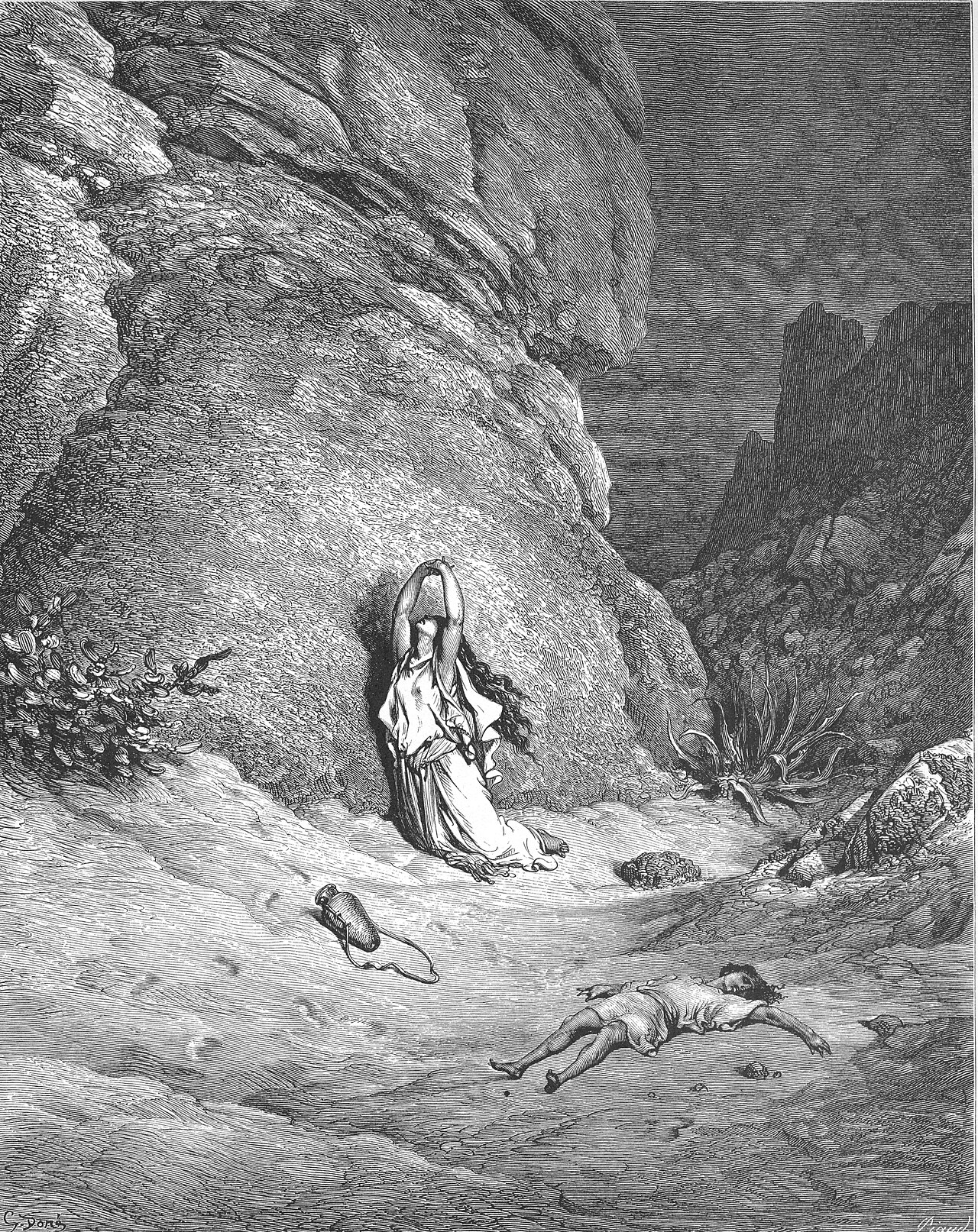
in Genesis 21Then she went off and sat down nearby, about a bowshot away, for she said, “I cannot bear to watch the boy die!” And as she sat nearby, she lifted up her voice and wept.
BSB
The same verse in ASV and KJV ▾
ASV
And she went, and sat her down over against him a good way off, as it were a bowshot: for she said, Let me not look upon the death of the child. And she sat over against him, and lifted up her voice, and wept.
KJV
And she went, and sat her down over against him a good way off, as it were a bowshot: for she said, Let me not see the death of the child. And she sat over against him, and lift up her voice, and wept.
⋯
This verse in Genesis 21
Commentary
6 notes on this verseThis site's exposition
Early in the morning, Abraham got up
on Genesis 21:14-16
Early in the morning Abraham got up, the same words that open 22:3 when he sets out for Moriah. Hagar wandered until the water in the skin was gone, left the boy under the bushes and sat a bowshot away, saying she could not bear to watch the boy die. Jamieson, Fausset and Brown read Ishmael here as about seventeen.
The record, by era
The Church Fathers1 voice
(Verse 15, 16.) And she put the boy under a tree, and went and sat opposite him, as if shooting an arrow. She said, 'I will not see the death of my child.' And she sat opposite him. And immediately it happened: The boy cried out, and wept, and God heard the voice of the boy from the place where he was. And the Angel of God called to Hagar from heaven, and so on, let no one move.
The Puritans and the Awakening2 voices
), though God had told her, before he was born, that he should live to be a man, a great man. We are apt to forget former promises, when present providences seem to contradict them; for we live by sense.
quarantine:debris (2026-07-29) — leading-punctuation+unbalanced-parens
And she went and sat her down over against him, a good way off,....
The Nineteenth Century2 voices
BRIEFLY LET US REHEARSE the circumstances. The child Isaac was, according to God’s word, to be the heir of Abraham. Ishmael, the elder son of Abraham, by the bondwoman Hagar, resided at home with his father till he was about eighteen years of age; but when he began to mock and scoff at the younger child whom God had ordained to be the heir, it became needful that he and his mother should be sent away from Abraham’s encampment.
BRIEFLY LET US REHEARSE the circumstances. The child Isaac was, according to God’s word, to be the heir of Abraham. Ishmael, the elder son of Abraham, by the bondwoman Hagar, resided at home with his father till he was about eighteen years of age; but when he began to mock and scoff at the younger child whom God had ordained to be the heir, it became needful that he and his mother should be sent away from Abraham’s encampment. It might have seemed unkind and heartless to have sent them forth, but God having arranged to provide for them sent a divine command which at once rendered their expulsion necessary, and certified its success. We may rest assured that whatever God commands he will be quite certain to justify. He knew it would be no cruelty to Hagar or Ishmael to be driven into independence, and he gave a promise which secured them everything which they desired. “Also of the son of the bondwoman will I make a great nation;” and again, “I have blessed him, and will make him fruitful, and will multiply him exceedingly; twelve princes shall he beget, and I will make him a great nation.” Had they both been able to go forth from Abraham’s tent in faith they might have trodden the desert with a joyous footstep, fully assured that he who bade them go, and he who promised that he would bless them, would be certain to provide all things needful for them. Early in the morning they were sent forth on their journey, with as much provision as they could carry, and probably they intended to make their way to Egypt, from which Hagar had come. They may have lost their way; at any rate, they are spoken of as wandering. Their store of food became exhausted, the water in the skin bottle was all spent; both of them felt the fatigue of the wilderness, and the heat of the pitiless sand; they were both faint and weary, and the younger utterly failed.
The words behind it
19 Hebrew wordsEvery Hebrew word of this verse in the order it stands, with what it means and the door to its own study. The last column counts the times a word stands in the whole Bible: the rarer the word, the more the places it appears belong together.
| Hebrew | Sound | Meaning | Word study | In the Bible |
|---|---|---|---|---|
| וַתֵּלֶךְ֩ | vatelekh | and she went | H1980 → | 1546 times |
| וַתֵּ֨שֶׁב | vateshev | and she sat | H3427 → | 1079 times |
| לָ֜הּ | lah | for <the> herself | ||
| מִנֶּ֗גֶד | mineged | from before | H5048 → | 151 times |
| הַרְחֵק֙ | harchek | at a distance | H7368 → | |
| כִּמְטַחֲוֵ֣י | kimtachavei | like [the] shooters of | H2909 → | |
| קֶ֔שֶׁת | keshet | a bow | H7198 → | 76 times |
| כִּ֣י | ki | for | H3588 → | 4482 times |
| אָֽמְרָ֔ה | ʾamerah | she said | H559 → | 5305 times |
| אַל־ | ʾal- | may not | H408 → | 724 times |
| אֶרְאֶ֖ה | ʾereh | I look | H7200 → | 1300 times |
| בְּמ֣וֹת | bemot | on [the] death of | H4194 → | 156 times |
| הַיָּ֑לֶד | haiyaled | the boy | H3206 → | 89 times |
| וַתֵּ֣שֶׁב | vateshev | and she sat | H3427 → | 1079 times |
| מִנֶּ֔גֶד | mineged | from before | H5048 → | 151 times |
| וַתִּשָּׂ֥א | vatisa' | and she lifted up | H5375 → | 656 times |
| אֶת־ | ʾet- | <obj.> | H853 → | 10935 times |
| קֹלָ֖הּ | kolah | voice her | H6963 → | 506 times |
| וַתֵּֽבְךְּ׃ | vatevek | and she wept | H1058 → | 114 times |
וַתֵּלֶךְ֩and she went
vatelekhH1980 →1546 times
וַתֵּ֨שֶׁבand she sat
vateshevH3427 →1079 times
לָ֜הּfor <the> herself
lah
מִנֶּ֗גֶדfrom before
minegedH5048 →151 times
הַרְחֵק֙at a distance
harchekH7368 →
כִּמְטַחֲוֵ֣יlike [the] shooters of
kimtachaveiH2909 →
קֶ֔שֶׁתa bow
keshetH7198 →76 times
כִּ֣יfor
kiH3588 →4482 times
אָֽמְרָ֔הshe said
ʾamerahH559 →5305 times
אַל־may not
ʾal-H408 →724 times
אֶרְאֶ֖הI look
ʾerehH7200 →1300 times
בְּמ֣וֹתon [the] death of
bemotH4194 →156 times
הַיָּ֑לֶדthe boy
haiyaledH3206 →89 times
וַתֵּ֣שֶׁבand she sat
vateshevH3427 →1079 times
מִנֶּ֔גֶדfrom before
minegedH5048 →151 times
וַתִּשָּׂ֥אand she lifted up
vatisa'H5375 →656 times
אֶת־<obj.>
ʾet-H853 →10935 times
קֹלָ֖הּvoice her
kolahH6963 →506 times
וַתֵּֽבְךְּ׃and she wept
vatevekH1058 →114 times
A shaded row is a word that stands 400 times or fewer in the Bible.
The walk
8 stopsEach card is a verse this one points to, and under it the verses that one points to in turn. Where several paths arrive at the same place, that place is listed first: the text keeps returning to it.
Through
Isaiah 49:15“Can a woman forget her nursing child, or lack compassion for the son of her womb? Even if she could forget, I will not forget you!
it leads to
- Psalms 103:13
As a father has compassion on his children, so the LORD has compassion on those who fear Him.
- Isaiah 44:21
Remember these things, O Jacob, for you are My servant, O Israel. I have made you, and you are My servant; O Israel, I will never forget you.
- Matthew 7:11
So if you who are evil know how to give good gifts to your children, how much more will your Father in heaven give good things to those who ask Him!
- Jeremiah 31:20
Is not Ephraim a precious son to Me, a delightful child? Though I often speak against him, I still remember him. Therefore My heart yearns for him; I have great compassion for him,” declares…
- Hosea 11:1
When Israel was a child, I loved him, and out of Egypt I called My son.
- Psalms 103:13
Through
Genesis 29:11Then Jacob kissed Rachel and wept aloud.
it leads to
- Genesis 33:4
Esau, however, ran to him and embraced him, threw his arms around his neck, and kissed him. And they both wept.
Reached by 2 separate paths from here.
- Genesis 33:4
Through
Ruth 1:9May the LORD enable each of you to find rest in the home of your new husband.” And she kissed them as they wept aloud
it leads to
- Ruth 3:1
One day Ruth’s mother-in-law Naomi said to her, “My daughter, should I not seek a resting place for you, that it may be well with you?
- Acts 20:37
They all wept openly as they embraced Paul and kissed him.
- Ruth 3:1
Where this verse is studied
About Genesis
This page draws on Charles Spurgeon, The Metropolitan Tabernacle Pulpit, Sermon No. 974: “Compassion for Souls” (lightly modernized text, CCEL edition); Jamieson, Fausset & Brown, Commentary Critical and Explanatory on the Whole Bible; Jerome, Hebrew Questions on Genesis; John Gill, Exposition of the Old Testament (1748-1763) and Matthew Henry, Commentary on the Whole Bible.