
Genesis 21:9
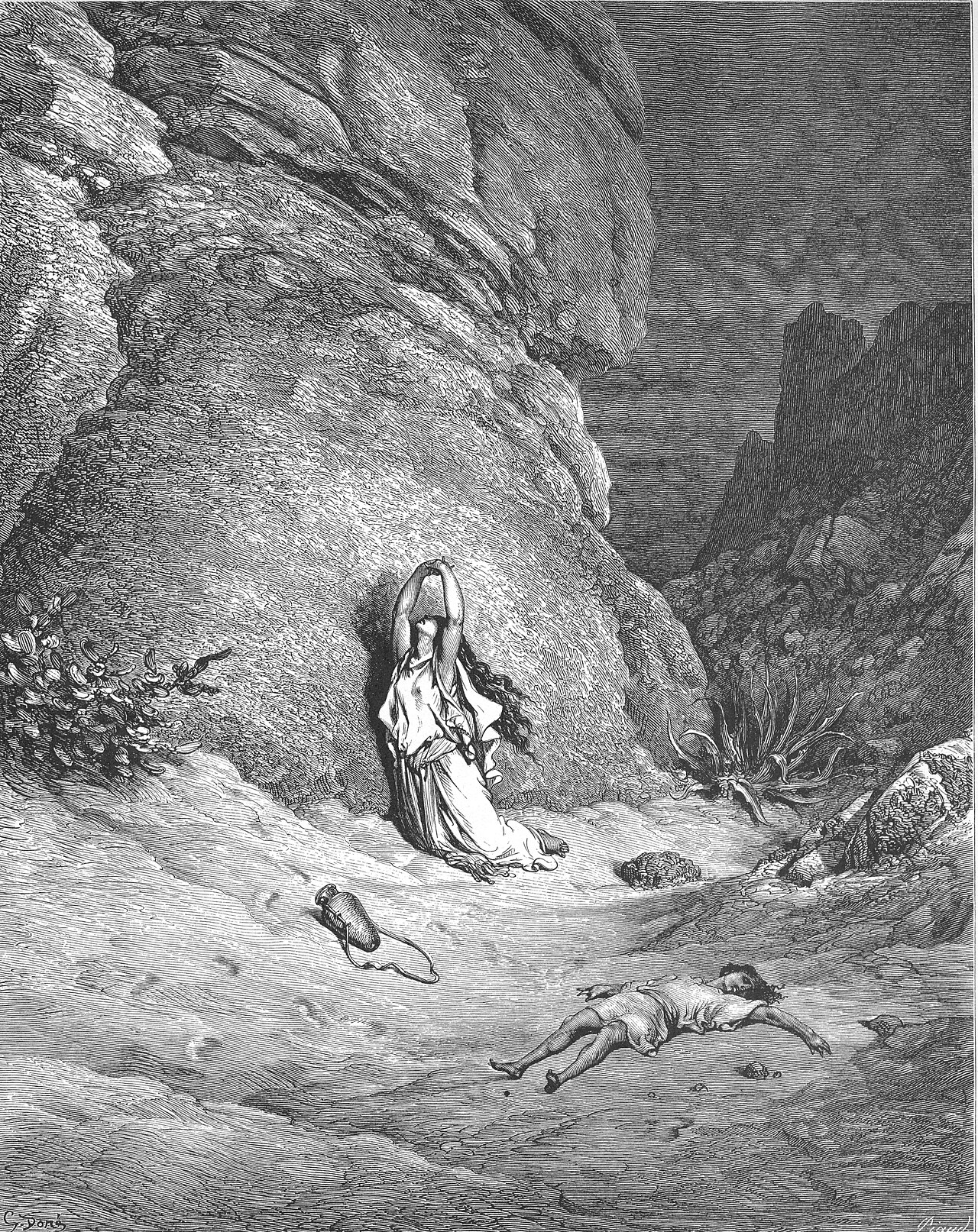
in Genesis 21But Sarah saw that the son whom Hagar the Egyptian had borne to Abraham was mocking her son,
BSB
The same verse in ASV and KJV ▾
ASV
And Sarah saw the son of Hagar the Egyptian, whom she had borne unto Abraham, mocking.
KJV
And Sarah saw the son of Hagar the Egyptian, which she had born unto Abraham, mocking.
⋯
This verse in Genesis 21
Commentary
12 notes on this verse(Chapter 21, Verse 9) And Sarah saw the son of Hagar the Egyptian, whom she bore to Abraham, playing. What follows, with his son Isaac, is not present in the Hebrew. Therefore, this is interpreted in two ways by the Hebrews: either that she made idols out of play, according to what is written elsewhere: The people sat down to eat and drink, and rose up to play (Exodus 32:6); or that she claimed the rights of the firstborn against Isaac, as if he were older, through play and jest.
This site's exposition
Hagar the Egyptian had borne to Abraham
on Genesis 21:9-10
Hagar is called the Egyptian here. Genesis gives what Ishmael did in one word, mocking, which Paul calls persecution at Galatians 4:29 and Clarke reads as ridicule. Sarah's demand is about the inheritance, that the slave woman's son will never share it with Isaac.
The record, by era
The Church Fathers4 voices
See, I ask you, dearly beloved, in this instance once again Sarah not tolerating the brashness of Ishmael and unable to put up equably with the maidservant's son being reared with Isaac. So just as she previously wished to check Hagar's arrogance and in her extreme irritation had her sent packing, so in this case too she wanted to nip Ishmael's forwardness in the bud. Not bearing to see the son born of grace and of the very gift of God being reared along with that of the Egyptian maidservant, she said to Abraham, "Send away the maidservant and her son: surely the son of the maidservant will not share the inheritance with my son?" Since she realized that she herself was in fact in extreme old age, and she saw the patriarch was well on (after all, they were both advanced in years), she was afraid that in the event of their sudden passing Ishmael would, on the score of his being born of an association of the patriarch, endeavor to thrust himself into his father's inheritance and become a sharer of it with Isaac. Hence she said, "Send away from here the maidservant and her son." Let her learn at this stage, she is saying, that the son of the maidservant has nothing in common with my son, Isaac. It is, in fact, not fair that the slave's son should be reared with that of the mistress, my son.
Then the time came for Isaac to be born, and milk flowed in the breasts of the old woman. On the day of the great feast that Abraham prepared when he circumcised and weaned Isaac, Sarah noticed Ishmael playing.
Spiritually, therefore, all indeed who come to the recognition of God through faith can be called sons of Abraham; but among these some cling to God on the basis of love, others on the basis of dread and fear of future judgment. Whence also the apostle John says, "He who fears is not perfected in love, but perfect love casts out fear." He therefore who "is perfected in love" is born of Abraham and is "a son of the free woman." But he who keeps the commandments, not in perfect love but in dread of future torment and in fear of punishments is, indeed, also himself a son of Abraham. He too receives gifts, that is, the reward of his work (because even "he who shall give a cup of cold water only in the name of a disciple, shall not lose his reward"). Nevertheless he is inferior to that person who is perfected, not in slavish fear but in the freedom of love.The apostle also shows something similar when he says, "As long indeed as the heir is a child, he differs nothing from a servant, though he be lord of all; but he is under tutors and governors until the time appointed by the father." He is "a child," therefore, who is nourished "with milk" and "is unskillful in the word of justice"; nor is he able to receive the "solid food" of the divine wisdom and knowledge of the law.
Sarah is angry because the son of the bondwoman plays with the son of the free woman, and she considers that play to be a disaster. She counsels Abraham and says, "Cast out the bondwoman and her son. For the son of the bondwoman shall not be heir with my son, Isaac."I shall not now consider how these words ought to be understood. The apostle discussed them in this way, saying, "Tell me, you who have read the law, have you not heard the law? For it is written that Abraham had two sons, the one by a bondwoman and the other by a free woman. But he indeed who was of the bondwoman was born according to the flesh, but he of the free woman was by promise. Which things are allegorical." What then? Is Isaac not "born according to the flesh"? Did Sarah not bear him? Is he not circumcised? In regard to this very incident, that he played with Ishmael, did he not play in the flesh? This indeed is what is astonishing in the apostle's understanding, that he called things "allegorical" that are quite obviously done in the flesh. His purpose is that we might learn how to treat other passages, and especially these in which the historical narrative appears to reveal nothing worthy of the divine law. Ishmael, therefore, is born "according to the flesh," the son of the bondwoman.
The Medieval Church1 voice
And when Sarah saw the son of Hagar the Egyptian playing, she said to Abraham: "Expel this slave woman and her son, for the son of the slave woman shall not be heir with my son Isaac."
5 more voices on this verse
The Puritans and the Awakening3 voices
), and perhaps his name bade him expect it. Note, God's favourites are often the world's laughing-stocks. (4.) The promise which he was not only the son, but the heir of, was to be the joy of all the saints in all ages, and that which would fill their mouths with laughter.
quarantine:debris (2026-07-29) — leading-punctuation+unbalanced-parens
29 ), that he that was born after the flesh persecuted him that was born after the Spirit. Ishmael is here called the son of the Egyptian, because, as some think, the 400 years' affliction of the seed of Abraham by the Egyptians began now, and was to be dated hence, ch. xv. She saw him playing with Isaac, so the LXX., and, in play, mocking him.
quarantine:debris (2026-07-29) — leading-citation-number+unbalanced-parens
And Sarah saw the son of Hagar the Egyptian,.... That is, Ishmael, who is not expressed by name, but described by being a son of Hagar, a servant of Sarah's, and an Egyptian woman; all which seems to be observed by way of slight, both to Hagar and her son: which she had born unto Abraham; not unto Sarah, as she proposed to herself, when she gave her maid to Abraham, Gen 16:
The Nineteenth Century2 voices
Mocking - What was implied in this mocking is not known. St. Paul, Gal 4:29, calls it persecuting; but it is likely he meant no more than some species of ridicule used by Ishmael on the occasion, and probably with respect to the age of Sarah at Isaac’s birth, and her previous barrenness. Jonathan ben Uzziel and the Jerusalem Targum represent Ishmael as performing some idolatrous rite on the occasion, and that this had given the offense to Sarah. Conjectures are as useless as they are endless.
A commentator
Jamieson, Fausset & Brown1802–1910
Commentary Critical and Explanatory on the Whole Bible (1871)
Sarah saw the son of Hagar . . . mocking--Ishmael was aware of the great change in his prospects, and under the impulse of irritated or resentful feelings, in which he was probably joined by his mother, treated the young heir with derision and probably some violence (Ga 4:29).
How the passage was read
What the Jewish commentators add
On the verses either side of this one
She said to Avraham, Drive out this slave-woman and her son, for the son of this slave-woman will not inherit with my son, with Yitzchok.
This section is reception history: how the passage was read and kept in the Jewish tradition. Where a reading parts from an essential of the Christian faith, the section says so at that point.
Texts and citation data: Sefaria; each excerpt follows its version’s licence. 4 further sources are cited on this chapter that carry no English text this site may quote or only restate the verse.
The words behind it
10 Hebrew wordsEvery Hebrew word of this verse in the order it stands, with what it means and the door to its own study. The last column counts the times a word stands in the whole Bible: the rarer the word, the more the places it appears belong together.
| Hebrew | Sound | Meaning | Word study | In the Bible |
|---|---|---|---|---|
| וַתֵּ֨רֶא | vatere' | and she saw | H7200 → | 1300 times |
| שָׂרָ֜ה | sarah | Sarah | H8283 → | 38 times |
| אֶֽת־ | ʾet- | <obj.> | H853 → | 10935 times |
| בֶּן־ | ben- | [the] son of | H1121 → | 4930 times |
| הָגָ֧ר | hagar | Hagar | H1904 → | 12 times |
| הַמִּצְרִ֛ית | hamitzrit | the Egyptian | H4713 → | 70 times |
| אֲשֶׁר־ | ʾasher- | whom | H834 → | 5497 times |
| יָלְדָ֥ה | yaldah | she had borne | H3205 → | 496 times |
| לְאַבְרָהָ֖ם | leavraham | to Abraham | H85 → | 175 times |
| מְצַחֵֽק׃ | metzachek | mocking | H6711 → | 13 times |
וַתֵּ֨רֶאand she saw
vatere'H7200 →1300 times
שָׂרָ֜הSarah
sarahH8283 →38 times
אֶֽת־<obj.>
ʾet-H853 →10935 times
בֶּן־[the] son of
ben-H1121 →4930 times
הָגָ֧רHagar
hagarH1904 →12 times
הַמִּצְרִ֛יתthe Egyptian
hamitzritH4713 →70 times
אֲשֶׁר־whom
ʾasher-H834 →5497 times
יָלְדָ֥הshe had borne
yaldahH3205 →496 times
לְאַבְרָהָ֖םto Abraham
leavrahamH85 →175 times
מְצַחֵֽק׃mocking
metzachekH6711 →13 times
A shaded row is a word that stands 400 times or fewer in the Bible.
The walk
8 stopsEach card is a verse this one points to, and under it the verses that one points to in turn. Where several paths arrive at the same place, that place is listed first: the text keeps returning to it.
Through
Genesis 16:1Now Abram’s wife Sarai had borne him no children, but she had an Egyptian maidservant named Hagar.
it leads to
- Galatians 4:24
These things serve as illustrations, for the women represent two covenants. One covenant is from Mount Sinai and bears children into slavery: This is Hagar.
- Genesis 12:16
He treated Abram well on her account, and Abram acquired sheep and cattle, male and female donkeys, menservants and maidservants, and camels.
- Genesis 15:2–3
But Abram replied, “O Lord GOD, what can You give me, since I remain childless, and the heir of my house is Eliezer of Damascus?”
- Genesis 21:9–10
But Sarah saw that the son whom Hagar the Egyptian had borne to Abraham was mocking her son,
- Galatians 4:24
Through
Galatians 4:22For it is written that Abraham had two sons, one by the slave woman and the other by the free woman.
it leads to
- Genesis 16:15
And Hagar bore Abram a son, and Abram gave the name Ishmael to the son she had borne.
- Genesis 16:15
Through
Galatians 4:29At that time, however, the son born by the flesh persecuted the son born by the Spirit. It is the same now.
it leads to
- Romans 8:13
For if you live according to the flesh, you will die; but if by the Spirit you put to death the deeds of the body, you will live.
- Galatians 5:11
Now, brothers, if I am still preaching circumcision, why am I still being persecuted? In that case the offense of the cross has been abolished.
- Galatians 4:23
His son by the slave woman was born according to the flesh, but his son by the free woman was born through the promise.
- Romans 8:13
Where this verse is studied
About Genesis
Who and where
3 names in this verse with a page on the site.
- PersonPatriarchsSarahAbraham's wife — barren, then bearing Isaac by promise “past age” through faith; Paul's allegory of the covenant of promise (Gal 4…
- PersonPatriarchsHagarSarah's Egyptian servant and mother of Ishmael; the first person to name God — “Thou God seest me” (El Roi, 16:13).
- PersonPatriarchsAbrahamCalled out of Ur, the father of all who believe, justified by faith, and the friend of God through whose seed all nations are bles…
This page draws on 10 works. Open the list of works
This page draws on Adam Clarke, Commentary on the Bible; Bede, Commentary on Genesis (Hexaemeron); Ephrem the Syrian, COMMENTARY ON GENESIS 18:1; Jamieson, Fausset & Brown, Commentary Critical and Explanatory on the Whole Bible; Jerome, Hebrew Questions on Genesis; John Chrysostom, HOMILIES ON GENESIS 46.2; John Gill, Exposition of the Old Testament (1748-1763); Matthew Henry, Commentary on the Whole Bible; Origen of Alexandria, HOMILIES ON GENESIS 7.4 and Origen of Alexandria, HOMILIES ON GENESIS 7.2.