
Genesischapter 19
38 verses · Moses, by tradition · 15th to 13th century BC · The Law
In Jewish life
The reading
Weekly portion 4 of 54
וַיֵּרָא Vayera, Genesis 18:1 to 22:24
Read with it: 2 Kings 4:1 to 4:37 in Ashkenazi use, and 2 Kings 4:1 to 4:23 in Sephardi use.
The verse numbers here are the ones a Hebrew Bible carries, which differ from an English Bible by a verse or two in several places. The Sephardi reading is named only where this site records a difference; communities vary beyond what is listed. What these books are, and how a Christian reader meets them →
What is done
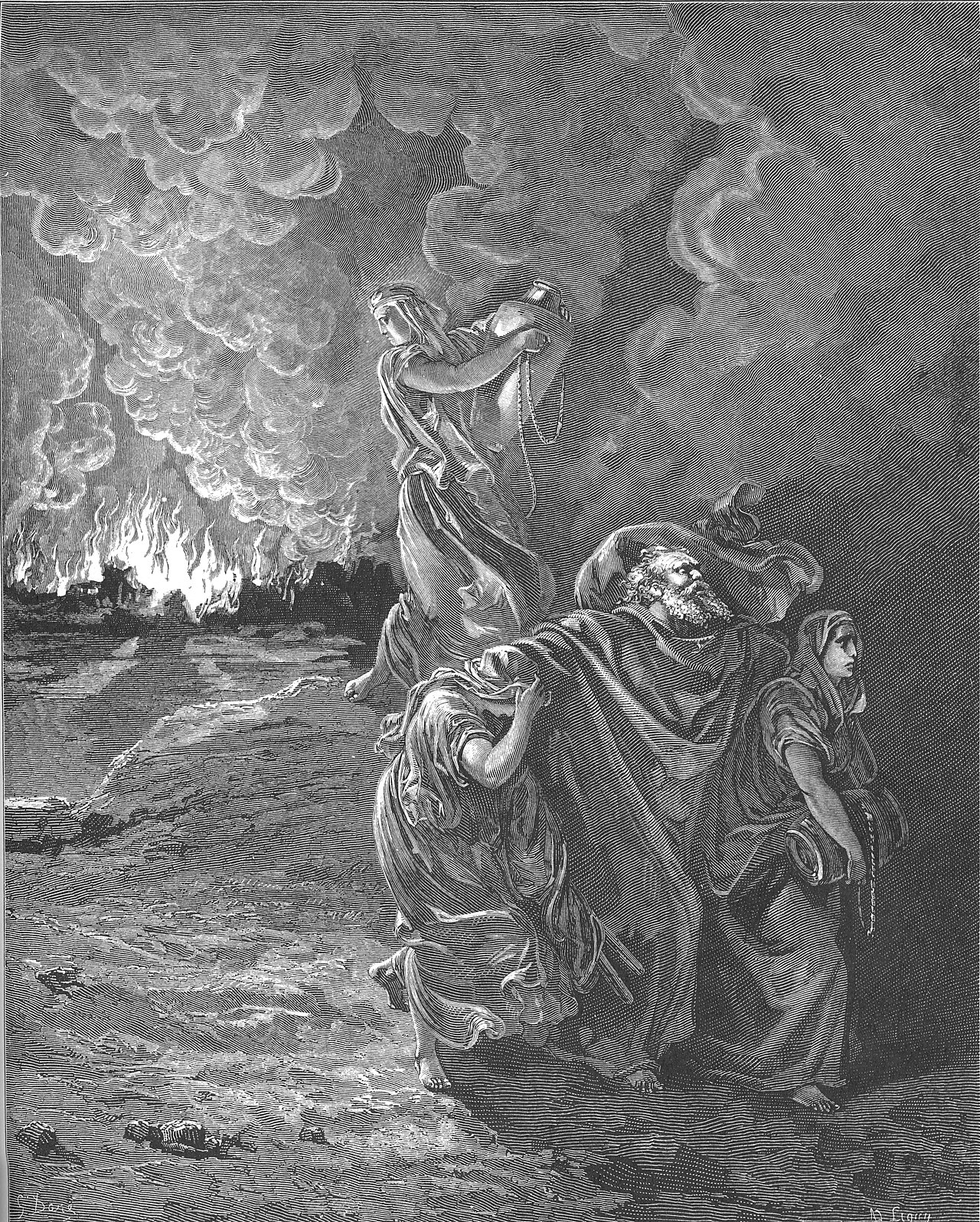
This chapter is heard inside the fourth portion of the annual cycle, in the same sitting as the visit at the oaks and the binding of Isaac (src/lib/hebraic/readings.ts). The two angels at the gate, the destruction of the cities and the cave at Zoar are read without a break from the pleading of Abraham. The card above carries the portion and the prophetic reading set beside it.
How it is read
The corpus holds the English text of three comments on this chapter and the reference alone for twenty one more. Radak is quoted from the CC-BY translation of Eliyahu Munk, HaChut Hameshulash.
Radak reads the plea of Lot in the seventh verse as a plea made on the ground of neighbourhood. Lot calls the men of the city his brothers and his neighbours, and asks them to leave his guests alone for his sake (Radak on Genesis 19:7:1). On the thirteenth verse he reads the outcry as the cry of "the victims of the cruelties of the Sodomites". He treats the wording of that verse as a point of Hebrew grammar (Radak on Genesis 19:13:1). On the twenty third verse he holds that the destruction began the moment Lot was inside Zoar, and that the angel acted on the word of God (Radak on Genesis 19:23:1).
Rashi comments on nineteen verses of this chapter, and the corpus holds the text of none of them, because the licence Sefaria reports for that English version keeps it out. They run from Rashi on Genesis 19:1:1 on the angels at the gate to Rashi on Genesis 19:24:1 on the overthrow. Ibn Ezra stands on the sixth verse at Ibn Ezra on Genesis 19:6:1, and Sforno on the tenth at Sforno on Genesis 19:10:1.
What the rabbis say
The corpus records forty places where the Midrash and the Talmud cite this chapter, thirty three under Midrash and seven under Talmud. It carries the locator for each one with no text, so the references stand here and the sayings are read at the source.
Bereshit Rabbah reads the chapter through from the gate to the cave. It reads the first verse at 49:14, the second at 50:4, the sixth at 45:6, the ninth at 50:7 and the tenth at 50:8. It reads the twelfth verse at 26:5, the thirteenth at 50:9, the twenty second at 50:12 and the twenty fifth at 51:4. It reads the thirtieth verse at 51:7, the thirty first at 51:8, the thirty second at 41:7, the thirty sixth at 45:4 and the thirty seventh at 51:11.
Aggadat Bereshit reads the sixteenth verse at 31:3, the seventeenth at 25:2, the twenty third at 25:1, the twenty fourth at 1:1 and the twenty seventh at 34:1. Bamidbar Rabbah reads the fifth verse at 20:22, the eighth at 10:5, the eleventh at 9:18, the twenty first at 11:7 and the twenty ninth at 20:19. Midrash Sekhel Tov reads the seventh and thirty fourth verses at the locators of the same names, and Bereshit Rabbati reads the nineteenth at Parashat Vayera 41.
The Talmud is cited at Bava Metzia 86b:20 on the first verse and 87a:1 on the third, which sets the welcome Lot gave beside the welcome Abraham gave in the chapter before. It is cited at Bava Batra 91b:10 on the fifteenth verse and at Berakhot 54b:8 on the pillar of salt. The Jerusalem Talmud reads the twenty eighth verse at Maaser Sheni 5:5:8. Avot DeRabbi Natan reads the thirty third verse at 34:5, and its second recension reads the thirty fifth at 37:10.
The text, verse by verse
Each word shows the Hebrew, the English under it, how it sounds and its Strong’s number. A rule between verses marks where the Hebrew manuscripts end a paragraph.
Angels at Lot's Door
Ibn Ezra on Genesis 19:1
[AT EVEN.] The term ba-erev (at even) will be explained in the chapter dealing with the Passover observed by the Israelites in Egypt.
Read it in full at Sefaria · Ibn Ezra's commentary on the Pentateuch, tran. and annot. by H. Norman Strickman and Arthur M. Silver. Menorah Pub., 1988-2004
Flee, and Do Not Look Back
Ramban on Genesis 19:12
Rashi comments: “Whom else of your family have you in the city besides your wife and daughters who are at home with you? If you have additionally a son-in-law, or sons and daughters, take them out from this place.
Read it in full at Sefaria · Commentary on the Torah by Ramban (Nachmanides). Translated and annotated by Charles B. Chavel. New York, Shilo Pub. House, 1971-1976
Fire, Brimstone, and a Pillar of Salt
Lot's Daughters in the Cave
Hebrew words in this chapter
The 40 most used Hebrew words of the chapter, counted by lemma. The article, the object marker, the negatives and the common prepositions are left out.
| Word | Sense here | Uses | Strong’s |
|---|---|---|---|
| לוֹטLôwṭ | Lot | 15 | H3876 |
| אָמַרʼâmar | to say | 14 | H559 |
| עִירʻîyr | the city | 12 | H5892 |
| בּוֹאbôwʼ | to come | 11 | H935 |
| אָבʼâb | father | 11 | H1 |
| נָאnâʼ | please | 9 | H4994 |
| יָצָאyâtsâʼ | to come out | 9 | H3318 |
| שָׁכַבshâkab | to lie down | 8 | H7901 |
| אֱנוֹשׁʼĕnôwsh | and men of | 8 | H582 |
| בַּתbath | daughter | 8 | H1323 |
| שְׁנַיִםshᵉnayim | two | 7 | H8147 |
| יְהֹוָהYᵉhôvâh | yahweh | 7 | H3068 |
| יָשַׁבyâshab | to dwell | 6 | H3427 |
| קוּםqûwm | and he arose | 6 | H6965 |
| אֶרֶץʼerets | land | 6 | H776 |
| הִנֵּהhinnêh | here | 6 | H2009 |
| סְדֹםÇᵉdôm | Sodom | 5 | H5467 |
| בַּיִתbayith | house of | 5 | H1004 |
| עָשָׂהʻâsâh | and he prepared | 5 | H6213 |
| פָּנִיםpânîym | face | 5 | H6440 |
| Word | Sense here | Uses | Strong’s |
|---|---|---|---|
| מָלַטmâlaṭ | to escape | 5 | H4422 |
| שָׁםshâm | there | 5 | H8033 |
| קָרָאqârâʼ | to call | 4 | H7121 |
| לַיִלlayil | night | 4 | H3915 |
| יָדַעyâdaʻ | to know | 4 | H3045 |
| יָדyâd | hand | 4 | H3027 |
| בֵּןbên | son | 4 | H1121 |
| מָקוֹםmâqôwm | place | 4 | H4725 |
| שָׁחַתshâchath | about to destroy | 4 | H7843 |
| כִּכָּרkikkâr | the valley | 4 | H3603 |
| חָיָהchâyâh | to live | 4 | H2421 |
| צֹעַרTsôʻar | Zoar | 4 | H6820 |
| בְּכִירָהbᵉkîyrâh | firstborn | 4 | H1067 |
| צָעִירtsâʻîyr | the young | 4 | H6810 |
| שָׁקָהshâqâh | let us make drink | 4 | H8248 |
| יַיִןyayin | wine | 4 | H3196 |
| פֶּתַחpethach | entrance | 3 | H6607 |
| דֶּלֶתdeleth | door | 3 | H1817 |
| אִישׁʼîysh | man | 3 | H376 |
| עַיִןʻayin | in view your | 3 | H5869 |
Keep studying
Sources for this chapter
The Hebrew text
STEP Bible, the tagged Hebrew text and its English glosses and James Strong, Strong's Exhaustive Concordance.
In Jewish life
Radak, Radak on Genesis 19:7:1, 19:13:1 and 19:23:1, in HaChut Hameshulash, translated by Eliyahu Munk, CC-BY; Rashi, Ibn Ezra and Sforno, their twenty one comments on Genesis 19, cited by reference; the licence Sefaria reports for the English versions keeps the text out of the corpus; The Midrash and the Talmud, the forty locators on Genesis 19 in scripts/data/sources/sefaria/genesis/19.json and MannaFest, the annual cycle table at src/lib/hebraic/readings.ts.
The rabbinic texts
Ramban, Commentary on the Torah by Ramban (Nachmanides). Translated and annotated by Charles B. Chavel. New York, Shilo Pub. House, 1971-1976; Ibn Ezra, Ibn Ezra's commentary on the Pentateuch, tran. and annot. by H. Norman Strickman and Arthur M. Silver. Menorah Pub., 1988-2004 and Sefaria, texts and citation data.