
Ezrachapter 2
70 verses · Ezra, by tradition · 5th century BC · History
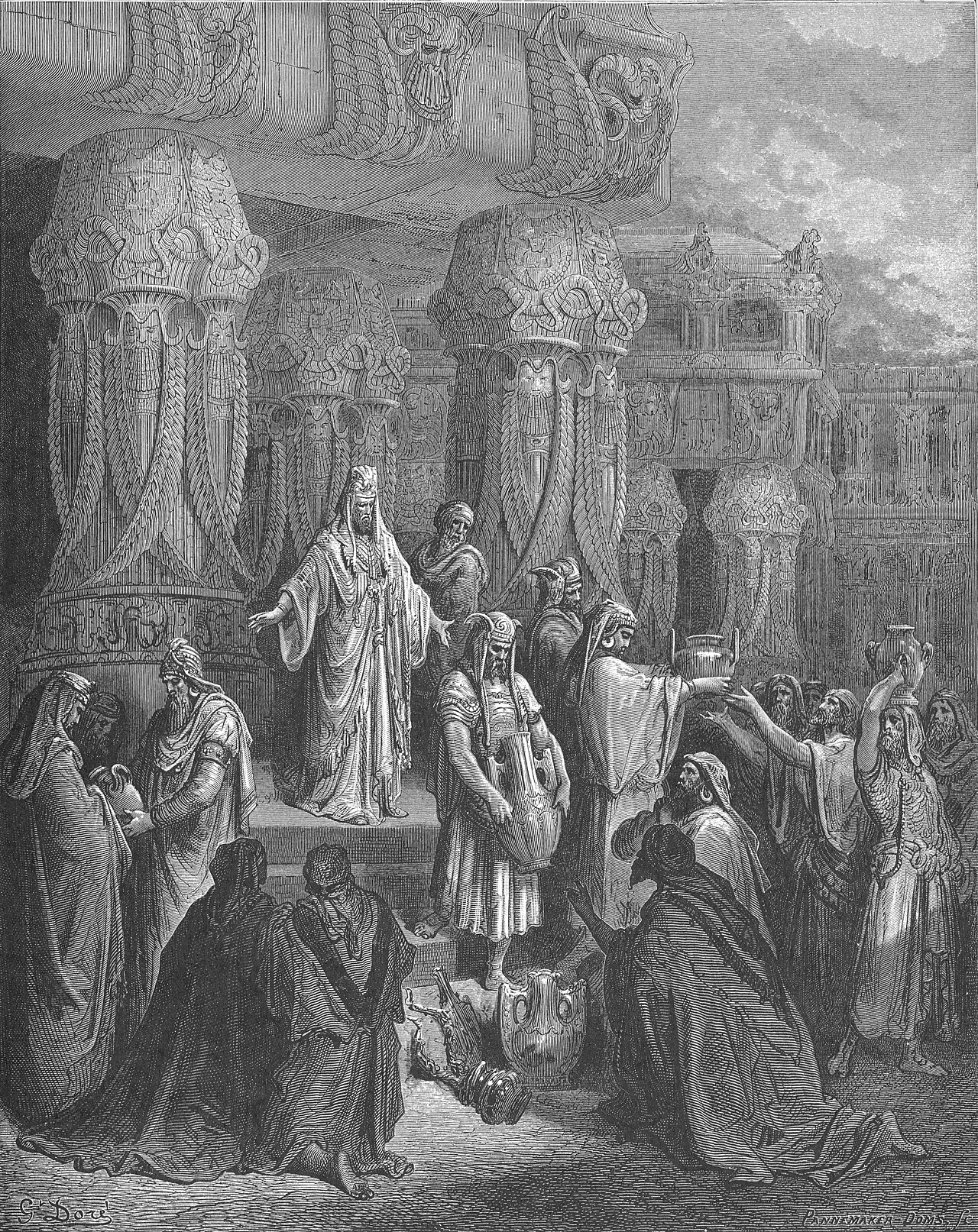
These men searched for their family records, but they could not find them and so were excluded from the priesthood as unclean.
Introduction
Ezra, by tradition, History, Ezra Overview.
This chapter is a register kept by a people who had lost their land and needed to prove who they were. Tradition gives the book to Ezra, and the list itself comes from the records of the first return under Zerubbabel. Its first hearers would have looked for their own families in it. Lists like this settled who could farm which fields and who could serve at the altar. Listen for how the list is arranged, by ancestor, by town and by office, and notice who could not prove a place. Read it as a record of people who chose a ruin over comfort.
Context
- Who
- Later readers who needed to know who came back and by what right they claimed their towns
- What
- A register of the families, towns and temple servants who returned under Zerubbabel, with the totals of people, animals and gifts.
- Where
- The road from Babylon to Jerusalem, and the towns of Judah and Benjamin named in the list, such as Bethlehem, Anathoth, Bethel, Lod and Jericho.
- When
- The first return, about 538 to 537 BC; the list belongs to that return, though it may have been compiled from records kept over some years.
- Why
- To record who belonged to the returned community and by what right families claimed their towns and priests their office.
Historical context
This chapter is a list, and lists were the backbone of ancient administration. It records about 42,360 people plus more than 7,000 servants, along with 736 horses, 245 mules, 435 camels, and 6,720 donkeys, a caravan large enough to be a small nation on the move and small enough to be swallowed by the land it was going to.
Show the rest of the historical context, 4 more paragraphs
The list is organized two ways at once: some families are listed by ancestor, others by town, Bethlehem, Netophah, Anathoth, Jericho, Lod. Those town entries are property claims. A family that could prove it belonged to a place could go back and work that ground.
Priests, Levites, singers, gatekeepers, and temple servants are counted separately because the temple could not function without each group. Strikingly few Levites came, 74 out of tens of thousands.
Then a hard paragraph. Some families could not show their father's house or their descent, so they were treated as unclean and excluded from the priesthood until a priest could stand up with Urim and Thummim. Those were the objects used to seek a yes-or-no decision from God, kept in the high priest's breastpiece. Their answer was: wait for a ruling nobody could presently give.
The chapter ends with donations by weight, gold drams, pounds of silver, priests' garments, and the whole company settling in their cities before the seventh month.
Significance
To the returnees this list was their charter. It said who they were, where they belonged, and what they had given. Every name in it belonged to someone who chose a ruin over a comfortable life in Babylon.
Show the rest of the significance, 1 more paragraph
And the exclusion paragraph shows a community trying to be careful rather than convenient. They would not simply grant priesthood on a claim. They were rebuilding something they intended to be right.
This chapter in Jewish lifeWhat this chapter is in Jewish life and reading.
What is done
This list of the returning families has no place in the synagogue year. The site's own table in src/lib/hebraic/readings.ts printed parashot total 0 and haftarah uses total 0 for Ezra, and no festival reading.
Some of its names are met in the study of the Torah portions, and the corpus shows where. Under the fourteenth verse it carries Midrash Tanchuma, Ki Tisa 9:2. Under the fifty-third it carries Midrash Tanchuma, Sh'lach 6:1 and Shemot 2:2, with Midrash Tanchuma Buber, Sh'lach 10:1 and Shemot 1:3.
How it is read
Rashi is the one commentator on this chapter whose English the corpus carries, quoted here from The Judaica Press complete Tanach with Rashi, translated by A. J. Rosenberg, which Sefaria reports as CC-BY. He reads the chapter as a census in a set order. The people of the province are the Children of Israel from the land of Israel, now coming up to Jerusalem from the captivity (Rashi on Ezra 2:1:1). The families are named two ways. "There are some in the chapter for whom the father’s name is used for the family name [surname] and there are some who are called by the name of their place" (Rashi on Ezra 2:3:1).
He marks where the count turns. "Until here, he counted the children of Judah and Benjamin, and from now on he counts the priests and the Levites" (Rashi on Ezra 2:36:1). He ties the order back to the heads of the families in the first chapter. The singers and the gatekeepers he names as Levites, the gatekeepers keeping the gates of the Temple (Rashi on Ezra 2:41:1). The Nethinim he describes as those "who were woodcutters and water-drawers for the congregation, and from there they derived their livelihood" (Rashi on Ezra 2:43:1). The children of Solomon's slaves are descendants of slaves King Solomon had (Rashi on Ezra 2:58:1).
The corpus carries seventeen further notes on this chapter without an English text, each marked linked because Sefaria holds no English version of the ref. Thirteen stand cited and unquoted at Ibn Ezra on Ezra 2:6:1, 2:9:1, 2:23:1, 2:25:1, 2:26:1, 2:29:1, 2:32:1, 2:40:1, 2:42:1, 2:46:1, 2:50:1, 2:55:1 and 2:57:1. Three stand at Metzudat David on Ezra 2:16:1, 2:31:1 and 2:39:1, and one at Malbim on Ezra 2:21:1.
What the rabbis say
The corpus carries forty rabbinic locators on this chapter and the text of none, so each is cited here rather than quoted. On the first verse it holds Pirkei DeRabbi Eliezer 8:4. On the second, the leaders of the return, it holds Megillah 16b:18, Ein Yaakov, Megillah 1:49, Ein Yaakov (Glick Edition), Megillah 1:42, and Jerusalem Talmud Shekalim 5:1:1 and 5:1:8.
The families draw scattered locators. On the fourteenth verse the corpus holds Midrash Tanchuma, Ki Tisa 9:2, and on the fifteenth Jerusalem Talmud Taanit 4:4:1. On the twenty-third it holds Pesikta DeRav Kahana 24:11, and on the thirty-fourth Pesikta Rabbati 10:1. On the thirty-sixth, the priests, it holds Jerusalem Talmud Taanit 4:2:8. On the forty-third, the Nethinim, it holds Yevamot 20a:8. On the fifty-first it holds Bereshit Rabbah 71:3, Midrash Sekhel Tov, Bereshit 29:32:2 and Yalkut Shimoni on Torah 126:3. On the fifty-third it holds Bamidbar Rabbah 16:10 with the four Tanchuma locators named above.
The later verses carry the heaviest Talmudic weight. On the fifty-eighth verse the corpus holds Jerusalem Talmud Kiddushin 4:1:6, and on the fifty-ninth Yevamot 122a:13. On the sixty-first it holds Kiddushin 69b:9, Ketubot 24b:14, and Jerusalem Talmud Kiddushin 4:1:3 and 4:1:4. On the sixty-third it holds Kiddushin 69b:15, Ketubot 25a:3, Ein Yaakov, Sotah 9:17, Ein Yaakov (Glick Edition), Sotah 9:16, and a passage of Otzar Midrashim on missing and extra letters, at 1:6.
The last verses close the chapter. On the sixty-fourth verse the corpus holds Arakhin 32b:15, Bava Metzia 28a:17, Ein Yaakov, Bava Metzia 2:7 and Bamidbar Rabbah 2:11. On the sixty-sixth it holds Ruth Rabbah 1:5, and on the sixty-seventh Ruth Rabbah (Lerner) 1:10:1. On the seventieth it holds Kiddushin 69b:8, Bava Metzia 28a:18 and Ein Yaakov, Kiddushin 4:2. What each of them teaches is a saying of the rabbis, and is reported as theirs wherever this site quotes one. The quotations wait on a fetch that carries the text.
Sources: Rashi, Rashi on Ezra 2:1:1 to 2:58:1, The Judaica Press complete Tanach with Rashi, translated by A. J. Rosenberg, reported CC-BY; Ibn Ezra, Ibn Ezra on Ezra 2:6:1, 2:9:1, 2:23:1, 2:25:1, 2:26:1, 2:29:1, 2:32:1, 2:40:1, 2:42:1, 2:46:1, 2:50:1, 2:55:1 and 2:57:1, cited by ref because the corpus carries no English text; Metzudat David, Metzudat David on Ezra 2:16:1, 2:31:1 and 2:39:1, cited by ref because the corpus carries no English text; Malbim, Malbim on Ezra 2:21:1, cited by ref because the corpus carries no English text; The Sefaria corpus, scripts/data/sources/sefaria/ezra/2.json, the 40 Talmud and Midrash locators of this chapter; The site's own files, src/lib/hebraic/readings.ts, probed for this book and printing parashot total 0, haftarah uses total 0 and festivalReadingForBook null.
The heads below are this chapter's scenes. The numbered points under each are its verses.
The men of Israel counted family by family
Ezra 2:1-2
each to his own town: The list answers the summons of Cyrus with a family and a town for each household. Each returns to his town, so the return restores residence as well as release. The form of the list follows the genealogies of 1 Chronicles 1 to 9, which did legal work for Israel.
Ezra 2:1
“That they are called children of the province. Judah, which had been an illustrious kingdom, to which other kingdoms had been made provinces, subject to it and dependent on it, was now itself made a province, to receive laws and commissions from the king of Persia and to be accountable to him. See how sin diminishes and debases a nation, which righteousness would exalt.”
Matthew Henry · Commentary on the Whole Bible (1707-1721)puritan
the count of the men of Israel: Nehemiah 7:7 gives this roll of leaders with twelve names, adding Nahamani and setting Azariah in Seraiah's place. Albert Barnes cites those twelve chiefs, and the wording of this verse, as evidence that men of the ten northern tribes returned with Zerubbabel. Ezra's own roll names eleven.
Ezra 2:2
“Which came with Zerubbabel - There are many difficulties in this table of names; but as we have no less than three copies of it, that contained here from Ezra 2:1-67, a second in Nehemiah 7:6-69, and a third in 1 Esdras 5:7-43, on a careful examination they will be found to correct each other. The versions also, and the Variae Lectiones of Kennicott and De Rossi, do much toward harmonizing the names.”
Adam Clarke · Commentary on the Bible (1810-1826)evangelical
1 more voice on this verse
Ezra 2:2
“Some of these several families are named from the persons that were their ancestors, others from the places in which they had formerly resided; as with us many surnames are the proper names of persons, others of places.”
Matthew Henry · Commentary on the Whole Bible (1707-1721)puritan
Ezra 2:3-35
the descendants of Parosh, 2,172: Verses 3 to 35 name family after family. Adam Clarke notes the pattern: a person's name marks descendants, and a place name marks its former inhabitants. John Gill sets the list beside the parallel roll in Nehemiah 7 and finds the two agree in substance while differing in some numbers.
Ezra 2:3
“The children of Parosh - Where the word children is found in this table, prefixed to the name of a man, it signifies the descendants of that person, as from Ezra 2:3-21. Where it is found prefixed to a place, town, etc., it signifies the inhabitants of that place, as from Ezr 2:21-35.”
Adam Clarke · Commentary on the Bible (1810-1826)evangelical
the descendants of Shephatiah, 372: Nehemiah 7:9 gives the same figure, 372. The two rolls open alike, with Parosh at 2,172 and Shephatiah at 372, and the first difference comes at Arah in the next verse.
the descendants of Arah, 775: Nehemiah 7:10 counts the descendants of Arah at 652, which is 123 fewer. Jamieson, Fausset and Brown explain the gap: 775 enrolled to go, and some died or were kept back before they came up from the captivity. In their reading 652 returned to Jerusalem.
Ezra 2:5
“It is probable that all mentioned as belonging to this family repaired to the general place of rendezvous, or had enrolled their names at first as intending to go; but in the interval of preparation, some died, others were prevented by sickness or insurmountable obstacles, so that ultimately no more than six hundred fifty-two came to Jerusalem.”
Jamieson, Fausset & Brown · Commentary Critical and Explanatory on the Whole Bible (1871)reformed
the descendants of Pahath-moab: Pahath-moab is the largest household named for an ancestor in verses 3 to 20. It came home in two branches, the line of Jeshua and the line of Joab. Nehemiah 7:11 counts 2,818, six more than Ezra.
the descendants of Elam, 1,254: Nehemiah 7:12 gives Elam the same 1,254. Elam is one of five households in verses 3 to 20 counted above a thousand, with Parosh, Pahath-moab, Azgad and Bigvai. Verse 31 names a second Elam with the identical figure.
the descendants of Zattu, 945: Nehemiah 7:13 counts Zattu at 845. The two figures differ by exactly one hundred, and Ezra's is the higher. Zattu is one of four entries where Ezra counts more than Nehemiah, with Arah, Bethel and Ai, and Lod, Hadid and Ono.
the descendants of Zaccai, 760: Nehemiah 7:14 gives Zaccai the same figure, 760. Across verses 3 to 20, Ezra and Nehemiah agree on both name and count for five households, Parosh, Shephatiah, Elam, Zaccai and Ater. The other thirteen differ in name, in count or in both.
the descendants of Bani, 642: Nehemiah 7:15 names this family Binnui. Its count there is 648, six more than Ezra's 642, and the name holds the same place in both rolls, between Zaccai and Bebai.
the descendants of Bebai, 623: Nehemiah 7:16 counts the descendants of Bebai at 628, five more. Across the families and towns, Nehemiah's number is the higher in eleven of the fifteen places where the two differ. Albert Barnes totals the items at 31,089 in Nehemiah and 29,818 in Ezra, against the whole assembly of 42,360.
the descendants of Azgad, 1,222: Nehemiah 7:17 counts Azgad at 2,322. The difference, 1,100, is the largest anywhere in the lay families of verses 3 to 35. The last two digits, 22, stand the same in both.
the descendants of Adonikam, 666: Matthew Henry notes that Adonikam signifies a high lord and that the family's count, 666, is the number of the beast in Revelation 13. Nehemiah 7:18 counts the family at 667, one more.
the descendants of Bigvai, 2,056: Nehemiah 7:19 counts Bigvai at 2,067, eleven more. The name Bigvai also stands among the leaders of verse 2, and at 2,056 the family is the third largest, after Pahath-moab and Parosh.
the descendants of Adin, 454: Nehemiah 7:20 counts Adin at 655. The difference of 201 is the third largest between the two rolls in the lay families of verses 3 to 35, after Azgad and Senaah.
the descendants of Ater (through Hezekiah), 98: Nehemiah 7:21 gives the same 98. Both rolls trace this branch of Ater's family through Hezekiah. The same name Ater returns in verse 42, heading one of the six families of gatekeepers.
the descendants of Bezai, 323: Nehemiah 7:23 counts Bezai at 324, one more than Ezra. Nehemiah also changes the order, setting Hashum at 7:22 before Bezai, where Ezra places Hashum later, after Jorah in verse 19.
the descendants of Jorah, 112: Nehemiah 7:24 gives the same count, 112, under the name Hariph. In both rolls the entry comes straight after Bezai, so Ezra's Jorah and Nehemiah's Hariph hold one place with one figure.
the descendants of Hashum, 223: Nehemiah 7:22 counts Hashum at 328, which is 105 more, and moves the family up to stand before Bezai. Both the count and the order differ between the two rolls.
the descendants of Gibbar, 95: Nehemiah 7:25 gives the same 95 under the name Gibeon. The entry closes the families counted by descent, and Bethlehem opens the entries headed the men of a town. Matthew Henry notes that such families take their names from ancestors in some cases and from places in others.
the men of Bethlehem, 123: Bethlehem opens the entries headed the men of a town. Albert Barnes reads each to his own town as the city where a man's forefathers had belonged, and these entries count by those cities. Nehemiah 7:26 joins Bethlehem and Netophah in one entry of 188.
Ezra 2:21
“The children of Beth-lehem - The inhabitants: see before.”
Adam Clarke · Commentary on the Bible (1810-1826)evangelical
the men of Netophah, 56: Ezra counts the 56 men of Netophah apart from the 123 of Bethlehem, a total of 179. Nehemiah 7:26 gives the pair a single figure of 188. The difference is nine.
the men of Anathoth, 128: Nehemiah 7:27 gives the same 128. Jamieson, Fausset and Brown note that Anathoth was a town whose people spurned the warning of Jeremiah and drew one of his severest predictions. They find it pleasant to see so many of its men returned.
Ezra 2:23
“The men of Anathoth--It is pleasant to see so many of this Jewish town returning. It was a city of the Levites; but the people spurned Jeremiah's warning and called forth against themselves one of his severest predictions (Jer 32:27-35). This prophecy was fulfilled in the Assyrian conquest.”
Jamieson, Fausset & Brown · Commentary Critical and Explanatory on the Whole Bible (1871)reformed
the descendants of Azmaveth, 42: Nehemiah 7:28 counts the same 42 as the men of Beth-azmaveth. Ezra heads this entry the descendants of Azmaveth, the form used for families, though it stands among the towns. The count of 42 is the smallest in the chapter.
the men of Kiriath-jearim, Chephirah, and Beeroth: Nehemiah 7:29 gives the same 743. Three towns share one figure here, as Lod, Hadid and Ono do in verse 33. The 743 men make the largest count of any entry that joins towns together.
the men of Ramah and Geba, 621: Nehemiah 7:30 gives the same 621 for Ramah and Geba. The pair is one of four entries that count two or three towns under a single figure, with verses 25, 28 and 33.
the men of Michmash, 122: Nehemiah 7:31 gives the same 122. Michmash is counted alone between two grouped entries, Ramah and Geba in verse 26 and Bethel and Ai in verse 28. Its neighbours on both sides are larger, at 621 and 223.
the men of Bethel and Ai, 223: Nehemiah 7:32 counts Bethel and Ai at 123. Ezra's 223 is exactly one hundred higher, the same size of gap as between the two counts of Zattu in verse 8.
the descendants of Nebo, 52: Nehemiah 7:33 gives the same 52. Its heading is the men of the other Nebo, where Ezra writes the descendants of Nebo. Ezra keeps the phrase the other for Elam in verse 31.
the descendants of Magbish, 156: Magbish appears only in Ezra's roll. Nehemiah 7:33 and 7:34 pass from the other Nebo straight to the other Elam, leaving out this entry and its 156. Every other entry of verses 3 to 35 has its counterpart in Nehemiah.
the descendants of the other Elam: Matthew Henry finds it strange that this second Elam counts exactly the same number as the first in verse 7, 1,254. Nehemiah 7:12 and 7:34 carry the same match.
the descendants of Harim, 320: Nehemiah 7:35 gives the same 320. A priestly house of Harim follows in verse 39 with 1,017, so the name stands once among the lay families and once among the priests.
the men of Lod, Hadid, and Ono: Nehemiah 7:37 counts Lod, Hadid and Ono at 721, four fewer. Nehemiah also sets the entry after Jericho, where Ezra places it before, so the two rolls differ in order here as well as in count.
Ezra 2:33
“The children of Lod, Hadid, and Ono - These were cities in the tribe of Benjamin; see on 1Ch 8:12 (note).”
Adam Clarke · Commentary on the Bible (1810-1826)evangelical
the men of Jericho, 345: Nehemiah 7:36 gives Jericho the same 345. Nehemiah places Jericho one entry earlier, before Lod, Hadid and Ono. In Ezra the descendants of Senaah follow and close the lay list.
and the descendants of Senaah, 3,630: Senaah's 3,630 is the largest count in the lay list of verses 3 to 35. Nehemiah 7:38 raises it to 3,930. The difference of 300 is second only to Azgad's in verse 12.
Priests, Levites, singers, porters, and the Nethinim
Ezra 2:36-42
The descendants of Jedaiah: Priests come first, then Levites, then the singers descended from Asaph, then the gatekeepers. John Gill notes that the Levites number only 74, against the thirty-eight thousand who served in David's day. The same order, priests before singers before gatekeepers, returns in worship once the altar stands in chapter 3.
the descendants of Immer, 1,052: Nehemiah 7:40 gives Immer the same 1,052. All four priestly figures, in verses 36 to 39, agree between the two rolls. John Gill cites the Jewish tradition that these four houses headed four courses of priests, the only courses to return from Babylon.
the descendants of Pashhur, 1,247: Pashhur's 1,247 is the largest of the four priestly houses. Nehemiah 7:41 gives the same figure. Together the priests number 4,289, John Gill's total, about one in ten of the whole assembly of 42,360 in verse 64.
and the descendants of Harim, 1,017: Nehemiah 7:42 gives Harim the same 1,017. With Harim the priests close. The 4,289 priests outnumber the Levites, singers and gatekeepers, whom John Gill counts at 341, by more than twelve to one.
the descendants of Jeshua and Kadmiel: Nehemiah 7:43 gives the same 74 but traces the descendants of Jeshua through Kadmiel, where Ezra names Jeshua and Kadmiel side by side. Both rolls end the line at Hodaviah, spelled Hodevah in Nehemiah. The count is the smallest of any group of temple staff.
the descendants of Asaph, 128: Nehemiah 7:44 counts the singers of Asaph at 148, twenty more. All the temple singers here come from one family. Verse 65 lists a second company of 200 male and female singers alongside the servants.
139 in all: Six families of gatekeepers share one count of 139. Nehemiah 7:45 gives 138. Two of the names recur: Ater heads a lay family in verse 16, and Akkub a family of temple servants in verse 45.
Ezra 2:43-54
The temple servants: The Nethinims are temple servants first appointed under David and Solomon to assist the Levites, their name meaning the given ones. Thirty five family names run unbroken from verse 43 to 54. Their place in this charter beside priest and Levite marks them full members of the restored community.
Ezra 2:43
“The Nethinims - The hieroduli or sacred slaves, “given” to the Levites to assist them in their work (see 1Ch 9:2 note).”
the descendants of Keros: Nehemiah 7:47 lists the same three families of temple servants, with the name Siaha spelled Sia. Both rolls keep the same order. Adam Clarke holds that the three copies of this list, in Ezra, Nehemiah and 1 Esdras, correct each other on careful examination.
the descendants of Lebanah: Nehemiah 7:48 has Lebanah and Hagabah and then passes to Shalmai, leaving out Akkub. Akkub is one of three temple-servant families missing from Nehemiah's roll, with Hagab in verse 46 and Asnah in verse 50. Nehemiah lists thirty-two families to Ezra's thirty-five.
the descendants of Hagab: Hagab is missing from Nehemiah 7:48. That roll runs from Hagabah straight to Shalmai and Hanan, the other two names of this verse. Ezra places Hagab one name after Hagabah, with Akkub between them.
the descendants of Giddel: Nehemiah 7:49 and 7:50 keep all three names. Giddel appears again in verse 56 among the descendants of Solomon's servants, one of several names the chapter uses in two different groups.
the descendants of Rezin: Nehemiah 7:50 and 7:51 keep Rezin, Nekoda and Gazzam. The name Nekoda returns in verse 60, heading one of the three families whose descent from Israel went unproved.
the descendants of Uzza: Nehemiah 7:51 and 7:52 keep Uzza, Paseah and Besai. With Besai ends the longest stretch in which the two rolls agree name for name, eleven families running from Shalmai in verse 46.
the descendants of Asnah: Nehemiah 7:52 passes from Besai to Meunim, leaving out Asnah. It also spells Nephusim as Nephushesim. Asnah is the last of the three temple-servant families Nehemiah omits, after Akkub and Hagab.
the descendants of Bakbuk: Nehemiah 7:53 gives these three names of temple servants unchanged. Of the thirty-five families of temple servants in Ezra, twenty-nine stand in Nehemiah with the same spelling.
the descendants of Bazluth: Nehemiah 7:54 spells the first name Bazlith. Mehida and Harsha stand there as Ezra has them. Bazluth is the last of the three spelling differences in this roll, after Siaha in verse 44 and Nephusim in verse 50.
the descendants of Barkos: Nehemiah 7:55 keeps Barkos, Sisera and Temah unchanged. Spread over the forty-five families of verses 43 to 57, the 392 of verse 58 comes to fewer than nine men a family. The four priestly houses average over a thousand.
and the descendants of Hatipha: Nehemiah 7:56 closes its roll of temple servants with the same two names, Neziah and Hatipha. Verse 54 is the one verse of the roll with two names, where each verse from 43 to 53 carries three. The next verse turns to Solomon's servants.
Ezra 2:55-58
The descendants of the servants of Solomon: close the roll of temple staff. Verse 58 counts the temple servants and the servants of Solomon together at 392. Jamieson, Fausset and Brown take these servants as either the labor Solomon conscripted for his building or staff from his own palace.
Ezra 2:55
“The children of Solomon's servants--either the strangers that monarch enlisted in the building of the temple, or those who lived in his palace, which was deemed a high honor.”
Jamieson, Fausset & Brown · Commentary Critical and Explanatory on the Whole Bible (1871)reformed
the descendants of Jaala: Nehemiah 7:58 gives these three names unchanged. All ten families of Solomon's servants in verses 55 to 57 stand in Nehemiah 7:57 to 59 in the same order. Peruda in verse 55 is spelled Perida there.
the descendants of Hattil: Nehemiah 7:59 spells the last name Amon. The Shephatiah of this verse bears the same name as the lay family of 372 in verse 4. One name stands among the lay families of Israel and among Solomon's servants.
numbered 392 in all: Nehemiah 7:60 gives the same 392. The temple servants and servants of Solomon together outnumber the Levites, singers and gatekeepers of verses 40 to 42, whom John Gill counts at 341.
Those who could not prove their fathers' house
Ezra 2:59-61
could not prove that their families were descended: Verses 59 to 61 name families who came from Babylonian towns but could not prove they were descended from Israel. The exile had broken written records, and the list records the gap as it stands. John Gill takes Tel-melah and Tel-harsha as Babylonian settlements otherwise unknown.
Ezra 2:59
“Tel-melah, Tel-harsa, Cherub, Addan, and Immer, were probably cities, or villages, of Babylonia, at which the Jews here spoken of had been settled. The first and third have been reasonably identified with the Thelme and Chiripha of Ptolemy. Of the rest, nothing is known at present.”
1 more voice on this verse
Ezra 2:59
“This, it seems, was expected and desired, but it does not appear that ever they were blessed with it under the second temple. They had the canon of the Old Testament complete, which was better than Urim; and, by the want of that oracle, they were taught to expect the Messiah the great Oracle, which the Urim and Thummim was but a type of.”
Matthew Henry · Commentary on the Whole Bible (1707-1721)puritan
652 in all: Nehemiah 7:62 counts these families at 642. Albert Barnes notes that families of unknown descent could not return each to his own town, as verse 1 describes. Bede reads the passage as showing the grace of God by which Gentiles were received into salvation under the Old Testament as well.
Ezra 2:60
“The children of Delaiah, the children of Tobiah, and the children of Nekoda, six hundred fifty and two. These, though their immediate parents were known, yet by their being mentioned here, it seems as if they could not carry their genealogy further, and make it clearly appear what was the house of their fathers, or what their family.”
And from among the priests: The priestly families are named without a count. Nehemiah 7:63 names the same three, Hobaiah, Hakkoz and Barzillai. They stand apart from the four priestly houses of verses 36 to 39, which are counted by name and number.
Ezra 2:62-63
searched for their family records: These men searched for their family records and could not find them. The governor barred them from the most holy things until a priest could consult the Urim and Thummim. John Gill notes the strict Jewish records of priestly descent that made such a claim checkable.
Ezra 2:62
“These sought their register among those that were reckoned by genealogy,.... To find their names written and registered there; for the Jews kept public registers of their priests, their descent, marriages, and offspring, that it might be known who were fit, and who not, to officiate as such: but they were not found; their names were not there, nor any account taken of them: therefore were they, as polluted, put from the priesthood; were not suffered to attend at the altar, and offer sacrifice, and enjoy the privileges belonging to that office.”
The governor ordered them: The governor is Zerubbabel, in Albert Barnes's reading. Barnes reads the word until as Zerubbabel's expectation that a priest who could consult the Urim and Thummim would come. The rabbinical writers he cites held that the second temple lacked this oracle for good.
Ezra 2:63
“The Tirshatha - i. e., Zerubbabel. See margin. The word is probably old Persian, though it does not occur in the cuneiform inscriptions. Some derive it from a root “to fear.” See the introduction to the Book of Ezra, first note. A priest with Urim and with Thummim - See Exo 28:30 note. According to the rabbinical writers, the second temple permanently lacked this glory of the first. Zerubbabel, it would seem by the present passage (compare Neh 7:65), expected that the loss would be only temporary.”
The whole congregation, their beasts, and their freewill gifts
Ezra 2:64-67
The whole assembly numbered 42,360: John Gill adds up the family counts and finds them nearly twelve thousand short of the stated 42,360. The Jewish tradition he cites explains the gap as members of other tribes who joined the builders. Adam Clarke notes that the manuscripts vary on the number of horses.
Ezra 2:64
“The sum total is given without any variation by Ezra, by Nehemiah (see the marginal reference), and by Esdras (1 Esdras 5:41), who adds, that in this reckoning only those of twelve years of age and upward were counted. It is curious that the total 42,360, is so greatly in excess of the items. Ezra’s items make the number 29,818; Nehemiah’s 31,089, Esdras, 33,950. The original document was probably illegible in places, and the writers were forced to make omissions.”
1 more voice on this verse
Ezra 2:64
“The servants and singers, male and female, are reckoned separately (Ezr 2:65), so that putting all these items together, the number of all who went with Zerubbabel amounted to fifty thousand, with eight thousand beasts of burden [ALTING, quoted in DAVIDSON'S Hermeneutics].”
Jamieson, Fausset & Brown · Commentary Critical and Explanatory on the Whole Bible (1871)reformed
in addition to their 7,337 menservants: Nehemiah 7:67 counts 245 singers where Ezra has 200, and 245 is also the figure both rolls give for the mules. The servants number about one to every six of the assembly. Jamieson, Fausset and Brown add servants and singers to the assembly for a company of about fifty thousand.
They had 736 horses, 245 mules: Nehemiah 7:68 gives the same 736 horses and 245 mules. John Gill judges that the animals could carry little more than the goods and baggage, so most of the assembly came up on foot.
Ezra 2:66
“Their horses - seven hundred, etc. - They went into captivity, stripped of every thing; they now return from it, abounding in the most substantial riches, viz., horses 736, or, according to Esdras, 7036; mules, 245; camels, 435; asses, 6720; besides gold, and silver, and rich stuffs. See below.”
Adam Clarke · Commentary on the Bible (1810-1826)evangelical
1 more voice on this verse
Ezra 2:66
“So that the far greatest part of them must walk on foot, since these can be thought to be little more than sufficient to carry their goods or baggage; some copies of the Vulgate Latin read six hundred and thirty six horses (c). (c) Ed. of Sixtus V. and the Lovain in James's Contrariety of Popish Bibles, p. 295.”
435 camels, and 6,720 donkeys: Nehemiah 7:69 gives the same 435 camels and 6,720 donkeys. With the horses and mules of verse 66 the beasts come to 8,136, which Jamieson, Fausset and Brown round to eight thousand. Donkeys make up more than four in five of them.
Ezra 2:68-70
some of the heads of the families: When they reach the house of the LORD, some of the heads of the families give freewill offerings to rebuild it on its original site. They give before any stone of the new house is laid. They give according to their ability: 61,000 darics of gold, and 100 priestly garments.
Ezra 2:68
“That they came to the house of the Lord at Jerusalem; and yet that house, that holy and beautiful house, was now in ruins, a heap of rubbish. But, like their father Abraham, when the altar was gone they came with devotion to the place of the altar ( Gen. xiii. 4 ); and it is the character of the genuine sons of Zion that they favour even the dust thereof, Ps. cii.”
Matthew Henry · Commentary on the Whole Bible (1707-1721)puritan
According to their ability: Nehemiah 7:70 to 72 divides the gift, and its figures total 41,000 darics of gold, 4,200 minas of silver, 597 priestly garments and 50 bowls. Ezra's gold and silver figures are the larger. Adam Clarke identifies the daric as a Persian gold coin.
Ezra 2:69
“Threescore and one thousand drams of gold - דרכמונים darkemonim, drakmons or darics; a Persian coin, always of gold, and worth about 1£. 5s., not less than £76,250 sterling in gold. Five thousand pounds of silver - מנים manim, manehs or minas. As a weight, the maneh was 100 shekels; as a coin, 60 shekels in value, or about 9£.; 5000 of these manehs therefore will amount to £45,000, making in the whole a sum of about £120,000; and in this are not included the 100 garments for priests.”
Adam Clarke · Commentary on the Bible (1810-1826)evangelical
settled in their own towns: Nehemiah 7:73 closes its copy of the list the same way. It adds a date: by the seventh month the Israelites had settled in their towns. Matthew Henry reads the quiet settling of priests, Levites and people as unity, with room enough in their towns for all of them.
Ezra 2:70
“All Israel - That the Israelites of the ten tribes returned to Palestine with Zerubbabel is apparent: (1) from 1Ch 9:3; (2) from the enumeration of twelve chiefs (Neh 7:7; 1 Esd. 5:8); and (3) from various expressions in Ezra Ezr 2:2, Ezr 2:59; Ezr 3:1.”
1 more voice on this verse
Ezra 2:70
“Their poverty was a bad cause, but their unity and unanimity were a good effect of it. Here was room enough for them all and all their substance, so that there was no strife among them, but perfect harmony, a blessed presage of their settlement, as their discords in the latter times of that state were of their ruin.”
Matthew Henry · Commentary on the Whole Bible (1707-1721)puritan
How this psalm is built
The patterns in this chapter
How this chapter is built
1 more paragraph on the patterns
The register runs in a fixed order: the leaders in verse 2, the families of Israel by ancestor and by town in verses 3 to 35, then the priests, the Levites, the singers, the gatekeepers, the temple servants and the servants of Solomon in verses 36 to 58. Verses 59 to 63 set apart those who could not prove their descent, and verses 64 to 67 give the totals. The numbers written in verses 3 to 60, counted from the Berean text in the store, add to 29,818, while verse 64 gives the whole assembly as 42,360, and the chapter does not say what makes up the difference. The same register stands again in Nehemiah 7:6 to 73 with a number of small differences in the figures.
Keep studying
People and groups5
Sources for this chapter
The summary
Jamieson, Fausset & Brown, Commentary Critical and Explanatory; John Wesley, Notes on the Old Testament and Matthew Henry, Complete Commentary.
The exposition
Adam Clarke, Commentary on the Bible; Albert Barnes, Notes, Explanatory and Practical, on the Old and New Testaments; Bede, Commentary on Ezra and Nehemiah; Berean Standard Bible; Jamieson Fausset and Brown, Commentary Critical and Explanatory on the Whole Bible; John Gill, Exposition of the Old Testament; Keil, The Books of Ezra, Nehemiah, and Esther and Matthew Henry, Commentary on the Whole Bible.