
Danielchapter 7
28 verses · KJVDaniel book hub →
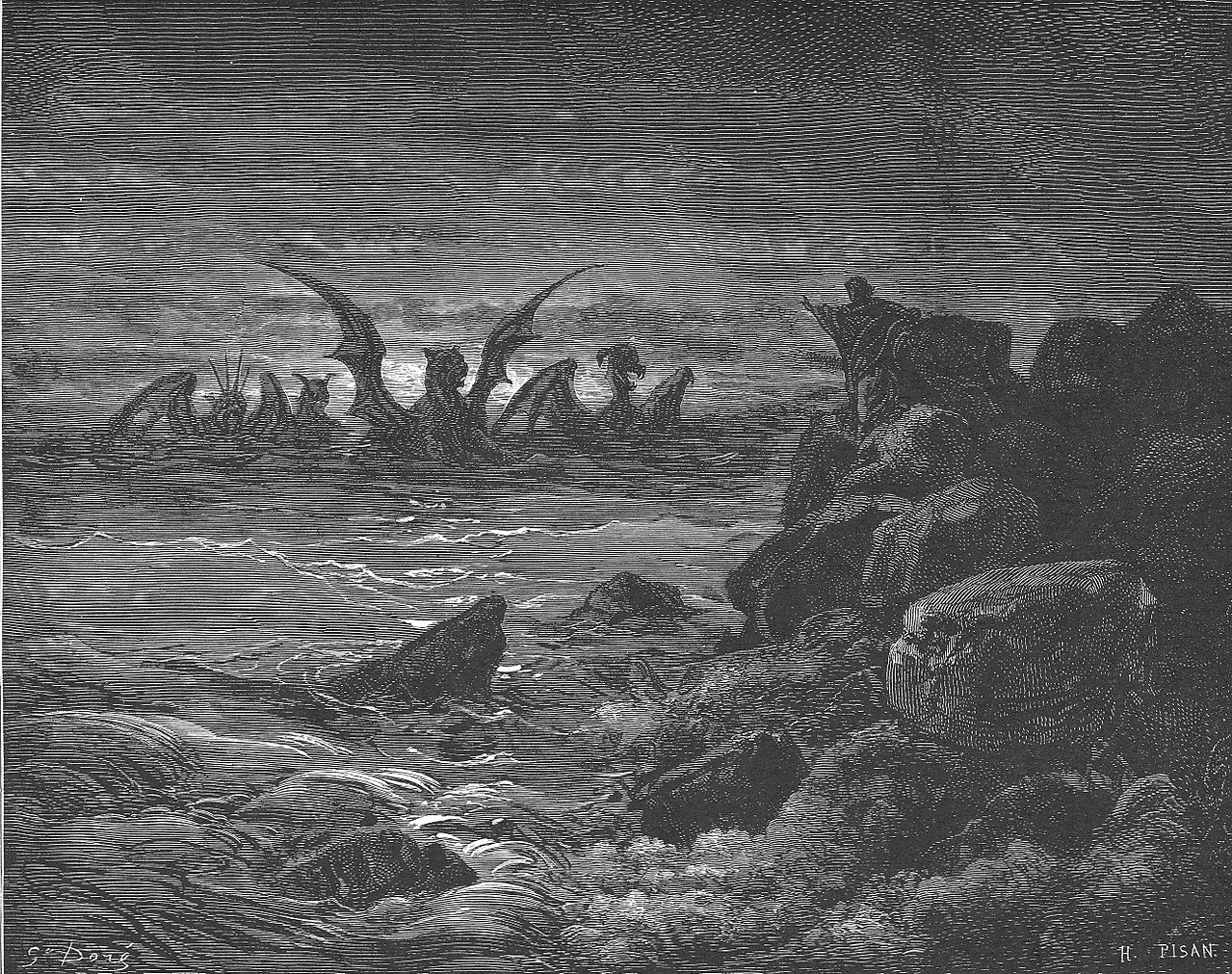
Daniel's Vision of the Four Beasts, Gustave Doré, Doré's English Bible (1866), public domain
Key verse
I saw in the night visions, and, behold, one like the Son of man came with the clouds of heaven, and came to the Ancient of days, and they brought him near before him.
It stands in The Ancient of Days and one like a son of man, verses 9 to 14.
The chapter
Chapter summary
The book's pivot, a night vision in the first year of Belshazzar. Four winds strive on the great sea, and four beasts come up: a lion with eagle's wings that are plucked; a bear with three ribs in its mouth; a leopard with four heads; and a fourth, dreadful and terrible, with iron teeth and ten horns, among which a little horn rises speaking great things. Then the throne room: 'one that was ancient of days did sit: his raiment was white as snow,' with a fiery stream and thousands ministering. 'There came with the clouds of heaven one like unto a son of man… and there was given him dominion': Jesus' own answer to the high priest. The kingdom is given to the saints.
Context
Prophecy · Daniel · Daniel overview
Where the chapter sits
Daniel 7 falls in Apocalyptic visions (chapters 7–12). The four beasts and the Son of Man (7); the ram and the goat (8); the seventy weeks (9); the great vision of the final conflict and resurrection (10–12).
The Son of Man. The four beasts; the Ancient of Days; one like the Son of Man approaching with the clouds of heaven.
Before it: Court narratives, chapters 1–6.
The whole shape of Daniel→The world behind this chapter
Daniel 7The history
The book turns here. Chapters 1-6 are stories about Daniel; from chapter 7 on they are visions given to Daniel, and the mood changes from court drama to something far larger.
The imagery came out of a shared ancient vocabulary. In the myths of Israel's neighbors, the sea was chaos, the place monsters came from, and a great sea churned by four winds throwing up beasts was a picture any listener in Babylon would have read instantly as history going wrong.
The rest of the history, and what it meant to them
The beasts are drawn from the world Daniel could see. A lion with eagle's wings was Babylon's own art: the Ishtar Gate and the palace throne room were covered in striding lions, and winged human-headed bulls guarded Assyrian and Babylonian doorways. A bear heavy on one side, a leopard with four wings, and finally something with iron teeth that no animal name fits.
Then the scene changes completely. Thrones are set, the Ancient of Days sits, books are opened, and one like a son of man comes with the clouds of heaven and is given a kingdom that will not pass away. In the ancient world, coming on the clouds was language for deity, and this figure receives worship from all peoples.
What it meant to them
The exile's problem was that history seemed to be a conveyor belt of predators, each worse than the last, and Israel was always underneath. This vision says the predators are real, they will keep coming, and they are all on a leash, the court sits, the books open, and dominion is taken away from them.
The promise at the end is the one that carried: the kingdom is given to a human figure who receives it from God Himself, and it is shared with "the saints of the most High." For a people whose kingdom had been taken, that was everything. Jesus later used "the Son of man" as His own title more than any other.
Sources cited
- John Calvin, Commentaries on the Book of the Prophet Daniel
- Jamieson, Fausset & Brown, Commentary Critical and Explanatory on the Whole Bible
- Chuck Missler, Learn the Bible in 24 Hours
The structure of this chapter
Threads running through this chapter
- The Son of man coming with cloudsPattern, vv. 13 to 14
People1
Places1
The heads below are this chapter's scenes. The numbered points under each are its verses.
A. Four beasts out of the great sea, and a little horn
1. (vv. 1-3)
Daniel 7:1
“In the first year of Belshazzar - This prophecy is written in Chaldee, to be a monument to him, of the reverence his father and grandfather shewed towards God, who had done such mighty works for them.”
John Wesley· Explanatory Notes upon the Old Testament (1765)evangelical
Daniel 7:2
“The four winds - Probably by the four winds of the great sea is signified commotions of contrary nations, striving together by wars, and producing these four beasts successively.”
John Wesley· Explanatory Notes upon the Old Testament (1765)evangelical
Daniel 7:3
“And so when the different beast was shown to the blessed prophet Daniel and it was shown that it differed from the others, it is necessary for us to consider that he does not discuss any of the beasts as mere animals, but in a model and image he portrays the kingdoms which have arisen in this world, just as he portrays the beasts destroying humanity. For the Great Sea indicates the whole world, he says; "The four winds of heaven," [Daniel 7:2] which signal the fourfold creation.”
Hippolytus of Rome· written before 235· Commentary on Daniel 4.2.1-3patristic
told the sum of the matters: Daniel dates his own vision to Belshazzar's first year, placing it chronologically before the feast of chapter 5 even though the book has already told that later story, and the bench reads the arrangement as thematic rather than strict order, the court narratives grouped first and the visions grouped after. The four winds striving upon the great sea and four beasts rising diverse one from another set the vision's grammar for the whole chapter: the sea as the troubled mass of nations in the older writers' reading, and the beasts as kingdoms rising out of that turmoil rather than settled powers. Gill and Keil both note the vision answers chapter 2's image from a different angle, the same four kingdoms now seen from the throne room rather than from a statue's metals.
2. (vv. 4-6)
eagle’s wings: The first beast, a lion with eagle's wings whose wings are plucked till it stands and is given a man's heart, is read by the traditional line, Keil, Barnes, and the site's own tradition following, as Babylon, its wings a figure for the swift conquests of Nebuchadnezzar and the plucking and standing a figure for his humbling in chapter 4. The bear raised on one side with three ribs in its mouth is read as Medo-Persia, the tilt reflecting Persia's dominance within the dual empire and the three ribs commonly read of Lydia, Babylon, and Egypt, its conquests. The four-winged, four-headed leopard is read as Greece under Alexander, the four heads matching the fourfold division of his empire among his generals after his early death, a division chapter 8 and chapter 11 both take up in more detail.
3. (vv. 7-8)
Daniel 7:8
“The "mouth" and "eyes" are those of a man, while the symbol is otherwise brutish, that is, it will assume man's true dignity, namely, wear the guise of the kingdom of God (which comes as the "Son of man" from above), while it is really bestial, namely, severed from God.”
Jamieson, Fausset & Brown· Commentary Critical and Explanatory on the Whole Bible (1871)reformed
dreadful and terrible, and strong exceedingly: The fourth beast has no animal likeness at all, only iron teeth, a devouring strength, and ten horns, which the traditional line reads as Rome, a power the older writers find fitting no single animal because it exceeded every kingdom before it in scale and brutality. Among the ten horns rises a little horn before whom three of the first horns are plucked up by the roots, with eyes like a man's and a mouth speaking great things, and the identifications are named rather than settled: the traditional and dispensational reading carries this horn forward to a future ruler out of a revived form of the fourth kingdom, while the critical line, following the ancient dispute Porphyry raised and Jerome answered, reads the horn as Antiochus Epiphanes within the Greek empire of the third beast. Both readings are held by named voices in the church's history and neither is adjudicated here.
B. The Ancient of Days and one like a son of man
1. (vv. 9-10)
Daniel 7:9
“Let him then be standing for you that you may not be afraid of him sitting; for when sitting he judges, as Daniel says, "the thrones were placed, and the books were opened, and the Ancient of Days did sit." But in Psalm 81 [82] it is written, "God stood in the congregation of gods and decides among the gods." So then when he sits he judges, when he stands he decides, and he judges concerning the imperfect but decides among the gods.”
Ambrose of Milan· written before 397· LETTER 63:6patristic
1 more voice on this verse
Daniel 7:9
“I beheld till the thrones were cast down,.... On which the governors of the above monarchies sat; and those of the ten kings, signified by the ten horns; and also that of the little horn.”
Daniel 7:10
“A fiery stream issued - This is not spoken of the final judgment; but of that which he was to execute upon this fourth beast, the Roman empire; and the little boasting horn which is a part of the fourth beast, and must fall when the other falls.”
Adam Clarke· Commentary on the Bible (1810-1826)evangelical
the Ancient of days did sit: The scene turns from the beasts to a throne room, the Ancient of days seated in garments white as snow and hair like pure wool, a throne of fiery flame, a fiery stream flowing before him, and thousand thousands ministering while ten thousand times ten thousand stand before him as the judgment is set and books are opened. The plural thrones of verse 9 drew attention in the Talmud itself, Sanhedrin 38b recording a debate over who sits on the second throne, with Rabbi Akiva proposing one for David and being rebuked by Rabbi Yose for prolonging the Shechinah's presence among mortals, a passage named, dated to the Bavli's compilation, and placed as the tradition's own wrestling with a text it read as leaving room for a second enthroned figure. The church's own reading, that the scene anticipates the Son of man's enthronement four verses later as one with the Ancient of days rather than merely before him, is the confession this site holds, and the essentials flag applies wherever a reading treats that second throne as anything less than fully divine.
2. (vv. 11-12)
Daniel 7:11
“Here is set forth the execution on earth of the judgment pronounced in the unseen heavenly court of judicature (Da 7:9, 10). body . . . given to . . . flame-- (Re 19:20).”
Jamieson, Fausset & Brown· Commentary Critical and Explanatory on the Whole Bible (1871)reformed
1 more voice on this verse
Daniel 7:11
“He himself died of a miserable disease, his family was rooted out, the kingdom wasted by the Parthians and Armenians, and at length made a province of the Roman empire by Pompey. And the Roman empire itself (if we take that for the fourth beast), after it began to persecute Christianity, declined and wasted away, and the body of it was destroyed.”
Matthew Henry· Commentary on the Whole Bible (1707-1721)puritan
Daniel 7:12
“The reason is: Christ's kingdom now is not of this world (Joh 18:36); and only at the second advent of Christ does it become an external power of the world. Hence Daniel, whose province it was to prophesy of the world powers, does not treat of Christianity until it becomes a world power, namely, at the second advent.”
Jamieson, Fausset & Brown· Commentary Critical and Explanatory on the Whole Bible (1871)reformed
the beast was slain: The fourth beast is slain and its body destroyed, given to the burning flame, for the great words its horn spoke, while the other three beasts have their dominion taken away yet their lives are prolonged for a season and time. Barnes reads the distinction as a picture of how empires actually end in the historical record, absorbed into their successors rather than annihilated outright, Babylon's people and institutions surviving under Persia, Persia's under Greece, in a way the fourth kingdom's own destruction does not share. The fourth beast alone meets total judgment, which the traditional line reads as fitting a kingdom that will not simply be conquered by the next in a normal succession but be replaced by the kingdom of verse 14 and verse 27 directly.
3. (vv. 13-14)
Daniel 7:13
“I saw in the night visions - Evidently in the same night visions, or on the same occasion, for the visions are connected. See Dan 7:1, Dan 7:7. The meaning is, that he continued beholding, or that a new vision passed before him. And, behold, one like the Son of man ... - It is remarkable that Daniel does not attempt to represent this by any symbol. The representation by symbols ceases with the fourth beast; and now the description assumes a literal form - the setting up of the kingdom of the Messiah and of the saints.”
1 more voice on this verse
Daniel 7:13
“A son of man - That is, the Messiah, he came with the clouds of heaven, gloriously, swiftly and terribly. And came - This relates to his ascension, at which time, he received his royal investiture, for the protection of his church, and curbing of their enemies.”
John Wesley· Explanatory Notes upon the Old Testament (1765)evangelical
Daniel 7:13
- Quoted inMark 13:26“At that time they will see the Son of Man coming in the clouds with great power and glory.”
'the Son of man coming in the clouds'
- Quoted inMatthew 24:30“At that time the sign of the Son of Man will appear in heaven, and all the tribes of the earth will mourn. They will see the Son of Man coming on the clouds of heaven, with power and great glory.”
'the Son of man coming in the clouds of heaven'
Daniel 7:14
“And so as many of you all who reverently draw near to God, observe the person who long ago was shown to the people by Moses and was manifested on the mountain and was proclaimed by the prophets and was seen as a man by the blessed Daniel, concerning whom he says, "I was looking into the vision of the night, and behold, one was coming like a son of man with the clouds of heaven, and he reached the Ancient of Days and was brought near to him and to him was given power and honor and the kingdom and all peoples, tribes, and tongues served him.”
Hippolytus of Rome· written before 235· Commentary on Daniel 4.11.1-5patristic
1 more voice on this verse
Daniel 7:14
“And there was given him dominion - This also is applied to our Lord Jesus by himself, after his resurrection, Mat 28:18. His dominion is an everlasting dominion - Christianity shall increase, and prevail to the end of the world. See the parallel passages in the margin.”
Adam Clarke· Commentary on the Bible (1810-1826)evangelical
one like the Son of man came with the clouds of heaven: One like the Son of man comes with the clouds of heaven to the Ancient of days and is given dominion, glory, and a kingdom that all peoples, nations, and languages should serve, an everlasting dominion that shall not pass away and a kingdom that shall not be destroyed. This is the verse the Lord took for his own identity and his own trial testimony: the coming-with-clouds vocabulary recurs at Matt 24:30, Matt 26:64, Mark 14:62 and Rev 1:7, and when Caiaphas demanded are thou the Christ, the Son of the Blessed, it was this very verse Jesus answered with, hereafter shall ye see the Son of man sitting on the right hand of power, and coming in the clouds of heaven. Keil and the whole Christian tradition read the Son of man's approach to, rather than distance from, the Ancient of days as itself a mark of shared glory, the human figure entering the divine throne room as no mere creature does elsewhere in this book.
C. The interpretation: the saints possess the kingdom
1. (vv. 15-18)
Daniel 7:15
“I Daniel was grieved in my spirit - That is, I was troubled; or my heart was made heavy and sad. This was probably in part because he did not fully understand the meaning of the vision, and partly on account of the fearful and momentous nature of what was indicated by it. So the apostle John Rev 5:4 says, “And I wept much because no man was found worthy to open and to read the book.” In the midst of my body - Margin, as in the Chaldee, sheath.”
Daniel 7:16
“I came near unto one of them that stood by - That is, to one of the angels who appeared to stand near the throne. Dan 7:10. Compare Dan 8:13; Zec 4:4-5; Rev 7:13. It was natural for Daniel to suppose that the angels who were seen encircling the throne would be able to give him information on the subject, and the answers which Daniel received show that he was not mistaken in his expectation. God has often employed angels to communicate important truths to men, or has made them the medium of communicating his will.”
Daniel 7:17
“These great beasts, which are four, are four kings - Four kings or four dynasties. There is no reason for supposing that they refer to individual kings, but the obvious meaning is, that they refer to four dominions or empires that would succeed one another on the earth. So the whole representation leads us to suppose, and so the passage has been always interpreted. The Latin Vulgate renders it regna; the Septuagint βασιλεῖαι basileiai; Luther, Reiche; Lengerke, Konigreiche.”
1 more voice on this verse
Daniel 7:17
“Compare Da 7:23, "fourth kingdom"; Each of the four kings represents a dynasty. Nebuchadnezzar, Alexander, Antiochus, and Antichrist, though individually referred to, are representatives of characteristic tendencies.”
Jamieson, Fausset & Brown· Commentary Critical and Explanatory on the Whole Bible (1871)reformed
Daniel 7:18
“But the saints of the Most High shall take the kingdom - I doubt whether this be the true sense of the original Chaldee, ויקבלון מלכותא קדשי עליונון vikabbelun malcutha kaddishey elyonin, “But the supreme holy ones shall receive the kingdom;” or, “they shall receive the kingdom of the supreme saints.” Properly translated by Montanus, Et suscipient regnum sanctorum altissimorum. Whatever we may think of the patriarchs and the Jews in their best times, there has never been so much holiness of heart possessed, and so much righteousness practiced, as by the genuine disciples of Christ.”
Adam Clarke· Commentary on the Bible (1810-1826)evangelical
1 more voice on this verse
Daniel 7:18
“Here, in the interpretation, "the saints," but in the vision (Da 7:13, 14), "the Son of man," takes the kingdom; for Christ and His people are one in suffering, and one in glory.”
Jamieson, Fausset & Brown· Commentary Critical and Explanatory on the Whole Bible (1871)reformed
grieved in my spirit: Daniel is grieved in his spirit at what he has seen and asks one of those standing by for the interpretation, and the answer is given in miniature before the fuller unpacking that follows: the four beasts are four kings, but the saints of the most High shall take the kingdom and possess it for ever, even for ever and ever. Henry reads the doubled for ever as the vision's own answer to the beasts' apparent permanence, kingdoms that looked unshakable in their hour proving temporary against a kingdom given to God's people that does not. The saints here are read across the tradition as either Israel specifically or the whole company of the redeemed, a question the exposition leaves open as the text itself leaves it, without a house verdict.
2. (vv. 19-22)
Daniel 7:19
“To Balaam's "Asshur" correspond Daniel's two eastern kingdoms, Babylon and Medo-Persia; to "Chittim," the two western kingdoms, Greece and Rome (compare Ge 10:4, 11, 22). In Babel, Nimrod the hunter (revolter) founds the first kingdom of the world (Ge 10:8-13). The Babylonian world power takes up the thread interrupted at the building of Babel, and the kingdom of Nimrod.”
Jamieson, Fausset & Brown· Commentary Critical and Explanatory on the Whole Bible (1871)reformed
Daniel 7:20
“And of the ten horns ... - See the notes at Dan 7:7-8. Whose look was more stout than his fellows - literally, “whose aspect was greater than that of its companions.” This does not mean that its look or aspect was more fierce or severe than that of the others, but that the appearance of the horn was greater - רב rab. In Dan 7:8, this is described as a “little horn;” and to understand this, and reconcile the two, we must suppose that the seer watched this as it grew until it became the largest of the number.”
Daniel 7:21
“Paul says further, "who opposes and exalts himself above all that is called god or that is worshiped," that is, above every divinity, so that antichrist will be the bitter foe of the idolatrous cults. He continues, "so that he sits in the temple of God." What temple is that? Paul says it is the destroyed temple of the Jews. For God forbid that it should be that temple of God in which we are! Why should I suggest such a thing? Lest you should think me complacent about us Christians.”
Cyril of Jerusalem· written before 386· Catechetical Lecture 15:15patristic
Daniel 7:22
“Until the Ancient of days came - Notes, Dan 7:9. That is, this was to occur after the horn grew to its full size, and after the war was made with the saints, and they had been overcome. It does not affirm that this would occur immediately, but that at some subsequent period the Ancient of days would come, and would set up a kingdom on the earth, or would make over the kingdom to the saints.”
4 more voices on this verse
Daniel 7:22
“Until the Ancient of days came,....”
Daniel 7:22
“For, "the time approached," [Daniel 7:22] that is, all at once the time was fulfilled and the saints possessed the kingdom, when the Judge of judges and the King of kings in the future comes from heaven, who shall remove every chief and power which opposes him and shall consume all in an eternal fire, punishing the unrighteous, but he shall give to his slaves both prophets and martyrs and to all who fear him the eternal kingdom.”
Hippolytus of Rome· written before 235· Commentary on Daniel 4.14.3patristic
Daniel 7:22
“The Father is never said to "come"; it is the Son who comes. judgment was given to . . . saints--Judgment includes rule; "kingdom" in the end of this verse (1Co 6:2; Christ first receives "judgment" and the "kingdom," then the saints with Him (Da 7:13, 14).”
Jamieson, Fausset & Brown· Commentary Critical and Explanatory on the Whole Bible (1871)reformed
Daniel 7:22
“Saints of the Most High - To the supereminent saints; see the note on Dan 7:18 (note).”
Adam Clarke· Commentary on the Bible (1810-1826)evangelical
diverse from all the others: Daniel presses further specifically on the fourth beast and its horn, and the angel's answer adds a detail the first telling did not give: the same horn made war with the saints and prevailed against them, until the Ancient of days came and judgment was given to the saints, who then possess the kingdom. Gill reads the horn's temporary success against the saints as the vision's honest acknowledgment that the kingdom's arrival does not mean the saints are spared conflict beforehand, only that the conflict does not have the last word. The until marks the turning point structurally the same way but if not marks chapter 3, a hinge on which the whole scene's outcome turns.
D. The fourth beast, times and law changed, and the end
1. (vv. 23-25)
Daniel 7:23
“Thus he said ... - That is, in explanation of the fourth symbol which appeared - the fourth beast, and of the events connected with his appearing. This explanation embraces the remainder of the chapter; and as the whole subject appeared difficult and momentous to Daniel before the explanation, so it may be said to be in many respects difficult, and in all respects momentous still.”
2 more voices on this verse
Daniel 7:23
These doctrines are not the fruit of ingenuity but are derived from the sacred Scriptures read in the church, particularly as gathered out of the prophecy of Daniel, in today's lection, and according to the interpretation given by the archangel Gabriel, who spoke as follows, "the fourth beast shall be the fourth kingdom on earth, which shall surpass all kingdoms."
Cyril of Jerusalem· written before 386· Catechetical Lecture 15:13patristic
Daniel 7:23
“These things were once taught people through riddles, but we ourselves have learned these very things by experience. We see the fulfillment of the prophecy; we behold daily that tributes are exacted, poverty oppresses many people, and other such things happen.”
Theodoret of Cyrus· written before 458· COMMENTARY ON DANIEL 7:23patristic
Daniel 7:24
“He will not merely, as Popery, substitute himself for Christ in Christ's name, but "deny the Father and the Son" (1Jo 2:22). The persecution is to continue up to Christ's second coming (Da 7:21, 22); the horn of blasphemy cannot therefore be past; for now there is almost a general cessation of persecution.”
Jamieson, Fausset & Brown· Commentary Critical and Explanatory on the Whole Bible (1871)reformed
Daniel 7:25
“He shall speak great words against the Most High - Sermones quasi Deus loquetur; “He shall speak as if he were God.” So St. Jerome quotes from Symmachus. To none can this apply so well or so fully as to the popes of Rome. They have assumed infallibility, which belongs only to God. They profess to forgive sins, which belongs only to God. They profess to open and shut heaven, which belongs only to God. They profess to be higher than all the kings of the earth, which belongs only to God.”
Adam Clarke· Commentary on the Bible (1810-1826)evangelical
1 more voice on this verse
Daniel 7:25
“The original word for "time" denotes a stated period or set feast; or the interval from one set feast to its recurrence, that is, a year [TREGELLES]; Le 23:44, "feasts." The passages in favor of the year-day theory are Eze 4:6, where each day of the forty during which Ezekiel lay on his right side is defined by God as meaning a year.”
Jamieson, Fausset & Brown· Commentary Critical and Explanatory on the Whole Bible (1871)reformed
devour the whole earth: The fourth kingdom is named plainly as diverse from all kingdoms before it, devouring the whole earth, and its ten horns are ten kings with another rising after and among them who subdues three kings, speaks against the most High, wears out the saints, and thinks to change times and laws for a time and times and the dividing of time. The traditional and dispensational readings take this figure and its allotted period forward to a future fulfillment tied to the little horn's earlier appearance in verse 8, while other readings within the church's history read the period against Antiochus's measured persecution of Judea; the parking order governs here and no date or modern application is built from either reading. Wesley notes the phrase time and times and the dividing of time recurs at Rev 12:14 in almost identical form, a connection the notes state without resolving what either passage's period denotes.
2. (vv. 26-27)
Daniel 7:26
“All Christ's enemies shall be made his footstool, and shall be consumed and destroyed to the end: these were the apostle uses concerning the man of sin, 2 Thess. ii. He shall be consumed with the spirit of Christ's mouth and destroyed with the brightness of his coming. [4.] Judgment is given to the saints of the Most High.”
Matthew Henry· Commentary on the Whole Bible (1707-1721)puritan
Daniel 7:27
“He is said to come with the clouds of heaven. Some refer this to his incarnation; he descended in the clouds of heaven, came into the world unseen, as the glory of the Lord took possession of the temple in a cloud. The empires of the world were beasts that rose out of the sea; but Christ's kingdom is from above: he is the Lord from heaven.”
Matthew Henry· Commentary on the Whole Bible (1707-1721)puritan
the judgment shall sit: The judgment sits and takes the horn's dominion away to consume and destroy it unto the end, and the kingdom, the dominion, and the greatness of the kingdom under the whole heaven are given to the people of the saints of the most High, an everlasting kingdom whom all dominions shall serve and obey. The bench reads verse 27 as the chapter's own summary of verse 14, the Son of man's kingdom and the saints' kingdom named as one and the same rather than as two separate promises, since the people who share in Christ's reign are never presented in Scripture as receiving a kingdom apart from him. Calvin reads the everlasting kingdom language here as deliberately answering every earthly empire the chapter has just paraded, none of them everlasting and this one alone so named.
3. (v. 28)
I kept the matter in my heart: The chapter ends where it began, with Daniel himself rather than with the vision's grandeur, his countenance changed and his cogitations troubling him, and he kept the matter in his heart rather than speaking it abroad. Clarke reads Daniel's own troubled reaction as instructive alongside the content of what he saw, a prophet given the clearest glimpse yet of the Son of man's coming kingdom and still left shaken rather than triumphant, since even revelation of final victory does not erase the cost of the conflict it discloses. The phrase kept in my heart recalls Mary's own keeping of what she could not yet fully understand, a parallel the older writers note without pressing further than the words themselves allow.
This page carries no textual note on Daniel 7. Where this site has examined a place the manuscripts differ, the examination is in the manuscripts room. Every place this site examines →
Sources for this chapter
The summary
Jamieson, Fausset & Brown, Commentary Critical and Explanatory; John Calvin, Commentaries; John Wesley, Notes on the Old Testament and Matthew Henry, Complete Commentary.
The context
C. F. Keil, Biblical Commentary on the Book of Daniel and Matthew Henry, Commentary on the Whole Bible.
The exposition
Adam Clarke, Commentary on the Bible; Albert Barnes, Notes on the Book of Daniel; Carl Friedrich Keil, Biblical Commentary on the Book of Daniel; Jerome, Commentary on Daniel; John Calvin, Commentary on the Prophet Daniel; John Gill, Exposition of the Old Testament; John Wesley, Explanatory Notes upon the Old Testament and Matthew Henry, Commentary on the Whole Bible.
Keep studying
On this page
Studies22
On this verse
- Antichrist: the Word and the Figure
- Revelation: the Canon's Closing Scroll
- The Son of Man in 1 Enoch
- Angelology
- Apocalyptic Literature
- The Beast and the False Prophet
- The Major Prophets
- Fire
- Jesus: Titles & Roles
- John on Patmos, Revelation 1
- Rome
- The Fourth Man in the Fire: Daniel 3
- The Ascension: Acts 1:1-11 · Luke 24:50-53
- The Horn
- The Throne
- The Throne Room
On this chapter
On this book
People1
Places1
Words12
Subjects2