
Daniel 7:17
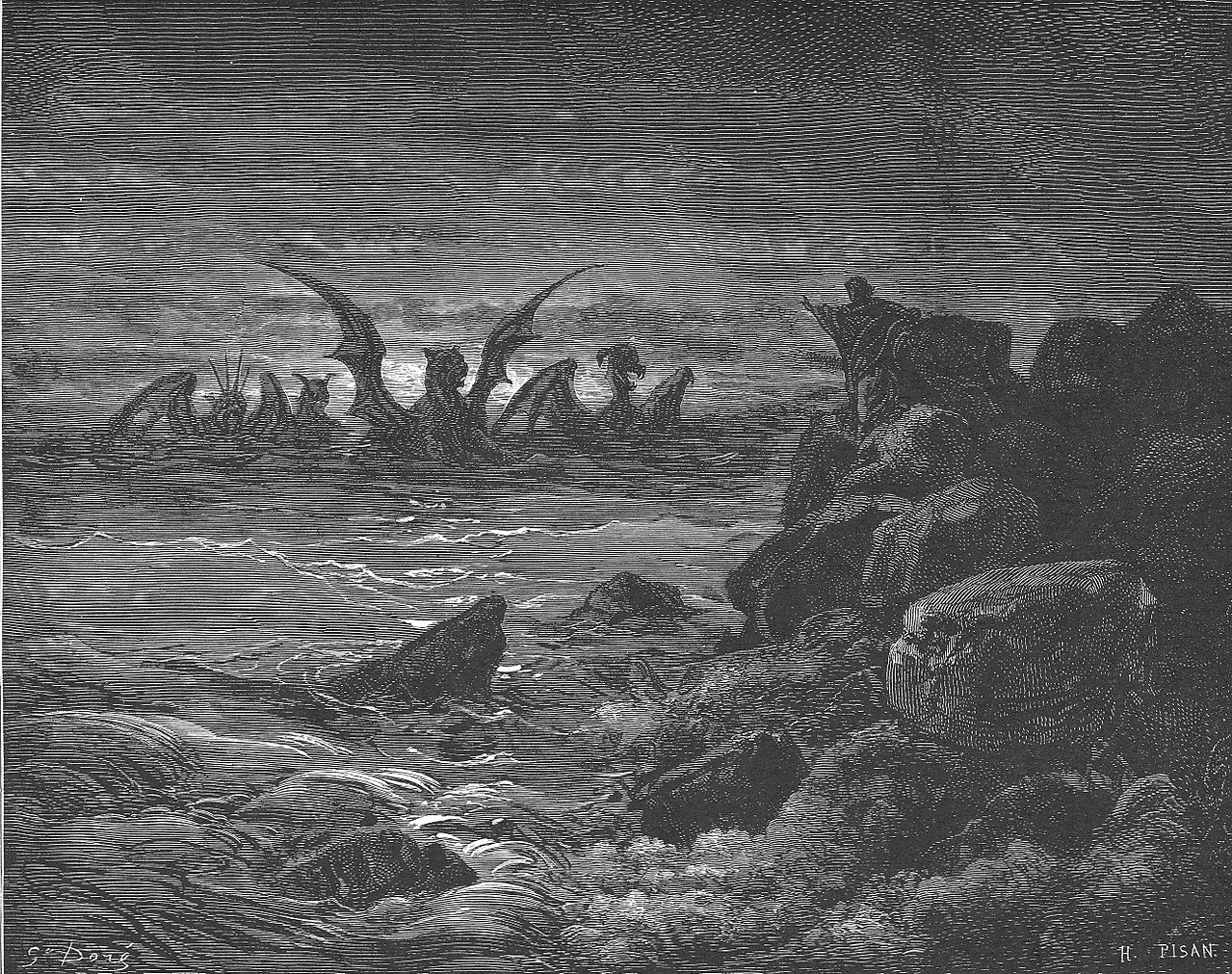
in Daniel 7‘These four great beasts are four kings who will arise from the earth.
BSB
The same verse in ASV and KJV ▾
ASV
These great beasts, which are four, are four kings, that shall arise out of the earth.
KJV
These great beasts, which are four, are four kings, which shall arise out of the earth.
⋯
This verse in Daniel 7
Commentary
12 notes on this verseVerses 17, 18. "These four great beasts are the four kingdoms which shall arise from the earth. But the saints of the Most High God shall take the kingdom." The four kingdoms of which we have spoken above were earthly in character. "For everything which is of the earth shall return to earth" (Ecclesiastes 3:20). But the saints shall never possess an earthly kingdom, but only a heavenly. Away, then, with the fable about a millennium! (Revelation 20:4-6) "...And they shall possess the kingdom unto eternity, even forever and ever..."
This site's exposition
grieved in my spirit
on Daniel 7:15-18
Daniel is grieved in his spirit at what he has seen and asks one of those standing by for the interpretation, and the answer is given in miniature before the fuller unpacking that follows: the four beasts are four kings, but the saints of the most High shall take the kingdom and possess it for ever, even for ever and ever. Henry reads the doubled for ever as the vision's own answer to the beasts' apparent permanence, kingdoms that looked unshakable in their hour proving temporary against a kingdom given to God's people that does not. The saints here are read across the tradition as either Israel specifically or the whole company of the redeemed, a question the exposition leaves open as the text itself leaves it, without a house verdict.
The record, by era
The Church Fathers4 voices
So that we may not turn aside from what is set before, so that what was seen by the prophet may be shown as true and so that what was perceived by us in the grace of the Lord and what was spoken may be sure, let us see if the angel confirms our words, who teaches the blessed Daniel, for he speaks in this way, "These four beasts are four kingdoms which shall arise upon the earth, and which shall be removed, and the saints of the most high shall inherit the kingdom and possess it forever and ever." [Daniel 7:17-18] And so it is necessary for the three beasts to have already passed away and to have ceased, just as was shown above, and while one beast is yet beginning to culminate, if this also is removed, the remaining earthly things cease, but the heavenly things begin, so that the perpetual and eternal kingdom of the saints may be shown and the heavenly kingdom may be clearly displayed to all, neither through a form as seen on the mountain of Sinai, nor in a pillar of cloud as revealed on the mountain peak, but with powers and armies of angels, incarnate God and man, son of God and of Man, the judge who is coming from the heavens into the world. Who shall remove all kingdoms which are in this world and shall thresh and shall winnow and shall scatter them as chaff from the summer threshing floor. And shall give the kingdom to the saints of the Most High as he collects grain for his barn, but the chaff heap he burns with unquenchable fire, though now he is despised by the godless and impious, and blasphemed by the unbelievers, who do not consider what is written, nor consider the authority of judgment laid upon them. For though he now also delays for a time, not wishing to bear judgment to the world, and so fulfills the prescription of his Father, but when he comes he will come with his armies and render to each according to his works.
The secret meaning of that vision had been disclosed to him by the angel, and the expression "four beasts" indicated the four empires: the Babylonian, which flourished at that time, the Mede, the Persian and the Greek. But the power, he says, would have been …
A commentator
Hippolytus of RomeHippolytus Exegetical Fragments - Of the visions of Daniel and Nebuchadnezzar · Written before 235.
proposed
1. In speaking of a "lioness from the sea," he meant the rising of the kingdom of Babylon, and that this was the "golden head of the image." And in speaking of its "eagle wings," be meant that king Nebuchadnezzar was exalted and that his glory was lifted up against God. Then he says "its wings were plucked off," i.e., that his glory was destroyed; for he was driven out of his kingdom. And the words, "A man's heart was given it, and it was made stand upon the feet of a man," mean that he came to himself again, and recognised that he was but a man, and gave the glory to God. Then after the lioness he sees a second beast, "like a bear," which signified the Persians. For after the Babylonians the Persians obtained the power. And in saying that "it had three ribs in its mouth," he pointed to the three nations, Persians, Medes, and Babylonians, which were expressed in the image by the silver after the gold. Then comes the third beast, "a leopard," which means the Greeks; for after the Persians, Alexander of Macedon had the power, when Darius was overthrown, which was also indicated by the brass in the image. And in saying that the beast "had four wings of a fowl, and four heads," he showed most clearly how the kingdom of Alexander was parted into four divisions. For in speaking of four heads, he meant the four kings that arose out of it. For Alexander, when dying, divided his kingdom into four parts. Then he says, "The fourth beast (was) dreadful and terrible: it had iron teeth, and claws of brass." Who, then, are meant by this but the Romans, whose kingdom, the kingdom that still stands, is expressed by the iron? "for," says he, "its legs are of iron." 2. After this, then, what remains, beloved, but the toes of the feet of the image, in which "part shall be of iron and part of clay mixed together? […]
But if so great a power is shown to have followed and to be still following the dispensation of His suffering, how great shall that be which shall follow His glorious advent! For He shall come on the clouds as the Son of man, so Daniel foretold, and His angels shall come with Him. These are the words: [quotes Daniel 7:9-28]
The Puritans and the Awakening1 voice
These great beasts, which are four, are four kings,....
5 more voices on this verse
The Puritans and the Awakening2 voices
Belshazzar's name here is, in the original, spelt differently from what it used to be; before it was Bel-she-azar--Bel is he that treasures up riches.
They are but terræfilii--from beneath; they savour of the earth, and their foundation is in the dust; they are of the earth earthy, and they are written in the dust, and to the dust they shall return.
The Nineteenth Century3 voices
A commentator
Albert Barnes1798–1870
Notes, Explanatory and Practical, on the Old and New Testaments (1832-1869)
These great beasts, which are four, are four kings - Four kings or four dynasties. There is no reason for supposing that they refer to individual kings, but the obvious meaning is, that they refer to four dominions or empires that would succeed one another on the earth. So the whole representation leads us to suppose, and so the passage has been always interpreted. The Latin Vulgate renders it regna; the Septuagint βασιλεῖαι basileiai; Luther, Reiche; Lengerke, Konigreiche.
A commentator
Jamieson, Fausset & Brown1802–1910
Commentary Critical and Explanatory on the Whole Bible (1871)
Compare Da 7:23, "fourth kingdom"; Each of the four kings represents a dynasty. Nebuchadnezzar, Alexander, Antiochus, and Antichrist, though individually referred to, are representatives of characteristic tendencies.
These great beasts - are four kings - See the preceding verses, where the following explanations are inserted and illustrated.
The words behind it
11 Hebrew wordsEvery Hebrew word of this verse in the order it stands, with what it means and the door to its own study. The last column counts the times a word stands in the whole Bible: the rarer the word, the more the places it appears belong together.
| Hebrew | Sound | Meaning | Word study | In the Bible |
|---|---|---|---|---|
| אִלֵּין֙ | ʾilein | these | H459 → | 5 times |
| חֵיוָתָ֣א | cheivata' | beasts the | H2423 → | 20 times |
| רַבְרְבָתָ֔א | ravrevata' | <the> great | H7260 → | 8 times |
| דִּ֥י | di | which | H1768 → | 345 times |
| אִנִּ֖ין | ʾinin | they | H581 → | 4 times |
| אַרְבַּ֑ע | ʾarba' | [are] four | H703 → | 8 times |
| אַרְבְּעָ֥ה | ʾarbeah | four | H703 → | 8 times |
| מַלְכִ֖ין | malkhin | kings | H4430 → | 180 times |
| יְקוּמ֥וּן | yekumun | they will arise | H6966 → | 35 times |
| מִן־ | min- | from | H4481 → | 109 times |
| אַרְעָֽא׃ | ʾara' | earth the | H772 → | 21 times |
אִלֵּין֙these
ʾileinH459 →5 times
חֵיוָתָ֣אbeasts the
cheivata'H2423 →20 times
רַבְרְבָתָ֔א<the> great
ravrevata'H7260 →8 times
דִּ֥יwhich
diH1768 →345 times
אִנִּ֖יןthey
ʾininH581 →4 times
אַרְבַּ֑ע[are] four
ʾarba'H703 →8 times
אַרְבְּעָ֥הfour
ʾarbeahH703 →8 times
מַלְכִ֖יןkings
malkhinH4430 →180 times
יְקוּמ֥וּןthey will arise
yekumunH6966 →35 times
מִן־from
min-H4481 →109 times
אַרְעָֽא׃earth the
ʾara'H772 →21 times
A shaded row is a word that stands 400 times or fewer in the Bible.
The walk
8 stopsEach card is a verse this one points to, and under it the verses that one points to in turn. Where several paths arrive at the same place, that place is listed first: the text keeps returning to it.
Through
Revelation 13:1Then I saw a beast with ten horns and seven heads rising out of the sea. There were ten royal crowns on its horns and blasphemous names on its heads.
it leads to
- Revelation 11:7
When the two witnesses have finished their testimony, the beast that comes up from the Abyss will wage war with them, and will overpower and kill them.
Reached by 2 separate paths from here.
- Revelation 12:3
Then another sign appeared in heaven: a huge red dragon with seven heads, ten horns, and seven royal crowns on his heads.
- Revelation 17:3
And the angel carried me away in the Spirit into a wilderness, where I saw a woman sitting on a scarlet beast that was covered with blasphemous names and had seven heads and ten…
- Revelation 11:7
Through
John 18:36Jesus answered, “My kingdom is not of this world; if it were, My servants would fight to prevent My arrest by the Jews. But now My kingdom is not of this realm.”
it leads to
- Luke 17:20–21
When asked by the Pharisees when the kingdom of God would come, Jesus replied, “The kingdom of God will not come with observable signs.
- Colossians 1:12–14
giving thanks to the Father, who has qualified you to share in the inheritance of the saints in the light.
- Romans 14:17
For the kingdom of God is not a matter of eating and drinking, but of righteousness, peace, and joy in the Holy Spirit.
- John 6:15
Then Jesus, realizing that they were about to come and make Him king by force, withdrew again to a mountain by Himself.
- Daniel 2:44
In the days of those kings, the God of heaven will set up a kingdom that will never be destroyed, nor will it be left to another people. It will shatter all these kingdoms…
- Luke 17:20–21
Where this verse is studied
On this page
Studies21
On this verse
On this chapter
- The Son of Man in 1 Enoch
- Angelology
- Antichrist (the Word and the Figure)
- Apocalyptic Literature
- The Beast and the False Prophet
- The Major Prophets
- Revelation, the Canon's Closing Scroll
- Fire
- Jesus: Titles & Roles
- John on Patmos, Revelation 1
- Rome
- The Fourth Man in the Fire: Daniel 3
- The Ascension: Acts 1:1-11 · Luke 24:50-53
- The Horn
- The Throne
- The Throne Room
About Daniel
This page draws on 11 works. Open the list of works
This page draws on Adam Clarke, Commentary on the Bible; Albert Barnes, Notes, Explanatory and Practical, on the Old and New Testaments (1832-1869); Ephrem the Syrian, COMMENTARY ON DANIEL 7:16; Hippolytus of Rome, Commentary on Daniel 4.10.1-4; Hippolytus of Rome, Hippolytus Exegetical Fragments - Of the visions of Daniel and Nebuchadnezzar; Jamieson, Fausset & Brown, Commentary Critical and Explanatory on the Whole Bible; Jerome, St. Jerome, Commentary on Daniel, CHAPTER SEVEN; John Gill, Exposition of the Old Testament (1748-1763); John Wesley, Explanatory Notes upon the Old Testament; Justin Martyr, Dialogue with Trypho, Chapter XXXI and Matthew Henry, Commentary on the Whole Bible.