
Daniel 7:2
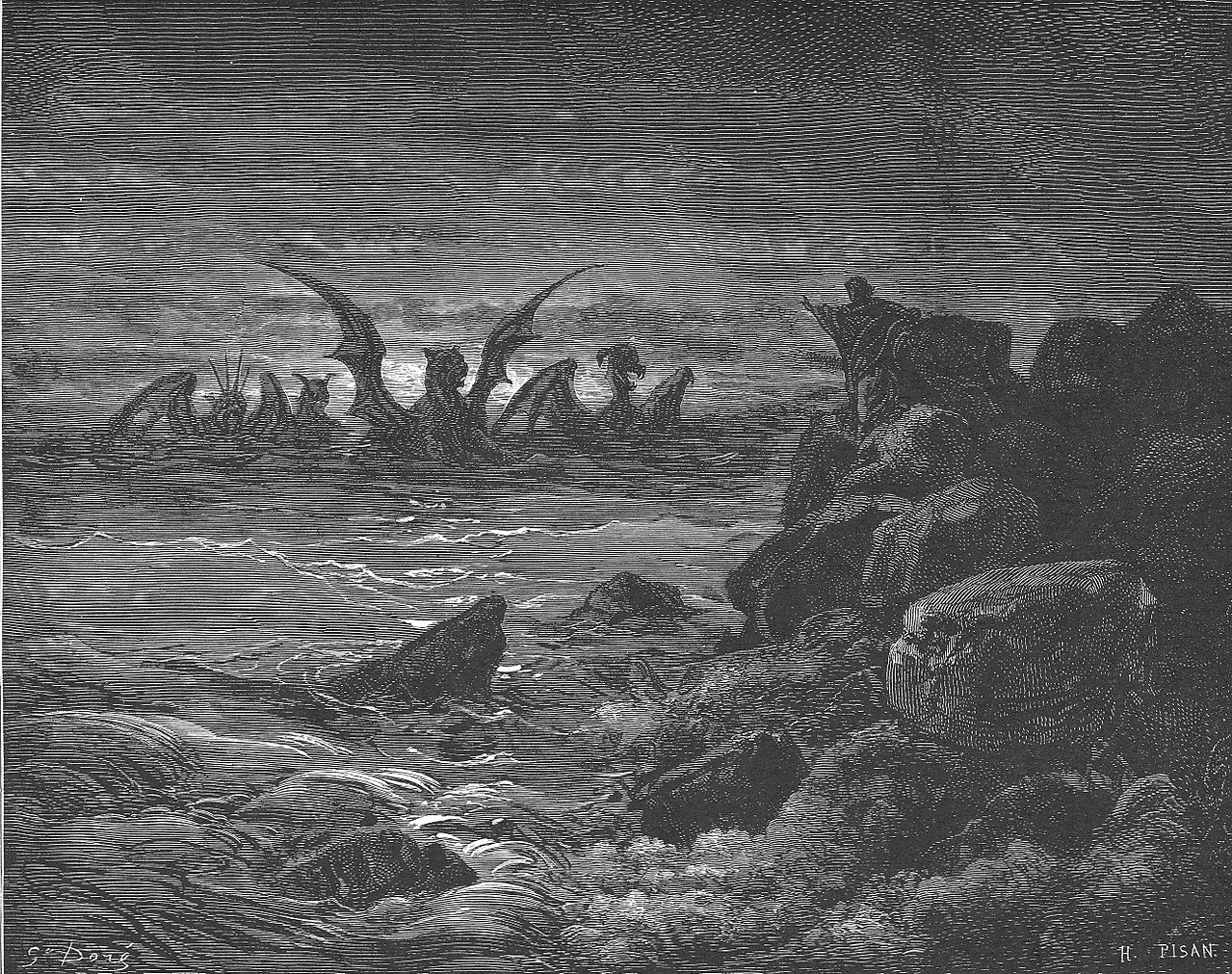
in Daniel 7Daniel declared: “In my vision in the night I looked, and suddenly the four winds of heaven were churning up the great sea.
BSB
The same verse in ASV and KJV ▾
ASV
Daniel spake and said, I saw in my vision by night, and, behold, the four winds of heaven brake forth upon the great sea.
KJV
Daniel spake and said, I saw in my vision by night, and, behold, the four winds of the heaven strove upon the great sea.
⋯
This verse in Daniel 7
Commentary
11 notes on this verseVerses 2, 3. "And during the night I saw in my vision, and behold, the four winds of heaven strove upon the great sea, and four great beasts were coming up out of the sea, differing from one another." The four winds of heaven I suppose to have been angelic powers to whom the principalities have been committed, in accordance with what we read in Deuteronomy: "When the Most High divided the nations and when He separated the children of Adam, He established the bounds of the peoples according to the number of the angels.
This site's exposition
told the sum of the matters
on Daniel 7:1-3
Daniel dates his own vision to Belshazzar's first year, placing it chronologically before the feast of chapter 5 even though the book has already told that later story, and the bench reads the arrangement as thematic rather than strict order, the court narratives grouped first and the visions grouped after. The four winds striving upon the great sea and four beasts rising diverse one from another set the vision's grammar for the whole chapter: the sea as the troubled mass of nations in the older writers' reading, and the beasts as kingdoms rising out of that turmoil rather than settled powers. Gill and Keil both note the vision answers chapter 2's image from a different angle, the same four kingdoms now seen from the throne room rather than from a statue's metals.
The record, by era
The Church Fathers3 voices
And so when the different beast was shown to the blessed prophet Daniel and it was shown that it differed from the others, it is necessary for us to consider that he does not discuss any of the beasts as mere animals, but in a model and image he portrays the kingdoms which have arisen in this world, just as he portrays the beasts destroying humanity. For the Great Sea indicates the whole world, he says; "The four winds of heaven," [Daniel 7:2] which signal the fourfold creation. And so when he says, "I saw four beasts rising from the sea," [Daniel 7:3] he speaks concerning the kingdoms of this world.
A commentator
Hippolytus of RomeHippolytus Exegetical Fragments - Of the visions of Daniel and Nebuchadnezzar · Written before 235.
proposed
1. In speaking of a "lioness from the sea," he meant the rising of the kingdom of Babylon, and that this was the "golden head of the image." And in speaking of its "eagle wings," be meant that king Nebuchadnezzar was exalted and that his glory was lifted up against God. Then he says "its wings were plucked off," i.e., that his glory was destroyed; for he was driven out of his kingdom. And the words, "A man's heart was given it, and it was made stand upon the feet of a man," mean that he came to himself again, and recognised that he was but a man, and gave the glory to God. Then after the lioness he sees a second beast, "like a bear," which signified the Persians. For after the Babylonians the Persians obtained the power. And in saying that "it had three ribs in its mouth," he pointed to the three nations, Persians, Medes, and Babylonians, which were expressed in the image by the silver after the gold. Then comes the third beast, "a leopard," which means the Greeks; for after the Persians, Alexander of Macedon had the power, when Darius was overthrown, which was also indicated by the brass in the image. And in saying that the beast "had four wings of a fowl, and four heads," he showed most clearly how the kingdom of Alexander was parted into four divisions. For in speaking of four heads, he meant the four kings that arose out of it. For Alexander, when dying, divided his kingdom into four parts. Then he says, "The fourth beast (was) dreadful and terrible: it had iron teeth, and claws of brass." Who, then, are meant by this but the Romans, whose kingdom, the kingdom that still stands, is expressed by the iron? "for," says he, "its legs are of iron." 2. After this, then, what remains, beloved, but the toes of the feet of the image, in which "part shall be of iron and part of clay mixed together? […]
For his part, Nebuchadnezzar sees the image, drawing a lesson in the futility of things of this life and the fact that they are appearances, as the divine apostle asserts, and not realities, there is nothing lasting or stable in them, everything fluid and failing …
The Puritans and the Awakening2 voices
The four winds - Probably by the four winds of the great sea is signified commotions of contrary nations, striving together by wars, and producing these four beasts successively.
Daniel spake and said, I saw in my vision by night,....
4 more voices on this verse
The Puritans and the Awakening1 voice
This is it which the kings of the nations are contending for in their wars, which are as noisy and violent as the battle of the winds; but how is the poor sea tossed and torn, how terrible are its concussions, and how violent its convulsions, while the winds are at strife which shall have the sole power of troubling it!
The Nineteenth Century3 voices
A commentator
Jamieson, Fausset & Brown1802–1910
Commentary Critical and Explanatory on the Whole Bible (1871)
proposed
21:1); the kingdom of God and the Son of man from the clouds of heaven (Da 7:13; compare Joh 8:23). TREGELLES takes "the great sea" to mean, as always elsewhere in Scripture (Jos 1:4; 9:1), the Mediterranean, the center territorially of the four kingdoms of the vision, which all border on it and have Jerusalem subject to them.
quarantine:debris (2026-07-29) — unbalanced-parens
The four winds of the heaven strove upon the great sea - The idea of strife is taken here from the effects that must be produced, were the east, the west, the north, and the south winds to rise tempestuously, and meet on the surface of the sea. By the great sea, the Mediterranean is meant; and is so called to distinguish it from those lakes called seas by the Hebrews; such as the Sea of Galilee, Dead Sea, Sea of Tiberias, etc.; but even that may refer to Asia, the scene of all these contentions. This dream is the same in meaning, under different emblems, as that of Nebuchadnezzar’s metallic image; but in Daniel’s dream several circumstances are added. It is supposed that Daniel had this dream about forty-eight years after Nebuchadnezzar had the vision of the great image.
A commentator
Albert Barnes1798–1870
Notes, Explanatory and Practical, on the Old and New Testaments (1832-1869)
proposed
Daniel spake and said - That is, he spake and said in the manner intimated in the previous verse. It was by a record made at the time, and thus he might be said to speak to his own generation and to all future times. I saw in my vision by night - I beheld in the vision; that is, he saw represented to him the scene which he proceeds to describe. He seemed to see the sea in a tempest, and these monsters come up from it, and the strange succession of events which followed. And behold, the four winds of the heaven - The winds that blow under the heaven, or that seem to come from the heaven - or the air. Compare Jer 49:36. The number of the winds is here referred to as four as they are now, as blowing mainly from the four quarters of the earth. Nothing is more common now than to designate them in this manner - as the east, the south, the west, the north wind. So the Latins - Eurus, Auster, Zephyrus, Boreas. Strove - מגיחן megı̂ychân. Burst, or rushed forth; seemed to conflict together. The winds burst, rushed from all quarters, and seemed to meet on the sea, throwing it into wild commotion. The Hebrew word (גיח gı̂yach) means to break or burst forth, as a fountain or stream of waters, Job 40:23; an infant breaking forth from the womb, Job 38:8; a warrior rushing forth to battle, Eze 32:2. Hence, the Chaldean to break forth; to rush forth as the winds. The symbol here would naturally denote some wild commotion among the nations, as if the winds of heaven should rush together in confusion. Upon the great sea - This expression would properly apply to any great sea or ocean, but it is probable that the one that would occur to Daniel would be the Mediterranean Sea, as that was best known to him and his contemporaries. […]
The words behind it
15 Hebrew wordsEvery Hebrew word of this verse in the order it stands, with what it means and the door to its own study. The last column counts the times a word stands in the whole Bible: the rarer the word, the more the places it appears belong together.
| Hebrew | Sound | Meaning | Word study | In the Bible |
|---|---|---|---|---|
| עָנֵ֤ה | ʾaneh | [was] replying | H6032 → | 30 times |
| דָנִיֵּאל֙ | daniyel | Daniel | H1841 → | 57 times |
| וְאָמַ֔ר | veamar | and [was] saying | H560 → | 71 times |
| חָזֵ֥ה | chazeh | seeing | H2370 → | 31 times |
| הֲוֵ֛ית | haveit | I was | H1934 → | 71 times |
| בְּחֶזְוִ֖י | bechezvi | in vision my | H2376 → | 12 times |
| עִם־ | ʾim- | with | H5974 → | 22 times |
| לֵֽילְיָ֑א | leilya' | night the | H3916 → | 5 times |
| וַאֲר֗וּ | vaaru | and lo! | H718 → | 5 times |
| אַרְבַּע֙ | ʾarba' | [the] four | H703 → | 8 times |
| רוּחֵ֣י | ruchei | [the] winds of | H7308 → | 11 times |
| שְׁמַיָּ֔א | shemaiya' | heavens the | H8065 → | 38 times |
| מְגִיחָ֖ן | megichan | [were] stirring up | H1519 → | |
| לְיַמָּ֥א | leyama' | <obj.> sea the | H3221 → | |
| רַבָּֽא׃ | raba' | <the> great | H7229 → | 15 times |
עָנֵ֤ה[was] replying
ʾanehH6032 →30 times
דָנִיֵּאל֙Daniel
daniyelH1841 →57 times
וְאָמַ֔רand [was] saying
veamarH560 →71 times
חָזֵ֥הseeing
chazehH2370 →31 times
הֲוֵ֛יתI was
haveitH1934 →71 times
בְּחֶזְוִ֖יin vision my
bechezviH2376 →12 times
עִם־with
ʾim-H5974 →22 times
לֵֽילְיָ֑אnight the
leilya'H3916 →5 times
וַאֲר֗וּand lo!
vaaruH718 →5 times
אַרְבַּע֙[the] four
ʾarba'H703 →8 times
רוּחֵ֣י[the] winds of
rucheiH7308 →11 times
שְׁמַיָּ֔אheavens the
shemaiya'H8065 →38 times
מְגִיחָ֖ן[were] stirring up
megichanH1519 →
לְיַמָּ֥א<obj.> sea the
leyama'H3221 →
רַבָּֽא׃<the> great
raba'H7229 →15 times
A shaded row is a word that stands 400 times or fewer in the Bible.
The walk
8 stopsEach card is a verse this one points to, and under it the verses that one points to in turn. Where several paths arrive at the same place, that place is listed first: the text keeps returning to it.
Through
Revelation 7:1After this I saw four angels standing at the four corners of the earth, holding back its four winds so that no wind would blow on land or sea or on any tree.
it leads to
- Matthew 24:31
And He will send out His angels with a loud trumpet call, and they will gather His elect from the four winds, from one end of the heavens to the other.
- Jeremiah 49:36
I will bring the four winds against Elam from the four corners of the heavens, and I will scatter them to all these winds. There will not be a nation to which Elam’s exiles…
- Mark 13:27
And He will send out the angels to gather His elect from the four winds, from the ends of the earth to the ends of heaven.
- Daniel 8:8
Thus the goat became very great, but at the height of his power, his large horn was broken off, and four prominent horns came up in its place, pointing toward the four winds of…
- Ezekiel 37:9
Then He said to me, “Prophesy to the breath; prophesy, son of man, and tell the breath that this is what the Lord GOD says: Come from the four winds, O breath, and breathe…
- Matthew 24:31
Through
Revelation 17:15Then the angel said to me, “The waters you saw, where the prostitute was seated, are peoples and multitudes and nations and tongues.
it leads to
- Revelation 17:1
Then one of the seven angels with the seven bowls came and said to me, “Come, I will show you the punishment of the great prostitute, who sits on many waters.
- Isaiah 8:7–8
the Lord will surely bring against them the mighty floodwaters of the Euphrates—the king of Assyria and all his pomp. It will overflow its channels and overrun its banks.
- Jeremiah 51:13
You who dwell by many waters, rich in treasures, your end has come; the thread of your life is cut.
- Revelation 17:1
Where this verse is studied
On this page
Studies21
On this verse
On this chapter
- The Son of Man in 1 Enoch
- Angelology
- Antichrist (the Word and the Figure)
- Apocalyptic Literature
- The Beast and the False Prophet
- The Major Prophets
- Revelation, the Canon's Closing Scroll
- Fire
- Jesus: Titles & Roles
- John on Patmos, Revelation 1
- Rome
- The Fourth Man in the Fire: Daniel 3
- The Ascension: Acts 1:1-11 · Luke 24:50-53
- The Horn
- The Throne
- The Throne Room
About Daniel
Who and where
1 name in this verse with a page on the site.
This page draws on 12 works. Open the list of works
This page draws on Adam Clarke, Commentary on the Bible; Albert Barnes, Notes, Explanatory and Practical, on the Old and New Testaments (1832-1869); Carl Friedrich Keil, Biblical Commentary on the Book of Daniel; Hippolytus of Rome, Commentary on Daniel 4.2.1-3; Hippolytus of Rome, Hippolytus Exegetical Fragments - Of the visions of Daniel and Nebuchadnezzar; Jamieson, Fausset & Brown, Commentary Critical and Explanatory on the Whole Bible; Jerome, Commentary on Daniel; John Gill, Exposition of the Old Testament; John Gill, Exposition of the Old Testament (1748-1763); John Wesley, Explanatory Notes upon the Old Testament; Matthew Henry, Commentary on the Whole Bible and Theodoret of Cyrus, COMMENTARY ON DANIEL 7:2-3.