
Daniel 7:3
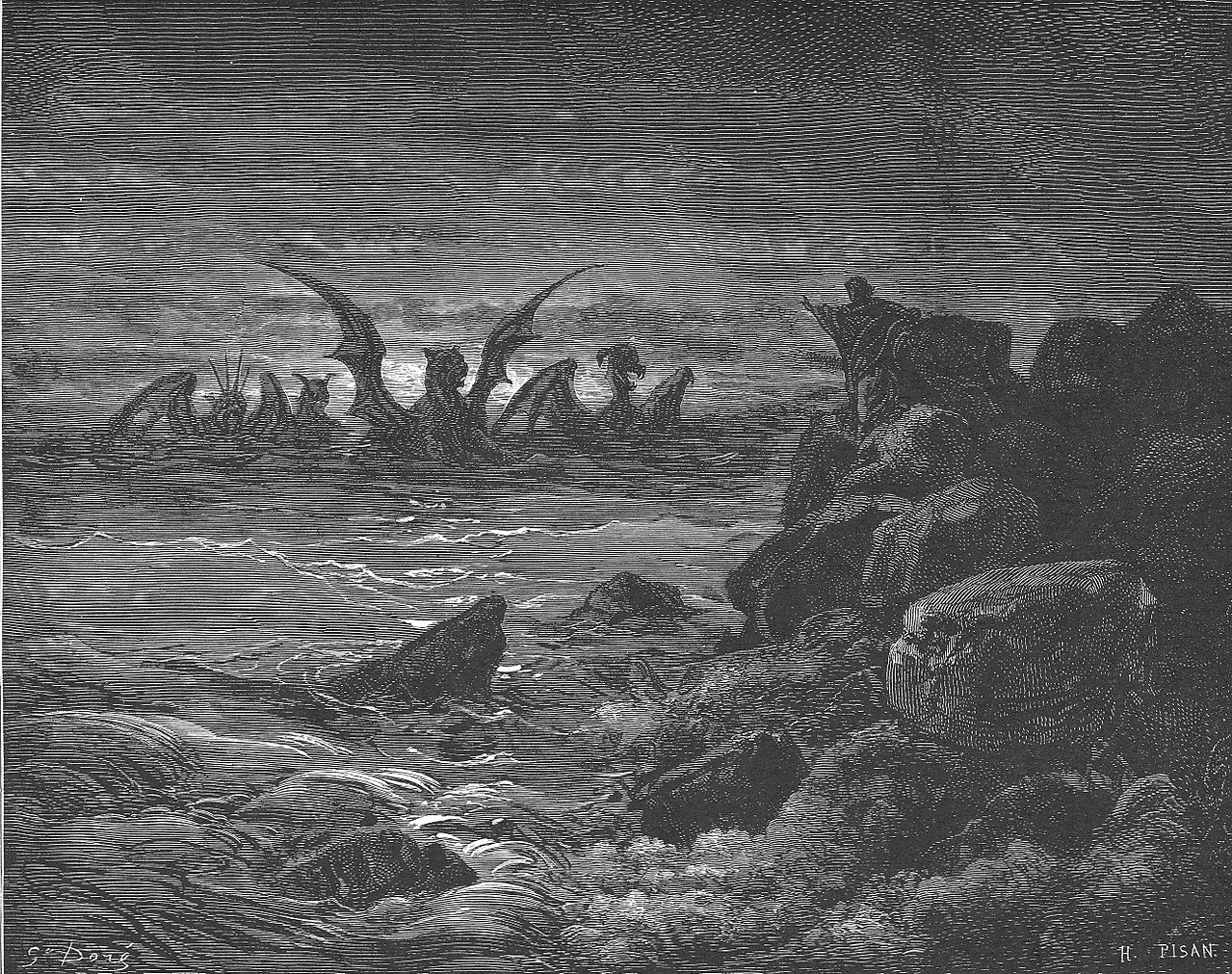
in Daniel 7Then four great beasts came up out of the sea, each one different from the others:
BSB
The same verse in ASV and KJV ▾
ASV
And four great beasts came up from the sea, diverse one from another.
KJV
And four great beasts came up from the sea, diverse one from another.
⋯
This verse in Daniel 7
Commentary
10 notes on this verseVerses 2, 3. "And during the night I saw in my vision, and behold, the four winds of heaven strove upon the great sea, and four great beasts were coming up out of the sea, differing from one another." The four winds of heaven I suppose to have been angelic powers to whom the principalities have been committed, in accordance with what we read in Deuteronomy: "When the Most High divided the nations and when He separated the children of Adam, He established the bounds of the peoples according to the number of the angels.
This site's exposition
told the sum of the matters
on Daniel 7:1-3
Daniel dates his own vision to Belshazzar's first year, placing it chronologically before the feast of chapter 5 even though the book has already told that later story, and the bench reads the arrangement as thematic rather than strict order, the court narratives grouped first and the visions grouped after. The four winds striving upon the great sea and four beasts rising diverse one from another set the vision's grammar for the whole chapter: the sea as the troubled mass of nations in the older writers' reading, and the beasts as kingdoms rising out of that turmoil rather than settled powers. Gill and Keil both note the vision answers chapter 2's image from a different angle, the same four kingdoms now seen from the throne room rather than from a statue's metals.
The record, by era
The Church Fathers3 voices
And so when the different beast was shown to the blessed prophet Daniel and it was shown that it differed from the others, it is necessary for us to consider that he does not discuss any of the beasts as mere animals, but in a model and image he portrays the kingdoms which have arisen in this world, just as he portrays the beasts destroying humanity. For the Great Sea indicates the whole world, he says; "The four winds of heaven," [Daniel 7:2] which signal the fourfold creation.
But the prophet, full of disdain for these various metals, sees "four beasts." From those four beasts he understands that those four formidable kingdoms, which will strike fear into all people, will at last have an end, but there will be only one kingdom that …
A commentator
Hippolytus of RomeHippolytus Exegetical Fragments - Of the visions of Daniel and Nebuchadnezzar · Written before 235.
proposed
1. In speaking of a "lioness from the sea," he meant the rising of the kingdom of Babylon, and that this was the "golden head of the image." And in speaking of its "eagle wings," be meant that king Nebuchadnezzar was exalted and that his glory was lifted up against God. Then he says "its wings were plucked off," i.e., that his glory was destroyed; for he was driven out of his kingdom. And the words, "A man's heart was given it, and it was made stand upon the feet of a man," mean that he came to himself again, and recognised that he was but a man, and gave the glory to God. Then after the lioness he sees a second beast, "like a bear," which signified the Persians. For after the Babylonians the Persians obtained the power. And in saying that "it had three ribs in its mouth," he pointed to the three nations, Persians, Medes, and Babylonians, which were expressed in the image by the silver after the gold. Then comes the third beast, "a leopard," which means the Greeks; for after the Persians, Alexander of Macedon had the power, when Darius was overthrown, which was also indicated by the brass in the image. And in saying that the beast "had four wings of a fowl, and four heads," he showed most clearly how the kingdom of Alexander was parted into four divisions. For in speaking of four heads, he meant the four kings that arose out of it. For Alexander, when dying, divided his kingdom into four parts. Then he says, "The fourth beast (was) dreadful and terrible: it had iron teeth, and claws of brass." Who, then, are meant by this but the Romans, whose kingdom, the kingdom that still stands, is expressed by the iron? "for," says he, "its legs are of iron." 2. After this, then, what remains, beloved, but the toes of the feet of the image, in which "part shall be of iron and part of clay mixed together? […]
The Puritans and the Awakening2 voices
), of different shapes, to denote the different genius and complexion of the nations in whose hands they were lodged. (1.) The first beast was like a lion,
quarantine:debris (2026-07-29) — leading-punctuation+unbalanced-parens
And four great beasts came up from the sea,....
3 more voices on this verse
The Nineteenth Century3 voices
A commentator
Jamieson, Fausset & Brown1802–1910
Commentary Critical and Explanatory on the Whole Bible (1871)
proposed
But the "beasts" here represent the world powers, in their beast-like, grovelling character. It is on the fundamental harmony between nature and spirit, between the three kingdoms of nature, history, and revelation, that Scripture symbolism rests. The selection of symbols is not arbitrary, but based on the essence of things.
Four great beasts came up from the sea - The term sea, in Hebrew ים yam, from המה hamah, to be tumultuous, agitated, etc., seems to be used here to point out the then known terraqueous globe, because of its generally agitated state; and the four winds striving, point out those predatory wars that prevailed almost universally among men, from the days of Nimrod, the founder of the Assyrian or Babylonish monarchy, down to that time, and in the end gave birth to the four great monarchies which are the subject of this vision. Diverse one from another - The people were different; the laws and customs different; and the administration of each differently executed.
A commentator
Albert Barnes1798–1870
Notes, Explanatory and Practical, on the Old and New Testaments (1832-1869)
proposed
And four great beasts came up from the sea - Not at once, but in succession. See the following verses. Their particular form is described in the subsequent verses. The design of mentioning them here, as coming up from, the sea, seems to have been to show that this succession of kingdoms sprang from the agitations and commotions among the nations represented by the heaving ocean.
The words behind it
10 Hebrew wordsEvery Hebrew word of this verse in the order it stands, with what it means and the door to its own study. The last column counts the times a word stands in the whole Bible: the rarer the word, the more the places it appears belong together.
| Hebrew | Sound | Meaning | Word study | In the Bible |
|---|---|---|---|---|
| וְאַרְבַּ֤ע | vearba' | and four | H703 → | 8 times |
| חֵיוָן֙ | cheivan | beasts | H2423 → | 20 times |
| רַבְרְבָ֔ן | ravrevan | great | H7260 → | 8 times |
| סָלְקָ֖ן | salkan | [were] coming up | H5559 → | 7 times |
| מִן־ | min- | from | H4481 → | 109 times |
| יַמָּ֑א | yama' | sea the | H3221 → | |
| שָׁנְיָ֖ן | shaneyan | [they were] different | H8133 → | 21 times |
| דָּ֥א | da' | this [one] | H1668 → | 6 times |
| מִן־ | min- | from | H4481 → | 109 times |
| דָּֽא׃ | da' | this [one] | H1668 → | 6 times |
וְאַרְבַּ֤עand four
vearba'H703 →8 times
חֵיוָן֙beasts
cheivanH2423 →20 times
רַבְרְבָ֔ןgreat
ravrevanH7260 →8 times
סָלְקָ֖ן[were] coming up
salkanH5559 →7 times
מִן־from
min-H4481 →109 times
יַמָּ֑אsea the
yama'H3221 →
שָׁנְיָ֖ן[they were] different
shaneyanH8133 →21 times
דָּ֥אthis [one]
da'H1668 →6 times
מִן־from
min-H4481 →109 times
דָּֽא׃this [one]
da'H1668 →6 times
A shaded row is a word that stands 400 times or fewer in the Bible.
The walk
8 stopsEach card is a verse this one points to, and under it the verses that one points to in turn. Where several paths arrive at the same place, that place is listed first: the text keeps returning to it.
Through
Revelation 13:1Then I saw a beast with ten horns and seven heads rising out of the sea. There were ten royal crowns on its horns and blasphemous names on its heads.
it leads to
- Revelation 12:3
Then another sign appeared in heaven: a huge red dragon with seven heads, ten horns, and seven royal crowns on his heads.
- Revelation 17:3
And the angel carried me away in the Spirit into a wilderness, where I saw a woman sitting on a scarlet beast that was covered with blasphemous names and had seven heads and ten…
- Revelation 11:7
When the two witnesses have finished their testimony, the beast that comes up from the Abyss will wage war with them, and will overpower and kill them.
- Daniel 7:23–25
This is what he said: ‘The fourth beast is a fourth kingdom that will appear on the earth, different from all the other kingdoms, and it will devour the whole earth, trample it down,…
- Daniel 7:2–3
Daniel declared: “In my vision in the night I looked, and suddenly the four winds of heaven were churning up the great sea.
- Revelation 12:3
Through
Psalms 76:4You are resplendent with light, more majestic than mountains filled with game.
it leads to
- Ezekiel 19:1–4
“As for you, take up a lament for the princes of Israel
- Daniel 7:17–28
‘These four great beasts are four kings who will arise from the earth.
- Ezekiel 19:1–4
Through
Daniel 7:17‘These four great beasts are four kings who will arise from the earth.
it leads to
- Revelation 13:11
Then I saw another beast rising out of the earth. This beast had two horns like a lamb, but spoke like a dragon.
- Revelation 13:11
Where this verse is studied
On this page
Studies21
On this verse
On this chapter
- The Son of Man in 1 Enoch
- Angelology
- Antichrist (the Word and the Figure)
- Apocalyptic Literature
- The Beast and the False Prophet
- The Major Prophets
- Revelation, the Canon's Closing Scroll
- Fire
- Jesus: Titles & Roles
- John on Patmos, Revelation 1
- Rome
- The Fourth Man in the Fire: Daniel 3
- The Ascension: Acts 1:1-11 · Luke 24:50-53
- The Horn
- The Throne
- The Throne Room
About Daniel
This page draws on 11 works. Open the list of works
This page draws on Adam Clarke, Commentary on the Bible; Albert Barnes, Notes, Explanatory and Practical, on the Old and New Testaments (1832-1869); Carl Friedrich Keil, Biblical Commentary on the Book of Daniel; Hippolytus of Rome, Commentary on Daniel 4.2.1-3; Hippolytus of Rome, Hippolytus Exegetical Fragments - Of the visions of Daniel and Nebuchadnezzar; Jamieson, Fausset & Brown, Commentary Critical and Explanatory on the Whole Bible; Jerome, Commentary on Daniel; John Gill, Exposition of the Old Testament; John Gill, Exposition of the Old Testament (1748-1763); Matthew Henry, Commentary on the Whole Bible and Theodoret of Cyrus, COMMENTARY ON DANIEL 7:2-3.