
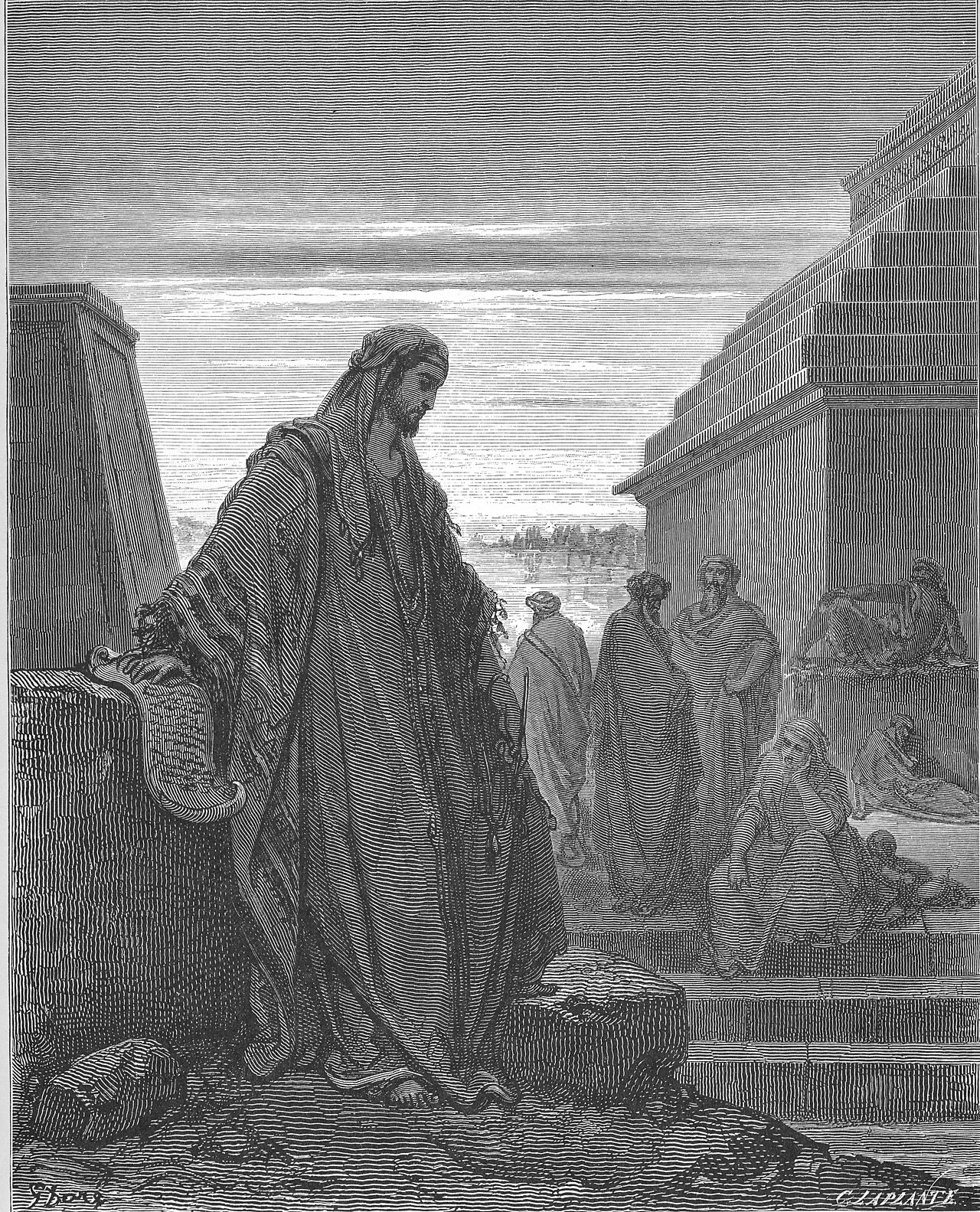
Danielchapter 2
49 verses · Daniel, by tradition · 6th century BC · The Prophets
In the days of those kings, the God of heaven will set up a kingdom that will never be destroyed, nor will it be left to another people. It will shatter all these kingdoms and bring them to an end, but will itself stand forever.
Introduction
Daniel, by tradition, The Prophets, Daniel Overview.
This chapter was written for exiles who served under a king who looked unbeatable and wanted to know how long any empire lasts. It is set in the second year of that king's reign, when a sleepless ruler turned on his own experts. Partway through the chapter the book changes language, from Hebrew to Aramaic, the common tongue of the empire, and stays in it for six chapters. Listen for the contest between the learned men of Babylon and a young captive who prays. Listen too for the order of the kingdoms and for the one that is different from all the rest.
Context
- Who
- Exiles under a king who looked unstoppable, wanting to know how long empires last
- What
- A narrative of the king's troubling dream, the failure of Babylon's wise men and Daniel's telling of the dream of the great image and its meaning.
- Where
- The royal court of Babylon, among the wise men who served the king.
- When
- The second year of Nebuchadnezzar, about 603 BC.
- Why
- To show that the God of a conquered people rules the kingdoms of the earth, sets their limits and will set up a kingdom that never ends.
Historical context
Babylon had a whole profession devoted to dreams. Scribes kept dream manuals, long lists pairing an image with its meaning, alongside omen texts that read the future in a sheep's liver, a stray dog, or the movement of a planet. A king with a troubling dream had experts on staff, and they had reference books.
Show the rest of the historical context, 3 more paragraphs
That is what makes Nebuchadnezzar's demand so brutal. He does not ask for the meaning. He asks them to tell him the dream itself. The manuals were useless. The experts admit it in the text: no one on earth can do this.
The dream is a statue made of four metals, each less valuable than the one above it, and Babylon is the head of gold. That image would have landed hard in that room. Nebuchadnezzar's Babylon really did glitter, his inscriptions boast of overlaying gates and shrines with gold, and the Ishtar Gate's glazed blue brick with its gold-colored bulls and dragons was the entrance to his processional street.
Then a stone cut without hands smashes the whole statue and grows into a mountain that fills the earth. To a Babylonian audience the point was unmissable: the gold head is the top of the sequence, and the sequence ends.
Significance
To the exiles this chapter said their captors were on a clock. Babylon was not the shape of the world forever; it was one metal in a statue that was going to come down.
Show the rest of the significance, 1 more paragraph
It also said something about where wisdom actually lives. The best-trained experts in the most learned city on earth hit a wall, and a captive teenager prayed and was given the answer. The God of a defeated people was reading the mind of the king who defeated them.
This chapter in Jewish lifeWhat this chapter is in Jewish life and reading.
What is done
The dream of the great image has no place in the synagogue's year. Probed for this lane, the site's own table in src/lib/hebraic/readings.ts printed parashot total 0 and haftarah uses total 0 for Daniel, and no festival reading. The site's book dossier records that Daniel stands among the Writings in the Hebrew Bible rather than among the Prophets, so no weekly portion is drawn from it and no Haftarah either.
The chapter's nearest companion in the weekly readings is the story of Pharaoh's dreams, and the corpus draws the two together. The site's table gives the portion Miketz as Genesis 41:1 to 44:17. The corpus carries Midrash Tanchuma Buber, Miketz 4:3 under the second verse, Miketz 4:4 under the tenth and Miketz 9:1 under the twentieth, with Midrash Tanchuma, Miketz 2:4 under the eleventh. Under the twenty-first and the twenty-ninth verses it carries Berakhot 55a:14 and 55b:21.
How it is read
Rashi is quoted from The Judaica Press complete Tanach with Rashi, translated by A. J. Rosenberg, which Sefaria reports as CC-BY, and Ibn Ezra from the Sefaria Community Translation, which Sefaria reports as CC0, each at fifty words or fewer.
At the fourth verse the book passes from Hebrew into Aramaic, and Rashi marks the change by giving the courtiers' greeting in Aramaic (Rashi on Daniel 2:4:1). Many of his notes in this chapter are glosses of the Aramaic, and eight of them say only that the words stand as translated.
Rashi dates the dream by Seder Olam, chapter 28, to the second year after the destruction of the Temple. Scripture names the year by the king's reign "because he demonstrated his insolence by entering the Inner Sanctum of the Sovereign of the Universe" (Rashi on Daniel 2:1:1).
Ibn Ezra records a difference over whether the king had truly forgotten the dream. One of the Geonim held that Nebuchadnezzar knew it and was testing his wise men, since otherwise he would not have believed Daniel. Ibn Ezra reads against him from the verse itself, where the king's spirit is troubled to know the dream, and says the king remembered it only when Daniel told it (Ibn Ezra on Daniel 2:3:1).
The rest of Ibn Ezra's notes follow Daniel's response. He went home to be alone with his companions and give the matter his whole mind (Ibn Ezra on Daniel 2:17:1). They asked mercy of the God of heaven because "there is no sage on earth who could help" (Ibn Ezra on Daniel 2:18:1). Daniel's blessing names wisdom and power, and Ibn Ezra reads it as saying that both belong to God alone, and that every creature above or below holds them only as a thing that comes from him (Ibn Ezra on Daniel 2:20:1).
The corpus carries twenty-four commentary entries on this chapter, the cap its fetch sets, and they stop at the twenty-fourth verse, so what the commentators say on the verses after it is not reported here.
What the rabbis say
The corpus carries forty rabbinic locators on this chapter. Four of them stand in the Talmud and its minor tractates and the rest in the Midrash. The corpus carries the text of none, so each is cited by ref here and never quoted.
On the first verse it holds Bereshit Rabbah 89:5 and Mekhilta DeRabbi Yishmael, Tractate Bachodesh 1:4. On the second verse it holds Aggadat Bereshit 7:1 and Midrash Tanchuma Buber, Miketz 4:3. On the fourth verse it holds Bereshit Rabbah 74:14 and Jerusalem Talmud Sotah 7:2:3. On the ninth verse it holds Midrash Lekach Tov on Lamentations 2:2:1. On the span Daniel 2:10 to 11 it holds Midrash Tanchuma Buber, Miketz 4:4. On the eleventh verse it holds Midrash Tanchuma, Miketz 2:4.
On the thirteenth verse it holds Pesikta Rabbati 6:1. On the fourteenth verse it holds Esther Rabbah 1:19. On the eighteenth verse it holds Eikhah Rabbah 1:51 and Ein Yaakov (Glick Edition), Taanit 1:34. On the nineteenth verse it holds Midrash Shmuel 14:1. On the span Daniel 2:20 to 21 it holds Midrash Tanchuma Buber, Miketz 9:1. On the twentieth verse it holds Otzar Midrashim, Midrash Bayom HaShmini ("on the Eighth Day") 1:3.
On the twenty-first verse it holds Berakhot 55a:14 and Bereshit Rabbati, Parashat Bereshit 24. On the twenty-second verse it holds Bamidbar Rabbah 15:2 and Bamidbar Rabbah 15:5. On the twenty-third verse it holds Bereshit Rabbah 71:5 and Midrash Lekach Tov, Genesis 29:35:1. On the twenty-fifth verse it holds Midrash Lekach Tov on Esther 2:19:2 and Sifrei Aggadah on Esther, Midrash Abba Guryon 2:7. On the twenty-eighth verse it holds Midrash Tehillim 119:25. On the twenty-ninth verse it holds Berakhot 55b:21.
On the thirty-first verse it holds Bereshit Rabbah 68:14. On the thirty-second verse it holds Bereshit Rabbati, Parashat Toldot 17. On the thirty-fourth verse it holds Aggadat Bereshit 20:2. On the thirty-fifth verse it holds Bamidbar Rabbah 13:14. On the span Daniel 2:36 to 37 it holds Tractate Soferim 5:18. On the thirty-seventh verse it holds Ein Yaakov (Glick Edition), Shevuot 4:5.
On the thirty-eighth verse it holds Bereshit Rabbah 45:9. On the forty-second verse it holds Eikhah Rabbah 1:42. On the forty-third verse it holds Aggadat Bereshit 23:4. On the forty-fourth verse it holds Mekhilta DeRabbi Shimon Ben Yochai 15:19. On the forty-fifth verse it holds Esther Rabbah 7:10. On the forty-sixth verse it holds Bamidbar Rabbah 13:4.
On the forty-seventh verse it holds Midrash Tehillim 10:4. On the forty-ninth verse it holds Ein Yaakov, Eiruvin 6:13.
What each locator teaches is a saying of the rabbis, and it is reported as theirs wherever this site quotes one. The quotations wait on a fetch that carries the text.
Sources: Rashi, Rashi on Daniel 2:1:1 to Daniel 2:24:1, The Judaica Press complete Tanach with Rashi, translated by A. J. Rosenberg, reported CC-BY; Ibn Ezra, Ibn Ezra on Daniel 2:2:1 to Daniel 2:20:1, Sefaria Community Translation, reported CC0; The Sefaria corpus, scripts/data/sources/sefaria/daniel/2.json, the 40 Talmud and Midrash locators of this chapter; The site's own files, src/lib/hebraic/readings.ts, probed for this book and printing daniel parashot total 0 and haftarah uses total 0, and src/components/book/dossier-content/daniel.ts on the place of Daniel among the Writings.
The heads below are this chapter's scenes. The numbered points under each are its verses.
A dream forgotten and a death sentence for the wise
Daniel 2:1-3
dreams that troubled his spirit: In the second year of a reign, the king's dreams “troubled his spirit, and sleep escaped him”. He summons “the magicians, enchanters, sorcerers, and astrologers,” four terms Keil takes as overlapping schools of Babylon's wisdom. In verse 5 he will require them to tell the dream itself before its interpretation.
Daniel 2:1
“And in the second year of the reign of Nebuchadnezzar - There is an apparent chronological difficulty in this statement which has given some perplexity to expositors. It arises mainly from two sources. (1) That in Jer 25:1, it is said that the first year of the reign of Nebuchadnezzar corresponded with the fourth year of Jehoiakim, king of Judah, and as the captivity was in the third year of the reign of Jehoiakim Dan 1:1, the time here would be the “fourth” year of the reign of Nebuchadnezzar, instead of the second.”
magicians, enchanters, sorcerers, and astrologers: The king summons his wise men to explain his dreams. Adam Clarke derives one title from a verb meaning to breathe, for its bearers claimed that the gods inspired them. Jamieson, Fausset and Brown take the astrologers, called Chaldeans, as a priestly class drawn from the first people of Babylon.
Daniel 2:2
“The magicians - חרטמים chartummim. See the note on Gen 41:8 (note). The astrologers - אשפים ashshaphim. Perhaps from נשף nashaph, to breathe, because they laid claim to Divine inspiration; but probably the persons in question were the philosophers and astronomers among the Babylonians. The sorcerers - מכשפים mechashshephim. See the note on Deu 18:10, and on Exo 22:18 (note), and Lev 19:31 (note), where several of these arts are explained. The Chaldeans - Who these were is difficult to be ascertained. They might be a college of learned men, where all arts and sciences were professed and taught.”
Adam Clarke · Commentary on the Bible (1810-1826)evangelical
2 more voices on this verse
Daniel 2:2
“How happy are we, whose lives are under the protection of the law and methods of justice, and lie not thus at the mercy of a peevish and capricious prince! We have found already, in Ezekiel, that Daniel was famous both for prudence and prayer; as a prince he had power with God and by man; by prayer he had power with God, by prudence he had power with man, and in both he prevailed.”
Matthew Henry · Commentary on the Whole Bible (1707-1721)puritan
Daniel 2:2
“Chaldeans--here, a certain order of priest-magicians, who wore a peculiar dress, like that seen on the gods and deified men in the Assyrian sculptures. Probably they belonged exclusively to the Chaldeans, the original tribe of the Babylonian nation, just as the Magians were properly Medes.”
Jamieson, Fausset & Brown · Commentary Critical and Explanatory on the Whole Bible (1871)reformed
my spirit is anxious: Jerome held that only a shadow or trace of the dream remained in the king's mind. Matthew Henry compares it to waking with the feeling of a dream after its images are gone. John Gill counts it one dream with several parts.
Daniel 2:3
“They speak to him in the Syriac tongue, which was then the same with the Chaldee, but now they differ much. And henceforward Daniel uses that language, or dialect of the Hebrew, for the same reason that those words, Jer. x.”
Matthew Henry · Commentary on the Whole Bible (1707-1721)puritan
Daniel 2:4-6
answered the king in Aramaic: The astrologers answer “in Aramaic,” and the book stays in Aramaic through chapter 7, the common language of the empire's court. They greet the king with the court formula “O king, may you live forever!” and ask, “Tell your servants the dream,” offering only to interpret.
Daniel 2:4
“In it the course, character, and crisis of the Gentile power are treated; whereas, in the other parts, which are in Hebrew, the things treated apply more particularly to the Jews and Jerusalem.”
Jamieson, Fausset & Brown · Commentary Critical and Explanatory on the Whole Bible (1871)reformed
Older translations read the king's words as saying the thing had gone from him, and Albert Barnes cites the Vulgate, the Greek and Luther. Gesenius, followed by Jamieson, Fausset and Brown, took the words as a final decree. The Berean follows that second sense.
Daniel 2:5
“The thing--that is, The dream, "is gone from me." GESENIUS translates, "The decree is gone forth from me," irrevocable (compare Isa 45:23); namely, that you shall be executed, if you do not tell both the dream and the interpretation.”
Jamieson, Fausset & Brown · Commentary Critical and Explanatory on the Whole Bible (1871)reformed
1 more voice on this verse
Daniel 2:5
“The king answered and said to the Chaldeans, The thing is gone from me - The Vulgate renders this, “Sermo recessit a me” - “The word is departed from me.” So the Greek, Ὁ λόγος ἀπ ̓ ἐμοῦ ἀπέστη Ho logos ap' emou apestē. Luther, “Es ist mir entfallen” - “It has fallen away from me,” or has departed from me.”
gifts and rewards and great honor: The rewards balance the threat of verse 5. Matthew Henry compares the astrologers to Balaam, who knew that Balak could promote him to great honor. Albert Barnes notes a test inside the demand: the king could check a told dream against his own memory.
Daniel 2:6
“But if ye show the dream - If you show what the dream was. And the interpretation thereof - What it signifies. That is, they were so to state the dream that Nebuchadnezzar would recognize it; and they were to give such an explanation of it as would commend itself to his mind as the true one.”
1 more voice on this verse
Daniel 2:6
“And they knew, as Balaam did concerning Balak, that he was able to promote them to great honour, and give them that wages of unrighteousness which, like him, they loved so dearly.”
Matthew Henry · Commentary on the Whole Bible (1707-1721)puritan
Daniel 2:7-9
The wise men repeat their request, and the king answers, “I know for sure that you are stalling for time”. He charges them with “false and fraudulent words, hoping the situation will change”. The execution decree goes out in verse 12, and these verses record the standoff.
Daniel 2:7
“They answered again, and said, Let the king tell his servants the dream, and we will show the interpretation of it - Certainly not an unreasonable request, in any circumstances, and especially in theirs. They did not profess, evidently, to be able to recal a dream that was forgotten, but the extent of their profession on this subject appears to have been, that they were able to “explain” what was commonly regarded as a prognostic of a future event.”
stalling for time: The Aramaic verb behind “stalling for time” means to buy, and Albert Barnes cites the Greek, which speaks of redeeming the time. Adam Clarke lists what the wise men could win by delay. The king might recall the dream or lose interest, or they might invent a dream or escape.
Daniel 2:8
“That ye would gain the time - The king means either that they wished to prolong the time that he might recollect it, or get indifferent about it; or that they might invent something in the place of it; or make their escape to save their lives, after having packed up their valuables. See Dan 2:9.”
Adam Clarke · Commentary on the Bible (1810-1826)evangelical
there is only one decree: The king's test is simple. A man who can recover the dream can be trusted with its meaning. Albert Barnes reads "only one decree" as a single sentence of death for every class of the wise men, with no favor shown to any.
Daniel 2:10-11
The astrologers now state the limit plainly: “No one on earth can do what the king requests,” and no king has ever asked it. Only “the gods, whose dwelling is not with mortals” could tell it, they say. The chapter answers their claim in verse 19.
Daniel 2:10
“And so since they said that what the king sought was impossible to be recounted by a man, God showed them that the things which are impossible with men, are possible with God.”
Hippolytus of Rome · written before 235 · Commentary on Daniel 2.4patristic
1 more voice on this verse
Daniel 2:10
“There is not a man upon the earth - The thing is utterly impossible to man. This was their decision: and when Daniel gave the dream, with its interpretation, they knew that the spirit of the holy gods was in him. So, even according to their own theology, he was immeasurably greater than the wisest in Babylon or in the world.”
Adam Clarke · Commentary on the Bible (1810-1826)evangelical
Albert Barnes notes that "difficult" first meant costly, then hard. Jamieson, Fausset and Brown take "the gods" here to mean the great gods of heaven, as distinct from men made gods such as Nimrod. Matthew Henry calls the astrologers' words a confession drawn from men who served idols.
Daniel 2:11
“And it is a rare thing that the king requireth - Chaldee, יקירה yaqqı̂yrâh - meaning, “choice, valuable, costly;” then, “heavy, hard, difficult.” Greek, βαρύς barus. Vulgate, “gravis - heavy, weighty.” The idea is not so much that the thing demanded by the king was “uncommon” or “rarely made” - though that was true, as that it was so difficult as to be beyond the human powers. They would not have been likely on such an occasion to say that the requirement was absolutely unjust or unreasonable.”
1 more voice on this verse
Daniel 2:11
“This confession of the divine omniscience is here extorted from these idolaters, to the honour of God and their own condemnation, who though they knew there is a God in heaven, to whom all hearts are open, all desires known, and from whom no secret is hid, yet offered up their prayers and praises to dumb idols, that have eyes and see not, ears and hear not.”
Matthew Henry · Commentary on the Whole Bible (1707-1721)puritan
Daniel 2:12-13
wise men of Babylon: The king's anger turns one failure into a general sentence: he orders “to destroy all the wise men of Babylon”. The decree reaches “Daniel and his friends,” who had been absent from the audience of verse 2. This decree brings Daniel into the story.
look for Daniel and his friends: Albert Barnes notes that the Aramaic can read that the wise men were already being executed. John Wesley explains Daniel's absence from the first audience by his youth, which the Chaldeans despised. Adam Clarke adds that the decree still reached him.
Daniel 2:13
“And the decree went forth that the wise men should be slain - The original here will bear a somewhat different translation, meaning, “the decree went forth, “and” the wise men were slain;” that is, the execution of the sentence was actually commenced. So the Vulgate: Et egressa sententia, sapientes interficiebantur. So also the Greek version: καὶ οἱ σοφοί ἀπεκτέννοντο kai hoi sophoi apektennonto - “and the wise men were slain.” This seems to me to be the more probable interpretation, and better to suit the connection.”
A night of prayer and a blessing when the answer came
Daniel 2:14-16
Daniel replied with discretion and tact: When Arioch comes to execute them, Daniel asks with “discretion and tact”, “Why is the decree from the king so harsh?” Daniel goes to the king. The wise men's delay in verse 8 met a charge of stalling; Daniel asks for time “so that he could give him the interpretation”.
Daniel 2:14
“Captain of the king’s guard - Chief of the king’s executioners or slaughter men. Margin, רב תבחיא rab tabachaiya, chief of the butchers, he that took off the heads of those whom the king ordered to be slain, because they had in any case displeased him. “Go and bring me the head of Giaffer.” The honorable butcher went and brought the head in a bag on a dish. It was Herod’s chief butcher that brought the head of John the Baptist in a dish to the delicate daughter of Herodias. This was the custom of the country.”
Adam Clarke · Commentary on the Bible (1810-1826)evangelical
Jamieson, Fausset and Brown read the question as asking why the rest had been condemned without being consulted. Daniel had known nothing until now. Albert Barnes notes that Arioch's title in this passage marks an officer of real power.
give him some time: Adam Clarke marks the contrast with the Chaldeans. They promised an interpretation only if the king supplied the dream, and Daniel undertook to give both. Albert Barnes suggests that Daniel may have made the request through a high officer of the palace.
Daniel 2:16
“That he would give him time - That is, that he might seek unto God for a revelation of the thing. The Chaldeans dared not even to promise this; they would only pledge themselves for the interpretation, provided the king would furnish the dream. Daniel engages both to find the lost dream, and to give the proper interpretation.”
Adam Clarke · Commentary on the Bible (1810-1826)evangelical
Daniel 2:17-19
explained the matter to his friends: Daniel returns home and urges his three friends “to plead for mercy from the God of heaven concerning this mystery”. “During the night, the mystery was revealed to Daniel in a vision,” the gift named at 1:17 in use for the first time.
plead for mercy: Albert Barnes reads the mercy asked from the God of heaven as the mystery revealed, so that Daniel and his friends would be spared. Adam Clarke supposes that all four prayed without ceasing until the answer came. He adds that the night of the answer is not known.
Daniel 2:18
“O what a craftsman this Spirit is! There is no delay in learning whatever he wills. As soon as he touches the mind, he teaches, and merely to have touched is to have taught. For as soon as he illuminates the human soul, he transforms it; he suddenly takes away what it was, and suddenly produces what it was not.”
Gregory the Dialogist · written before 604 · Forty Gospel Homilies, Homily 30patristic
revealed to Daniel in a vision: Adam Clarke leaves open whether Daniel saw the vision in a dream or received the mystery by direct inspiration. Matthew Henry notes that the prayer itself is not recorded. The blessing Daniel gave the God of heaven is given in full, in verses 20 to 23.
Daniel 2:20-23
Daniel's hymn gives “wisdom and power” to God, who “removes kings and establishes them,” words spoken before the king hears a vision about kingdoms. He praises the God who “reveals the deep and hidden things”. The address “O God of my fathers” ties this revelation to Israel's covenant history.
Daniel 2:20
“Daniel answered and said - The word “answer,” in the Scriptures, often occurs substantially in the sense of “speak” or “say.” It does not always denote a reply to something that has been said by another, as it does with us, but is often used when a speech is commenced, as if one were replying to something that “might” be said in the case, or as meaning that the circumstances in the case gave rise to the remark.”
He removes kings and establishes them: Jerome read this line as preparing the king for the dream's subject, the succession of kingdoms, and Jamieson, Fausset and Brown follow him. Empires rise and fall by God's will. Origen counted such earthly power a gift of God, of a lower order than the spiritual gifts.
Daniel 2:21
“And he changeth the times and the seasons - The object of this is to assert the general control of God in reference to all changes which occur. The assertion is made, undoubtedly, in view of the revolutions in empire which Daniel now saw, from the signification of the dream, were to take place under the Divine hand. Foreseeing now these vast changes denoted by different parts of the image Dan 2:36-45, stretching into far-distant times, Daniel was led to ascribe to God the control over “all” the revolutions which occur on earth.”
1 more voice on this verse
Daniel 2:21
“He changeth - God can make the sun go back or stand still, as in Ahaz and Joshua's time, it is the great part of God's power and prerogative to change times.”
John Wesley · Explanatory Notes upon the Old Testament (1765)evangelical
reveals the deep and hidden things: Albert Barnes defines the deep things as matters beyond human reach, kept hidden until God makes them known. Matthew Henry applies the line to prophecy. God shows things to come to his servants and prophets.
O God of my fathers: Albert Barnes takes these fathers as the whole Jewish people. Jerome saw Daniel giving thanks for God's faithfulness to those fathers, and giving no credit to any merit of his own. The plural in "what we have requested" includes the three friends who prayed with him.
Daniel 2:23
“What was hidden from the celebrated Chaldeans, who made the interpreting of dreams their profession, is revealed to Daniel, a captive-Jew, a babe, much their junior. God would hereby put honour upon the Spirit of prophecy just when he was putting contempt upon the spirit of divination.”
Matthew Henry · Commentary on the Whole Bible (1707-1721)puritan
There is a God in heaven who reveals secrets
Daniel 2:24-25
Daniel goes to Arioch: “Do not execute the wise men of Babylon! Bring me before the king, and I will give him the interpretation”. Arioch brings him in haste and tells the king, “I have found a man among the exiles from Judah,” though Daniel came to him.
Daniel 2:24
“Note, Since God shows common kindness to the evil and good, we should do so too, and be ready to save the lives of even bad men, Matt. v. 45 . A good man is a common good.”
Matthew Henry · Commentary on the Whole Bible (1707-1721)puritan
Jerome and Jamieson, Fausset and Brown note that Arioch claims he has found the man. Albert Barnes reads "hastily" as trembling excitement. He traces it to joy that the interpretation was found, or to relief that the wise men of Babylon would no longer be killed.
Daniel 2:25
“Then Arioch brought in Daniel before the king in haste - The Chaldee word used here implies “in tumultuous haste,” as of one who was violently excited, or in a state of trepidation, from בהל bâhal - “to tremble, to be in trepidation.” The trepidation in this case may have arisen from one or both of two causes: (1) exultation, or joy, that the great secret was discovered; or (2) joy that the effusion of blood might be stayed, and that there might be now no necessity to continue the execution of the sentence against the wise men.”
Daniel 2:26-30
The king asks, and Daniel agrees with the astrologers: “No wise man, enchanter, medium, or magician can explain to the king the mystery”. He names the source, “there is a God in heaven who reveals mysteries”. The purpose he gives is “that you may understand the thoughts of your mind”.
Daniel 2:26
“Belteshazzar - By this name of Belteshazzar he had given Daniel, he took courage as if he might expect some great thing from him: for the word signifies the keeper of secret treasure.”
John Wesley · Explanatory Notes upon the Old Testament (1765)evangelical
enchanter, medium, or magician: Daniel begins by confirming what the Chaldeans said in verses 10 and 11. Adam Clarke reads this as needed so the king would see the folly of trusting those men or their gods. Augustine ranked the interpreter above the seer.
in the latter days: Adam Clarke says the phrase "the latter days" in the prophets generally means the days of the Messiah. Jamieson, Fausset and Brown translate it "in the after days" and extend it to the whole future. Matthew Henry carries what will happen to Christ's kingdom.
Daniel 2:28
“There is a God in heaven - To distinguish him from those idols, the works of men’s hands; and from the false gods in which the Chaldeans trusted. In the latter days - A phrase which, in the prophets, generally means the times of the Messiah. God is about to show what shall take place from this time to the latest ages of the world. And the vision most certainly contains a very extensive and consecutive prophecy; which I shall treat more largely at the close of the chapter, giving in the mean time a short exposition.”
Adam Clarke · Commentary on the Bible (1810-1826)evangelical
Connectionsperson/daniel
your thoughts turned to the future: Matthew Henry and Hippolytus of Rome both place the dream after the king had lain awake weighing the future of his conquests. Hippolytus names Egypt and the Jewish land among them. The dream answered the king's own question.
not because I have more wisdom: Albert Barnes notes that Daniel turns from the king's thoughts in verse 29 to himself, and says the mystery was revealed for the king's sake. Jamieson, Fausset and Brown set his words on wisdom beside Joseph's in Genesis 41:16. John Chrysostom held that silence about oneself calms the hearer.
Daniel 2:30
“But as for me - So far as I am concerned in this matter, or whatever skill or wisdom I may evince in the interpretation, it is not to be traced to myself. The previous verse commences with the expression “as for thee;” and in this verse, by the phrase “as for me,” Daniel puts himself in strong contrast with the king.”
The great image and the stone cut without hands
Daniel 2:31-33
a great statue appeared: The statue's metals fall in value, which the older commentators read as a decline in worth while the kingdoms grow harder. The statue is “great and dazzling” and “its form was awesome,” and its feet, the part that bears the weight, mix iron with clay.
Daniel 2:31
“Thou, O king, sawest - Margin, “wast seeing.” The margin is in accordance with the Chaldee. The language is properly what denotes a prolonged or attentive observation. He was in an attitude favorable to vision, or was looking with intensity, and there appeared before him this remarkable image. Compare Dan 7:1-2, Dan 7:4, Dan 7:6. It was not a thing which appeared for a moment, and then vanished, but which remained so long that he could contemplate it with accuracy. And, behold, a great image - Chaldee, “one image that was grand” - שׂגיא חד צלם tselēm chad s'agı̂y'.”
1 more voice on this verse
Daniel 2:31
“Those kingdoms only are mentioned which stand in some relation to the kingdom of God; of these none is left out; the final establishment of that kingdom is the aim of His moral government of the world. The colossus of metal stands on weak feet, of clay. All man's glory is as ephemeral and worthless as chaff (compare 1Pe 1:24).”
Jamieson, Fausset & Brown · Commentary Critical and Explanatory on the Whole Bible (1871)reformed
head of the statue: Aphrahat linked the head of gold to Jeremiah's word that Babylon is a golden cup in the Lord's hand. Albert Barnes notes that the Aramaic reads good gold. The whole colossal head appeared to be made of it alone.
Daniel 2:32
“Head was of fine gold - The Babylonish empire, the first and greatest. Breast and his arms of silver - The Medo-Persian empire, under Cyrus, etc. His belly and his thighs of brass - The Macedonian empire, under Alexander the Great, and his successors.”
Adam Clarke · Commentary on the Bible (1810-1826)evangelical
1 more voice on this verse
Daniel 2:32
As Daniel said, "You are the head of gold." And why was he called the head of gold? Was it not because the word of Jeremiah was fulfilled in him? For Jeremiah said, "Babylon is a golden cup in the hand of the Lord that makes all the earth to drink of its wine." And also Babylon was called the head of all kingdoms, as it is written, "Babylon was the head of the kingdom of Nimrod."
Aphrahat the Persian Sage · written before 345 · DEMONSTRATIONS 5:11patristic
part iron and part clay: Adam Clarke read the iron legs as Rome and the mixed feet as Rome joined to barbarian nations in ten kingdoms. Ephrem the Syrian read the iron as Alexander and the toes as ten Hellenistic kings after him. Jamieson, Fausset and Brown call the clay brittle earthenware.
Daniel 2:33
“The clay, in Da 2:41, "potter's clay," Da 2:43, "miry clay," means "earthenware," hard but brittle (compare Ps 2:9; Re 2:27, where the same image is used of the same event); the feet are stable while bearing only direct pressure, but easily broken to pieces by a blow (Da 2:34), the iron intermixed not retarding, but hastening, such a result.”
Jamieson, Fausset & Brown · Commentary Critical and Explanatory on the Whole Bible (1871)reformed
Daniel 2:34-36
a stone was cut out: The stone, “cut out, but not by human hands,” strikes the statue on “its feet of iron and clay,” the mixed part of verse 33. The older commentators read the stone as Christ and his kingdom, and the stone “became a great mountain and filled the whole earth”.
Daniel 2:34
“The thing is, I think, a dark saying, a shadow of what should come. For what is the stone that is laid but Christ Himself? for of Him Isaiah says, "And I will lay in the foundations of Sion a costly stone, precious, elect:" and Daniel likewise, "A stone was cut out without hands," that is, Christ was born without a man.”
Gregory of Nyssa · written before 395 · On the Baptism of Christpatristic
2 more voices on this verse
Daniel 2:34
“As the fourth kingdom, or Rome, was represented in a twofold state, first strong, with legs of iron, then weak, with toes part of iron, part of clay; so this fifth kingdom, that of Christ, is seen conversely, first insignificant as a "stone," then as a "mountain" filling the whole earth.”
Jamieson, Fausset & Brown · Commentary Critical and Explanatory on the Whole Bible (1871)reformed
Daniel 2:34
“A stone was cut out - The fifth monarchy; the spiritual kingdom of the Lord Jesus, which is to last for ever, and diffuse itself over the whole earth.”
Adam Clarke · Commentary on the Bible (1810-1826)evangelical
became a great mountain: Augustine read the stone as Christ and the mountain as his church, grown from a small stone until it filled the whole earth. Irenaeus tied the stone to the resurrection of the just. Jamieson, Fausset and Brown stress that the iron, clay, bronze, silver and gold are shattered at once.
Daniel 2:35
“Then was the iron, the clay, the brass, the silver, and the gold broken to pieces together, and became like the chaff of the summer threshing-floor - The word rendered “together” (כצרה kachădâh) our translators would seem to have understood as referring to “time;” to its being done simultaneously. The more literal interpretation, however, is, “as one;” that is, “they were beaten small as one,” referring to identity of condition. They were all reduced to one indiscriminate mass; to such a mass that the original materials could no longer be distinguished, and would all be blown away together.”
1 more voice on this verse
Daniel 2:35
“If therefore the great God showed future things by Daniel, and confirmed them by His Son; and if Christ is the stone which is cut out without hands, who shall destroy temporal kingdoms, and introduce an eternal one, which is the resurrection of the just; as he declares, "The God of heaven shall raise up a kingdom which shall never be destroyed,"-let those thus confuted come to their senses, who reject the Creator (Demiurgum), and do not agree that the prophets were sent beforehand from the same Father from whom also the Lord came, but who assert that prophecies originated…”
Irenaeus · written before 202 · Against Heresies 5:26.2patristic
Gold, silver, bronze, iron: and a kingdom that stands forever
now we will tell the king: Albert Barnes explains the plural. The meaning came in answer to the joint prayer of verse 18, so Daniel shares the credit with his three friends. John Gill notes that the king could now confirm every detail of the recited dream.
Daniel 2:36
“This is the dream; and we will tell the interpretation thereof before the king - Daniel here speaks in his own name, and in the name of his companions. Hence, he says, “we will tell the interpretation.” It was in answer to their united supplications Dan 2:18, that this meaning of the vision had been made known to him; and it would not only have been a violation of the rules of modesty, but an unjust assumption, if Daniel had claimed the whole credit of the revelation to himself.”
1 more voice on this verse
Daniel 2:36
“This is the dream,.... Which Nebuchadnezzar dreamed, but had forgot, and was now punctually and exactly made known to him; for the truth of which he is appealed unto; for, no doubt, by this account, the whole of his dream, and every circumstance of it, were brought to his mind: and we will tell the interpretation thereof before the king; for though both the dream, and the interpretation of it, were only revealed to Daniel; yet he joins his companions with him, partly because they were now present, and chiefly because they were assisting to him in prayer for it.”
Daniel 2:37-38
king of kings: Daniel calls Nebuchadnezzar “the king of kings” and names the source: “the God of heaven has given” it, over people, beasts and birds alike. “You are that head of gold” names Babylon as the first of the kingdoms, the fixed point from which every reading of the metals begins.
Daniel 2:37
“Thou, O King, art a king of kings - The phrase “king of kings” is a Hebraism, to denote a supreme monarch, or one who has other kings under him as tributary, Ezr 7:12; Eze 26:7. As such it is applied by way of eminence to the Son of God, in Rev 17:14; Rev 19:16. As here used, it means that Nebuchadnezzar ruled over tributary kings and princes, or that he was the most eminent of the kings of the earth.”
You are that head of gold: Jamieson, Fausset and Brown hear Genesis 1:28 in this list, a dominion first given to man and lent for a time to a world power. Albert Barnes takes the language as general. Matthew Henry notes other great kingdoms of the time, such as the Scythians.
Daniel 2:38
“And wheresoever the children of men dwell, the beasts of the field, and the fowls of the heavens, hath he given into thy hand - This is evidently general language, and is not to be pressed literally. It is designed to say that he ruled over the whole world; that is, the world as then known. This is common language applied in the Scriptures to the Babylonian, Persian, Grecian, and Roman kingdoms.”
Daniel 2:39-43
arise another kingdom, inferior to yours: The traditional reading, as old as Jerome's reply to Porphyry, takes the silver as Medo-Persia, the bronze as Greece, and the fourth as Rome. A critical reading ends the fourth kingdom in the divided Hellenistic states after Alexander. Both read the iron “mixed with clay,” as a divided final state.
Daniel 2:39
“That Medo-Persia is the second kingdom appears from Da 5:28 and Da 8:20. Isa 21:2. inferior--"The kings of Persia were the worst race of men that ever governed an empire" [PRIDEAUX].”
Jamieson, Fausset & Brown · Commentary Critical and Explanatory on the Whole Bible (1871)reformed
there will be a fourth kingdom: Albert Barnes records two leading views of this fourth kingdom. Jerome and John Wesley held it to be Rome. Others took it as the kingdoms that followed Alexander the Great, and Ephrem the Syrian named Alexander himself as the iron that crushes all things.
Daniel 2:40
"And there shall be a fourth empire like unto iron. Just as iron breaks to pieces and overcomes all else, so it shall break to pieces and shatter all these preceding empires . ..." Now the fourth empire, which clearly refers to the Romans, is the iron empire which breaks in pieces and overcomes all others.
Jerome · written before 420 · St. Jerome, Commentary on Daniel, CHAPTER TWOpatristic
1 more voice on this verse
Daniel 2:40
“And the fourth kingdom - Represented in the image by the legs of iron, and the feet “part of iron, and part of clay,” Dan 2:33. The first question which arises here is, what kingdom is referred to by this? In regard to this, there have been two leading opinions: one, that it refers to the Roman empire; the other, that it refers to the kingdoms or dynasties that immediately succeeded the reign of Alexander the Great; embracing the kingdoms of the Seleucidae and Lagidae, Syria, and Egypt - in the language of Prof.”
this will be a divided kingdom: John Wesley saw the divided kingdom in Rome's civil wars and in provinces that threw off its rule. Jamieson, Fausset and Brown report that Newton placed the kingdoms of the ten toes in the past and Tregelles in the future. Albert Barnes reads the iron and clay as mixed together.
Daniel 2:41
“But its feet and toes are partly of iron and partly of earthenware, a fact most clearly demonstrated at the present time. For just as there was at the first nothing stronger or hardier than the Roman realm, so also in these last days there is nothing more feeble, since we require the assistance of barbarian tribes both in our civil wars and against foreign nations.”
Jerome · written before 420 · St. Jerome, Commentary on Daniel, CHAPTER TWOpatristic
1 more voice on this verse
Daniel 2:41
“NEWTON, who understands the Roman empire to be parted into the ten kingdoms already (whereas TREGELLES makes them future), explains the "clay" mixture as the blending of barbarous nations with Rome by intermarriages and alliances, in which there was no stable amalgamation, though the ten kingdoms retained much of Rome's strength.”
Jamieson, Fausset & Brown · Commentary Critical and Explanatory on the Whole Bible (1871)reformed
partly strong and partly brittle: Albert Barnes prefers "brittle" for the Aramaic word, meaning frail and easily broken. Jerome saw the verse fulfilled in his own day. In his judgment Rome, once the strongest kingdom, had become the most brittle.
Daniel 2:42
“And as the toes of the feet were part of iron and part of clay, so the kingdom shall be partly strong, and partly broken - Margin, “brittle.” The margin is the more correct rendering of the Chaldee word (תבירה tebı̂yrâh). It means “frail, fragile” - easily broken, but not necessarily that it was actually broken. That did not occur until the stone cut out of the mountain impinged on it.”
the peoples will mix: Albert Barnes calls the verse hard to interpret. He took the King James phrase seed of men to mean a foreign people mixed into the first kingdom. Jamieson, Fausset and Brown report Newton's reading: barbarian peoples mixed with Rome through marriages, yet the iron and clay would “not hold together”.
Daniel 2:43
“And whereas thou sawest iron mixed with miry clay, they shall mingle themselves with the seed of men - Various explanations have been given of this verse, and it certainly is not of easy interpretation. The phrase “seed of men,” would properly denote something different from the original stock that was represented by iron; some foreign admixture that would be so unlike that, and that would so little amalgamate with it, as to be properly represented by clay as compared with iron. Prof.”
Daniel 2:44-45
heaven will set up a kingdom: The interpretation ends with a kingdom “that will never be destroyed, nor will it be left to another people”: it will “shatter all these kingdoms”. Daniel closes, “The dream is true, and its interpretation is trustworthy,” the certainty the wise men could not offer in verses 10 and 11.
Daniel 2:44
“A kingdom which shall never be destroyed - The extensive and extending empire of Christ. Shall not be left to other people - All the preceding empires have swallowed up each other successively; but this shall remain to the end of the world.”
Adam Clarke · Commentary on the Bible (1810-1826)evangelical
4 more voices on this verse
Daniel 2:44
“He, being begotten by the Father before the beginning of time, was God the Word, the only-begotten Son, and remains the same for ever; for "of His kingdom there shall be no end," says Daniel the prophet. Let us all therefore love one another in harmony, and let no one look upon his neighbour according to the flesh, but in Christ Jesus. Let nothing exist among you which may divide you; but be ye united with your bishop, being through him subject to God in Christ.”
Ignatius of Antioch · written before 108 · Epistle of Ignatius to the Magnesianspatristic
Daniel 2:44
“And in the days of these kings, &c. Not of the Babylonian, Persian, and Grecian kings; nor, indeed, of the old Roman kings, or emperors; but in the days of these ten kings, or kingdoms, into which the Roman empire is divided, signified by the ten toes, of different power and strength.”
Daniel 2:44
“In the days of these kings - While the iron kingdom stood, for Christ was born in the reign of Augustus Caesar. And this kingdom is not bounded by any limits, as worldly empires are, but is truly universal.”
John Wesley · Explanatory Notes upon the Old Testament (1765)evangelical
Daniel 2:44
“The falling of the stone on the image must mean, destroying judgment on the fourth Gentile power, not gradual evangelization of it by grace; and the destroying judgment cannot be dealt by Christians, for they are taught to submit to the powers that be, so that it must be dealt by Christ Himself at His coming again.”
Jamieson, Fausset & Brown · Commentary Critical and Explanatory on the Whole Bible (1871)reformed
The dream is true: Jerome read the stone cut out without human hands as Christ's birth from a virgin, and John Wesley as his conception by the Holy Ghost. Jamieson, Fausset and Brown treat Daniel's exact recall of the dream as a proof offered to the king. The recall vouches for the meaning.
Daniel 2:45
“And the gold - This denotes the small beginning of Christ's visible kingdom, and the different rise of Christ from all other; his conception by the Holy Ghost, without father and mother, respectively as to his two natures.”
John Wesley · Explanatory Notes upon the Old Testament (1765)evangelical
Nebuchadnezzar bows and Daniel is promoted
paid homage to Daniel: Porphyry doubted a proud king would fall before a captive. Jerome answered with the Lycaonians, who tried to present offerings to Paul and Barnabas in Acts 14. Jamieson, Fausset and Brown read the homage as worship of God in the person of Daniel.
Daniel 2:46-49
Nebuchadnezzar fell on his face: Nebuchadnezzar “fell on his face, paid homage to Daniel,” and ordered incense offered to him, though Daniel had named God as the revealer. His words, “Your God is truly the God of gods and Lord of kings,” answer the astrologers' claim in verse 11.
God of gods: The man Daniel called the king of kings in verse 37 confesses the Lord of kings above him, a turn Jamieson, Fausset and Brown mark. The king who demanded the dream now calls Daniel's God “the Revealer of Mysteries”.
Daniel 2:47
Lord of kings--The world power shall at last have to acknowledge this (Re 17:14; 19:16); even as Nebuchadnezzar, who had been the God-appointed "king of kings" (Da 2:37), but who had abused the trust, is constrained by God's servant to acknowledge that God is the true "Lord of kings."
Jamieson, Fausset & Brown · Commentary Critical and Explanatory on the Whole Bible (1871)reformed
gave him many generous gifts: Porphyry faulted Daniel for accepting Babylon's gifts, as Jerome reports. Hippolytus of Rome compared the king's promotion of Daniel to Pharaoh's promotion of Joseph. Jamieson, Fausset and Brown credit much of the exiles' relief to Daniel's place as ruler over the province of Babylon.
remained in the king’s court: Jerome's text says Daniel remained in the king's gate. Jamieson, Fausset and Brown explain the gate as the seat of the king's court, citing Esther 2:19. Adam Clarke notes that Shadrach, Meshach and Abednego, who shared Daniel's anxieties and prayers, now share his promotion.
Daniel 2:49
“Daniel requested of the king, and he set Shadrach, Meshach, and Abed-nego over the affairs of the province of Babylon - He wished his three companions promoted, who had shared his anxieties, and helped him by their prayers. They all had places of trust, in which they could do much good, and prevent much evil. Daniel sat in the gate of the king - That is, was the chief officer in the palace; and the greatest confidant and counselor of the king.”
Adam Clarke · Commentary on the Bible (1810-1826)evangelical
2 more voices on this verse
Daniel 2:49
"And Daniel asked a favor from the king and he appointed Shadrach, Mishach, and Abednego over the affairs of the country of Babylon." [Daniel 2:49] And this which happened under Daniel is worthy of faith and approval.
Hippolytus of Rome · written before 235 · Commentary on Daniel 2.10patristic
Daniel 2:49
“Then Daniel requested of the king ... - In his own remarkable prosperity, and in the extraordinary honors conferred on him, he did not forget the companions of his humbler days.”
How this psalm is built
The form: A court narrative that holds a revealed dream of four kingdoms and the kingdom of God, and opens the Aramaic half of the book, as guide classes it.
The patterns in this chapter
| Device | What it does | Where to see it |
|---|---|---|
| The change of language at verse 4 | The wise men answer the king in Aramaic at verse 4, and the book stays in Aramaic until the end of chapter 7. The site's book guide marks the Aramaic span as the chapters about the Gentile kingdoms, told in the language of the empire. Chapter 8 returns to Hebrew.This site's published book guide, src/components/book/guides/daniel/DanielGuide.tsx, the chiasm table of chapters 2 to 7 and the language bands. | Daniel 2:4, Daniel 7:28, Daniel 8:1 |
| The same four kingdoms, twice | The Aramaic chapters are arranged in pairs that mirror each other. Chapters 2 and 7 each set out four kingdoms followed by the kingdom of God. Chapters 3 and 6 each tell of servants delivered in a trial, and chapters 4 and 5 each tell of a proud king judged. This chapter is the outer frame on the court side.This site's published book guide, src/components/book/guides/daniel/DanielGuide.tsx, the chiasm table of chapters 2 to 7 and the language bands. | Daniel 2:37, Daniel 2:44 |
How this chapter is built
1 more paragraph on the patterns
The chapter runs in three movements. Verses 1 to 13 are the king's demand and the failure of the wise men. Verses 14 to 30 are Daniel's request, his prayer and his answer to the king. Verses 31 to 49 are the dream, its meaning and the king's response. The dream moves down the image from gold to silver, bronze, iron and clay, and a stone cut without hands ends it. The change from Hebrew to Aramaic comes at verse 4 and holds until the end of chapter 7. The site's book guide reads chapters 2 to 7 as a set of mirrored pairs. This chapter and chapter 7 are the outer pair, each telling of four kingdoms and then the kingdom of God.
Keep studying
Studies15
Places1
Words12
Subjects2
Sources for this chapter
The summary
Jamieson, Fausset & Brown, Commentary Critical and Explanatory; John Calvin, Commentaries; John Wesley, Notes on the Old Testament and Matthew Henry, Complete Commentary.
The form and classifications
This site's published book guide, src/components/book/guides/daniel/DanielGuide.tsx, the chiasm table of chapters 2 to 7 and the language bands.
The exposition
Adam Clarke, Commentary on the Bible; Albert Barnes; Aphrahat the Persian Sage, DEMONSTRATIONS 5:11; Augustine of Hippo; Carl Friedrich Keil, Biblical Commentary on the Book of Daniel; Edward Bouverie Pusey, Daniel the Prophet; Ephrem the Syrian, COMMENTARY ON DANIEL 2:40; Hippolytus of Rome; Irenaeus, AGAINST HERESIES 5:26.2; Jamieson, Fausset & Brown, Commentary Critical and Explanatory on the Whole Bible; Jerome; John Chrysostom; John Gill; John Wesley, Explanatory Notes upon the Old Testament; Matthew Henry, Commentary on the Whole Bible; Origen of Alexandria, COMMENTARY ON THE EPISTLE TO THE ROMANS 1:12 and Robert Jamieson, A. R. Fausset, and David Brown, Commentary Critical and Explanatory on the Whole Bible.