
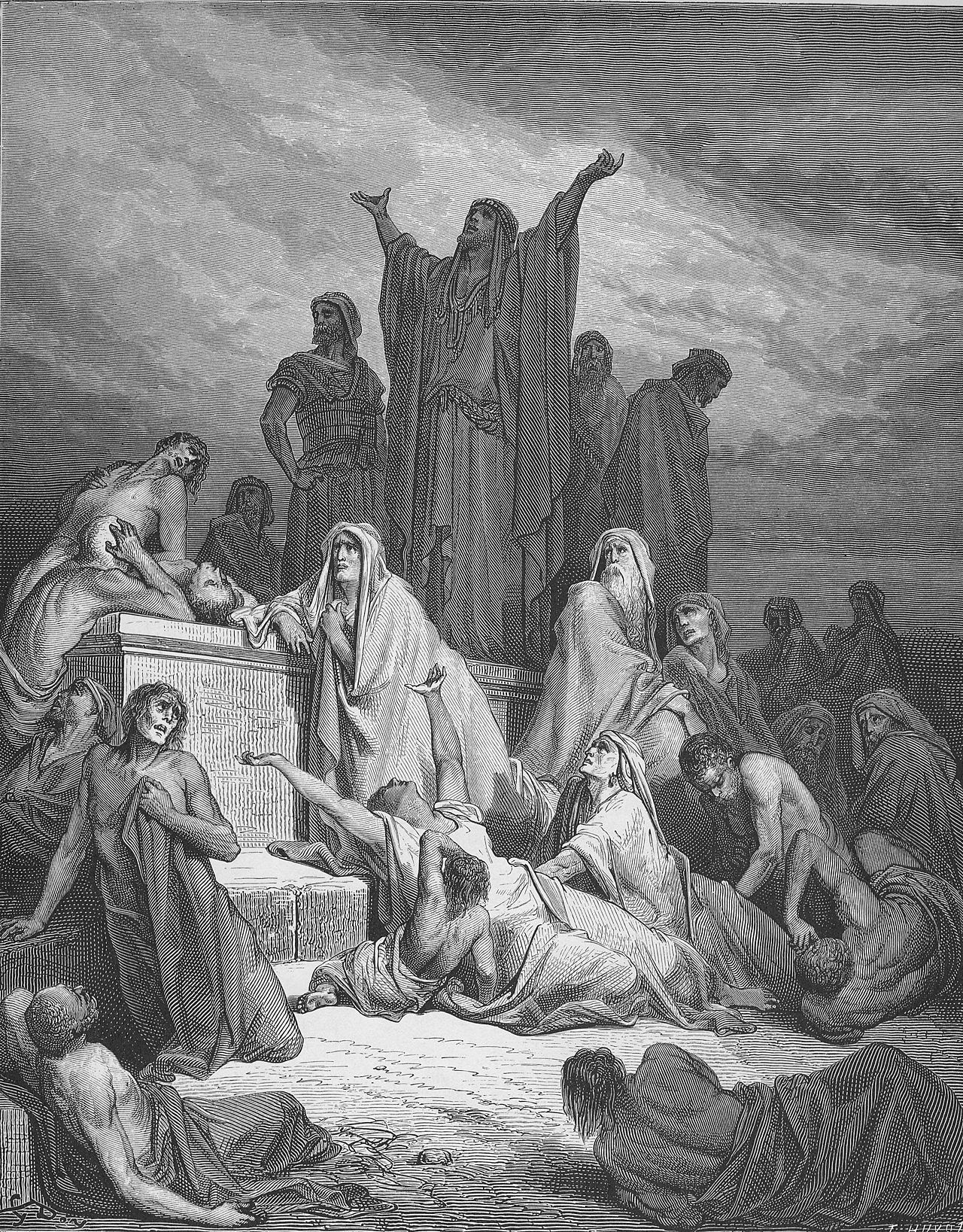
2 Samuelchapter 24
25 verses · Samuel, Nathan and Gad, by tradition · 10th century BC · History
And again the anger of the Lord was kindled against Israel, and he moved David against them to say, Go, number Israel and Judah.
Introduction
Samuel, Nathan and Gad, by tradition, History, 2 Samuel Overview.
This chapter closes 2 Samuel with a census, a plague and the purchase of a piece of ground. The writer places it last in the book's closing section, and later readers knew the ground as the place where the temple would stand. A census in that world counted men who could fight and pay tax, and Israel's law required a ransom for every man counted. The chapter has a parallel in 1 Chronicles 21 that tells it with differences. Listen for the moment the king's conscience wakes, and for the choice he makes when he is offered three judgments. Notice what he refuses to accept as a gift.
Context
- Who
- Israelites who would later worship on the very ground this chapter buys
- What
- An account of David's census, the plague that follows, and the altar he builds on the threshing floor he buys from Araunah.
- Where
- The whole land from Dan to Beersheba, ending at Araunah's threshing floor on the height north of Jerusalem.
- When
- Late in the reign, about 972 BC; the count took nine months and twenty days.
- Why
- To show the king casting himself on the LORD's mercy after trusting in numbers, and to mark the ground of later worship.
Historical context
A census in that world had two purposes: taxation and conscription. It was a military headcount, the report comes back as men who draw the sword, and that is what made it dangerous. Israel's own law required a ransom payment for every man counted, precisely so a numbering would not become a plague, and even Joab, no soft man, argues against it.
Show the rest of the historical context, 3 more paragraphs
The count takes nine months and twenty days and covers the whole country, from Gilead in the east to the Phoenician coast and down to the Negev. That itinerary is one of the clearest descriptions of the kingdom's actual borders anywhere in the Bible.
The parallel account in Chronicles differs in two well-known ways. It gives different totals, and it says the adversary incited David where this chapter says the LORD's anger did. The usual reading holds both: God permitted the testing and the accuser provoked it, the same double account given of Job, and the differing numbers likely reflect what each list counted, since Chronicles says outright that Joab never finished the tally of two tribes.
The ending buys a piece of ground. A threshing floor was a flat exposed rock surface on a height where the evening wind could carry off the chaff, which is why it was outside the city on the ridge to the north. Araunah offers it free along with his oxen and threshing sledges for firewood, and David refuses on the principle that an offering costing nothing is not an offering. Chronicles identifies that rock as the site where the temple was then built.
Significance
The first hearers knew what the king had been counting: his own strength. The plague answered the question of whose strength held the nation up.
Show the rest of the significance, 1 more paragraph
And the last scene turns the disaster into an address. The place where the destroying angel stopped became the place where Israel would bring its sacrifices for four hundred years. The book that began with a lament over a dead king ends with an altar on a bought hill.
This chapter in Jewish lifeWhat this chapter is in Jewish life and reading.
How it is read
The chapter opens with a sentence that has been argued over for centuries, and Rashi's note on it is one line long. The verse records that the anger of the LORD was kindled again against Israel. Rashi's whole note on it reads, "I do not know what it was [they did]" (Rashi on II Samuel 24:1:1, the Metsudah Tanach series, Lakewood, N.J., CC-BY). On the next clause he gives only the sense of the verb, that David was stirred up (Rashi on II Samuel 24:1:2). The corpus carries no classical comment here on the other account of the same event in 1 Chronicles, so this card states no answer to the question of who moved David. The estate argues that question elsewhere.
Rashi reads Joab as trying to stop the census without refusing outright. At the third verse he counts out the doublings in Joab's blessing and reckons it larger than the blessing of Moses, and immediate where Moses spoke of a distant time (Rashi on II Samuel 24:3:1). At the fifth he says Joab began with the men of Gad because they were hardened fighters who might resist and end the count (Rashi on II Samuel 24:5:1). At the sixth he reads the turn to the newly settled land the same way, as a delay in which the king might send word to stop (Rashi on II Samuel 24:6:1). At the ninth he explains the two words for counting from the Pesikta. Joab made a larger count and a smaller one, meaning to show the smaller first and the larger only if the king grew angry (Rashi on II Samuel 24:9:1).
The three afflictions and the plague draw four notes. At the twelfth verse Rashi reads the offer as one of three rather than all three. He then reports a reason for the number, that the three answer the three curses David had put on Saul (Rashi on II Samuel 24:12:1). At the fourteenth he takes the king's anguish plainly, that the least of the three is very hard (Rashi on II Samuel 24:14:1). At the fifteenth he takes the span of the plague from the Targum, which measures it from the slaughter of the morning offering to the sprinkling of its blood (Rashi on II Samuel 24:15:1). At the sixteenth and twenty-third he identifies Araunah as the chief officer of the fortress of Zion, which had been the Jebusite stronghold (Rashi on II Samuel 24:16:1 and 24:23:1).
The threshing floor closes the book and the chapter. At the twentieth verse Rashi says Araunah had been hiding from the angel, and he takes that from the account in Chronicles (Rashi on II Samuel 24:20:1). At the twenty-second he explains the threshing instrument as a heavy wooden tool with jagged edges, worked over straw to cut it into fodder (Rashi on II Samuel 24:22:1). At the twenty-fourth he faces the difference between the fifty shekels of silver here and the six hundred shekels of gold in Chronicles. He answers that David collected fifty silver shekels from each tribe, which came to six hundred, and he names the end of the tractate Zevachim and the Sifrei for it (Rashi on II Samuel 24:24:1).
Metzudat David and Radak carry ten refs. The corpus holds them with the reason that Sefaria holds no English version of them, so they stand cited and unquoted. They are Metzudat David on II Samuel 24:2:1, 24:17:1 and 24:21:1, and Radak on II Samuel 24:7:1, 24:10:1, 24:11:1, 24:13:1, 24:18:1, 24:19:1 and 24:25:1.
What the rabbis say
The corpus carries forty rabbinic locators for this chapter and the text of none, so each is cited and linked here rather than quoted. The opening verse draws Berakhot 62b:11 with Ein Yaakov (Glick Edition), Berakhot 9:14 and Midrash Shmuel 30:1. The census itself draws Bamidbar Rabbah 2:11, Midrash Aggadah, Exodus 30:13:1 and Midrash Lekach Tov, Exodus 38:21:1, all three reading it against the counting laws of Exodus. The route Joab took draws Bereshit Rabbah 94:9 and Midrash Shmuel 32:3, and the nine months and twenty days draw Seder Olam Rabbah 14:2.
The king's confession and the prophet's offer gather the next run. On the smiting of David's heart the corpus carries Midrash Tehillim 100:1, and on the word to Gad, Tanna DeBei Eliyahu Rabbah 7:1. On the three afflictions it carries Mekhilta DeRabbi Shimon Ben Yochai 18:7 and Midrash Tehillim 17:2, with Midrash Shmuel 31:1 on the choice put to him. On his answer it carries Midrash Shmuel 31:2 and Otzar Midrashim, Pirkei Rabbeinu HaKadosh 4:3. On the plague and its hours it carries Aggadat Bereshit 38:3, Devarim Rabbah 5:11 and Ein Yaakov (Glick Edition), Yoma 2:3. On the staying of the angel it carries Berakhot 62b:13, Midrash Sekhel Tov, Shemot 9:28:2 and Midrash Shmuel 31:4. On the king's plea for the sheep it carries Mekhilta DeRabbi Yishmael, Tractate Pischa 1:19, Pirkei DeRabbi Eliezer 43:2 and Sifrei Devarim 344:2.
The altar closes the list. On the command to raise it the corpus carries Bamidbar Rabbah 14:1, Midrash Tanchuma Buber, Nasso 31:1 and Midrash Tanchuma Buber, Vayishlach 22:1. On the going up to Araunah it carries Jerusalem Talmud Sanhedrin 1:3:4 and Jerusalem Talmud Shevuot 2:2:2, and on Araunah seeing the king, Jerusalem Talmud Peah 8:7:3. On the offer of the oxen and the wooden gear it carries Avodah Zarah 24b:4, Bamidbar Rabbah 11:7 and Ein Yaakov, Zevakhim 14:5. On the prince's gift it carries Ein Yaakov (Glick Edition), Berakhot 1:31 and Megillah 1:32. On the price the king insisted on paying it carries Midrash Shmuel 32:1 and Midrash Tannaim on Deuteronomy 12:5:8. On the altar and the staying of the plague it carries Midrash Shmuel 32:2 and Otzar Midrashim, Baraita of Rabbi Pinchas Ben Yair 1:21. What each of them teaches is a saying of the rabbis, and is reported as theirs wherever this site quotes one. The quotations wait on a fetch that carries the text.
Sources: Rashi, Rashi on II Samuel 24:1:1 to 24:24:1, the Metsudah Tanach series, Lakewood, N.J., CC-BY; Metzudat David, Metzudat David on II Samuel 24:2:1, 24:17:1 and 24:21:1, cited by ref because the corpus carries no English text; Radak, Radak on II Samuel 24:7:1, 24:10:1, 24:11:1, 24:13:1, 24:18:1, 24:19:1 and 24:25:1, cited by ref because the corpus carries no English text; The Babylonian Talmud, Berakhot 62b:11 and 62b:13 and Avodah Zarah 24b:4, with Jerusalem Talmud Sanhedrin 1:3:4, Shevuot 2:2:2 and Peah 8:7:3, cited by locator from the Sefaria corpus for 2 Samuel 24; The Midrash, Midrash Shmuel 30:1, 31:1, 31:2, 31:4, 32:1, 32:2 and 32:3, Bamidbar Rabbah 2:11, 11:7 and 14:1, Devarim Rabbah 5:11, Midrash Tehillim 17:2 and 100:1, and Tanna DeBei Eliyahu Rabbah 7:1, cited by locator from the Sefaria corpus for 2 Samuel 24.
The heads below are this chapter's scenes. The numbered points under each are its verses.
Numbering the people, over Joab's protest
2 Samuel 24:1-2
he moved David against them: Two Scriptures name two different agents for the same act. Here the anger of the Lord was kindled and he moved David to number the people; 1 Chronicles 21:1 says Satan stood up against Israel and provoked David to the census. Jamieson, Fausset and Brown read the adversary as the active mover while God's supporting grace was judicially withdrawn, and Matthew Henry says the same in his own words, that Satan tempted while God permitted. Both texts stand as written, and the readings are named rather than resolved.
2 Samuel 24:1
“And again the anger of the Lord was kindled against Israel - This sentence is the heading of the whole chapter, which goes on to describe the sin which kindled this anger, namely, the numbering of the people 1Ch 21:7-8; 1Ch 27:24. There is no note of time, except that the word “again” shows that these events happened “after” those of 2 Sam. 21. (Compare also 2Sa 24:25; 2Sa 21:14.)”
2 more voices on this verseWhat preachers and commentators have said about this verse, in their own words.
2 Samuel 24:1
“We are sure that God is not the author of sin; he tempts no man: we are told ( 1 Chron. xxi. 1 ) that Satan provoked David to number Israel. Satan, as an enemy, suggested it for a sin, as he put it into the heart of Judas to betray Christ.”
Matthew Henry · Commentary on the Whole Bible (1707-1721)puritan
2 Samuel 24:1
“Satan was the active mover, while God only withdrew His supporting grace, and the great tempter prevailed against the king. The order was given to Joab, who, though not generally restrained by religious scruples, did not fail to present, in strong terms (see on 1Ch 21:3), the sin and danger of this measure.”
Jamieson, Fausset & Brown · Commentary Critical and Explanatory on the Whole Bible (1871)reformed
Albert Barnes reads the order as given to Joab and the commanders together, as verse 4 shows, and compares Numbers 1:4, where a leader from each tribe helped Moses count. Matthew Henry reports a view that the census distrusted God's promise to Abraham of seed past counting. Dan to Beersheba spans the whole land.
2 Samuel 24:2
“1Ch 21:2, supplies some missing words. This passage should run, as at 2Sa 24:4, “And the king said to Joab and to the princes of the host who were with him,” etc. (compare 1Ch 27:22). They were employed “with Joab” as his assistants in the numbering, exactly as in the previous numbering Num 1:4 when a prince was appointed from each tribe to be “with” Moses and Aaron.”
2 Samuel 24:3-4
why doth my lord the king delight in this thing?: Joab objects before a soldier is counted, asking why the king delights in a census at all rather than arguing that numbering itself is forbidden. Matthew Henry reads the objection as proof that many things not sinful in themselves turn into sin through the delight a man takes in them, a fault Joab could see in David though he never saw it in himself. The king's word prevails over Joab and the captains all the same, and Joab goes out to carry an order he had just resisted.
2 Samuel 24:3
“Joab said unto the king - This very bad man saw that the measure now recommended by the king was a wrong one, and might be ruinous to the people, and therefore he remonstrates against it in a very sensible speech; but the king was infatuated, and would hear no reason.”
Adam Clarke · Commentary on the Bible (1810-1826)evangelical
prevailed against Joab: The word of the king prevailed against Joab. Jamieson, Fausset and Brown note that Joab, seldom held back by scruples, pressed the danger hard at 1 Chronicles 21:3. Matthew Henry counts it an unhappiness for great men to have servants who will help them in evil.
2 Samuel 24:4
“Joab must not gainsay it, lest he be thought to grudge his time and pains in the king's service. It is an unhappiness to great men to have those about them that will aid them and serve them in that which is evil.”
Matthew Henry · Commentary on the Whole Bible (1707-1721)puritan
2 Samuel 24:5-9
they passed over Jordan, and pitched in Aroer: The counters cross Jordan at Aroer and range north through Gilead toward Dan, then west toward Tyre and the Hivite cities, before circling south to Beersheba, tracing the whole land in nine months and twenty days. Joab returns a sum of eight hundred thousand swordsmen in Israel and five hundred thousand in Judah, and Albert Barnes reads the figures as partial, since Chronicles gives different totals and states plainly that Joab left Levi and Benjamin out of the count. John Gill takes the circuit itself as a mark of diligence, a task finished in ten months lacking ten days.
2 Samuel 24:5
“Aroer - Aroer on the Arnon (Deu 2:36 note). Aroer itself stood on the very edge of the precipitous cliff of the valley; and in the valley beneath, possibly in an island in the stream, stood another city which is here alluded to. River - Rather, “the valley” (margin). They passed from Aroer, northward to Gad, and so pitched at Jazer (see the marginal references), which is on the frontier of Gad and Reuben.”
the land of Tahtim–hodshi: The count went to Gilead and on to Tahtim-hodshi, which Jamieson, Fausset and Brown, with Adam Clarke, read as newly won land east of Gilead, taken from the Hagarites under Saul (1 Chronicles 5:10). Albert Barnes judges the text corrupt and suggests the land of the Hittites. Clarke renders Dan-jaan as Dan of the woods.
2 Samuel 24:6
“Tahtim-hodshi - Where this place was is not exactly known: some think that the words refer to a newly conquered country, as our margin, the nether land newly inhabited; and if so, this was probably the country eastward of Gilead, which the Israelites, in the time of Saul, had conquered from the Hagarites, and dwelt in themselves. See 1Ch 5:10, where this transaction is recorded. To Dan-jaan - Or, to Dan of the woods.”
Adam Clarke · Commentary on the Bible (1810-1826)evangelical
The count reached the fortress of Tyre and then Beersheba, and Adam Clarke places the fortress at old Tyre on the mainland. Albert Barnes counts Gibeon and Beeroth as Hivite cities. Their survival into the reign of David ties back to the oath of chapter 21.
2 Samuel 24:7
“The strong hold of Tyre - “The fenced city,” as it is generally rendered throughout the historical books. The cities of the Hivites - Gibeon, Chephirah, Beeroth, and Kirjath-jearim, and perhaps Shechem, besides those at the foot of Hermon and Lebanon, of which we do not know the names. This continuance of distinct communities of Hivites so late as the end of David’s reign is remarkable.”
nine months and twenty days: John Gill traces their route through the whole land as a full circuit, east, north, west and then south. Adam Clarke notes the count was never finished (1 Chronicles 21:6). 1 Chronicles 27:24 adds that the total never entered the annals of King David.
Adam Clarke sets these totals beside 1 Chronicles 21:5, which gives 1,100,000 for Israel and 470,000 for Judah, and holds that numbers suffered most in copying. Jamieson, Fausset and Brown count a frontier force of thirty thousand into Judah's figure here. Matthew Henry notes that David's conscience woke at the sum.
2 Samuel 24:9
“1Ch 27:23 indicates sufficiently why the numbering was sinful. It is also stated in 1Ch 21:6, that Joab purposely omitted Levi and Benjamin from the reckoning. Eight hundred thousand ... five hundred thousand - In Chronicles the numbers are differently given. It is probable therefore that the Chronicler has included in his statement of the sum total some numbers which are not included here.”
1 more voice on this verse
2 Samuel 24:9
“It must also be observed that, exclusive of the troops before mentioned, there was an army of observation on the frontiers of the Philistines' country, composed of thirty thousand men, as appears from 2Sa 6:1; which, it seems, were included in the number of five hundred thousand of the people of Judah by the author of Samuel.”
Jamieson, Fausset & Brown · Commentary Critical and Explanatory on the Whole Bible (1871)reformed
Three choices, and David falls into the hand of God
David’s heart smote him: The confession comes only after the tally is complete and laid before him, not during the nine months the counting took. David's own words name the census foolish and the guilt his own, I have sinned greatly, take away the iniquity of thy servant. Matthew Henry observes that conscience often wakes only after the pleasure a sin promised has already been collected in full.
2 Samuel 24:10
“David said - I have sinned greatly - We know not exactly in what this sin consisted. I have already hinted, 2Sa 24:1, that probably David now began to covet an extension of empire, and purposed to unite some of the neighboring states with his own; and having, through the suggestions of Satan or some other adversary, (for so the word implies), given way to this covetous disposition, he could not well look to God for help, and therefore wished to know whether the thousands of Israel and Judah might be deemed equal to the conquests which he meditated.”
Adam Clarke · Commentary on the Bible (1810-1826)evangelical
2 Samuel 24:11-14
the word of the Lord came unto the prophet Gad: Gad is named David's seer, and the word of the Lord reaches the king through him rather than through the dream, Urim or prophet that failed Saul at 1 Samuel 28:6. Three judgments are offered, famine, flight before enemies, or pestilence, and Albert Barnes notes that Chronicles gives three years of famine where this text gives seven, a difference stated honestly rather than smoothed away. David will not choose between armies of men and settles on the third term by trusting the judge rather than bargaining the sentence, let us fall now into the hand of the Lord, for his mercies are great. Adam Clarke reads the choice as David's own nobility, since pestilence exposed him and his household to the same danger as the poorest man in Israel.
2 Samuel 24:11
“For when David was up - It is supposed that David’s contrition arose from the reproof given by Gad, and that in the order of time the reproof came before the confession stated in the 10th verse. David’s seer - A holy man of God, under the Divine influence, whom David had as a domestic chaplain.”
Adam Clarke · Commentary on the Bible (1810-1826)evangelical
Matthew Henry gives two reasons the LORD offers David three options: to humble David by weighing each judgment, and to rebuke his pride in his own power over Israel. Jamieson, Fausset and Brown note that Moses counted Israel at the command of God, so the fault lay in motive. A king who chose a count now chooses a penalty.
2 Samuel 24:12
“God, by putting him thus to his choice, designed, [1.] To humble him the more for his sin, which we would see to be exceedingly sinful when he came to consider each of these judgments as exceedingly dreadful. Or, [2.] To upbraid him with the proud conceit he had of his own sovereignty over Israel. He that is so great a prince begins to think he may have what he will.”
Matthew Henry · Commentary on the Whole Bible (1707-1721)puritan
Gad offers David three years of famine, three months of fleeing and three days of plague, and the Berean text follows 1 Chronicles 21:12 and the Septuagint in the first. The Hebrew of Samuel reads seven years, and Adam Clarke blames a copyist's confusion of two letters. Jamieson, Fausset and Brown keep seven, counting past famine years.
2 Samuel 24:13
“Shall seven years of famine come unto thee--that is, in addition to the three that had been already, with the current year included (see on 1Ch 21:11).”
Jamieson, Fausset & Brown · Commentary Critical and Explanatory on the Whole Bible (1871)reformed
his mercies are great: David asks to fall into the LORD's hand, and Hebrews 10:31 calls it a fearful thing to fall into the hands of the living God. Matthew Henry reconciles the two: the fear belongs to the impenitent, and David as a penitent casts himself on the great mercies of the LORD. Ambrose of Milan retells the scene with Nathan in Gad's place.
2 Samuel 24:14
“I am in a great strait: let us fall now into the hand of the Lord - David acted nobly in this business. Had he chosen war, his own personal safety was in no danger, because there was already an ordinance preventing him from going to battle. Had he chosen famine, his own wealth would have secured his and his own family’s support. But he showed the greatness of his mind in choosing the pestilence, to the ravages of which himself and household were exposed equally with the meanest of his subjects.”
Adam Clarke · Commentary on the Bible (1810-1826)evangelical
1 more voice on this verse
2 Samuel 24:14
“It is a dreadful thing, the apostle says, to fall into the hands of the living God ( Heb. x. 31 ), a fearful thing indeed for sinners that have, by their impenitency, shut themselves out from all hope of his mercy. But David, a penitent, dares cast himself into God's hand, knowing he shall find that his mercies are great.”
Matthew Henry · Commentary on the Whole Bible (1707-1721)puritan
The angel's hand stayed above Jerusalem
seventy thousand men: The third judgment falls on the whole land, from Dan to Beersheba, the same reach used for the census in verse 2 now measuring the dead. Albert Barnes calls it the most destructive plague recorded against Israel, exceeding the fourteen thousand seven hundred of Numbers 16 and the twenty four thousand of Numbers 25. The stroke runs only until an appointed hour, a limit set before any word of mercy is spoken.
2 Samuel 24:15
“The time appointed - Perhaps “the time of the assembly,” meaning the time of the evening sacrifice, at three o’clock, when the people assembled for prayer, more commonly described as “the time of the evening oblation” Dan 9:21; 1Ki 18:29, 1Ki 18:36; Act 3:1; Luk 1:10. Seventy thousand - It is the most destructive plague recorded as having fallen upon the Israelites. In the plague that followed the rebellion of Korah there died 14,700 Num 16:49; in the plague, on account of Baal-Peor, 24,000 Num 25:9; 1Co 10:8.”
1 more voice on this verse
2 Samuel 24:15
“Note, Those who truly repent of their sins, and have them pardoned are yet often made to smart for them in this world. (2.) The punishment must answer to the sin. He was proud of the judgment he must be chastised with for this sin must be such as will make them fewer.”
Matthew Henry · Commentary on the Whole Bible (1707-1721)puritan
the threshingplace of Araunah the Jebusite: The destroying angel is stayed over Jerusalem and stands at Araunah's threshingfloor, the ground later called Mount Moriah, the mountain of Genesis 22. Matthew Henry passes on Lightfoot's observation that the very place where Abraham was stopped from slaying Isaac is the place where this angel is stopped from destroying the city. The site is fixed in the narrative here, before David or the reader is told what it will become.
2 Samuel 24:16
“The angel stretched out his hand upon Jerusalem - By what means this destruction took place, we know not: it appears that an angel was employed in it, and that this minister of Divine justice actually appeared as an object. of sight; for it is said, 2Sa 24:17, When David saw the angel that smote the people, he said, etc.; and both Ornan and his four sons saw him and were affrighted, 1Ch 21:20. The threshing-place of Araunah - These threshing-places, we have already seen, were made in the open air.”
Adam Clarke · Commentary on the Bible (1810-1826)evangelical
these sheep, what have they done?: David sees the angel and asks to bear the judgment alone, offering himself and his father's house in the people's place and calling them sheep, the same word once used of the flock he kept at Bethlehem. Matthew Henry reads the plea as a shadow of Christ, who gave himself so that God's hand fell on him rather than on the sheep. The king who numbered the flock out of his own vanity now asks to be counted for it instead.
2 Samuel 24:17
“Most people, when God's judgments are abroad, charge others with being the cause of them, and care not who falls by them, so they can escape. But David's penitent and public spirit was otherwise affected. Let this remind us of the grace of our Lord Jesus, who gave himself for our sins and was willing that God's hand should be against him, that we might escape.”
Matthew Henry · Commentary on the Whole Bible (1707-1721)puritan
2 more voices on this verse
2 Samuel 24:17
“But in the body politic as well as natural, when the head suffers, all the members suffer along with it; and, besides, although David's sin was the immediate cause, the great increase of national offenses at this time had (2Sa 24:1) kindled the anger of the Lord.”
Jamieson, Fausset & Brown · Commentary Critical and Explanatory on the Whole Bible (1871)reformed
2 Samuel 24:17
“Compare the passage in Chronicles. The account here is abridged; and 2Sa 24:18 has the appearance of being the original statement.”
I will not offer that which cost me nothing
2 Samuel 24:18-23
rear an altar unto the Lord: Gad returns the same day with an instruction rather than another choice, go up and build an altar on Araunah's floor. Araunah sees the king coming and bows himself to the ground, then offers the floor, the oxen for the burnt offering, and the threshing instruments for wood, refusing no part of what the king might need. Adam Clarke reads the offer as loyalty to the king, care for a people under plague, and regard for his own safety in one gesture, and Araunah closes it with a blessing, the Lord thy God accept thee.
2 Samuel 24:18
“Araunah--or Ornan (1Ch 21:18), the Jebusite, one of the ancient inhabitants, who, having become a convert to the true religion, retained his house and possessions. He resided on Mount Moriah, the spot on which the temple was afterwards built (2Ch 3:1); but that mount was not then enclosed in the town.”
Jamieson, Fausset & Brown · Commentary Critical and Explanatory on the Whole Bible (1871)reformed
1 more voice on this verse
2 Samuel 24:18
“God's encouraging us to offer to him spiritual sacrifices is a comfortable evidence of his reconciling us to himself. That peace is made between God and sinners by sacrifice, and not otherwise, even by Christ the great propitiation, of whom all the legal sacrifices were types. It is for his sake that the destroying angel is told to stay his hand.”
Matthew Henry · Commentary on the Whole Bible (1707-1721)puritan
At the word of Gad, David went up, and John Gill has him climb from the lower city to Mount Moriah, where a threshing floor stood open to the wind for winnowing. Caesarius of Arles notes that the chosen place belonged to a Gentile, Araunah the Jebusite. The king obeys at once, as the LORD had commanded.
2 Samuel 24:19
“And David, according to the saying of Gad, went up as the Lord commanded. From the place where he was in a lower part of the city to Mount Moriah, on which was the threshing floor, a place fit for winnowing corn when threshed.”
the king and his servants: Albert Barnes compares 1 Chronicles 21:20, which mentions four sons, and he takes them as David's, brought along with the elders. He suggests the compiler here used the general word servants. Chronicles also has Araunah threshing wheat when the king arrives.
2 Samuel 24:20
And his servants - In Chronicles “his four sons,” namely, David’s. It is very possible that David may have taken his sons with him, as well as his elders, and Gad’s original narrative may have mentioned the circumstance, which the compiler of this chapter did not care to specify, and so used the general term “his servants.”
Jamieson, Fausset and Brown read verse 16 as told in advance, since David says the plague is still running and it stops only after the sacrifice. David had already seen the angel and prayed at verse 17. He comes to buy, and the price matters in verse 24.
2 Samuel 24:21
“And Araunah said, wherefore is my lord the king come to his servant?....”
Albert Barnes explains the threshing sledge as a board set with iron teeth, drawn by oxen over the grain (Isaiah 41:15). The oxen were at work on the floor that day, and their wooden yokes would feed the fire. 1 Samuel 6:14 records a like use of a cart's wood.
2 Samuel 24:22
“Here be oxen for burnt-sacrifice - He felt for the king; and showed his loyalty to him by this offer. He felt for the people; and was willing to make any sacrifice to get the plague stayed. He felt for his own personal safety; and therefore was willing to give up all to save his life. He felt for the honor of God; and therefore was glad that he had a sacrifice to offer, so that God might magnify both his justice and mercy.”
Adam Clarke · Commentary on the Bible (1810-1826)evangelical
The Hebrew can read king Araunah gave these to the king. Matthew Henry reports the view that Araunah the Jebusite had been a king, and Albert Barnes reads O king, as the Berean text does. Araunah gives the king the oxen, the threshing sledges and the ox yokes, and asks that the LORD his God accept him.
2 Samuel 24:23
All these things did Araunah, as a king, give--Indicating, as the sense is, that this man had been anciently a heathen king or chief, but was now a proselyte who still retained great property and influence in Jerusalem, and whose piety was evinced by the liberality of his offers. The words, "as a king," are taken by some to signify simply, "he gave with royal munificence."
Jamieson, Fausset & Brown · Commentary Critical and Explanatory on the Whole Bible (1871)reformed
1 more voice on this verse
2 Samuel 24:23
“Either, “the whole O king does Araunah give unto the king;” or (2) “the whole did king Araunah give to the king.” The former is preferable.”
2 Samuel 24:24-25
of that which doth cost me nothing: David refuses the free offer and buys the floor and the oxen for fifty shekels of silver, stating the principle the whole scene exists to teach, that an offering costing nothing is no sacrifice at all. Adam Clarke calls it a maxim from heaven, that a religion costing nothing is worth nothing, and Jamieson, Fausset and Brown note that this fifty-shekel price bought only the floor and oxen, while a far larger sum recorded in Chronicles later bought the whole hill for the temple. David builds the altar, offers burnt offerings and peace offerings, and the Lord is entreated for the land; the two books of Samuel close on an altar bought at a price and a prayer answered, on the mountain that 2 Chronicles 3:1 names as the site of Solomon's house.
2 Samuel 24:24
“Neither will I offer burnt-offerings - It is a maxim from heaven, “Honour the Lord with thy substance.” He who has a religion that costs him nothing, has a religion that is worth nothing: nor will any man esteem the ordinances of God, if those ordinances cost him nothing. Had Araunah’s noble offer been accepted, it would have been Araunah’s sacrifice, not David’s; nor would it have answered the end of turning away the displeasure of the Most High. It was David that sinned, not Araunah: therefore David must offer sacrifice, and at his own expense too.”
Adam Clarke · Commentary on the Bible (1810-1826)evangelical
burnt offerings and peace offerings: Jamieson, Fausset and Brown read two sacrifices here, the burnt offerings to atone and the peace offerings to give thanks. Adam Clarke cites 1 Chronicles 21:26, where the LORD answered by fire on the altar David built, and Matthew Henry supposes the same sign here. Clarke finds the close of the book in 1 Chronicles 22 to 29.
2 Samuel 24:25
“David - offered burnt-offerings - And that these sacrifices were pleasing to the Lord, is evident from a circumstance marked in the parallel place, 1Ch 21:26: David called upon the Lord, and he answered him from heaven by fire upon the altar of burnt-offering. The plague was stalled - Jerusalem did not share in the common calamity, seventy thousand being the whole that were slain throughout the land. This book is unfinished, and requires 1 Chronicles 22, 23, 24, 25, 26, 27, 28, and 29, to complete it.”
Adam Clarke · Commentary on the Bible (1810-1826)evangelical
1 more voice on this verse
2 Samuel 24:25
“David offered burnt offerings and peace offerings--There seem to have been two sacrifices; the first expiatory, the second a thanksgiving for the cessation of the pestilence (see on 1Ch 21:26).”
Jamieson, Fausset & Brown · Commentary Critical and Explanatory on the Whole Bible (1871)reformed
How this psalm is built
The form: Narrative, a census, a plague and the buying of an altar, the A prime panel that closes the book's ring, as Samuel classes it.
The patterns in this chapter
| Device | What it does | Where to see it |
|---|---|---|
| From Dan to Beersheba, first counted and then buried | The same reach of the land is named twice and the second use answers the first. At verse 2 Joab is sent through all the tribes of Israel, from Dan to Beersheba, to number the people. At verse 15 the plague falls on the people from Dan to Beersheba, and seventy thousand men die. The phrase that measured the king's strength is the phrase that measures the dead.Albert Barnes, Notes on the Old Testament, on 2 Samuel 24:15, as the published exposition of this chapter reports him. | 2 Samuel 24:2, 2 Samuel 24:15 |
| The circuit of the counters, stage by stage | Verses 5 to 9 trace the whole route rather than summarise it. The counters cross the Jordan at Aroer, range north through Gilead toward Dan, turn west toward Tyre and the Hivite cities, and circle south to Beersheba. The text gives the time it took, nine months and twenty days. John Gill takes the circuit itself as a mark of diligence, a task finished in ten months lacking ten days.John Gill, Exposition of the Old Testament, on 2 Samuel 24:5 to 9, as the published exposition of this chapter reports him. | 2 Samuel 24:5, 2 Samuel 24:7, 2 Samuel 24:8 |
| The flock, counted and then spoken for | David asks at verse 17 what these sheep have done, and offers himself and his father's house in their place. The published exposition notes that sheep is the same word used of the flock he kept at Bethlehem before any of this began. The king who numbered the people out of his own vanity now asks to be counted for them instead.Matthew Henry, Commentary on the Whole Bible, on 2 Samuel 24:17, as the published exposition of this chapter reports him. | 2 Samuel 24:17 |
| The plea made when the angel is in sight | Verse 17 is spoken to God with the destroying angel standing at the threshing floor. David names the guilt as his own, says that he is the one who has sinned and done wickedly, and asks that the hand fall on him and on his father's house. Matthew Henry reads the plea as a shadow of Christ, who gave Himself so that God's hand fell on Him rather than on the sheep.Jamieson, Fausset and Brown, Commentary Critical and Explanatory on the Whole Bible, on 2 Samuel 24:17, as the published exposition of this chapter reports them. | 2 Samuel 24:17 |
The debated readings
16 more paragraphs on the patterns
This chapter carries the most argued question in the book and three differences of number besides, and the published exposition names them rather than smoothing any of them away.
Who moved David to number Israel
Verse 1 says the anger of the LORD was kindled against Israel and He moved David to number them. 1 Chronicles 21:1 says Satan rose up against Israel and incited David to the census. Jamieson, Fausset and Brown read the adversary as the active mover while God's supporting grace was judicially withdrawn, and Matthew Henry says the same in his own words, that Satan tempted while God permitted. The dossier carries a third and a fourth position. Chronicles specialists including Sara Japhet note that the Hebrew noun at 1 Chronicles 21:1 stands without the definite article, which elsewhere usually marks an ordinary adversary rather than the proper name. The mainstream critical reading holds that Chronicles rewrote its source to move the offence away from the LORD. Both texts stand as written and this row decides nothing between them. Every party inside the story treats the census as sin, since Joab objects before it starts and David's own heart smites him at verse 10.
The totals at verse 9
Joab returns eight hundred thousand swordsmen in Israel and five hundred thousand in Judah. Albert Barnes reads the figures as partial, since Chronicles gives different totals and states plainly that Joab left Levi and Benjamin out of the count.
Seven years or three
Verse 13 offers seven years of famine where the parallel in Chronicles gives three. Albert Barnes states the difference honestly rather than smoothing it away, and this row keeps it the same way.
The price at verse 24
David buys the floor and the oxen for fifty shekels of silver. Jamieson, Fausset and Brown note that this price bought the floor and the oxen only, and that a far larger sum recorded in Chronicles later bought the whole hill for the temple. The two figures are for two purchases rather than for one.
The historical value
The plague is measured against the others in Israel's record. Albert Barnes calls it the most destructive recorded against the nation, exceeding the fourteen thousand seven hundred of Numbers 16 and the twenty four thousand of Numbers 25. The stroke runs only until an appointed hour, and that limit is set before any word of mercy is spoken.
The census circuit is itself a description of the kingdom's reach at its widest, which is why the route is given stage by stage. The counters go out past the Jordan and as far as Tyre and the Hivite cities before turning south.
The divine connection
The book ends where the temple will stand. The angel stops at Araunah's floor, the altar goes up on that ground, and 2 Chronicles 3:1 names the same place as the site of Solomon's house. The dossier's own reading joins it to Genesis 22, where Abraham was stopped on the same mountain.
David's plea at verse 17 is the one place in the chapter the commentators read forward to Christ. Matthew Henry reads the king offering himself in the people's place as a shadow of the one on whom God's hand did fall. The estate carries the whole line at /featured/david-as-a-type-of-christ.
The closing clause answers the clause that closed chapter 21. There, after the bones were buried, God was entreated for the land. Here, after the altar is built and the offerings made, the LORD is entreated for the land and the plague is stayed. The appendix opens and closes on bloodguilt answered, which is what the dossier's ring records.
Keep studying
Words12
Subjects1
Sources for this chapter
The summary
Jamieson, Fausset & Brown, Commentary Critical and Explanatory and Matthew Henry, Complete Commentary.
The form and classifications
Adam Clarke, Commentary on the Bible, on 2 Samuel 24:24 to 25, as the published exposition of this chapter reports him; Matthew Henry, Commentary on the Whole Bible, on 2 Samuel 24:16, as the published exposition of this chapter reports him and This site's published guide to 2 Samuel, src/components/book/guides/2-samuel/Book2SamuelGuide.tsx, act III, the beat for chapter 24, "Census, plague, and an altar".
The exposition
Adam Clarke, Commentary on the Bible; Albert Barnes; Ambrose of Milan, Letter 51.8-9; Caesarius of Arles, SERMON 122.1; Jamieson Fausset and Brown, Commentary Critical and Explanatory on the Whole Bible; Jamieson, Fausset & Brown, Commentary Critical and Explanatory on the Whole Bible; John Gill and Matthew Henry, Commentary on the Whole Bible.