
2 Samuel 24:14
in 2 Samuel 24David answered Gad, “I am deeply distressed. Please, let us fall into the hand of the LORD, for His mercies are great; but do not let me fall into the hands of men.”
BSB
The same verse in ASV and KJV ▾
ASV
And David said unto Gad, I am in a great strait: let us fall now into the hand of Jehovah; for his mercies are great; and let me not fall into the hand of man.
KJV
And David said unto Gad, I am in a great strait: let us fall now into the hand of the Lord; for his mercies are great: and let me not fall into the hand of man.
⋯
This verse in 2 Samuel 24
Commentary
7 notes on this verseI am in a great strait: let us fall now into the hand of the Lord - David acted nobly in this business. Had he chosen war, his own personal safety was in no danger, because there was already an ordinance preventing him from going to battle. Had he chosen famine, his own wealth would have secured his and his own family’s support. But he showed the greatness of his mind in choosing the pestilence, to the ravages of which himself and household were exposed equally with the meanest of his subjects.
This site's exposition
the word of the Lord came unto the prophet Gad
on 2 Samuel 24:11-14
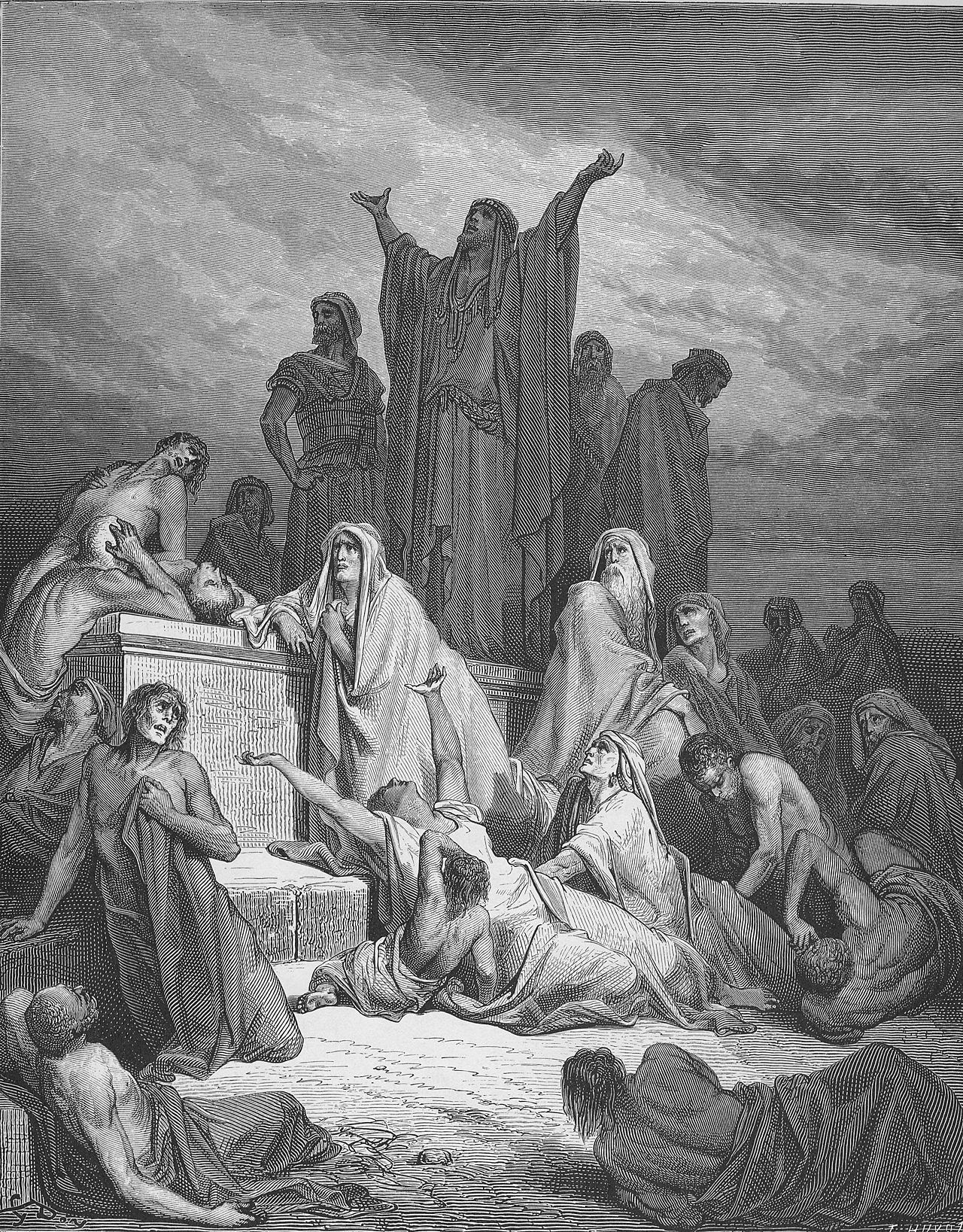
Gad is named David's seer, and the word of the Lord reaches the king through him rather than through the dream, Urim or prophet that failed Saul at 1 Samuel 28:6. Three judgments are offered, famine, flight before enemies, or pestilence, and Albert Barnes notes that Chronicles gives three years of famine where this text gives seven, a difference stated honestly rather than smoothed away. David will not choose between armies of men and settles on the third term by trusting the judge rather than bargaining the sentence, let us fall now into the hand of the Lord, for his mercies are great. Adam Clarke reads the choice as David's own nobility, since pestilence exposed him and his household to the same danger as the poorest man in Israel.
This site's exposition
His mercies are great
David asks to fall into the LORD's hand, and Hebrews 10:31 calls it a fearful thing to fall into the hands of the living God. Matthew Henry reconciles the two: the fear belongs to the impenitent, and David as a penitent casts himself on the great mercies of the LORD. Ambrose of Milan retells the scene with Nathan in Gad's place.
The record, by era
The Church Fathers1 voice
And again, David, after he had commanded the people to be numbered, was smitten in heart, and said to the Lord: "I have sinned exceedingly, because I have commanded this, and now, O Lord, take away the iniquity of Thy servant, for I have transgressed exceedingly." And the prophet Nathan was sent again to him, to offer him the choice of three things, that he should select the one he chose—famine in the land for three years, or that he should flee for three months before his enemies, or mortal pestilence in the land for three days.
The Puritans and the Awakening2 voices
It is a dreadful thing, the apostle says, to fall into the hands of the living God ( Heb. x. 31 ), a fearful thing indeed for sinners that have, by their impenitency, shut themselves out from all hope of his mercy. But David, a penitent, dares cast himself into God's hand, knowing he shall find that his mercies are great.
And David said unto Gad, I am in a great strait,....
The Nineteenth Century1 voice
A commentator
Jamieson, Fausset & Brown1802–1910
Commentary Critical and Explanatory on the Whole Bible (1871)
proposed
He proceeded on a good principle in choosing the pestilence. In pestilence he was equally exposed, as it was just and right he should be, to danger as his people, whereas, in war and famine, he possessed means of protection superior to them.
The words behind it
18 Hebrew wordsEvery Hebrew word of this verse in the order it stands, with what it means and the door to its own study. The last column counts the times a word stands in the whole Bible: the rarer the word, the more the places it appears belong together.
| Hebrew | Sound | Meaning | Word study | In the Bible |
|---|---|---|---|---|
| וַיֹּ֧אמֶר | vaiyomer | and he said | H559 → | 5305 times |
| דָּוִ֛ד | david | David | H1732 → | 999 times |
| אֶל־ | ʾel- | to | H413 → | 5510 times |
| גָּ֖ד | gad | Gad | H1410 → | 72 times |
| צַר־ | tzar- | it is distress | H6862 → | 109 times |
| לִ֣י | li | to <the> me | ||
| מְאֹ֑ד | meod | exceedingly | H3966 → | 300 times |
| נִפְּלָה־ | nipelah- | let us fall | H5307 → | 435 times |
| נָּ֤א | na' | please | H4994 → | 404 times |
| בְיַד־ | veyad- | in [the] hand of | H3027 → | 1618 times |
| יְהוָה֙ | yahweh | Yahweh | H3068 → | 6520 times |
| כִּֽי־ | ki- | for | H3588 → | 4482 times |
| רַבִּ֣ים | rabim | [are] great | H7227 → | 454 times |
| רַֽחֲמָ֔יו | rachamo | compassion<s> his | H7356 → | |
| וּבְיַד־ | uveyad- | and in [the] hand of | H3027 → | 1618 times |
| אָדָ֖ם | ʾadam | humankind | H120 → | 551 times |
| אַל־ | ʾal- | may not | H408 → | 724 times |
| אֶפֹּֽלָה׃ | ʾepolah | I fall | H5307 → | 435 times |
וַיֹּ֧אמֶרand he said
vaiyomerH559 →5305 times
דָּוִ֛דDavid
davidH1732 →999 times
אֶל־to
ʾel-H413 →5510 times
גָּ֖דGad
gadH1410 →72 times
צַר־it is distress
tzar-H6862 →109 times
לִ֣יto <the> me
li
מְאֹ֑דexceedingly
meodH3966 →300 times
נִפְּלָה־let us fall
nipelah-H5307 →435 times
נָּ֤אplease
na'H4994 →404 times
בְיַד־in [the] hand of
veyad-H3027 →1618 times
יְהוָה֙Yahweh
yahwehH3068 →6520 times
כִּֽי־for
ki-H3588 →4482 times
רַבִּ֣ים[are] great
rabimH7227 →454 times
רַֽחֲמָ֔יוcompassion<s> his
rachamoH7356 →
וּבְיַד־and in [the] hand of
uveyad-H3027 →1618 times
אָדָ֖םhumankind
ʾadamH120 →551 times
אַל־may not
ʾal-H408 →724 times
אֶפֹּֽלָה׃I fall
ʾepolahH5307 →435 times
A shaded row is a word that stands 400 times or fewer in the Bible.
The walk
8 stopsEach card is a verse this one points to, and under it the verses that one points to in turn. Where several paths arrive at the same place, that place is listed first: the text keeps returning to it.
Through
Jonah 4:2So he prayed to the LORD, saying, “O LORD, is this not what I said while I was still in my own country? This is why I was so quick to flee toward Tarshish.…
it leads to
- Psalms 86:15
But You, O Lord, are a compassionate and gracious God, slow to anger, abounding in loving devotion and faithfulness.
Reached by 2 separate paths from here.
- Exodus 34:6–7
Then the LORD passed in front of Moses and called out: “The LORD, the LORD God, is compassionate and gracious, slow to anger, abounding in loving devotion and faithfulness,
- Numbers 14:18–19
‘The LORD is slow to anger and abounding in loving devotion, forgiving iniquity and transgression. Yet He will by no means leave the guilty unpunished; He will visit the iniquity of the fathers upon…
- Psalms 86:15
Through
Psalms 51:1Have mercy on me, O God, according to Your loving devotion; according to Your great compassion, blot out my transgressions.
it leads to
- Acts 3:19
Repent, then, and turn back, so that your sins may be wiped away,
- Isaiah 44:22
I have blotted out your transgressions like a cloud, and your sins like a mist. Return to Me, for I have redeemed you.
- Isaiah 43:25
I, yes I, am He who blots out your transgressions for My own sake and remembers your sins no more.
- Psalms 51:9
Hide Your face from my sins and blot out all my iniquities.
- Colossians 2:14
having canceled the debt ascribed to us in the decrees that stood against us. He took it away, nailing it to the cross!
- Acts 3:19
Where this verse is studied
By subject
Mercy35 verses
On this page
About 2 Samuel
Who and where
1 name in this verse with a page on the site.
This page draws on Adam Clarke, Commentary on the Bible; Albert Barnes, Notes on the Old Testament; Ambrose of Milan, Letter 51.8-9; Jamieson, Fausset & Brown, Commentary Critical and Explanatory on the Whole Bible; John Gill, Exposition of the Old Testament (1748-1763) and Matthew Henry, Commentary on the Whole Bible.