
2 Samuel 24:18
in 2 Samuel 24And that day Gad came to David and said to him, “Go up and build an altar to the LORD on the threshing floor of Araunah the Jebusite.”
BSB
The same verse in ASV and KJV ▾
ASV
And Gad came that day to David, and said unto him, Go up, rear an altar unto Jehovah in the threshing-floor of Araunah the Jebusite.
KJV
And Gad came that day to David, and said unto him, Go up, rear an altar unto the Lord in the threshingfloor of Araunah the Jebusite.
⋯
This verse in 2 Samuel 24
Commentary
7 notes on this verseNotice, brothers, that no place in the land of the Jews was found worthy for the altar of the Lord to be built; but in the land of the Gentiles a place is chosen where the angel is seen and the altar of the Lord …
This site's exposition
rear an altar unto the Lord
on 2 Samuel 24:18-23
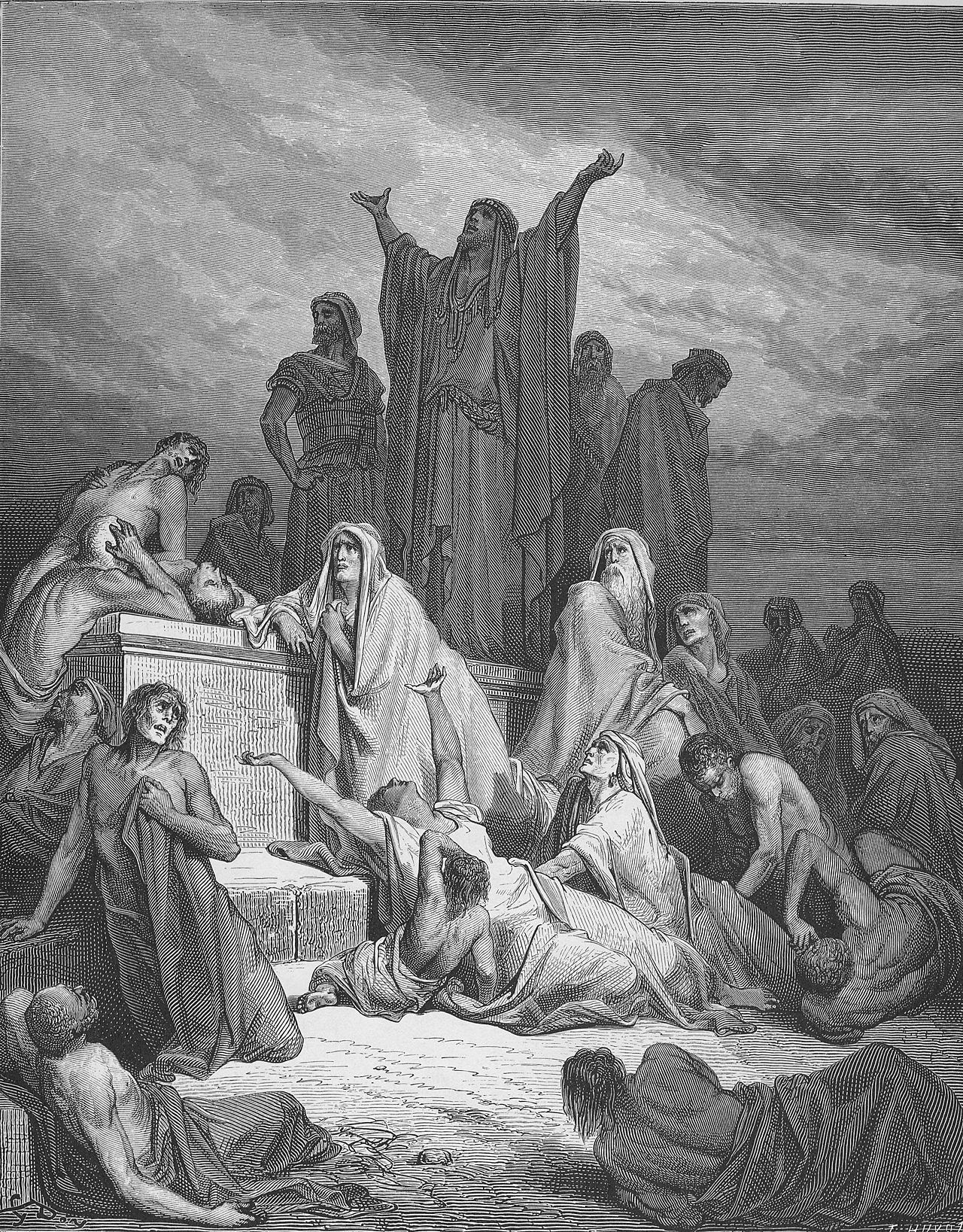
Gad returns the same day with an instruction rather than another choice, go up and build an altar on Araunah's floor. Araunah sees the king coming and bows himself to the ground, then offers the floor, the oxen for the burnt offering, and the threshing instruments for wood, refusing no part of what the king might need. Adam Clarke reads the offer as loyalty to the king, care for a people under plague, and regard for his own safety in one gesture, and Araunah closes it with a blessing, the Lord thy God accept thee.
The record, by era
The Puritans and the Awakening3 voices
God's encouraging us to offer to him spiritual sacrifices is a comfortable evidence of his reconciling us to himself. That peace is made between God and sinners by sacrifice, and not otherwise, even by Christ the great propitiation, of whom all the legal sacrifices were types. It is for his sake that the destroying angel is told to stay his hand.
1 And again the anger of the L ORD was kindled against Israel, and he moved David against them to say, Go, number Israel and Judah. 2 For the king said to Joab the captain of the host, which was with him, Go now through all the tribes of Israel, from Dan even to Beer-sheba, and number ye the people, that I may know the number of the people.
quarantine:scripture (2026-07-29) — scripture-overlap:97%@v1-2
And Gad came that day to David,....
The Nineteenth Century2 voices
A commentator
Jamieson, Fausset & Brown1802–1910
Commentary Critical and Explanatory on the Whole Bible (1871)
Araunah--or Ornan (1Ch 21:18), the Jebusite, one of the ancient inhabitants, who, having become a convert to the true religion, retained his house and possessions. He resided on Mount Moriah, the spot on which the temple was afterwards built (2Ch 3:1); but that mount was not then enclosed in the town.
Go up, rear an altar unto the Lord - This place is supposed to be Mount Moriah: on which, according to the rabbins, Cain and Abel offered their sacrifices; where Abraham attempted to sacrifice Isaac, and where the temple of Solomon was afterwards built.
The words behind it
15 Hebrew wordsEvery Hebrew word of this verse in the order it stands, with what it means and the door to its own study. The last column counts the times a word stands in the whole Bible: the rarer the word, the more the places it appears belong together.
| Hebrew | Sound | Meaning | Word study | In the Bible |
|---|---|---|---|---|
| וַיָּבֹא־ | vaiyavo'- | and he came | H935 → | 2568 times |
| גָ֥ד | gad | Gad | H1410 → | 72 times |
| אֶל־ | ʾel- | to | H413 → | 5510 times |
| דָּוִ֖ד | david | David | H1732 → | 999 times |
| בַּיּ֣וֹם | baiyom | on the day | H3117 → | 2304 times |
| הַה֑וּא | hahu' | <the> that | H1931 → | 1879 times |
| וַיֹּ֣אמֶר | vaiyomer | and he said | H559 → | 5305 times |
| ל֗וֹ | lo | to <the> him | ||
| עֲלֵה֙ | ʾaleh | go up | H5927 → | 890 times |
| הָקֵ֤ם | hakem | raise up | H6965 → | 628 times |
| לַֽיהוָה֙ | layahweh | to Yahweh | H3068 → | 6520 times |
| מִזְבֵּ֔חַ | mizbeach | an altar | H4196 → | 401 times |
| בְּגֹ֖רֶן | begoren | on [the] threshing floor of | H1637 → | 36 times |
| אֲרַ֥וְנָה | ʾaraneyah | Araunah | H728 → | 9 times |
| הַיְבֻסִֽי׃ | hayvusi | the Jebusite | H2983 → | 41 times |
וַיָּבֹא־and he came
vaiyavo'-H935 →2568 times
גָ֥דGad
gadH1410 →72 times
אֶל־to
ʾel-H413 →5510 times
דָּוִ֖דDavid
davidH1732 →999 times
בַּיּ֣וֹםon the day
baiyomH3117 →2304 times
הַה֑וּא<the> that
hahu'H1931 →1879 times
וַיֹּ֣אמֶרand he said
vaiyomerH559 →5305 times
ל֗וֹto <the> him
lo
עֲלֵה֙go up
ʾalehH5927 →890 times
הָקֵ֤םraise up
hakemH6965 →628 times
לַֽיהוָה֙to Yahweh
layahwehH3068 →6520 times
מִזְבֵּ֔חַan altar
mizbeachH4196 →401 times
בְּגֹ֖רֶןon [the] threshing floor of
begorenH1637 →36 times
אֲרַ֥וְנָהAraunah
ʾaraneyahH728 →9 times
הַיְבֻסִֽי׃the Jebusite
hayvusiH2983 →41 times
A shaded row is a word that stands 400 times or fewer in the Bible.
The walk
4 stopsEach card is a verse this one points to, and under it the verses that one points to in turn. Where several paths arrive at the same place, that place is listed first: the text keeps returning to it.
Through
2 Samuel 24:11When David got up in the morning, a revelation from the LORD had come to Gad the prophet, David’s seer:
it leads to
- 1 Samuel 9:9
(Formerly in Israel, a man on his way to inquire of God would say, “Come, let us go to the seer.” For the prophet of today was formerly called the seer.)
- 1 Samuel 22:5
Then the prophet Gad said to David, “Do not stay in the stronghold. Depart and go into the land of Judah.” So David left and went to the forest of Hereth.
- 1 Chronicles 29:29
Now the acts of King David, from first to last, are indeed written in the Chronicles of Samuel the Seer, the Chronicles of Nathan the Prophet, and the Chronicles of Gad the Seer,
- 1 Chronicles 2:19
When Azubah died, Caleb married Ephrath, who bore to him Hur.
- 1 Samuel 9:9
Where this verse is studied
On this page
Studies2
On this verse
On this chapter
About 2 Samuel
Who and where
1 name in this verse with a page on the site.
This page draws on Adam Clarke, Commentary on the Bible; Caesarius of Arles, SERMON 122.1; Jamieson, Fausset & Brown, Commentary Critical and Explanatory on the Whole Bible; John Gill, Exposition of the Old Testament; John Gill, Exposition of the Old Testament (1748-1763) and Matthew Henry, Commentary on the Whole Bible.