
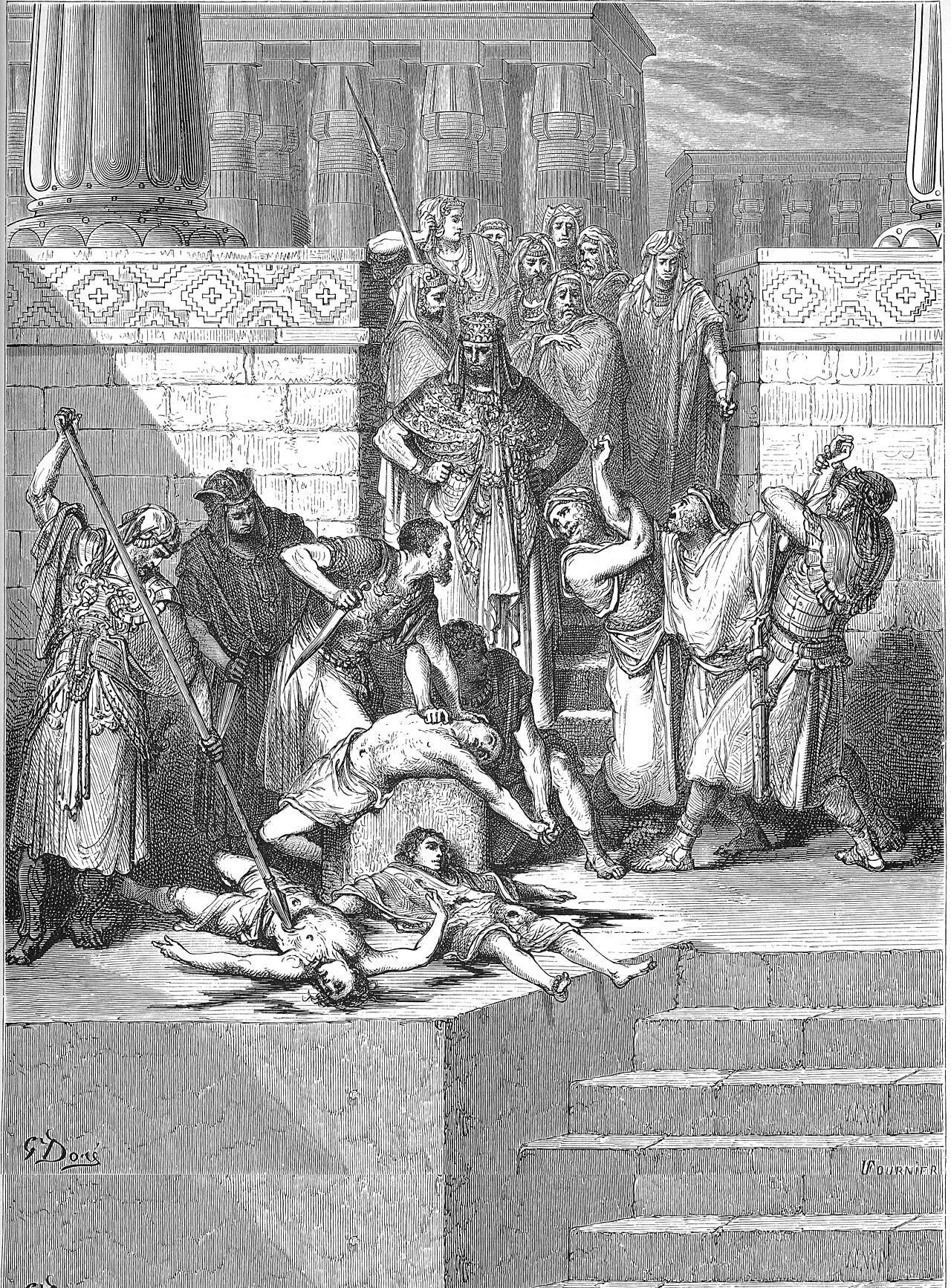
2 Kingschapter 25
30 verses · Jeremiah, by tradition · 6th century BC · History
On the seventh day of the fifth month, in the nineteenth year of Nebuchadnezzar’s reign over Babylon, Nebuzaradan captain of the guard, a servant of the king of Babylon, entered Jerusalem.
Introduction
Jeremiah, by tradition, History, 2 Kings Overview.
This last chapter of Kings was written for exiles in Babylon, reading how their city ended. It is dated more closely than almost any chapter in the Old Testament, down to the month and the day, and the same events are told again in Jeremiah 39 and 52. It moves from a siege to a burning, to a short governorship, and to a flight into Egypt. Listen for the inventory of the temple's bronze, and compare it with the building of the temple in 1 Kings 7. Then weigh the four closing verses, which the whole book leaves for last.
Context
- Who
- Exiles in Babylon reading how their city ended and why
- What
- An account of the siege and fall of Jerusalem, the burning of the temple, the second deportation, the murder of Gedaliah, and the release of Jehoiachin from prison in Babylon.
- Where
- Jerusalem under siege and in ruins, the plains of Jericho, Riblah in the land of Hamath, Mizpah, and Babylon.
- When
- The siege began in January 588 BC and the city fell in July 586 BC on the reckoning this site follows, with 587 BC held by others, and Jehoiachin was released about 561 BC.
- Why
- To record the end of the kingdom of Judah as the prophets had warned, and to close the book on a surviving son of David at the king of Babylon's table.
Historical context
The chapter belongs to Zedekiah until verse 21, then to Gedaliah son of Ahikam, and at the last to Jehoiachin. The time is about eighteen months of siege and then a generation of exile. The siege opens in the ninth year of Zedekiah and the city falls in his eleventh, and the closing scene stands in the thirty-seventh year of Jehoiachin's captivity.
Show the rest of the historical context, 3 more paragraphs
The places are named as the account moves: Jerusalem walled in, the plains of Jericho, Riblah in the land of Hamath, Mizpah, Egypt, and a room in Babylon. The occasion is the rebellion that closed chapter 24.
A first hearer knew that a siege wall built all around a city was the standard Babylonian method, and that famine usually ended it. Blinding a rebel vassal after killing his heirs in front of him was a known punishment for a broken oath. Leaving the poorest of the land to work the vineyards kept the ground producing under a governor.
The fifth month named at verse 8 became a fast still kept generations later, which Zechariah 7 and 8 record. The ostraca found at Lachish, written about 588 BC, are letters from the last months of this war.
Significance
For the exiles this chapter answered the question their whole situation asked. The city fell because the covenant held, and the book had been arguing that from chapter 17 onward.
Show the rest of the significance, 1 more paragraph
It also showed them prophecy keeping its word in detail, since Zedekiah was told he would see the king of Babylon and told he would not see Babylon. And it left them something to hold, a man of David's line changing out of prison clothes and eating at a king's table for the rest of his life.
This chapter in Jewish lifeWhat this chapter is in Jewish life and reading.
How it is read
The last chapter of the book is where the classical comment carries the most narrative that is not in the text, and where it is most careful about what it is doing. Two traditions fill out the capture of the king, and both are reported here as what the rabbis taught rather than as what the chapter says.
The first is the cave. The text says the men of war fled by night by the gate between the two walls. Rashi says a cave ran from the king's house to the plains of Jericho and he fled through it. God set a deer walking on the roof of the cave, the Chaldeans chased the deer, and when they came to the cave's mouth in the plains they found him and took him. He anchors the reading in the prophet's word about a net spread and a snare (Rashi on II Kings 25:4:1). That is a rabbinic reading and not the plain sense of the verse, and this site reports it as theirs.
The second is the oath. The text says the king of Babylon gave judgment upon him, and Rashi reads it as a dispute about an oath, that the two argued over the oath the vassal had sworn. The Metsudah edition's note gives both halves of the background. Radak's is the plain one, that the king had broken his oath of allegiance. The Talmud's at Nedarim 65a is fuller: the vassal had once seen the Babylonian king eating a live creature and had sworn never to tell, had the oath annulled, told, and was found out when the story began to be laughed at (Rashi on II Kings 25:6:1). The second is a saying of the rabbis, carried here because it is what the corpus carries, and reported as theirs.
The rest of the chapter is read close to the ground. The ninth year is the ninth of the last king's reign, with the note carrying Radak's synchronism to the seventeenth year of the Babylonian (Rashi on II Kings 25:1:1). The great houses that are burned are read to include the places where Torah and prayer were magnified as well as the houses of the princes, with the Talmud at Megillah 27a behind it (Rashi on II Kings 25:9:1). That is the one line in these twelve chapters where the classical comment puts a house of study inside the burning of the city. The fugitives who fell away to the king of Babylon are explained from the same verb used of men who came over to David (Rashi on II Kings 25:11:1).
Who was left behind is read as a question about labour. The poorest of the land are left as vinedressers and husbandmen, and Rashi reads the second word from digging, the same root as the word for a wine vat, which is a digging in the ground. The note carries Metzudat Tzion reading them as wine pressers, and a further reading that they were the men who caught the creature from which the blue dye was drawn, kept alive because the Babylonian king wanted the dye for his robes (Rashi on II Kings 25:12:1). At the seventeenth verse Rashi meets a number that does not match the earlier book, three cubits of capital here against five there, and instead of harmonising it afresh he points back to where he settled it, saying he reconciled the verses there (Rashi on II Kings 25:17:1). The officer taken with the priests is identified by his office, the man who knew how many men each city sent into the army (Rashi on II Kings 25:19:1). The captains who come to Gedaliah are read as the men who had left the city to hide in the strongholds and the rocks and the woods (Rashi on II Kings 25:23:1).
The book does not end at the ash, and neither does the comment. On the lifting up of the captive king's head Rashi gives the plain occasion, that the old king had died and his successor reigned in his place (Rashi on II Kings 25:27:1). On the words spoken to him he gives three words, "Words of consolation" (Rashi on II Kings 25:28:1). A Christian page that reads this chapter as the end of a story would be reading it against its own last paragraph, and the classical comment keeps the ending the book gives it.
Metzudat David and Radak comment across this chapter at further verses, and the corpus carries those refs with the reason that Sefaria holds no English version of them, so they stand here cited and unquoted: Metzudat David on II Kings 25:2:1, 25:5:1, 25:14:1, 25:15:1, 25:24:1, 25:25:1 and 25:26:1, and Radak on II Kings 25:3:1, 25:8:1, 25:10:1, 25:18:1, 25:29:1 and 25:30:1. Radak stands on the last two verses of the book, the allowance given to the captive king all the days of his life, and Metzudat David on the killing of Gedaliah, and what either makes of those waits on a fetch that carries the text.
What the rabbis say
The corpus carries forty rabbinic locators for this chapter and the text of none, so each is cited and linked here rather than quoted. Five stand on the seventh verse, where the king's sons are killed before his eyes and his eyes are put out: Eikhah Rabbah 1:51, Ein Yaakov (Glick Edition), Sotah 1:27, Horayot 11b:18, Midrash Tanchuma Buber, Bo 15:1, and Midrash Tanchuma Buber, Chukat 28:1, with Sanhedrin 96b:1 on the verse before it, which is where the rabbis take up the judgment given on him.
Five stand on the eighth verse, the day the captain of the guard came to Jerusalem, and the corpus gathers them from the places the rabbis treat the calendar of mourning: Ein Yaakov, Taanit 4:11, Jerusalem Talmud Taanit 4:6:4, Midrash Lekach Tov on Esther, Introduction 2, and Seder Olam Rabbah 27:2, with Kohelet Rabbah 10:4:1 anchored across the whole of the burning and the deportation from the eighth verse to the twenty-second. Four more stand on the ninth, where the house of the LORD and the houses of Jerusalem are burned: Eikhah Rabbah, Petichta 12, Ein Yaakov (Glick Edition), Megillah 4:1, Jerusalem Talmud Megillah 3:1:4, and Megillah 27a:2, the last of which is the passage Rashi cites above.
Otzar Midrashim, Forty Nine Midot, Compilation from Baraita of 49 Midot 14 stands on the seventeenth verse, where the pillars and the vessels of the house are measured and carried off.
The priests and officers taken to Riblah carry eight. On the eighteenth verse, Bamidbar Rabbah 11:3, Jerusalem Talmud Sanhedrin 1:2:4 and 1:2:5, and Megillah 23a:7. On the nineteenth, Jerusalem Talmud Sanhedrin 1:2:6 and Shir HaShirim Rabbah 3:7:3. On the twentieth, Ein Yaakov (Glick Edition), Sanhedrin 11:38. On the twenty-first, where Judah is carried away out of its land, Mekhilta DeRabbi Yishmael, Tractate Vayassa 1:20.
The governor left in the land carries three. On the twenty-second verse, Pirkei DeRabbi Eliezer 8:4. On the twenty-fifth, where he is struck down in the seventh month, Jerusalem Talmud Horayot 3:5:7 and Rosh Hashanah 18b:5, which is the passage where the rabbis set out the fasts of the calendar.
The close of the book carries eleven, more than any other place in the chapter. On the twenty-seventh verse, where the captive king's head is lifted up, Avot DeRabbi Natan, Recension B 17:2, Ein Yaakov, Megillah 1:23, and Kohelet Rabbah 2:15:3, with Bereshit Rabbah 83:2 anchored across the last four verses together. On the twenty-ninth, where he changes his prison clothes and eats bread before the king continually, Avot DeRabbi Natan, Recension B 17:4, Midrash Shmuel 18:5, Ruth Rabbah (Lerner) 7:12:5, and Yalkut Shimoni on Torah 869:2. On the thirtieth, the daily allowance given him all the days of his life, Bamidbar Rabbah 23:13, Ein Yaakov (Glick Edition), Sanhedrin 6:19, Ein Yaakov, Sanhedrin 6:19, and Jerusalem Talmud Kiddushin 1:7:3. Aggadat Bereshit 64:2 stands on the first verse, where the siege begins. What each of them teaches is a saying of the rabbis, and is reported as theirs wherever this site quotes one. The quotations wait on a fetch that carries the text.
Sources: Rashi, Rashi on II Kings 25:1:1, 25:4:1, 25:6:1, 25:9:1, 25:11:1, 25:12:1, 25:17:1, 25:19:1, 25:23:1, 25:27:1 and 25:28:1, The Metsudah Tanach series, Lakewood, N.J, CC-BY; Radak, Radak, the readings the Metsudah edition carries at II Kings 25:1:1 and 25:6:1, and his own refs at 25:3:1, 25:8:1, 25:10:1, 25:18:1, 25:29:1 and 25:30:1, cited by ref because the corpus carries no English text; Metzudat David, Metzudat David on II Kings 25:2:1, 25:5:1, 25:14:1, 25:15:1, 25:24:1, 25:25:1 and 25:26:1, cited by ref because the corpus carries no English text; The Sefaria corpus, scripts/data/sources/sefaria/2-kings/25.json, the 40 Talmud and Midrash locators of this chapter.
The heads below are this chapter's scenes. The numbered points under each are its verses.
A breach by night, capture near Jericho, and eyes put out
2 Kings 25:1-3
on the tenth day of the tenth month: The siege begins "on the tenth day of the tenth month" of Zedekiah's ninth year, matching Jeremiah 52:4 almost word for word. At Ezekiel 24:1-2 the prophet in Babylon is told to write down the name of this same day. Two witnesses in two places mark one date.
2 Kings 25:1
“In the ninth year ... - As the final catastrophe approaches, the historian becomes more close and exact in his dates, marking not only the year, but the month and the day, on which the siege began, no less than those on which it closed 2Ki 25:3. From Eze 24:1 we find that on the very day when the host of Nebuchadnezzar made its appearance before Jerusalem the fact was revealed to Ezekiel in Babylonia, and the fate of the city announced to him Eze 24:6-14. The army seems to have at first spread itself over all Judaea.”
2 more voices on this verseWhat preachers and commentators have said about this verse, in their own words.
2 Kings 25:1
“And it came to pass in the ninth year of his reign,.... Of the reign of Zedekiah king of Judah. From hence to the end of 2Ki 25:7, the account exactly agrees with Jer 52:4.”
2 Kings 25:1
“What think you of Nebuchadnezzar? Have you not heard from Scripture that he was bloodthirsty, fierce, with the disposition of a lion? Have you not heard that he disinterred the kings? Have you not heard that he brought the people away into captivity? Have you not heard that he put the king's sons to the sword before Zedekiah's eyes and then blinded him? Have you not heard that he shattered the cherubim?”
Cyril of Jerusalem · written before 386 · Catechetical Lecture 2:17-19patristic
the city was kept under siege: Barnes measures the siege almost exactly a year and a half, from the tenth month of the ninth year to the fourth of the eleventh. Jeremiah 37:5 records a pause when an Egyptian army marched out and the Chaldeans withdrew for a time. Barnes reads the suffering inside in Lamentations.
2 Kings 25:2
“And the city was besieged, etc. - Nebuchadnezzar, having routed the Egyptian army, returned to Jerusalem, and besieged it so closely that, being reduced by famine, and a breach made in the wall, the Chaldeans entered it on the ninth day of the fourth month, (Wednesday, July 27), Zedekiah and many others endeavoring to make their escape by night.”
Adam Clarke · Commentary on the Bible (1810-1826)evangelical
the famine in the city: Lamentations 4:10 describes mothers cooking their own children in this famine, as John Wesley notes. Adam Clarke sets the day in late July. At Jeremiah 38:17 the prophet had urged King Zedekiah to surrender to the officers of the king of Babylon and save the city.
2 Kings 25:3
“The people - For the common people, but only for the great men. Now they eat their own children for want of food, Lam. iv, 3, &c. Jer. in this extremity, earnestly persuaded the king to surrender; but his heart was hardened to his destruction.”
John Wesley · Explanatory Notes upon the Old Testament (1765)evangelical
2 Kings 25:4-5
Then the city was breached: When "the city was breached", the men of war fled. The Chaldeans overtake the king "in the plains of Jericho", and "all his army was separated from him". Ezekiel 12:13 had spoken of a net spread for this king and of his being brought to Babylon without seeing it.
2 Kings 25:4
“The city was broken up - Rather, “broken into,” i. e., A breach was made about midnight in the northern wall Eze 9:2, and an entry effected into the second or lower city (see the 2Ki 22:14 note), which was protected by the wall of Manasseh 2Ch 33:14. Precipitate flight followed on the advance of the Babylonians to the “middle gate,” or gate of communication between the upper and the lower cities. This position was only a little north of the royal palace, which the king therefore quitted.”
in the plains of Jericho: Jeremiah 38:23 had told Zedekiah that he would be seized by the king of Babylon, as Albert Barnes points out. Ezekiel 12:14 foretold the scattering of all his troops. The plains of Jericho lie in the Jordan Valley, east of Jerusalem on the road to the river crossing.
2 Kings 25:5
“Jeremiah Jer 38:23 and Ezekiel Eze 12:13 had prophesied this capture; and the latter had also prophesied the dispersion of the troops 2Ki 25:14.”
2 Kings 25:6-7
they pronounced judgment on him: They "slaughtered the sons of Zedekiah before his eyes," then "put out his eyes," an order that fulfils two prophecies. Jeremiah 32:4 said he would see the king of Babylon with his own eyes. Ezekiel 12:13 said he would be brought to Babylon and not see it.
2 Kings 25:6
“To Riblah - See 2Ki 23:33 note. A position from where Nebuchadnezzar could most conveniently superintend the operations against Tyre and Jerusalem. In the absence of the monarch, the siege of Jerusalem was conducted by a number of his officers, the chief of whom were Nebuzar-adan, the captain of the guard, and Nergal-shar-ezer (Neriglissar), the Rab-mag Jer 39:3, Jer 39:13.”
bound him with bronze shackles: John Wesley reads the slaughter of the sons of Zedekiah before his eyes as Babylon's declaration that his kingdom was ended. Albert Barnes notes that Jeremiah records it twice. Jeremiah 52:11 adds that the king of Babylon kept him in custody until he died.
The house burned, the walls broken, the pillars carried away
2 Kings 25:8-10
the seventh day of the fifth month: Nebuzaradan burns "the house of the LORD" first, then "the royal palace," the destroyer's order following the builder's own priority of temple before palace. The walls come down last, a formal demolition carried out by "the whole army of the Chaldeans."
2 Kings 25:8
“And in the fifth month, on the seventh day of the month,.... In Jer 52:12 it is the tenth day of the month; which, how to be reconciled; see Gill on Jer 52:12. which is the nineteenth year of King Nebuchadnezzar; who, according to Ptolemy's canon, reigned forty three years; Metasthenes (u) says forty five; and from hence, to the end of 2Ki 25:12 facts are related as in Jer 52:12 whither the reader is referred. (u) De Judicio Temp. & Annal. Pers. fol. 221. 2.”
He burned down the house: Matthew Henry notes that the Romans burned the second temple in the same month and on the same day of the month. Albert Barnes links Psalm 79 to this fire. Jeremiah 21:10 and 34:2 had told Zedekiah that the king of Babylon would burn Jerusalem down.
2 Kings 25:9
“He burnt the house of the Lord - Compare the prophecies of Jeremiah Jer 21:10; Jer 34:2; Jer 38:18, Jer 38:23. Psa 79:1-13 is thought to have been written soon after this destruction of the temple.”
1 more voice on this verse
2 Kings 25:9
“The people having forfeited the promises made concerning it, those promises must be understood of the gospel-temple, which is God's rest for ever. It is observable that the second temple was burnt by the Romans the same month, and the same day of the month, that the first temple was burnt by the Chaldeans, which, Josephus says, was the tenth of August.”
Matthew Henry · Commentary on the Whole Bible (1707-1721)puritan
broke down the walls around Jerusalem: Matthew Henry notes that the walls around Jerusalem stayed broken until Nehemiah rebuilt them, about a hundred and forty years later. Nehemiah 1:3 still reports the wall broken down. Jamieson, Fausset and Brown note that Nebuzaradan came to Jerusalem after the siege to raze the city and its walls.
2 Kings 25:11-12
carried into exile the people who remained: The bulk of the surviving population is carried off, and the poorest of the land are left as vinedressers and husbandmen. Leaving the poor to work the vineyards and fields is the ordinary policy of the conqueror, keeping the ground producing under a governor.
2 Kings 25:11
“People - Whom neither the sword nor famine had destroyed, who were eight hundred and thirty two persons, Jer. lii, 29, being members and traders of that city: for it is likely, there were very many more of the country people fled thither, who were left with others of their brethren to manure the land.”
John Wesley · Explanatory Notes upon the Old Testament (1765)evangelical
to tend the vineyards and fields: Albert Barnes reads the policy as preparing the land for colonists from elsewhere in the empire, as Assyria had settled foreigners in Samaria at 17:24. Jeremiah 39:10 adds that the captain of the guard gave the poorest of the land vineyards and fields at that time. The poor became landholders.
2 Kings 25:12
“There was probably an intention of seating colonists into the country from some other part of the Empire, as the Assyrians had done in Samaria 2Ki 17:24.”
the Chaldeans broke up the bronze pillars: The "bronze pillars" were named Jachin and Boaz at their casting (1 Kings 7:21), and here they are broken up without their names. The bronze Sea goes the same way. What stood about three hundred and seventy years from Solomon's dedication ends as metal for a foreign treasury.
2 Kings 25:13
“The pillars of brass ... - All the more precious treasures had been already removed from the temple 2Ki 24:13. But there still remained many things, the list of which is given in Jer 52:17-23 much more fully than in this place. Objects in brass, or rather bronze, were frequently carried off by the Assyrians from the conquered nations. Bronze was highly valued, being the chief material both for arms and implements. The breaking up of the pillars, bases, etc., shows that it was for the material, and not for the workmanship, that they were valued.”
1 more voice on this verse
2 Kings 25:13
“When the things signified were sinned away what should the signs stand there for? Ahaz had profanely cut off the borders of the bases, and put the brazen sea upon a pavement of stones ( 2 Kings xvi. 17 ); justly therefore are the brass themselves, and the brazen sea, delivered into the enemy's hand.”
Matthew Henry · Commentary on the Whole Bible (1707-1721)puritan
2 Kings 25:14-17
They also took away the pots, shovels: The pillar's height of "eighteen cubits" and its "network of bronze pomegranates" repeat the casting description of 1 Kings 7:15-16 almost word for word. Verse 16 says "the weight of the bronze from all these articles was beyond measure", an echo of the original casting account.
2 Kings 25:14
“It was a righteous thing with God to deprive those of the benefit of his worship who had slighted it so long and preferred false worships before it. Those that would have many altars shall now have none. Several of the great men are slain in cold blood--Seraiah the chief priest (who was the father of Ezra as appears, Ezra vii.”
Matthew Henry · Commentary on the Whole Bible (1707-1721)puritan
Most of the gold had gone in the first capture, as Henry notes, so these were the last pieces of pure gold and fine silver. Ezra 1:9-10 lists gold and silver bowls among the articles returned from Babylon. The vessels outlived the temple.
the weight of the bronze: Albert Barnes explains that the Babylonians weighed captured gold and silver and left the bronze unweighed. He notes Assyrian monuments that show royal scribes recording the weight of captured gold and silver. The movable stands are described at 1 Kings 7:27-37.
2 Kings 25:16
“Without weight - The Babylonians did not take the trouble to weigh the brass as they did the gold and silver. In the Assyrian monuments there are representations of the weighing of captured articles in gold and silver in the presence of the royal scribes.”
Each pillar was eighteen cubits: The capital here is three cubits high, while 1 Kings 7:16 and Jeremiah 52:22 give each capital five. Albert Barnes corrects the figure in this verse to five cubits to agree with those passages. A cubit is about eighteen inches.
2 Kings 25:17
Compare with this description the accounts in marginal references. The height of the capital (“three cubits”) must be corrected, in accordance with those passages, to “five cubits.”
Seventy at Riblah: so Judah was carried away out of his land
2 Kings 25:18-21
took away Seraiah the chief priest: Seraiah "the chief priest" is named as Jehozadak's father at 1 Chronicles 6:14-15, and Ezra 7:1 traces Ezra's priestly line back through this same Seraiah. All are struck down at Riblah, and the verse closes the kingdom: "So Judah was taken into exile, away from its own land."
2 Kings 25:18
“Seraiah the chief priest - Zephaniah - The person who is here called the second priest was what the Jews call sagan, a sort of deputy, who performed the functions of the high priest when he was prevented by any infirmity from attending the temple service. See on 2Ki 23:4 (note).”
Adam Clarke · Commentary on the Bible (1810-1826)evangelical
1 more voice on this verse
2 Kings 25:18
“It devolved on Nebuzaradan to select for exemplary punishment the persons whom he regarded as most guilty, either in respect of the original rebellion or of the protracted resistance. Instead of taking indiscriminately the first comers, he first selected those who by their offices would be likely to have had most authority - the high priest; the second priest (2Ki 23:4 note); three of the temple Levites; the commandant of the city; five members of the king’s Privy Council (or seven, see 2Ki 25:19 note); and the secretary (or adjutant) of the captain of the host.”
five royal advisors: Jeremiah 52:25 counts seven of these royal advisors, and this verse counts five. Jamieson, Fausset and Brown suppose that two more were found later, and Albert Barnes leaves the number open. The Hebrew calls them men who saw the king's face.
2 Kings 25:19
“Out of the city - This clause shows that the five persons mentioned in 2Ki 25:18 were taken out of the temple. Five men - Or, “seven men,” according to Jer 52:25. It is impossible to say which of the two numbers is correct. Of them that were in the king’s presence - See the margin. A mode of speech arising from the custom of Eastern rulers to withdraw themselves as much as possible from the view of their subjects.”
Nebuzaradan captain of the guard: Nebuzaradan carried out Nebuchadnezzar's order at Jeremiah 39:11-12 to look after Jeremiah, and at Jeremiah 40:1 he released the prophet from his chains at Ramah. The same captain of the guard brought these men to Riblah. The prophet went free and the court went to judgment.
So Judah was taken into exile: Matthew Henry reads this verse as Deuteronomy 28:36 fulfilled. Adam Clarke holds that the king of Babylon put these men to death at Riblah for counselling Zedekiah to revolt. Albert Barnes marks this as the end of the kingdom.
2 Kings 25:21
“Now the scripture was fulfilled, The Lord shall bring thee, and the king which thou shalt set over thee, into a nation which thou hast not known, Deut. xxviii. Sin kept their fathers forty years out of Canaan, and now turned them out. The Lord is known by those judgments which he executes, and makes good that word which he has spoken, Amos iii.”
Matthew Henry · Commentary on the Whole Bible (1707-1721)puritan
Gedaliah at Mizpah, murdered by a man of the seed royal
2 Kings 25:22-24
appointed Gedaliah son of Ahikam: Gedaliah's father Ahikam had kept Jeremiah from being put to death at Jeremiah 26:24. His grandfather Shaphan was the scribe who read the found book of the law to Josiah. His counsel matches Jeremiah's at Jeremiah 27 and 29, to submit to Babylon and seek the peace of the city.
2 Kings 25:22
“His father Ahikam was one that countenanced and protected Jeremiah when the princes had vowed his death, Jer. xxvi. It is probable that this Gedaliah, by the advice of Jeremiah, had gone over the Chaldeans, and had conducted himself so well that the king of Babylon entrusted him with the government.”
Matthew Henry · Commentary on the Whole Bible (1707-1721)puritan
1 more voice on this verse
2 Kings 25:22
“Made Gedaliah - ruler - This was no regal dignity; he was only a sort of hind or overseer, appointed to regulate the husbandmen.”
Adam Clarke · Commentary on the Bible (1810-1826)evangelical
Albert Barnes identifies these commanders as officers who fled the city with Zedekiah and went into hiding when his army scattered. In Barnes's placing, Netophah lay near Bethlehem and Maacah east of the upper Jordan beside Bashan. Mizpah was a town of Benjamin.
2 Kings 25:23
“The captains of the armies - i. e., the officers of the troops who had fled from Jerusalem with Zedekiah 2Ki 25:4, and had then dispersed and gone into hiding 2Ki 25:5. For Mizpah, see Jos 18:26 note. The Netophathite - Netophah, the city of Ephai (compare Jer 40:8), appears to have been in the neighborhood of Bethlehem Neh 7:26; Ezr 2:21-22. The name is perhaps continued in the modern Antubeh, about 2 12 miles S. S. E. of Jerusalem. A Maachathite - Maachah lay in the stony country east of the upper Jordan, bordering upon Bashan Deu 3:14.”
Gedaliah took an oath: Albert Barnes reads the oath as a pledge of pardon to men whose lives were forfeit as rebels against the king of Babylon. John Wesley holds that Gedaliah could swear it safely, with the word of the LORD through Jeremiah behind him. Matthew Henry places his murder within two months.
2 Kings 25:24
“As rebels against the Babylonian king, their lives were forfeit. Gedaliah pledged himself to them by oath, that, if they gave no further cause of complaint, their past offences should be forgiven.”
1 more voice on this verse
2 Kings 25:24
“What a fatal breach was made upon them, soon afterwards, by the death of Gedaliah, within two months after he entered upon his government. The utter extirpation of the Jews, for the present, was determined, and therefore it was in vain for them to think of taking root again: the whole land must be plucked up, Jer. xlv.”
Matthew Henry · Commentary on the Whole Bible (1707-1721)puritan
2 Kings 25:25-26
who was a member of the royal family: Ishmael, "a member of the royal family," kills Gedaliah "along with the Judeans and Chaldeans who were with him at Mizpah." Jeremiah 40:14 gives the fuller account, naming Baalis king of Ammon behind the plot. Then "all the people small and great" flee "to Egypt for fear of the Chaldeans."
2 Kings 25:25
“Smote Gedaliah - This was at an entertainment which Gedaliah had made for them; see Jer 41:1, etc. He was not content with this murder, but slew fourscore more, who were coming with offerings to the temple, and took several as prisoners, among whom were some of the king’s daughters; and set off to go to the Ammonites: but Johanan, the son of Careah, hearing of these outrages, raised a number of men, and pursued Ishmael upon which Ishmael’s prisoners immediately turned and joined Johanan; so that he, and eight of his accomplices, with difficulty escaped to the Ammonites.”
Adam Clarke · Commentary on the Bible (1810-1826)evangelical
1 more voice on this verse
2 Kings 25:25
“The generous governor, though apprised of his intentions, refused to credit the report, much less to sanction the proposal made by an attached friend to cut off Ishmael. The consequence was, that he was murdered by this same Ishmael, when entertaining him in his own house (Jer 41:1).”
Jamieson, Fausset & Brown · Commentary Critical and Explanatory on the Whole Bible (1871)reformed
fled to Egypt for fear: Matthew Henry reads the flight of all the people to Egypt as the last threat of Deuteronomy 28:68 fulfilled. John Gill counts the king's daughters and Baruch among those who fled for fear of the Chaldeans. Jeremiah 44 records the prophet's word to them in Egypt.
2 Kings 25:26
“And all the people, both small and great,.... High and low, rich and poor, among whom were the king's daughters, committed to the care of Gedaliah, and also the prophets Jeremiah and Baruch, see Jer 41:16. and the captains of the armies rose, and came to Egypt; contrary to the express command of God; these were Johanan, and the captain of the forces with him, Jer 43:4. for they were afraid of the Chaldees; lest they should come and avenge the death of Gedaliah, appointed governor of Judea, see Jer 41:17.”
2 more voices on this verse
2 Kings 25:26
“In the twelfth year of king Zedekiah, seventy years before the dominance of the Persians, Nebuchadnezzar campaigned against the Phoenicians and Jews, as Berossus says in his "Researches on the Chaldeans." Juba, writing "On the Assyrians," admits that he took his account from Berossus, testifying to its accuracy. Nebuchadnezzar blinded Zedekiah and removed him to Babylon, deporting the whole people except a few who escaped to Egypt. The captivity lasted for seventy years. Jeremiah and Habakkuk continued to prophesy under Zedekiah, and in the fifth year of his reign Ezekiel was prophesying in Babylon.”
Clement of Alexandria · written before 215 · The Stromata Book 1patristic
2 Kings 25:26
“Thus was there a full end made of them by their own folly and disobedience, and Egypt had the last of them, that the last verse of that chapter of threatenings might be fulfilled, after all the rest, Deut. xxviii. 68 , The Lord shall bring thee into Egypt again. These events are more largely related by the prophet Jeremiah, ch. xl. to ch. xlv.”
Matthew Henry · Commentary on the Whole Bible (1707-1721)puritan
Jehoiachin lifted out of prison to eat at the king's table
the thirty-seventh year of the exile: The date stands beside Jeremiah 52:31, which gives the twenty-fifth day. In the year he began to reign, Evil-merodach, Nebuchadnezzar's son and successor, "released King Jehoiachin of Judah from prison". The Hebrew says he lifted up Jehoiachin's head, the idiom Pharaoh's cupbearer hears at Genesis 40:13, meaning restoration to rank.
2 Kings 25:27
“The captivity of Jehoiachin commenced in the year 597 B.C. - the eighth year of Nebuchadnezzar. It terminated 561 B.C. - the first year of Evil-merodach, the son and successor of Nebuchadnezzar. He reigned only two years, being murdered by his brother-in-law, Neriglissar, or Nergal-shar-ezer. He is said to have provoked his fate by lawless government and intemperance.”
2 more voices on this verse
2 Kings 25:27
“Seven and twentieth - Or, on the twenty fifth day, as it is, Jer. lii, 31. For then the decree was made, which was executed upon the twenty seventh day.”
John Wesley · Explanatory Notes upon the Old Testament (1765)evangelical
2 Kings 25:27
Jeremiah calls this son of Jehoiakim Jeconiah, and the Pharaoh Neco called the father of this man, though named Eliakim, Jehoiakim, whom Babylon, having carried off, cast forth before the gate, as the present prophet and Josephus in the tenth book of his Antiquities says. And the other editions have given the signet ring as a seal. And every person who through repentance makes shine again what is according to the image becomes a seal, a ring on the "right hand of God."
Origen of Alexandria · written before 253 · Fragments from the Catena on Jeremiah 14patristic
2 Kings 25:28-30
set his throne above the thrones of the: The lamp promised for David's sake at 1 Kings 11:36, 15:4 and 2 Kings 8:19 narrows to one living man. It is kept in a captive, and Matthew 1:11-12 carries this king into the genealogy of Christ. He changes "out of his prison clothes".
2 Kings 25:28
“The kings that were with him - Probably captive kings, like Jehoiachin himself. Compare Jdg 1:7.”
changed out of his prison clothes: Barnes sets the new clothes beside Joseph's linen at Genesis 41:42 and Mordecai's royal garments at Esther 8:15, a man's rank shown by his dress. Joseph also left prison for a king's favour. Matthew Henry saw in the change a picture of a believer's release at death.
2 Kings 25:29
“However the death of afflicted saints is to them such a change as this was to Jehoiachin: it will release them out of their prison, shake off the body, that prison-garment, and open the way to their advancement; it will send them to the throne, to the table, of the King of kings, the glorious liberty of God's children.”
Matthew Henry · Commentary on the Whole Bible (1707-1721)puritan
1 more voice on this verse
2 Kings 25:29
“Evil-merodach gave him garments befitting his rank. To dress a man suitably to his position was the first thought of an Oriental Gen 41:42; Est 8:15; Dan 5:29; Luk 15:22. So again, Oriental kings regarded it as a part of their greatness to feed daily a vast multitude of persons at their courts (see 1Ki 4:22-23). Of these, as here, a certain number had the special privilege of sitting actually at the royal board, while the others ate separately, generally at a lower level. See Jdg 1:7; 2Sa 9:13; 1Ki 2:7; Psa 41:9.”
a daily portion: Albert Barnes reads the portion as an allowance from the royal treasury, given in addition to his place at the king's table. Jeremiah 52:34 ends that book on the same provision, kept until the day of his death. Adam Clarke dates Evil-merodach's murder about two years later.
2 Kings 25:30
“A continual allowance given him of the king - He lived in a regal style, and had his court even in the city of Babylon, being supplied with every requisite by the munificence and friendship of the king. In about two years after this, Evil-merodach was slain in a conspiracy; and it is supposed that Jehoiachin, then about fifty-eight years of age, fell with his friend and protector. Thus terminates the catastrophe of the Jewish kings, people, and state; the consequence of unheard-of rebellions and provocations against the Majesty of heaven.”
Adam Clarke · Commentary on the Bible (1810-1826)evangelical
How this psalm is built
The form: A siege narrative closing in an inventory of plunder, a short governorship, and a coda set a generation later in Babylon, as Keil, with F. W. Farrar classes it.
The patterns in this chapter
| Device | What it does | Where to see it |
|---|---|---|
| The date given to the day | Four dates are fixed by year, month and day: the siege begins in the ninth year on the tenth day of the tenth month, the famine bites on the ninth day of the fourth month, Nebuzaradan enters on the seventh day of the fifth month, and the release comes on the twenty-seventh day of the twelfth month of the thirty-seventh year. The site's exposition note on 25:1 to 3 records that the first matches Jeremiah 52:4 almost word for word and that Ezekiel 24:1 to 2 has the prophet in Babylon commanded to write down the same day as a sign. Two witnesses in two places mark one date.Matthew Henry, Commentary on the Whole Bible, 1710, cited by the site's exposition note on 2 Kings 25:1 to 3. | 2 Kings 25:1, 2 Kings 25:3, 2 Kings 25:8, 2 Kings 25:27 |
| The temple furnishing inventoried a second time | Verses 13 to 17 list what Solomon made and what became of it: the bronze pillars, the stands and the Sea broken up for their metal, then the pots, shovels, wick trimmers and dishes, then the censers and bowls taken by their metal with gold set apart from silver. The site's exposition note on 25:14 to 17 records that the pillar's height at eighteen cubits with a three cubit capital, the network and the pomegranates, repeats the casting description of 1 Kings 7:15 to 16 almost word for word, so the inventory that opened the temple's furnishing closes it here in the same terms.F. W. Farrar, The Second Book of Kings, the Expositor's Bible, cited by the site's exposition note on 2 Kings 25:14 to 17. | 2 Kings 25:13, 2 Kings 25:15, 2 Kings 25:16, 2 Kings 25:17, 1 Kings 7:15 |
| Named at their casting, broken without their names | 1 Kings 7:21 gave the two pillars names a worshipper read on the way in, and verse 13 breaks them in pieces without speaking either one. The site's exposition note on 25:13, which cites Keil with Henry, makes the silence itself the point, and records that the bronze Sea cast by Hiram at 1 Kings 7:23 to 26 goes the same way, and that what stood roughly three hundred and seventy years from Solomon's dedication ends as scrap metal for a foreign treasury.Keil, The Books of the Kings, cited by the site's exposition note on 2 Kings 25:13. | 2 Kings 25:13, 1 Kings 7:21, 1 Kings 7:23 |
| For the rest of his life, written twice | The last two verses close the book on one phrase used twice, once for the meals at the king's table at verse 29 and once for the daily portion at verse 30. The site's exposition note on 25:28 to 30, which cites Henry with Jamieson, Fausset and Brown, reads the repetition as set down twice to stand against reversal, and records that the lamp promised for David's sake at 1 Kings 11:36, 1 Kings 15:4 and 2 Kings 8:19 narrows across the two books to this one living man, kept as a captive's raised seat at a foreign table rather than as a throne recovered in Jerusalem.Matthew Henry, Commentary on the Whole Bible, 1710, cited by the site's exposition note on 2 Kings 25:28 to 30. | 2 Kings 25:29, 2 Kings 25:30, 2 Kings 8:19 |
The historical value
18 more paragraphs on the patterns
Riblah in the land of Hamath is the fixed point of the chapter's geography. It served Pharaoh Neco as a field headquarters at 23:33 and serves Nebuchadnezzar as one here at verses 6 and 20, and the site's exposition note on verses 6 and 7 records the repetition. The same town holds two empires within one generation.
The site's own historical layer for this chapter names the Lachish Letters, the ostraca of about 588 BC, among its sources, alongside the Babylonian Chronicles and Edwin R. Thiele's chronology.
The fast that came out of this chapter is recorded in Scripture itself. The site's exposition note on verses 8 to 10 records that the fifth month here becomes the fast Zechariah 7:3, 7:5 and 8:19 name centuries later, a mourning kept long after the reason for it had passed into history.
The last four verses match a find. The dossier's Jehoiachin ration tablets from Babylon, about 592 BC, list rations of oil issued to Ya'u-kinu, king of the land of Yahudu, and to his sons, and the dossier states plainly that this is the same arrangement the book's closing verses describe when they record his continual allowance from the king at verse 30.
The debated concept
The year the city fell is the first question and the site's own historical layer states the difference on its face: the siege runs from January 588, the city falls in July 586 BC, and some reckon 587. The dossier's chronology question carries the reason a date can move by a year. Thiele holds the numbers consistent once the ancient conventions are applied, since the two kingdoms began regnal years in different months and counted a partial first year differently, and the dossier records that his synchronisms are the basis for the standard dates of 931, 722 and 586 BC across conservative and critical scholarship alike.
The date of the release is the second, and the commentators name it rather than resolve it. The site's exposition note on verse 27, which cites Wesley with Barnes, records that this verse gives the twenty-seventh day where Jeremiah 52:31 gives the twenty-fifth, and that the commentators name the two-day variance honestly.
The height of the capital on the pillars is the third. Verse 17 gives three cubits and 1 Kings 7:16 gives five. Rashi reconciles them by holding that two of the five were taken up where the column was set into the capital and served as its base, and says he settled the verses at the earlier place. The site records the figures the text carries and the reconciliation with its holder.
The divine connection and the words answered in order
The chapter is the densest stretch of fulfilled prophecy in the two books, and the site's exposition carries four cases with their references.
The escape at verse 4 answers Ezekiel 12:13. The site's exposition note on verses 4 and 5 records that the net of that verse closes exactly as spoken, that the LORD would bring him to Babylon and yet he would not see it, and that the flight answers a specific prophecy before the capture even lands.
The blinding at verse 7 answers two words at once rather than one. The site's exposition note on verses 6 and 7 records that Jeremiah 32:4 promised Zedekiah would see the king of Babylon eye to eye and Ezekiel 12:13 promised he would be carried to Babylon and not see it, and that the order in this verse gives sight first and takes it second, so both words stand.
The day of the siege at verse 1 answers Ezekiel 24:1 to 2, where a prophet already in Babylon is told to write down that day as a sign. The escape route at verse 4 and the leaving of the poorest at verse 12 are both recorded in nearly the same words at Jeremiah 39:4 and 39:10.
The flight to Egypt at verse 26 carries its own dark irony, which the site's exposition note on verses 25 and 26, citing Clarke with Gill, states plainly: Jeremiah 43:6 to 7 records the prophet himself carried along against his own counsel into the land he had warned them against.
The last four verses are the book's own closing argument and the site presents them as the guide's Christ table does, without overstatement. The lamp promised for David's sake narrows to one living man, and Matthew 1:11 to 12 carries Jeconiah by that name through this door into the genealogy of Christ. What the text claims is a seat at a table and a daily portion. What the church has read in it is the line kept alive, and the site states the reading with the verse it rests on.
How the rest of Scripture reads this chapter
Jeremiah 52 tells the same events again at greater length and supplies the deportation figures. Jeremiah 39 tells the fall from inside the city. Jeremiah 40 to 44 carries the whole Gedaliah episode with what this chapter leaves out, including the part of Baalis king of Ammon at Jeremiah 40:14, which the site's exposition note on verses 25 and 26 leaves where it lies. 2 Chronicles 36:17 to 21 adds the seventy years and the land keeping its sabbaths. Ezekiel dates his visions by this exile. Lamentations is written over this chapter. Zechariah 7 and 8 name the fast that came from it. Psalm 137 is sung by the people carried off in it.
The priestly line survives the chapter it ends in. The site's exposition note on verses 18 to 21 records that Seraiah the chief priest is named as Jehozadak's father at 1 Chronicles 6:14 to 15 and that Ezra 7:1 traces Ezra's own line back through him, so the generation that ends the kingdom is the generation the return is built from.
Keep studying
Studies13
Sources for this chapter
The summary
Jamieson, Fausset & Brown, Commentary Critical and Explanatory; John Wesley, Notes on the Old Testament and Matthew Henry, Complete Commentary.
The context
Keil, The Books of the Kings and Matthew Henry, Commentary on the Whole Bible.
The form and classifications
Albert Barnes, with Adam Clarke, Notes on the Old Testament and Commentary on the Bible, 1832, cited together by the site's exposition note on 2 Kings 25:4 to 5; Jamieson, Fausset and Brown, with Matthew Henry, Commentary Critical and Explanatory on the Whole Bible, 1871, and Commentary on the Whole Bible, 1710, cited together by the site's exposition note on 2 Kings 25:28 to 30 and Keil, with F. W. Farrar, The Books of the Kings and The Second Book of Kings, the Expositor's Bible, cited together by the site's exposition note on 2 Kings 25:8 to 10.
The exposition
Adam Clarke, Commentary on the Bible; Albert Barnes; Berean Standard Bible, Jeremiah 39:11-12; Jeremiah 40:1; F. W. Farrar, The Second Book of Kings (Expositor's Bible); Jamieson, Fausset & Brown, Commentary Critical and Explanatory on the Whole Bible; Jamieson, Fausset and Brown, Commentary Critical and Explanatory on the Whole Bible; John Gill; John Wesley, Explanatory Notes upon the Old Testament; Keil, The Books of the Kings and Matthew Henry, Commentary on the Whole Bible.