
1 Samuelchapter 24
22 verses · BSB1 Samuel book hub →
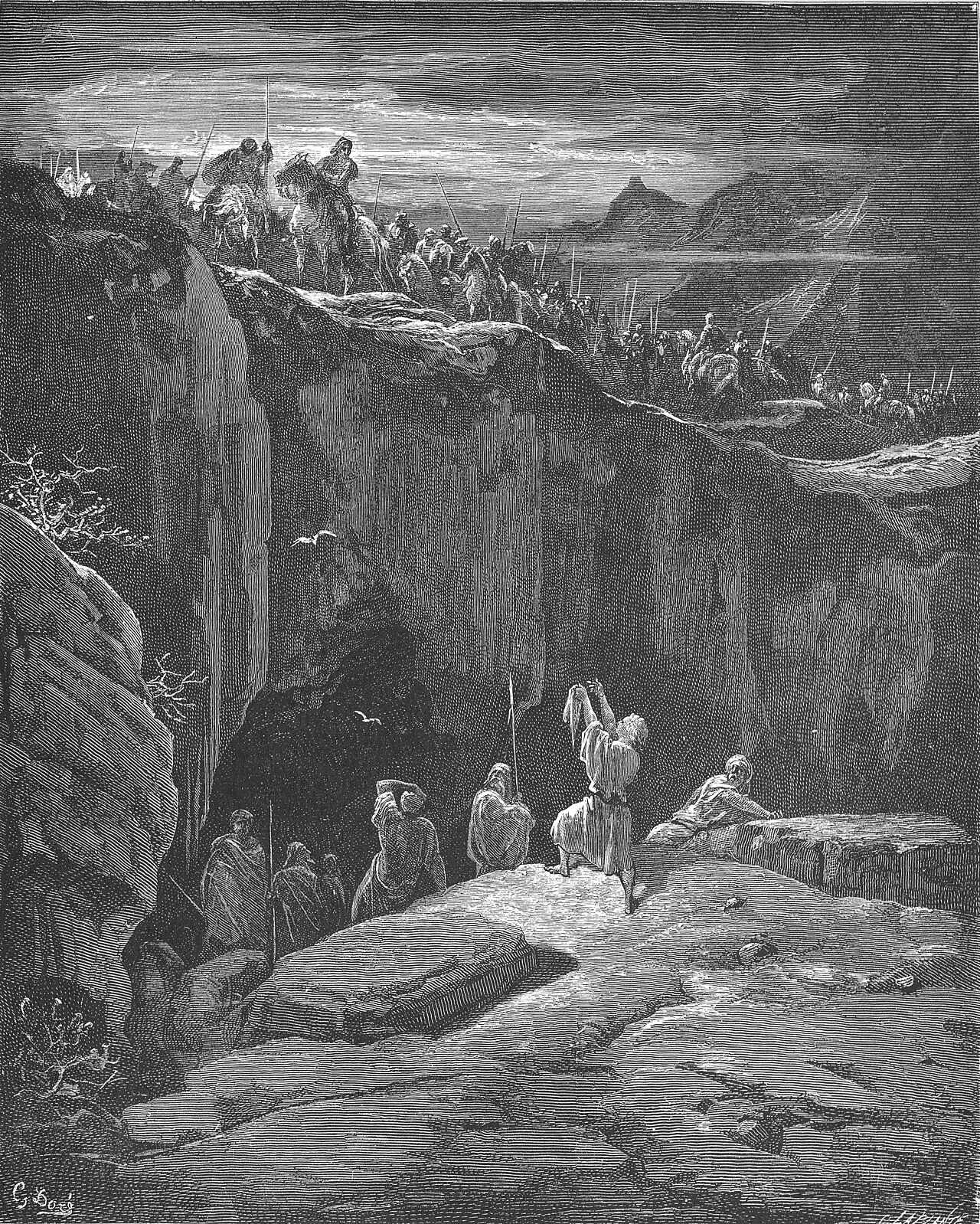
David Shows Saul How He Spared His Life, Gustave Doré, Doré's English Bible (1866), public domain
Key verse
Soon Saul came to the sheepfolds along the road, where there was a cave, and he went in to relieve himself. And David and his men were hiding in the recesses of the cave.
It stands in scene A of the chapter, verses 1 to 7.
The chapter
Chapter summary
In the wilderness of En-gedi Saul enters a cave to cover his feet, not knowing David's men are in the sides of it. They read it as providence handed over; David creeps up and cuts off the skirt of Saul's robe, and his heart smites him even for that: Jehovah forbid that I should put forth my hand against my lord, seeing he is Jehovah's anointed. He restrains his men, lets the king walk out, then calls from the cave mouth holding the cloth, see the skirt in my hand; Jehovah judge between me and thee. Saul weeps aloud: thou art more righteous than I. He asks David to swear he will not cut off his seed.
Context
History · Samuel, Nathan, Gad · 1 Samuel overview
Where the chapter sits
1 Samuel 24 falls in David's rise in Saul's shadow (chapters 16–31). David anointed in secret; Goliath; Jonathan's covenant; Saul's pursuit; the cave of Adullam; Nabal and Abigail; the Philistine sanctuary; Saul's death at Gilboa.
Saul spared in the cave. David cuts Saul's robe; ‘the LORD forbid that I should do this thing unto my master.’
Before it: Saul's reign: promise and rejection, chapters 9–15.
The whole shape of 1 Samuel→The world behind this chapter
1 Samuel 24The history
En-gedi is a freshwater spring in the middle of a furnace, a green gorge of waterfalls and palms breaking out of bare cliffs on the western shore of the Dead Sea, with ibex on the rocks and caves in the limestone. It is the obvious refuge in that country and the obvious place to look for a fugitive, and Saul brings three thousand chosen men to search it.
Some of the caves there are enormous, with mouths that blind anyone stepping in from the desert glare and recesses that run back into total darkness. Saul goes in to relieve himself, the Hebrew idiom is to cover his feet, which meant setting aside his outer robe and being at his most vulnerable, alone, while his guard waited outside.
The rest of the history, and what it meant to them
Cutting off the corner of a robe is a legally loaded act, not a souvenir. The corner and hem of a garment stood for a man's identity and authority; Samuel had already read a torn robe corner as the tearing away of Saul's kingdom. David's men urge him to kill; he takes the hem instead, and even that strikes his conscience.
His stated reason is the argument that governs the rest of his life as a fugitive: the LORD forbid that I should do this thing to my lord, the LORD's anointed. Anointing conferred an office God had given, and David refuses to take by his own hand what he has been promised by God's. He will not begin his reign with a precedent that any future man may kill a king he thinks unfit.
The proverb David quotes, out of the wicked comes wickedness, is his answer to the charge that he is plotting. He also uses two deliberately small images for himself: a dead dog, a single flea. The king of Israel is hunting an insect with an army.
What it meant to them
Saul weeps and admits it aloud: you are more righteous than I, for you have repaid me good and I have repaid you evil. He even says he knows David will surely be king. Then he goes home, and comes back hunting two chapters later.
For first hearers that was the lesson about repentance without change. Saul's tears were genuine and worth nothing. And the request he makes, swear you will not cut off my descendants after me, is the same one Jonathan asked, from a man with a far worse claim on it.
Sources cited
- Keil and Delitzsch, Biblical Commentary on the Old Testament: The Books of Samuel
- John H. Walton, Victor H. Matthews, and Mark W. Chavalas, The IVP Bible Background Commentary: Old Testament
A. A cave at En-gedi and a skirt cut off in the dark
1. (vv. 1-2)
a.Saul turns from a Philistine war he has just fought to hunt one man, and commits three thousand chosen men to the search, the same size force he once led against the whole Philistine army at 13:2. Wesley notes the rocks of the wild goats are steep and dangerous even to an ordinary traveler, so the king's anger over David outweighs his own safety. En-gedi's cliffs along the Dead Sea shore give the outlaw band exactly the kind of ground three thousand soldiers cannot easily search.
1 Samuel 24:1, 2 voicesWhat preachers and commentators have said about these verses, in their own words.
1 Samuel 24:1
“Saul was returned - It is very probable that it was only a small marauding party that had made an excursion in the Israelitish borders, and this invasion was soon suppressed.”
Adam Clarke· Commentary on the Bible (1810-1826)evangelical
1 Samuel 24:1-2
“But it is not enough for Saul that David is thus cooped up; he cannot be easy while he is alive. Providence brings Saul alone into the same cave wherein David and his men had hidden themselves,”
Matthew Henry· Commentary on the Whole Bible (1707-1721)puritan
1 Samuel 24:2, 2 voices
1 Samuel 24:2
“Rocks of the wild goats - The original (צורי היעלים tsurey haiyeelim) is variously understood. The Vulgate makes a paraphrase: Super abruptissimas petras quae solis ibicibus perviae sunt; “On the most precipitous rocks over which the ibexes alone can travel.” The Targum: the caverns of the rocks. The Septuagint make the original a proper name; for out of צרוי היעלים tsurey haiyeelim, they make Σαδδαιεμ Saddaiem, and in some copies Αειαμειν Aeiamein, which are evidently corruptions of the Hebrew.”
Adam Clarke· Commentary on the Bible (1810-1826)evangelical
1 Samuel 24:2
“These very rocks are exceeding steep, and full of precipices, and dangerous to travelers, as an eye-witness hath left upon record. And yet Saul was so transported with rage, as to venture himself and his army here, that he might take David, who, as he thought, would judge himself safe, and therefore be secure in such inaccessible places.”
John Wesley· Explanatory Notes upon the Old Testament (1765)evangelical
2. (v. 3)
a.Saul stops in a cave to cover his feet, a common way of naming a private need, while David's men are already waiting unseen in its recesses. Henry allows two readings, easing nature or simply resting from the heat, and either way providence has walked the hunter into the hunted man's own hiding place. Barnes describes these En-gedi caverns as deep enough that a man near the mouth stays visible while men further in remain hidden even by daylight.
1 Samuel 24:3, 3 voices
1 Samuel 24:3
“Remained in the sides - Rather, “were in the sides of the cave dwelling or abiding there.” Some of these caverns are very deep and spacious. Any one near the mouth of the cave would be visible, but those in the recesses would be quite in the dark and invisible, especially if the incident occurred at night. Psa 67:1-7, according to the title, was composed on this occasion.”
1 Samuel 24:3
“And it is not improbable, that being weary with his eager and almost incessant pursuit, first of David, then of the Philistines, and now of David again, he both needed and desired some sleep, God also disposing him thereto, that David might have this eminent occasion to demonstrate his integrity to Saul, and to all Israel.”
John Wesley· Explanatory Notes upon the Old Testament (1765)evangelical
1 Samuel 24:3
“Some by the covering of the feet understand the easing of nature, and think that this was Saul's errand into the cave: but the former interpretation is more probable.”
Matthew Henry· Commentary on the Whole Bible (1707-1721)puritan
3. (vv. 4-5)
a.David's men read Saul's arrival as the answer to a promise David had received of the throne, though Clarke and Jamieson, Fausset and Brown both note that God had never actually promised to deliver Saul himself into David's hand that day. David cuts off the skirt of Saul's robe rather than take the life his men are urging, and the next verse turns the whole scene on its hinge: his heart smites him for the cloth alone. Gill reads that reaction as conscience working on a lesser act than the one his men proposed, which measures how far David will not go.
1 Samuel 24:4, 3 voices
1 Samuel 24:4-5
“When, therefore, he was alone and had removed his robe and laid it down somewhere beside him, the light from the mouth of the cave made him visible to those hidden within the darkness. All of David's companions wanted to rush upon the enemy and avenge themselves on the one who had come to kill them, since God had given the enemy into the hands of those who were being pursued for slaughter. But David forbade them to attack, considering an assault against their king unlawful. He drew his own sword from its sheath and imperceptibly stood behind Saul.”
Gregory of Nyssa· written before 395· ON THE INSCRIPTIONS OF THE PSALMS 2.14.227-28patristic
1 Samuel 24:4
“And the men of David said - We know not to what promise of God the men of David refer; they perhaps meant no more than to say, “Behold, the Lord hath delivered thine enemy into thy land, now do to him as he wishes to do to thee.” Then David arose - Though I have a high opinion of the character of David, yet the circumstances of the case seem to indicate that he arose to take away the life of Saul, and that it was in reference to this that his heart smote him.”
Adam Clarke· Commentary on the Bible (1810-1826)evangelical
1 Samuel 24:4
“Behold, &c. - Not that God had said these words, or made any such promise; but they put this construction upon those promises which God had made to him, of delivering him from all his enemies, and carrying him through all difficulties to the throne.”
John Wesley· Explanatory Notes upon the Old Testament (1765)evangelical
1 Samuel 24:5, 1 voice
1 Samuel 24:5
“And it came to pass afterward, that David's heart smote him,.... His conscience accused him, and he repented of what he had done: because he had cut off Saul's skirt; which though less than what his servants put him upon, and he might have thoughts of doing, yet was considered by him as a great indignity to his sovereign, and therefore sat uneasy on his mind.”
4. (vv. 6-7)
a.David states the anointed argument at full length for the first time in the book, the Lord forbid that I should do this thing unto my master, the Lord's anointed, seeing he is the anointed of the Lord. The title had entered Scripture as an office at 2:10 and had been fixed on David himself at 16:6, and here he refuses to let his own anointing become grounds for touching Saul's. He does not merely hold his own hand but stays his servants with these words, and Henry calls the restraint a type of Christ, who saved his persecutors rather than striking them down.
1 Samuel 24:6, 2 voices
1 Samuel 24:6-7
“What a virtuous action that was, when David wished rather to spare the king his enemy, though he could have injured him! How useful, too, it was, for it helped him when he succeeded to the throne. For all learned to be faithful to their king and not to seize the kingdom but to fear and reverence him. Thus what is virtuous was preferred to what was useful, and then usefulness followed on what was virtuous.”
Ambrose of Milan· written before 397· On the Duties of the Clergy 3.9.60patristic
1 Samuel 24:6
“The Lord’s anointed - However unworthily Saul was now acting, he had been appointed to his high office by God himself, and he could only be removed by the authority which placed him on the throne. Even David, who knew he was appointed to reign in his stead, and whose life Saul had often sought to destroy, did not conceive that he had any right to take away his life; and he grounds the reasons of his forbearance on this - He is my master, I am his subject.”
Adam Clarke· Commentary on the Bible (1810-1826)evangelical
1 Samuel 24:7, 2 voices
1 Samuel 24:7
“Suffered them not to rise against Saul - As he could restrain them, it was his duty to do so; had he connived at their killing him, David would have been the murderer. In praying for the king we call God the only Ruler of princes, for this simple reason, that their authority is the highest among men, and next to that of God himself; hence he alone is above them. We find this sentiment well expressed by an elegant poet: - Regum timendorum in proprios greges, Reges in ipsos imperium est Jovis.”
Adam Clarke· Commentary on the Bible (1810-1826)evangelical
1 Samuel 24:7
“He would not only not do this evil thing himself, but he would not suffer those about him to do it. Thus did he render good for evil to him from whom he had received evil for good, and was herein both a type of Christ, who saved his persecutors, and an example to all Christians not to be overcome of evil, but to overcome evil with good.”
Matthew Henry· Commentary on the Whole Bible (1707-1721)puritan
B. After whom is the king come out? A dead dog, a flea
1. (vv. 8-9)
a.David waits until Saul is safely out of the cave before calling after him, and bows to the earth even as he prepares to charge the king with wrongdoing. His opening question names the real danger at Saul's court, men whose words Gill identifies with Doeg and the flatterers who kept feeding the king's suspicion of David. Barnes reads David's own psalms of complaint against false accusers as the record of exactly this pressure.
1 Samuel 24:8, 2 voices
1 Samuel 24:8-11
“Saul, therefore, came out of the cave unaware of what had happened, wearing the little garment which had been trimmed all around. David came out behind him in self-assurance, and having seized the hill lying above the cave in advance, held out the end [of Saul's robe] in his hand. This was nothing other than a bloodless trophy against his enemies.”
Gregory of Nyssa· written before 395· ON THE INSCRIPTIONS OF THE PSALMS 2.14.229-30patristic
1 Samuel 24:8-15
“He seems to have been naturally susceptible of strong, and, as in this instance, of good and grateful impressions. The improvement of his temper, indeed, was but transient--his language that of a man overwhelmed by the force of impetuous emotions and constrained to admire the conduct, and esteem the character, of one whom he hated and dreaded.”
Jamieson, Fausset & Brown· Commentary Critical and Explanatory on the Whole Bible (1871)reformed
1 Samuel 24:9, 2 voices
1 Samuel 24:9
“And David said to Saul, wherefore hearest thou men's words,.... The false charges and accusations, that some of Saul's courtiers brought against David, as Doeg the Edomite, and such like sycophants and flatterers, to whom Saul hearkened, and believed what they said, and acted upon it.”
1 Samuel 24:9
“David was quite aware that there were flatterers at Saul’s court who were continually inflaming the King’s mind by their false accusations against him. This explains the language of many of the Psalms, e. g. Ps. 10; Psa 11:1-7; Psa 12:1-8; 35; and many more.”
2. (vv. 10-11)
a.David repeats the anointed argument at verse 10, this day thine eyes have seen how the Lord had delivered thee into mine hand, and some bade me kill thee, but mine eye spared thee, for he is the Lord's anointed. He holds up the skirt itself as evidence a knife could just as easily have written, and calls the difference between the cloth and the man proof that there is neither evil nor transgression in his hand. The closing clause turns the argument on Saul without warning: I have not sinned against thee, yet thou huntest my soul to take it.
1 Samuel 24:11, 1 voice
1 Samuel 24:11
"He is my lord, and the Lord's anointed, whom I ought to protect, and to whom I owe faith and allegiance, and therefore I said, I will not touch a hair of his head." Such a happy command he had of himself that his nature, in the midst of the greatest provocation, was not suffered to rebel against his principles.
Matthew Henry· Commentary on the Whole Bible (1707-1721)puritan
3. (vv. 12-13)
a.David hands the case to heaven rather than to his own hand, the Lord judge between me and thee, and the Lord avenge me of thee, but mine hand shall not be upon thee. Clarke compares the appeal to a wider human instinct, the common refuge of the poor and oppressed to call on God as judge when no earthly court will hear them. He backs it with a proverb already old in his own day, wickedness proceedeth from the wicked, and lets the maxim argue that a man who has spared his enemy twice is not the wicked man Saul's court has painted him.
1 Samuel 24:12, 2 voices
1 Samuel 24:12
“The Lord judge between me and thee,.... And make it appear who is in the right, and who in the wrong: and the Lord avenge me of thee; if he continued thus to persecute him: but mine hand shall not be upon thee; to kill thee, though it may be in my power again to do it, as it has been; but this I am determined upon, let me suffer what I will, I will not lay hands on thee to do thee any hurt, but leave thee with God to requite all the evil done to me by thee.”
1 Samuel 24:12
“The Lord judge between me and thee - Appeals of this kind to God are the common refuge of the poor and oppressed people. So also among the Hindoos: God will judge between us. Mother Kalee will judge. Sometimes this springs from a consciousness of innocence, and sometimes from a desire of revenge.”
Adam Clarke· Commentary on the Bible (1810-1826)evangelical
1 Samuel 24:13, 2 voices
1 Samuel 24:13
“Wickedness proceeded from the wicked - This proverb may be thus understood: He that does a wicked act, gives proof thereby that he is a wicked man. From him who is wicked, wickedness will proceed; he who is wicked will add one iniquity to another. Had I conspired to dethrone thee, I should have taken thy life when it was in my power, and thus added wickedness to wickedness.”
Adam Clarke· Commentary on the Bible (1810-1826)evangelical
1 Samuel 24:13
“Wickedness, &c. - That is, wicked men will do wicked actions, among which this is one, to kill their sovereign Lord and king; and therefore if I were so wicked a person as thy courtiers represent me, I should make no conscience of laying violent hands upon thee.”
John Wesley· Explanatory Notes upon the Old Testament (1765)evangelical
4. (vv. 14-15)
a.David measures himself down to nothing in the same breath he measures Saul's whole army, after whom is the king of Israel come out, after a dead dog, after a flea. Clarke reads the two images together as total contempt joined to total harmlessness, a target too small to justify three thousand men in pursuit. The appeal opened at verse 12 closes here with three verbs stacked on one judge, be judge, and plead my cause, and deliver me, leaving the outcome entirely outside David's own hand.
1 Samuel 24:14, 1 voice
1 Samuel 24:14
“After a dead dog - A term used among the Hebrews to signify the most sovereign contempt; see 2Sa 16:9. One utterly incapable of making the least resistance against Saul, and the troops of Israel. The same idea is expressed in the term flea. The Targum properly expresses both thus: one who is weak, one who is contemptible.”
Adam Clarke· Commentary on the Bible (1810-1826)evangelical
1 Samuel 24:15, 2 voices
1 Samuel 24:15
“The Lord therefore be Judge, and judge between me and thee,.... Signifying he did not desire to be judge in his own cause, but leave it with God to determine it for him in his providence: and see, and plead my cause; look with pity upon him, take his cause in his hand, plead it, and do him justice: and deliver me out of thine hand: which was a prayer of faith, believing he would do it in due time, see Psa 7:6.”
1 Samuel 24:15
“Saul's penitent reply to David's speech. It was strange that he had patience to hear him out, considering how outrageous he was against him, and how cutting David's discourse was. But God restrained him and his men; and we may suppose Saul struck with amazement at the singularity of the event, and much more when he found how much he had lain at David's mercy.”
Matthew Henry· Commentary on the Whole Bible (1707-1721)puritan
C. Saul weeps: thou art more righteous than I
1. (vv. 16-17)
a.Saul knows David's voice before he can make out his face at that distance, and Wesley reads the weeping that follows as grief over his own sin against God as much as his cruelty to David. Saul's confession goes only so far, thou art more righteous than I, and Henry marks the limit precisely: bad men will commonly go no further than this, owning there are those better than they rather than owning their own wickedness outright.
1 Samuel 24:16, 2 voices
1 Samuel 24:16
“My son David? - David had called Saul his master, lord, and king. Saul accosts him here as his son, to show that he felt perfectly reconciled to him, and wished to receive him as formerly into his family.”
Adam Clarke· Commentary on the Bible (1810-1826)evangelical
1 Samuel 24:16
“Thy voice - He knew his voice, though being at a great distance from him, he could not discern his face. Wept - From the sense of his sin against God, and his base carriage to David.”
John Wesley· Explanatory Notes upon the Old Testament (1765)evangelical
1 Samuel 24:17, 2 voices
1 Samuel 24:17-19
“Not even this act of benevolence moved Saul, however. Again he gathered an army and again he set out in pursuit, until he was a second time apprehended by David in the cave where he more clearly revealed his own iniquity and made the virtue of David even more resplendent. Envy is the most savage form of hatred. Favors render those who are hostile to us for any other reason more tractable, but kind treatment shown to an envious and spiteful person only aggravates his dislike.”
Basil of Caesarea· written before 379· CONCERNING ENVYpatristic
1 Samuel 24:17
“He should have said, Thou are righteous, but I am wicked; but the utmost he will own is this: Thou art more righteous than I. Bad men will commonly go no further than this in their confessions; they will own they are not so good as some others are; there are those that are better than they, and more righteous.”
Matthew Henry· Commentary on the Whole Bible (1707-1721)puritan
2. (vv. 18-20)
a.Saul states the plain fact of the day, when the Lord had delivered him into David's hand, David killed him not, and reasons from ordinary custom that no man lets his enemy go well away without cause. The confession climaxes at verse 20 with Saul saying outright what he had resisted for years, I know well that thou shalt surely be king, and that the kingdom of Israel shall be established in thine hand. Clarke notes the bitter edge under the admission: Saul knew this before, and pursued David to the death anyway.
1 Samuel 24:19, 1 voice
1 Samuel 24:19
“If a man find his enemy, will he let him go well away? - Or rather, Will he send him in a good way?”
Adam Clarke· Commentary on the Bible (1810-1826)evangelical
1 Samuel 24:20, 2 voices
1 Samuel 24:20
“I know well that thou shalt surely be king - Hebrew, Reigning, thou shalt reign. He knew this before; and yet he continued to pursue him with the most deadly hatred.”
Adam Clarke· Commentary on the Bible (1810-1826)evangelical
1 Samuel 24:20
“Note, Sooner or later, God will force even those that are of the synagogue of Satan to know and own those that he has loved, and to worship before their feet; for so is the promise, Rev. iii. This acknowledgement which Saul made of David's incontestable title to the crown was a great encouragement to David himself and a support to his faith and hope.”
Matthew Henry· Commentary on the Whole Bible (1707-1721)puritan
3. (vv. 21-22)
a.Saul asks for one thing only, an oath that David will not cut off his descendants once the throne is his, the same request Jonathan had already made of David at 20:15. David swears it and Saul goes home, but the scene does not close in reconciliation: David and his men go back up to the stronghold rather than to Saul's court. Clarke reads the parting plainly, David could not trust Saul with his life, for an evil spirit still had dominion over him, and chapter 26 will run this same cave scene almost beat for beat.
1 Samuel 24:21, 2 voices
1 Samuel 24:21
“Swear now ... - The same request which Jonathan made 1Sa 20:15. The deep, genealogical feeling of the Israelites breaks out here as so often elsewhere.”
1 Samuel 24:21
“Saul by his disobedience had ruined his own soul, and never took care by repentance to prevent that ruin, and yet is very solicitous that his name might not be destroyed nor his seed cut off.”
Matthew Henry· Commentary on the Whole Bible (1707-1721)puritan
1 Samuel 24:22, 2 voices
1 Samuel 24:22
“Saul went home - Confounded at a sense of his own baseness, and overwhelmed with a sense of David’s generosity. David and his men gat them up unto the hold - Went up to Mizpeh, according to the Syriac and Arabic. David could not trust Saul with his life; the utmost he could expect from him was that he should cease from persecuting him; but even this was too much to expect from a man of such a character as Saul. He was no longer under the Divine guidance; an evil spirit had full dominion over his soul.”
Adam Clarke· Commentary on the Bible (1810-1826)evangelical
1 Samuel 24:22
“It is dangerous venturing upon the mercy of a reconciled enemy. We read of those who believed in Christ, and yet he did not commit himself to them because he knew all men. Those that like David are innocent as doves must thus like him be wise as serpents.”
Matthew Henry· Commentary on the Whole Bible (1707-1721)puritan
The text of this chapter
This page carries no textual note on 1 Samuel 24. Where this site has examined a place the manuscripts differ, the examination is in the manuscripts room. Every place this site examines →
This page draws on 10 works. Open for the list.
This page draws on Adam Clarke; Albert Barnes; Ambrose of Milan, On the Duties of the Clergy 3.9.60; Basil of Caesarea, CONCERNING ENVY; Bede, Commentary on Samuel; Gregory of Nyssa; Jamieson, Fausset & Brown, Commentary Critical and Explanatory on the Whole Bible (1871); John Gill; John Wesley and Matthew Henry.
Keep studying
On this page
Studies1