
1 Samuel 24:10
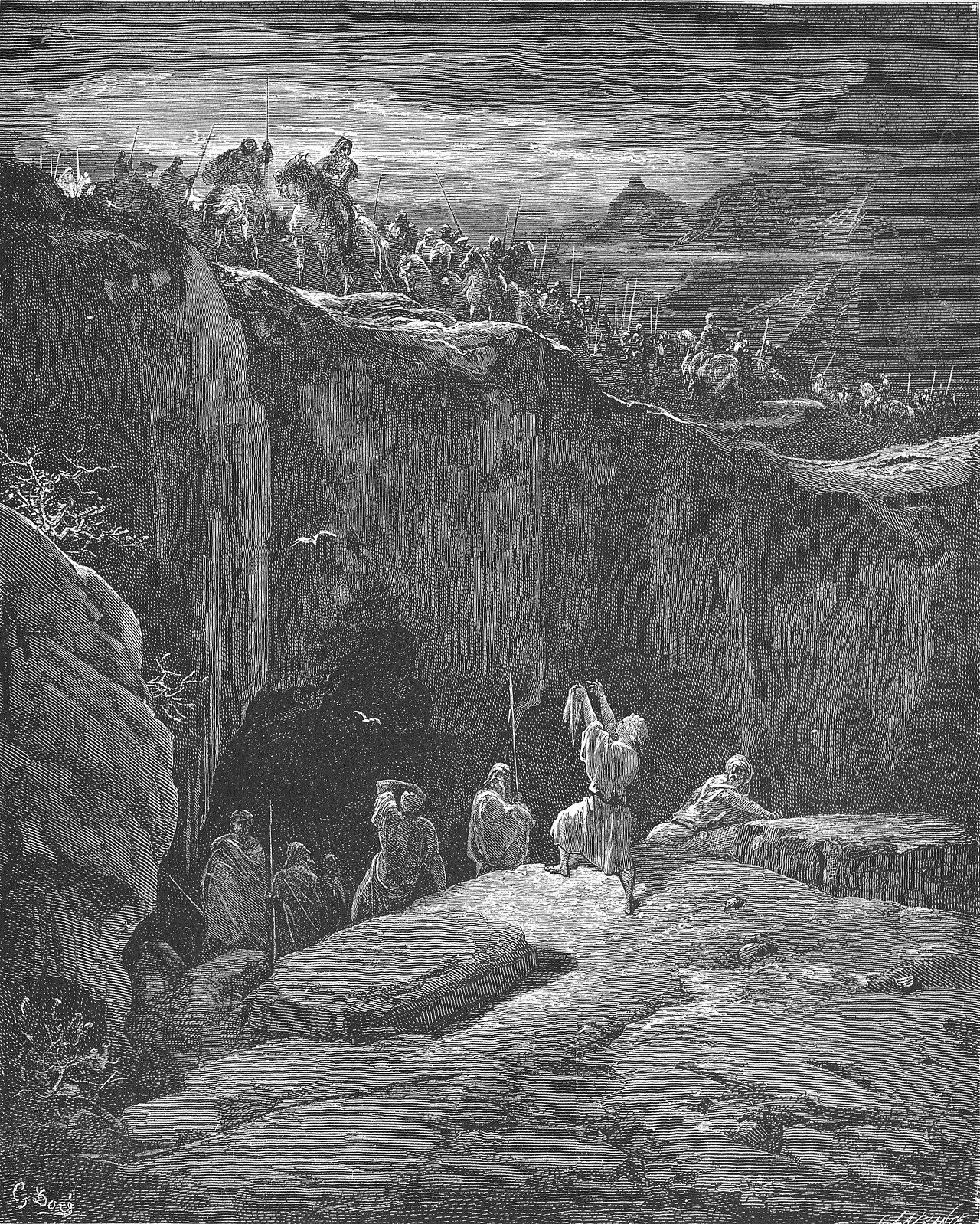
in 1 Samuel 24Behold, this day you have seen with your own eyes that the LORD delivered you into my hand in the cave. I was told to kill you, but I spared you and said, ‘I will not lift my hand against my lord, since he is the LORD’s anointed.’
BSB
The same verse in ASV and KJV ▾
ASV
Behold, this day thine eyes have seen how that Jehovah had delivered thee to-day into my hand in the cave: and some bade me kill thee; but mine eye spared thee; and I said, I will not put forth my hand against my lord; for he is Jehovah’s anointed.
KJV
Behold, this day thine eyes have seen how that the Lord had delivered thee to day into mine hand in the cave: and some bade me kill thee: but mine eye spared thee; and I said, I will not put forth mine hand against my lord; for he is the Lord’s anointed.
⋯
This verse in 1 Samuel 24
Commentary
5 notes on this verseSaul, therefore, came out of the cave unaware of what had happened, wearing the little garment which had been trimmed all around. David came out behind him in self-assurance, and having seized the hill lying above the cave in advance, held out the end [of Saul's robe] in his hand. This was nothing other than a bloodless trophy against his enemies.
This site's exposition
this day you have seen with your own eyes
on 1 Samuel 24:10-11
David repeats the argument from the anointing, telling Saul he was urged to kill him but spared him “since he is the LORD’s anointed”. He holds up the corner of the robe as proof that a knife could as easily have taken the king's life.
The record, by era
The Church Fathers1 voice
So what did David reply? "Your servant, my lord the king." A contest and rivalry then developed as to which one would pay greater respect to the other: one admitted the other to kinship, the other called him lord. What he means is something like this: I am interested in one thing only, your welfare and the progress of virtue. You called me child, and I love and am fond of you if you have me as a servant, provided you set aside your resentment, provided you do not suspect me of any evil or think me to be scheming and warring against you. He fulfilled that apostolic law, note, that bids us excel ourselves in showing one another honor, unlike the general run of people, whose disposition is worse than beasts' and who cannot bear to be the first to greet their neighbor, having the view that they are shamed and insulted if they share a mere greeting with someone.
The Puritans and the Awakening1 voice
Behold, this day thine eyes have seen,....
The Nineteenth Century1 voice
A commentator
Jamieson, Fausset & Brown1802–1910
Commentary Critical and Explanatory on the Whole Bible (1871)
He seems to have been naturally susceptible of strong, and, as in this instance, of good and grateful impressions. The improvement of his temper, indeed, was but transient--his language that of a man overwhelmed by the force of impetuous emotions and constrained to admire the conduct, and esteem the character, of one whom he hated and dreaded.
How the passage was read
What the Jewish commentators add
Why do you listen. Why do you accept Do'eg's slander concerning me? 4 Rashi states that Dovid was alluding to Do’eg because Dovid said ‘why do you listen to the man [ אָדָם ]’, in the singular, referring to one individual person.
This section is reception history: how the passage was read and kept in the Jewish tradition. Where a reading parts from an essential of the Christian faith, the section says so at that point.
Texts and citation data: Sefaria; each excerpt follows its version’s licence. 4 further sources are cited on this chapter that carry no English text this site may quote or only restate the verse.
The words behind it
25 Hebrew wordsEvery Hebrew word of this verse in the order it stands, with what it means and the door to its own study. The last column counts the times a word stands in the whole Bible: the rarer the word, the more the places it appears belong together.
| Hebrew | Sound | Meaning | Word study | In the Bible |
|---|---|---|---|---|
| הִנֵּה֩ | hineh | here! | H2009 → | 843 times |
| הַיּ֨וֹם | haiyom | the day | H3117 → | 2304 times |
| הַזֶּ֜ה | hazeh | <the> this | H2088 → | 1180 times |
| רָא֣וּ | rau | they have seen | H7200 → | 1300 times |
| עֵינֶ֗יךָ | ʾeineikha | eyes your | H5869 → | 887 times |
| אֵ֣ת | ʾet | <obj.> | H853 → | 10935 times |
| אֲשֶׁר־ | ʾasher- | this: | H834 → | 5497 times |
| נְתָנְךָ֩ | netanekha | he gave you | H5414 → | 2011 times |
| יְהוָ֨ה׀ | yahweh | Yahweh | H3068 → | 6520 times |
| הַיּ֤וֹם׀ | haiyom | this day | H3117 → | 2304 times |
| בְּיָדִי֙ | beyadi | in hand my | H3027 → | 1618 times |
| בַּמְּעָרָ֔ה | bamearah | in the cave | H4631 → | 37 times |
| וְאָמַ֥ר | veamar | and someone said | H559 → | 5305 times |
| לַהֲרָגֲךָ֖ | laharagakha | to kill you | H2026 → | 167 times |
| וַתָּ֣חָס | vatachos | and it looked with compassion | H2347 → | |
| עָלֶ֑יךָ | ʾaleikha | on you | H5921 → | 5755 times |
| וָאֹמַ֗ר | vaomar | and I said | H559 → | 5305 times |
| לֹא־ | lo'- | not | H3808 → | 5168 times |
| אֶשְׁלַ֤ח | ʾeshlach | I will stretch out | H7971 → | 845 times |
| יָדִי֙ | yadi | hand my | H3027 → | 1618 times |
| בַּֽאדֹנִ֔י | badoni | on lord my | H113 → | 333 times |
| כִּי־ | ki- | for | H3588 → | 4482 times |
| מְשִׁ֥יחַ | meshiach | [is] [the] [one] anointed of | H4899 → | 39 times |
| יְהוָ֖ה | yahweh | Yahweh | H3068 → | 6520 times |
| הֽוּא׃ | hu' | he | H1931 → | 1879 times |
הִנֵּה֩here!
hinehH2009 →843 times
הַיּ֨וֹםthe day
haiyomH3117 →2304 times
הַזֶּ֜ה<the> this
hazehH2088 →1180 times
רָא֣וּthey have seen
rauH7200 →1300 times
עֵינֶ֗יךָeyes your
ʾeineikhaH5869 →887 times
אֵ֣ת<obj.>
ʾetH853 →10935 times
אֲשֶׁר־this:
ʾasher-H834 →5497 times
נְתָנְךָ֩he gave you
netanekhaH5414 →2011 times
יְהוָ֨ה׀Yahweh
yahwehH3068 →6520 times
הַיּ֤וֹם׀this day
haiyomH3117 →2304 times
בְּיָדִי֙in hand my
beyadiH3027 →1618 times
בַּמְּעָרָ֔הin the cave
bamearahH4631 →37 times
וְאָמַ֥רand someone said
veamarH559 →5305 times
לַהֲרָגֲךָ֖to kill you
laharagakhaH2026 →167 times
וַתָּ֣חָסand it looked with compassion
vatachosH2347 →
עָלֶ֑יךָon you
ʾaleikhaH5921 →5755 times
וָאֹמַ֗רand I said
vaomarH559 →5305 times
לֹא־not
lo'-H3808 →5168 times
אֶשְׁלַ֤חI will stretch out
ʾeshlachH7971 →845 times
יָדִי֙hand my
yadiH3027 →1618 times
בַּֽאדֹנִ֔יon lord my
badoniH113 →333 times
כִּי־for
ki-H3588 →4482 times
מְשִׁ֥יחַ[is] [the] [one] anointed of
meshiachH4899 →39 times
יְהוָ֖הYahweh
yahwehH3068 →6520 times
הֽוּא׃he
hu'H1931 →1879 times
A shaded row is a word that stands 400 times or fewer in the Bible.
The walk
8 stopsEach card is a verse this one points to, and under it the verses that one points to in turn. Where several paths arrive at the same place, that place is listed first: the text keeps returning to it.
Through
Psalms 105:15“Do not touch My anointed ones! Do no harm to My prophets!”
it leads to
- Zechariah 2:8
For this is what the LORD of Hosts says: “After His Glory has sent Me against the nations that have plundered you—for whoever touches you touches the apple of His eye—
- Genesis 26:11
So Abimelech warned all the people, saying, “Whoever harms this man or his wife will surely be put to death.”
- Genesis 20:7
Now return the man’s wife, for he is a prophet; he will pray for you and you will live. But if you do not restore her, be aware that you will surely die—you and…
- 1 John 2:27
And as for you, the anointing you received from Him remains in you, and you do not need anyone to teach you. But just as His true and genuine anointing teaches you about all…
- Genesis 49:8–33
Judah, your brothers shall praise you. Your hand shall be on the necks of your enemies; your father’s sons shall bow down to you.
- Zechariah 2:8
Through
1 Samuel 24:4So David’s men said to him, “This is the day about which the LORD said to you, ‘Behold, I will deliver your enemy into your hand, that you may do with him as you…
it leads to
- 1 Samuel 26:8–11
Abishai said to David, “Today God has delivered your enemy into your hand. Now, therefore, please let me thrust the spear through him into the ground with one stroke. I will not need to…
- 1 Samuel 26:23
May the LORD repay every man for his righteousness and faithfulness. For the LORD delivered you into my hand today, but I would not stretch out my hand against the LORD’s anointed.
- 1 Samuel 25:28–30
Please forgive your servant’s offense, for the LORD will surely make a lasting dynasty for my lord, because he fights the LORD’s battles. May no evil be found in you as long as you…
- 1 Samuel 26:8–11
Where this verse is studied
About 1 Samuel
This page draws on Bede, Commentary on Samuel; Gregory of Nyssa, ON THE INSCRIPTIONS OF THE PSALMS 2.14.229-30; Jamieson, Fausset & Brown, Commentary Critical and Explanatory on the Whole Bible; John Chrysostom, HOMILIES ON DAVID AND SAUL 3; John Gill, Exposition of the Old Testament (1748-1763) and Matthew Henry, Commentary on the Whole Bible.