
1 Samuel 24:16
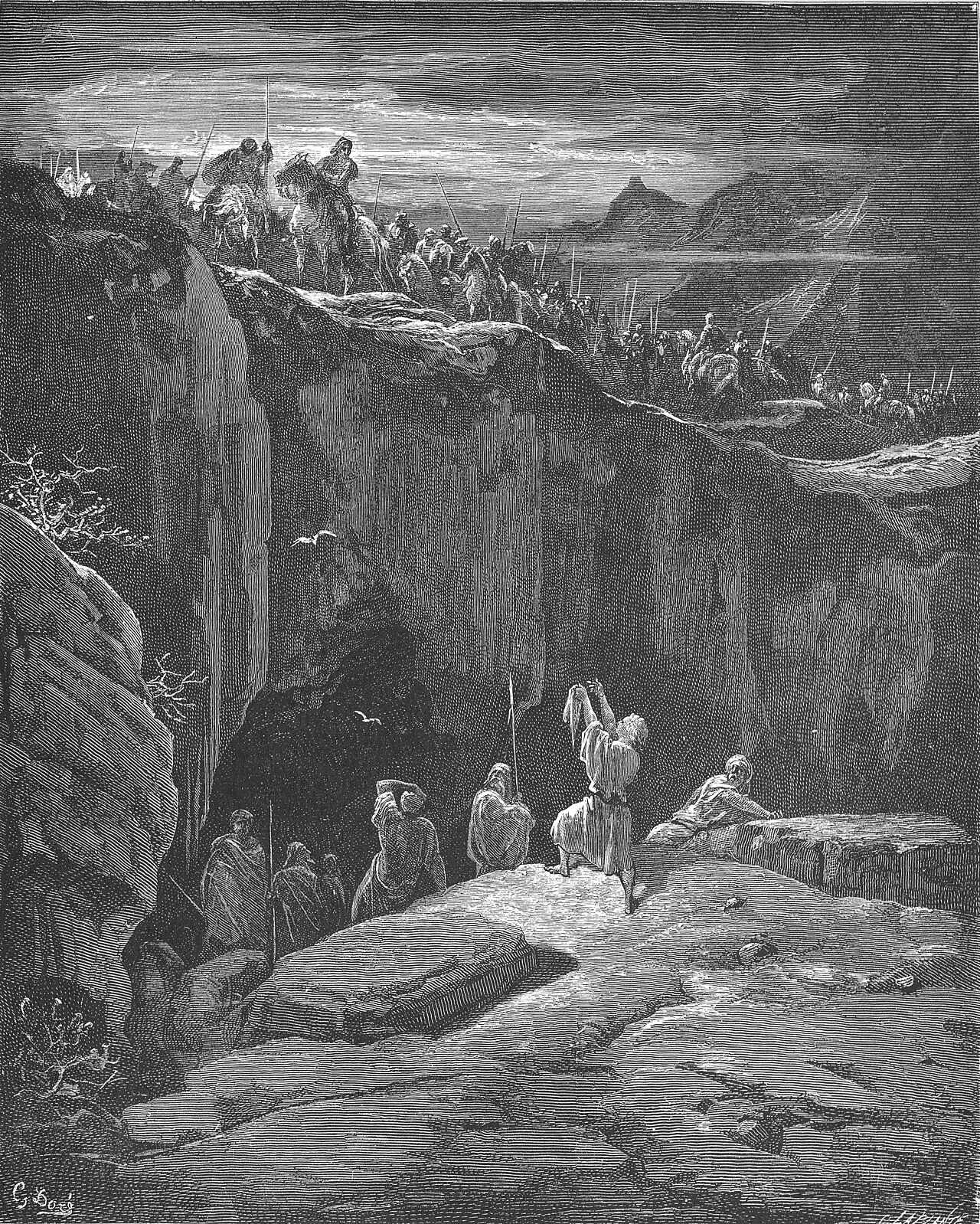
in 1 Samuel 24When David had finished saying these things, Saul called back, “Is that your voice, David my son?” Then Saul wept aloud
BSB
The same verse in ASV and KJV ▾
ASV
And it came to pass, when David had made an end of speaking these words unto Saul, that Saul said, Is this thy voice, my son David? And Saul lifted up his voice, and wept.
KJV
And it came to pass, when David had made an end of speaking these words unto Saul, that Saul said, Is this thy voice, my son David? And Saul lifted up his voice, and wept.
⋯
This verse in 1 Samuel 24
Commentary
8 notes on this verseMy son David? - David had called Saul his master, lord, and king. Saul accosts him here as his son, to show that he felt perfectly reconciled to him, and wished to receive him as formerly into his family.
This site's exposition
Is this thy voice, my son David
on 1 Samuel 24:16-17
Saul knows David's voice before he can make out his face at that distance, and Wesley reads the weeping that follows as grief over his own sin against God as much as his cruelty to David. Saul's confession goes only so far, thou art more righteous than I, and Henry marks the limit precisely: bad men will commonly go no further than this, owning there are those better than they rather than owning their own wickedness outright.
The record, by era
The Church Fathers1 voice
What then did Saul say? Having heard David saying, "See, here is the corner of your cloak in my hand," and everything else by which he mounted his defense along with this, he said, "Is this your voice, my child David?" O, what a great change had suddenly taken place: the one who could never bear even to call him by name, and instead hated the very mention of it, even admitted him to kinship, calling him "child." What could be more blessed than David, who turned the murderer into a father, the wolf into a lamb, who filled the furnace of anger with heavy dew, turned the tempest into tranquility and allayed all the inflammation of resentment? Those words of David, you see, penetrated the mind of that enraged man and effected this total transformation, as you can see from those words. He did not even say, "Are these your words, my son David?" but "Is this your voice, my child David?" He was now heartened by his very utterance. Just as a father hears the voice of his son returning from somewhere and is excited not only at the sight of him but also at the sound of his voice, so Saul too, when David's words penetrated and drove out the hostility, now recognized him as holy, and in setting aside one passion he was affected by another. That is to say, by driving out resentment he was affected by benevolence and fellow feeling.
The Medieval Church1 voice
And Saul lifted up his voice, and wept, etc. And as the Lord taught through the apostles, the people of the Jews, among those who were predestined to eternal life, lifted up their voice in the confession of faith, which they had long sunk low …
The Puritans and the Awakening3 voices
Thy voice - He knew his voice, though being at a great distance from him, he could not discern his face. Wept - From the sense of his sin against God, and his base carriage to David.
David Spares Saul in the Cave. 1 And it came to pass, when Saul was returned from following the Philistines, that it was told him, saying, Behold, David is in the wilderness of Engedi.
quarantine:scripture (2026-07-29) — scripture-overlap:94%@v1-3
Many mourn for their sins that do not truly repent of them, weep bitterly for them, and yet continue in love and league with them. He ingenuously acknowledges David's integrity and his own iniquity (
quarantine:debris (2026-07-29) — unbalanced-parens
1 more voice on this verse
The Puritans and the Awakening1 voice
And it came to pass, when David had made an end of speaking these words unto Saul,....
The words behind it
19 Hebrew wordsEvery Hebrew word of this verse in the order it stands, with what it means and the door to its own study. The last column counts the times a word stands in the whole Bible: the rarer the word, the more the places it appears belong together.
| Hebrew | Sound | Meaning | Word study | In the Bible |
|---|---|---|---|---|
| וַיְהִ֣י׀ | vayhi | and it was | H1961 → | 3559 times |
| כְּכַלּ֣וֹת | kekhalot | when finished | H3615 → | 208 times |
| דָּוִ֗ד | david | David | H1732 → | 999 times |
| לְדַבֵּ֞ר | ledaber | to speak | H1696 → | 1141 times |
| אֶת־ | ʾet- | <obj.> | H853 → | 10935 times |
| הַדְּבָרִ֤ים | hadevarim | the words | H1697 → | 1440 times |
| הָאֵ֙לֶּה֙ | haeleh | <the> these | H428 → | 746 times |
| אֶל־ | ʾel- | to | H413 → | 5510 times |
| שָׁא֔וּל | shaul | Saul | H7586 → | 402 times |
| וַיֹּ֣אמֶר | vaiyomer | and he said | H559 → | 5305 times |
| שָׁא֔וּל | shaul | Saul | H7586 → | 402 times |
| הֲקֹלְךָ֥ | hakolecha | ¿ voice your | H6963 → | 506 times |
| זֶ֖ה | zeh | [is] this | H2088 → | 1180 times |
| בְּנִ֣י | beni | O son my | H1121 → | 4930 times |
| דָוִ֑ד | david | David | H1732 → | 999 times |
| וַיִּשָּׂ֥א | vaiyisa' | and he lifted up | H5375 → | 656 times |
| שָׁא֛וּל | shaul | Saul | H7586 → | 402 times |
| קֹל֖וֹ | kolo | voice his | H6963 → | 506 times |
| וַיֵּֽבְךְּ׃ | vaiyevek | and he wept | H1058 → | 114 times |
וַיְהִ֣י׀and it was
vayhiH1961 →3559 times
כְּכַלּ֣וֹתwhen finished
kekhalotH3615 →208 times
דָּוִ֗דDavid
davidH1732 →999 times
לְדַבֵּ֞רto speak
ledaberH1696 →1141 times
אֶת־<obj.>
ʾet-H853 →10935 times
הַדְּבָרִ֤יםthe words
hadevarimH1697 →1440 times
הָאֵ֙לֶּה֙<the> these
haelehH428 →746 times
אֶל־to
ʾel-H413 →5510 times
שָׁא֔וּלSaul
shaulH7586 →402 times
וַיֹּ֣אמֶרand he said
vaiyomerH559 →5305 times
שָׁא֔וּלSaul
shaulH7586 →402 times
הֲקֹלְךָ֥¿ voice your
hakolechaH6963 →506 times
זֶ֖ה[is] this
zehH2088 →1180 times
בְּנִ֣יO son my
beniH1121 →4930 times
דָוִ֑דDavid
davidH1732 →999 times
וַיִּשָּׂ֥אand he lifted up
vaiyisa'H5375 →656 times
שָׁא֛וּלSaul
shaulH7586 →402 times
קֹל֖וֹvoice his
koloH6963 →506 times
וַיֵּֽבְךְּ׃and he wept
vaiyevekH1058 →114 times
A shaded row is a word that stands 400 times or fewer in the Bible.
The walk
8 stopsEach card is a verse this one points to, and under it the verses that one points to in turn. Where several paths arrive at the same place, that place is listed first: the text keeps returning to it.
Through
Luke 21:15For I will give you speech and wisdom that none of your adversaries will be able to resist or contradict.
it leads to
- Jeremiah 1:9
Then the LORD reached out His hand, touched my mouth, and said to me: “Behold, I have put My words in your mouth.
- Ephesians 6:19
Pray also for me, that whenever I open my mouth, words may be given me so that I will boldly make known the mystery of the gospel,
- Luke 12:12
For at that time the Holy Spirit will teach you what you should say.”
- Acts 6:10
but they could not stand up to his wisdom or the Spirit by whom he spoke.
- Exodus 4:11–12
And the LORD said to him, “Who gave man his mouth? Or who makes the mute or the deaf, the sighted or the blind? Is it not I, the LORD?
- Jeremiah 1:9
Through
Acts 6:10but they could not stand up to his wisdom or the Spirit by whom he spoke.
it leads to
- Luke 21:15
For I will give you speech and wisdom that none of your adversaries will be able to resist or contradict.
- Matthew 10:19–20
But when they hand you over, do not worry about how to respond or what to say. In that hour you will be given what to say.
- Luke 21:15
Through
Genesis 33:4Esau, however, ran to him and embraced him, threw his arms around his neck, and kissed him. And they both wept.
it leads to
- Genesis 45:14–15
Then Joseph threw his arms around his brother Benjamin and wept, and Benjamin wept as they embraced.
- Genesis 45:14–15
About 1 Samuel
Who and where
2 names in this verse with a page on the site.
- PersonUnited MonarchyDavidSecond king of united Israel, shepherd-turned-monarch, ancestor of the Messiah, and traditional author of many Psalms.
- PersonUnited monarchySaulIsrael's first king, head and shoulders above the people; began in humility, ended in rejection — sparing what God devoted, consul…
This page draws on Adam Clarke, Commentary on the Bible; Bede, Commentary on Samuel; John Chrysostom, HOMILIES ON DAVID AND SAUL 3; John Gill, Exposition of the Old Testament (1748-1763); John Wesley, Explanatory Notes upon the Old Testament and Matthew Henry, Commentary on the Whole Bible.