
1 Samuel 24:2
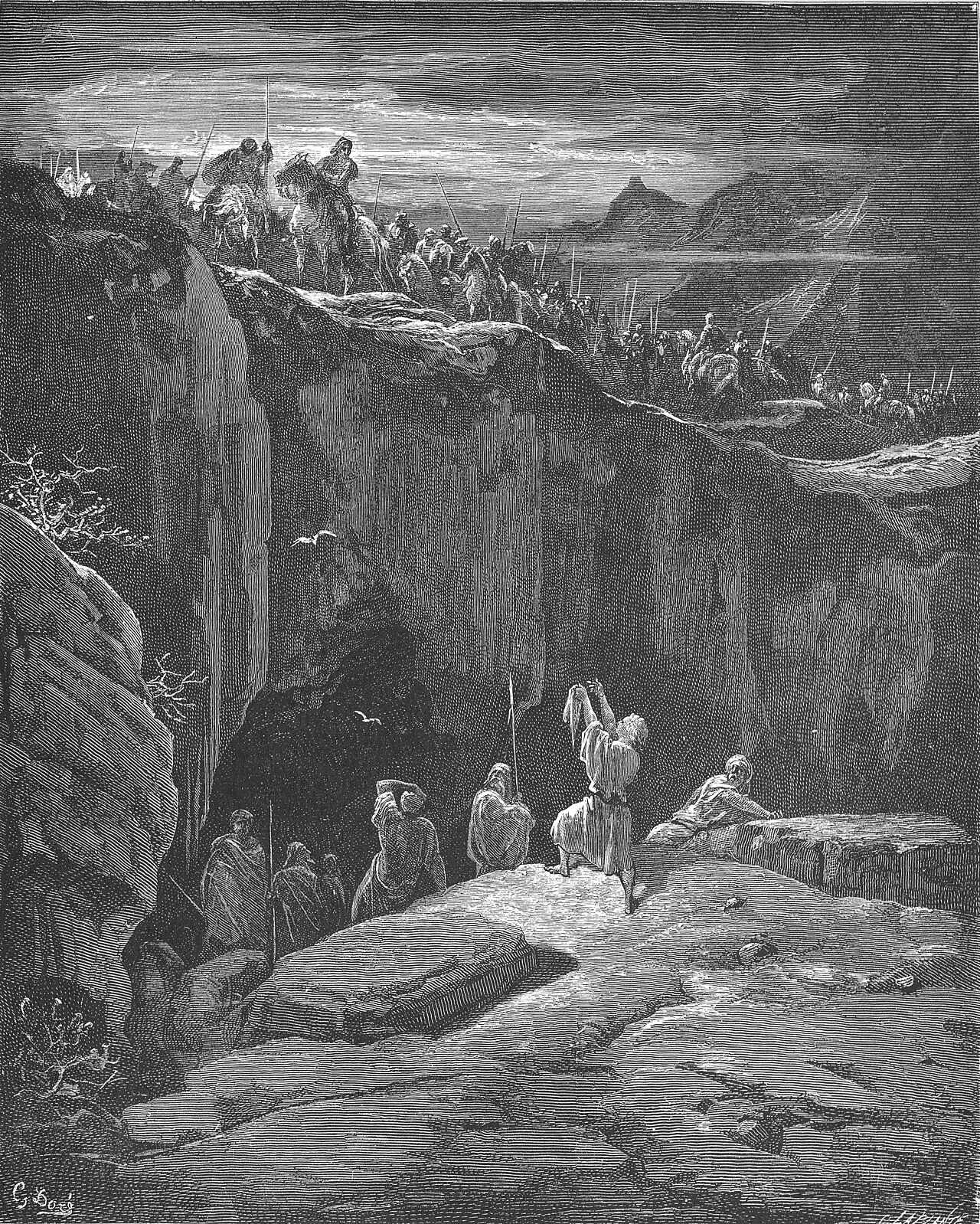
in 1 Samuel 24So Saul took three thousand chosen men from all Israel and went to look for David and his men in the region of the Rocks of the Wild Goats.
BSB
The same verse in ASV and KJV ▾
ASV
Then Saul took three thousand chosen men out of all Israel, and went to seek David and his men upon the rocks of the wild goats.
KJV
Then Saul took three thousand chosen men out of all Israel, and went to seek David and his men upon the rocks of the wild goats.
⋯
This verse in 1 Samuel 24
Commentary
8 notes on this verseRocks of the wild goats - The original (צורי היעלים tsurey haiyeelim) is variously understood. The Vulgate makes a paraphrase: Super abruptissimas petras quae solis ibicibus perviae sunt; “On the most precipitous rocks over which the ibexes alone can travel.” The Targum: the caverns of the rocks. The Septuagint make the original a proper name; for out of צרוי היעלים tsurey haiyeelim, they make Σαδδαιεμ Saddaiem, and in some copies Αειαμειν Aeiamein, which are evidently corruptions of the Hebrew.
This site's exposition
returned from following the Philistines
on 1 Samuel 24:1-2
Saul turns from a Philistine war he has just fought to hunt one man, and commits three thousand chosen men to the search, the same size force he once led against the whole Philistine army at 13:2. Wesley notes the rocks of the wild goats are steep and dangerous even to an ordinary traveler, so the king's anger over David outweighs his own safety. En-gedi's cliffs along the Dead Sea shore give the outlaw band exactly the kind of ground three thousand soldiers cannot easily search.
This site's exposition
the region of the Rocks of the Wild Goats
Clarke gives the Hebrew for the Rocks of the Wild Goats as tsurey haiyeelim and sets out how the old versions read it. The Latin Vulgate speaks of steep rocks crossed only by ibexes, the Targum of caves in the rocks, and the Greek of a place name. Barnes reads it as craggy ground in the wilderness of En-gedi.
The record, by era
The Medieval Church1 voice
Saul, however, taking three thousand chosen men, etc. Just as in a good sense the number three is usually placed for a certain mysterious grace, clearly designating those who are either glorious by the confession of the Holy Trinity, or devoted by faith, hope, and …
The Puritans and the Awakening3 voices
These very rocks are exceeding steep, and full of precipices, and dangerous to travelers, as an eye-witness hath left upon record. And yet Saul was so transported with rage, as to venture himself and his army here, that he might take David, who, as he thought, would judge himself safe, and therefore be secure in such inaccessible places.
But it is not enough for Saul that David is thus cooped up; he cannot be easy while he is alive. Providence brings Saul alone into the same cave wherein David and his men had hidden themselves,
Then Saul took three thousand chosen men out of all Israel,....
The Nineteenth Century1 voice
A commentator
Albert Barnes1798–1870
Notes, Explanatory and Practical, on the Old and New Testaments (1832-1869)
proposed
The rocks of the wild goats - To signify the craggy precipitous character of the country.
How the passage was read
What the Jewish commentators add
On the verses either side of this one
And David went up from there and dwelt in the stronghold of En gedi.
This section is reception history: how the passage was read and kept in the Jewish tradition. Where a reading parts from an essential of the Christian faith, the section says so at that point.
Texts and citation data: Sefaria; each excerpt follows its version’s licence. 4 further sources are cited on this chapter that carry no English text this site may quote or only restate the verse.
The words behind it
17 Hebrew wordsEvery Hebrew word of this verse in the order it stands, with what it means and the door to its own study. The last column counts the times a word stands in the whole Bible: the rarer the word, the more the places it appears belong together.
| Hebrew | Sound | Meaning | Word study | In the Bible |
|---|---|---|---|---|
| וַיִּקַּ֣ח | vaiyikach | and he took | H3947 → | 966 times |
| שָׁא֗וּל | shaul | Saul | H7586 → | 402 times |
| שְׁלֹ֧שֶׁת | sheloshet | three | H7969 → | 432 times |
| אֲלָפִ֛ים | ʾalafim | thousand<s> | H505 → | 505 times |
| אִ֥ישׁ | ʾish | man | H376 → | 1663 times |
| בָּח֖וּר | bachur | chosen | H977 → | 171 times |
| מִכָּל־ | mikol | from all | H3605 → | 5413 times |
| יִשְׂרָאֵ֑ל | yisrael | Israel | H3478 → | 2507 times |
| וַיֵּ֗לֶךְ | vaiyelekh | and he went | H1980 → | 1546 times |
| לְבַקֵּ֤שׁ | levakesh | to seek | H1245 → | 225 times |
| אֶת־ | ʾet- | <obj.> | H853 → | 10935 times |
| דָּוִד֙ | david | David | H1732 → | 999 times |
| וַֽאֲנָשָׁ֔יו | vaanashav | and men his | H582 → | 566 times |
| עַל־ | ʾal- | on | H5921 → | 5755 times |
| פְּנֵ֖י | penei | [the] face of | H6440 → | 2123 times |
| צוּרֵ֥י | tzurei | [the] rocks of | H6697 → | |
| הַיְּעֵלִֽים׃ | haiyeelim | the mountain goats | H3277 → |
וַיִּקַּ֣חand he took
vaiyikachH3947 →966 times
שָׁא֗וּלSaul
shaulH7586 →402 times
שְׁלֹ֧שֶׁתthree
sheloshetH7969 →432 times
אֲלָפִ֛יםthousand<s>
ʾalafimH505 →505 times
אִ֥ישׁman
ʾishH376 →1663 times
בָּח֖וּרchosen
bachurH977 →171 times
מִכָּל־from all
mikolH3605 →5413 times
יִשְׂרָאֵ֑לIsrael
yisraelH3478 →2507 times
וַיֵּ֗לֶךְand he went
vaiyelekhH1980 →1546 times
לְבַקֵּ֤שׁto seek
levakeshH1245 →225 times
אֶת־<obj.>
ʾet-H853 →10935 times
דָּוִד֙David
davidH1732 →999 times
וַֽאֲנָשָׁ֔יוand men his
vaanashavH582 →566 times
עַל־on
ʾal-H5921 →5755 times
פְּנֵ֖י[the] face of
peneiH6440 →2123 times
צוּרֵ֥י[the] rocks of
tzureiH6697 →
הַיְּעֵלִֽים׃the mountain goats
haiyeelimH3277 →
A shaded row is a word that stands 400 times or fewer in the Bible.
The walk
8 stopsEach card is a verse this one points to, and under it the verses that one points to in turn. Where several paths arrive at the same place, that place is listed first: the text keeps returning to it.
Through
Psalms 104:18The high mountains are for the wild goats, the cliffs a refuge for the rock badgers.
it leads to
- Proverbs 30:26
the rock badgers are creatures of little power, yet they make their homes in the rocks;
- Job 39:1
“Do you know when mountain goats give birth? Have you watched the doe bear her fawn?
- Leviticus 11:5
The rock badger, though it chews the cud, does not have a divided hoof; it is unclean for you.
- Proverbs 30:26
Through
1 Samuel 13:2He chose for himself three thousand men of Israel: Two thousand were with Saul at Michmash and in the hill country of Bethel, and a thousand were with Jonathan in Gibeah of Benjamin. And…
it leads to
- 1 Samuel 10:26
Saul also went to his home in Gibeah, and the men of valor whose hearts God had touched went with him.
- 1 Samuel 14:31
That day, after the Israelites had struck down the Philistines from Michmash to Aijalon, the people were very faint.
- 1 Samuel 13:5
Now the Philistines assembled to fight against Israel with three thousand chariots, six thousand horsemen, and troops as numerous as the sand on the seashore. They went up and camped at Michmash, east of…
- 1 Samuel 10:26
Through
Psalms 37:32Though the wicked lie in wait for the righteous, and seek to slay them,
it leads to
- Luke 14:1
One Sabbath, Jesus went to eat in the home of a leading Pharisee, and those in attendance were watching Him closely.
- Luke 14:1
Through
Psalms 141:6When their rulers are thrown down from the cliffs, the people will listen to my words, for they are pleasant.
it leads to
- 2 Chronicles 25:12
and the army of Judah also captured 10,000 men alive. They took them to the top of a cliff and threw them down so that all were dashed to pieces.
- 2 Chronicles 25:12
About 1 Samuel
Who and where
2 names in this verse with a page on the site.
- PersonUnited MonarchyDavidSecond king of united Israel, shepherd-turned-monarch, ancestor of the Messiah, and traditional author of many Psalms.
- PersonUnited monarchySaulIsrael's first king, head and shoulders above the people; began in humility, ended in rejection — sparing what God devoted, consul…
This page draws on Adam Clarke, Commentary on the Bible; Albert Barnes, Notes, Explanatory and Practical, on the Old and New Testaments (1832-1869); Bede, Commentary on Samuel; John Gill, Exposition of the Old Testament (1748-1763); John Wesley, Explanatory Notes upon the Old Testament and Matthew Henry, Commentary on the Whole Bible.