
1 Samuel 24:9
in 1 Samuel 24and said to Saul, “Why do you listen to the words of men who say, ‘Look, David intends to harm you’?
BSB
The same verse in ASV and KJV ▾
ASV
And David said to Saul, Wherefore hearkenest thou to men’s words, saying, Behold, David seeketh thy hurt?
KJV
And David said to Saul, Wherefore hearest thou men’s words, saying, Behold, David seeketh thy hurt?
⋯
This verse in 1 Samuel 24
Commentary
8 notes on this verseAnd David said to Saul, wherefore hearest thou men's words,.... The false charges and accusations, that some of Saul's courtiers brought against David, as Doeg the Edomite, and such like sycophants and flatterers, to whom Saul hearkened, and believed what they said, and acted upon it.
This site's exposition
My lord the king
on 1 Samuel 24:8-9
David bows to the earth even as he prepares to charge the king with wrongdoing. His opening question names the danger at Saul's court, men whose words Gill identifies with Doeg and the flatterers. Barnes reads David's own psalms of complaint against false accusers as the record of this pressure.
This site's exposition
Why do you listen to the words of men
David blames the king's advisers and spares Saul himself. The reports had come from Doeg at 22:9 and from the Ziphites at 23:19. Henry reads what follows as a solemn protest of innocence, backed by the evidence in David's hand.
The record, by era
The Church Fathers2 voices
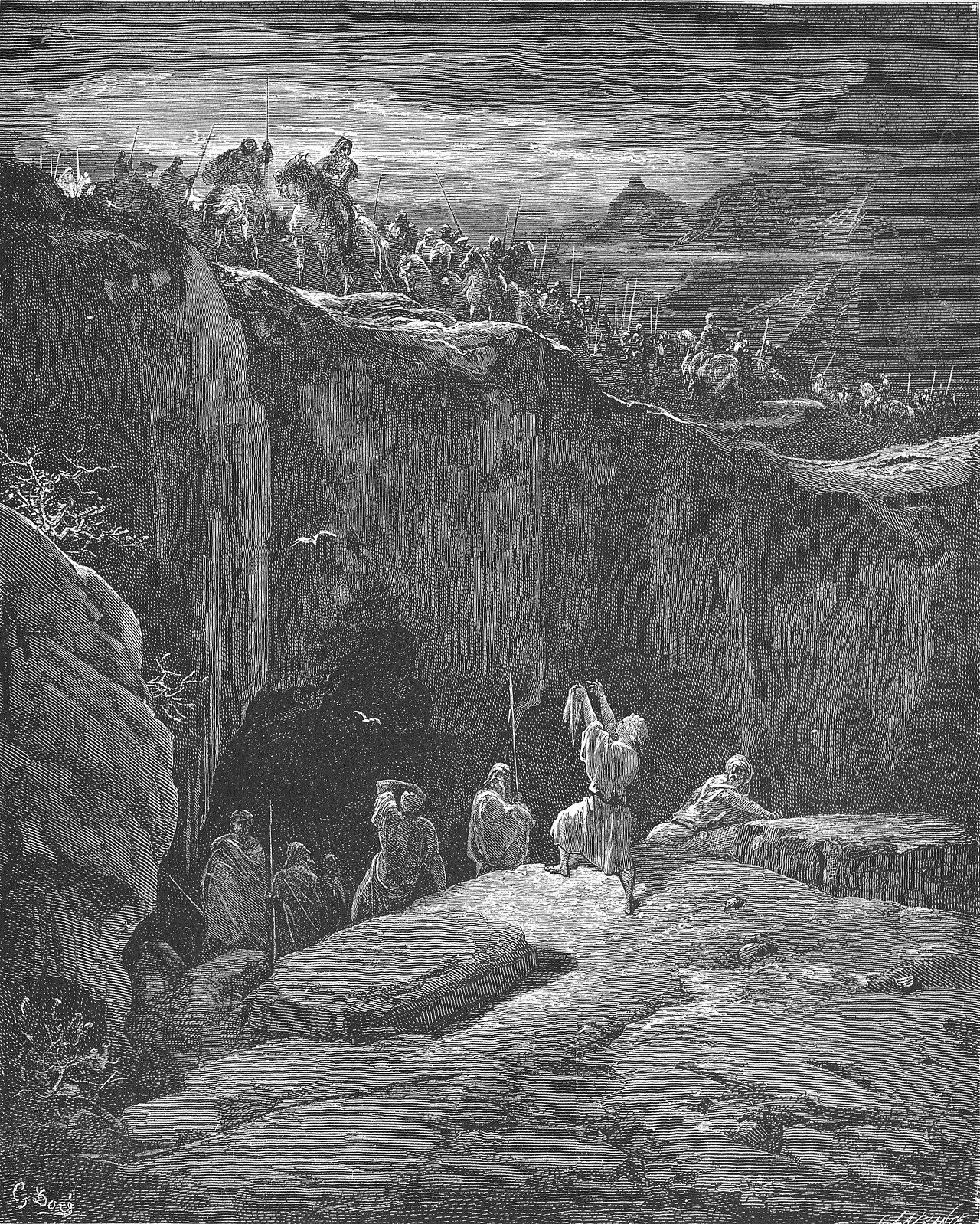
Saul, therefore, came out of the cave unaware of what had happened, wearing the little garment which had been trimmed all around. David came out behind him in self-assurance, and having seized the hill lying above the cave in advance, held out the end [of Saul's robe] in his hand. This was nothing other than a bloodless trophy against his enemies.
So what did David reply? "Your servant, my lord the king." A contest and rivalry then developed as to which one would pay greater respect to the other: one admitted the other to kinship, the other called him lord. What he means is something like this: I am interested in one thing only, your welfare and the progress of virtue. You called me child, and I love and am fond of you if you have me as a servant, provided you set aside your resentment, provided you do not suspect me of any evil or think me to be scheming and warring against you. He fulfilled that apostolic law, note, that bids us excel ourselves in showing one another honor, unlike the general run of people, whose disposition is worse than beasts' and who cannot bear to be the first to greet their neighbor, having the view that they are shamed and insulted if they share a mere greeting with someone.
The Puritans and the Awakening1 voice
He solemnly protests his own innocence, and that he is far from designing any hurt or mischief to Saul: " There is neither evil nor transgression in my hand,
quarantine:debris (2026-07-29) — odd-straight-quotes
The Nineteenth Century2 voices
A commentator
Albert Barnes1798–1870
Notes, Explanatory and Practical, on the Old and New Testaments (1832-1869)
David was quite aware that there were flatterers at Saul’s court who were continually inflaming the King’s mind by their false accusations against him. This explains the language of many of the Psalms, e. g. Ps. 10; Psa 11:1-7; Psa 12:1-8; 35; and many more.
A commentator
Jamieson, Fausset & Brown1802–1910
Commentary Critical and Explanatory on the Whole Bible (1871)
He seems to have been naturally susceptible of strong, and, as in this instance, of good and grateful impressions. The improvement of his temper, indeed, was but transient--his language that of a man overwhelmed by the force of impetuous emotions and constrained to admire the conduct, and esteem the character, of one whom he hated and dreaded.
How the passage was read
What the Jewish commentators add
On the verses either side of this one
Why do you listen. Why do you accept Do'eg's slander concerning me? 4 Rashi states that Dovid was alluding to Do’eg because Dovid said ‘why do you listen to the man [ אָדָם ]’, in the singular, referring to one individual person.
This section is reception history: how the passage was read and kept in the Jewish tradition. Where a reading parts from an essential of the Christian faith, the section says so at that point.
Texts and citation data: Sefaria; each excerpt follows its version’s licence. 4 further sources are cited on this chapter that carry no English text this site may quote or only restate the verse.
The words behind it
13 Hebrew wordsEvery Hebrew word of this verse in the order it stands, with what it means and the door to its own study. The last column counts the times a word stands in the whole Bible: the rarer the word, the more the places it appears belong together.
| Hebrew | Sound | Meaning | Word study | In the Bible |
|---|---|---|---|---|
| וַיֹּ֤אמֶר | vaiyomer | and he said | H559 → | 5305 times |
| דָּוִד֙ | david | David | H1732 → | 999 times |
| לְשָׁא֔וּל | leshaul | to Saul | H7586 → | 402 times |
| לָ֧מָּה | lamah | <to> why? | H4100 → | 752 times |
| תִשְׁמַ֛ע | tishma' | do you listen to | H8085 → | 1159 times |
| אֶת־ | ʾet- | <obj.> | H853 → | 10935 times |
| דִּבְרֵ֥י | divrei | [the] words of | H1697 → | 1440 times |
| אָדָ֖ם | ʾadam | someone | H120 → | 551 times |
| לֵאמֹ֑ר | lemor | <to> saying | H559 → | 5305 times |
| הִנֵּ֣ה | hineh | there! | H2009 → | 843 times |
| דָוִ֔ד | david | David | H1732 → | 999 times |
| מְבַקֵּ֖שׁ | mevakesh | [is] seeking | H1245 → | 225 times |
| רָעָתֶֽךָ׃ | raatekha | harm your | H7451 → | 662 times |
וַיֹּ֤אמֶרand he said
vaiyomerH559 →5305 times
דָּוִד֙David
davidH1732 →999 times
לְשָׁא֔וּלto Saul
leshaulH7586 →402 times
לָ֧מָּה<to> why?
lamahH4100 →752 times
תִשְׁמַ֛עdo you listen to
tishma'H8085 →1159 times
אֶת־<obj.>
ʾet-H853 →10935 times
דִּבְרֵ֥י[the] words of
divreiH1697 →1440 times
אָדָ֖םsomeone
ʾadamH120 →551 times
לֵאמֹ֑ר<to> saying
lemorH559 →5305 times
הִנֵּ֣הthere!
hinehH2009 →843 times
דָוִ֔דDavid
davidH1732 →999 times
מְבַקֵּ֖שׁ[is] seeking
mevakeshH1245 →225 times
רָעָתֶֽךָ׃harm your
raatekhaH7451 →662 times
A shaded row is a word that stands 400 times or fewer in the Bible.
The walk
8 stopsEach card is a verse this one points to, and under it the verses that one points to in turn. Where several paths arrive at the same place, that place is listed first: the text keeps returning to it.
Through
Leviticus 19:16You must not go about spreading slander among your people. You must not endanger the life of your neighbor. I am the LORD.
it leads to
- Exodus 23:1
“You shall not spread a false report. Do not join the wicked by being a malicious witness.
- Exodus 23:7
Stay far away from a false accusation. Do not kill the innocent or the just, for I will not acquit the guilty.
- Proverbs 20:19
He who reveals secrets is a constant gossip; avoid the one who babbles with his lips.
- Proverbs 11:13
A gossip reveals a secret, but a trustworthy person keeps a confidence.
- Exodus 23:1
Through
Proverbs 16:28A perverse man spreads dissension, and a gossip divides close friends.
it leads to
- Proverbs 17:9
Whoever conceals an offense promotes love, but he who brings it up separates friends.
- Proverbs 17:9
Through
Proverbs 18:8The words of a gossip are like choice morsels that go down into the inmost being.
it leads to
- Proverbs 16:28
A perverse man spreads dissension, and a gossip divides close friends.
- Proverbs 12:18
Speaking rashly is like a piercing sword, but the tongue of the wise brings healing.
- Leviticus 19:16
You must not go about spreading slander among your people. You must not endanger the life of your neighbor. I am the LORD.
- Proverbs 16:28
Where this verse is studied
About 1 Samuel
Who and where
2 names in this verse with a page on the site.
- PersonUnited MonarchyDavidSecond king of united Israel, shepherd-turned-monarch, ancestor of the Messiah, and traditional author of many Psalms.
- PersonUnited monarchySaulIsrael's first king, head and shoulders above the people; began in humility, ended in rejection — sparing what God devoted, consul…
This page draws on Albert Barnes, Notes on the Old Testament; Albert Barnes, Notes, Explanatory and Practical, on the Old and New Testaments (1832-1869); Gregory of Nyssa, ON THE INSCRIPTIONS OF THE PSALMS 2.14.229-30; Jamieson, Fausset & Brown, Commentary Critical and Explanatory on the Whole Bible; John Chrysostom, HOMILIES ON DAVID AND SAUL 3; John Gill, Exposition of the Old Testament (1748-1763); John Gill, Exposition of the Old Testament and Matthew Henry, Commentary on the Whole Bible.