
1 Samuel 24:8
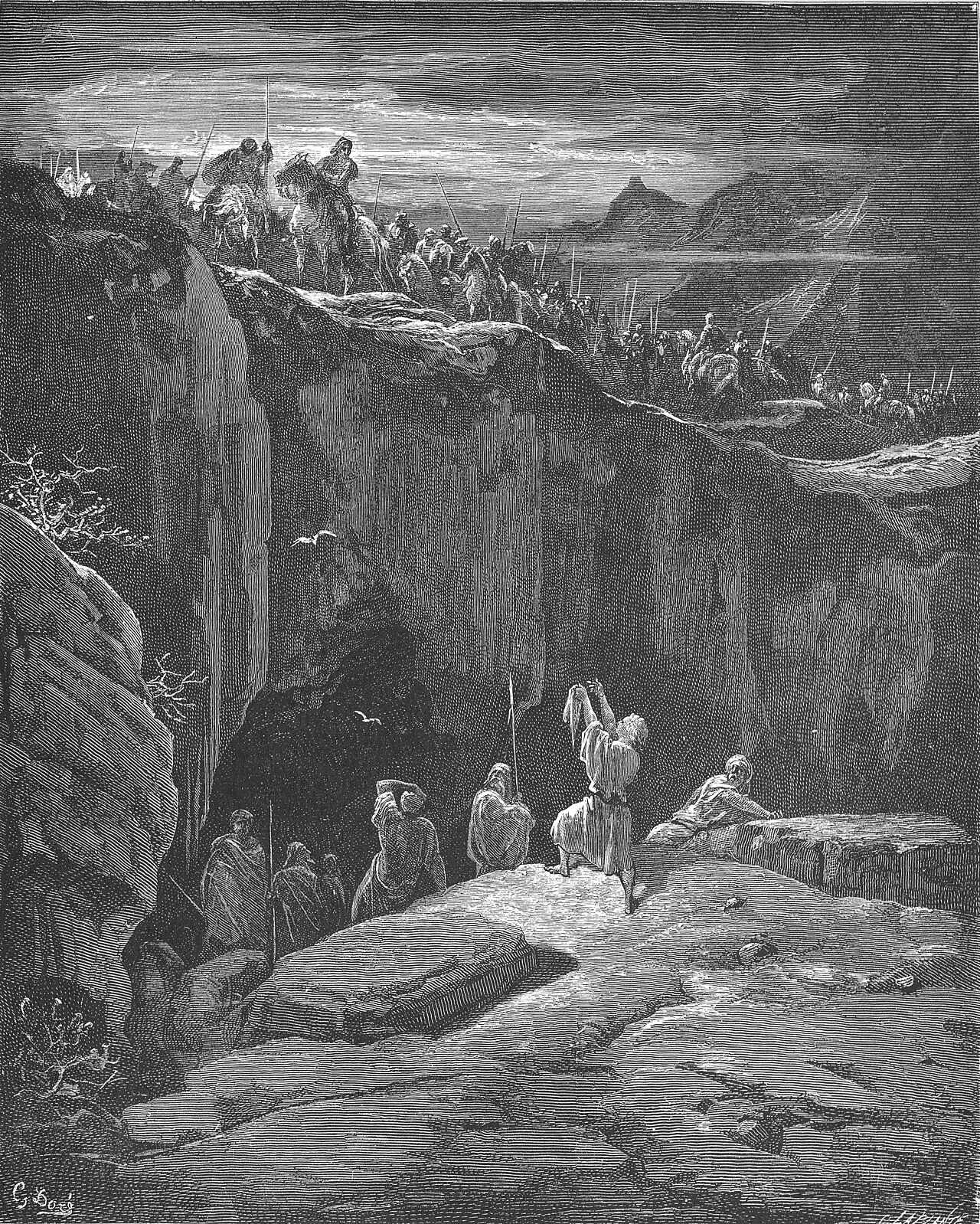
in 1 Samuel 24After that, David got up, went out of the cave, and called out to Saul, “My lord the king!” When Saul looked behind him, David bowed facedown in reverence
BSB
The same verse in ASV and KJV ▾
ASV
David also arose afterward, and went out of the cave, and cried after Saul, saying, My lord the king. And when Saul looked behind him, David bowed with his face to the earth, and did obeisance.
KJV
David also arose afterward, and went out of the cave, and cried after Saul, saying, My lord the king. And when Saul looked behind him, David stooped with his face to the earth, and bowed himself.
⋯
This verse in 1 Samuel 24
Commentary
7 notes on this verseSaul, therefore, came out of the cave unaware of what had happened, wearing the little garment which had been trimmed all around. David came out behind him in self-assurance, and having seized the hill lying above the cave in advance, held out the end [of Saul's robe] in his hand. This was nothing other than a bloodless trophy against his enemies.
This site's exposition
My lord the king
on 1 Samuel 24:8-9
David waits until Saul is safely out of the cave before calling after him, and bows to the earth even as he prepares to charge the king with wrongdoing. His opening question names the real danger at Saul's court, men whose words Gill identifies with Doeg and the flatterers who kept feeding the king's suspicion of David. Barnes reads David's own psalms of complaint against false accusers as the record of exactly this pressure.
The record, by era
The Church Fathers2 voices
So what did David reply? "Your servant, my lord the king." A contest and rivalry then developed as to which one would pay greater respect to the other: one admitted the other to kinship, the other called him lord. What he means is something like this: I am interested in one thing only, your welfare and the progress of virtue. You called me child, and I love and am fond of you if you have me as a servant, provided you set aside your resentment, provided you do not suspect me of any evil or think me to be scheming and warring against you. He fulfilled that apostolic law, note, that bids us excel ourselves in showing one another honor, unlike the general run of people, whose disposition is worse than beasts' and who cannot bear to be the first to greet their neighbor, having the view that they are shamed and insulted if they share a mere greeting with someone.
When he had offered this excellent sacrifice, then, achieved the victory and omitted nothing needed for a trophy, the cause of the problem, Saul, arose and left the cave, all unaware of what had gone on. "David also left behind him," looking in the direction of heaven with eyes now free of concern, and more satisfied on that occasion than when he had overthrown Goliath and cut off the savage's head. It was, in fact, a more conspicuous victory than the former one, the spoils more majestic, the booty more glorious, the trophy more commendable. In the former case he needed a sling, stones and battle line, whereas in this case thought counted for everything, the victory was achieved without weapons, and the trophy was erected without blood being spilt. He returned, therefore, bearing not a savage's head but resentment mortified and rage unnerved—spoils he deposited not in Jerusalem but in heaven and the city on high.
The Medieval Church1 voice
And bowing himself, David prostrated on the ground and worshiped. The Savior, with his compassionate heart, bowed down to help and aid earthly and weak hearts, showing through the ministers of His word, He Himself first presented examples of worship and reconciliation with God to …
The Puritans and the Awakening1 voice
David also arose afterward,.... After Saul was gone: and went out of the cave; where he had been all the time that Saul had been in it: and cried after Saul: with a loud voice: my lord the king; by which titles Saul would know that he was called unto: and when Saul looked behind him; to see who it was that called unto him: David stooped with his face to the earth, and bowed himself: giving reverence and honour to him as a king; See Gill on 1Sa 20:41.
The Nineteenth Century1 voice
A commentator
Jamieson, Fausset & Brown1802–1910
Commentary Critical and Explanatory on the Whole Bible (1871)
He seems to have been naturally susceptible of strong, and, as in this instance, of good and grateful impressions. The improvement of his temper, indeed, was but transient--his language that of a man overwhelmed by the force of impetuous emotions and constrained to admire the conduct, and esteem the character, of one whom he hated and dreaded.
The words behind it
20 Hebrew wordsEvery Hebrew word of this verse in the order it stands, with what it means and the door to its own study. The last column counts the times a word stands in the whole Bible: the rarer the word, the more the places it appears belong together.
| Hebrew | Sound | Meaning | Word study | In the Bible |
|---|---|---|---|---|
| וַיָּ֨קָם | vaiyakom | and he arose | H6965 → | 628 times |
| דָּוִ֜ד | david | David | H1732 → | 999 times |
| אַחֲרֵי־ | ʾacharei- | after | H310 → | 715 times |
| כֵ֗ן | khen | thus | H3651 → | 771 times |
| וַיֵּצֵא֙ | vaiyetze' | and he went out | H3318 → | 1067 times |
| מֵֽהַמְּעָרָ֔ה | mehamearah | from the cave | H4631 → | 37 times |
| וַיִּקְרָ֧א | vaiyikra' | and he called out | H7121 → | 733 times |
| אַֽחֲרֵי־ | ʾacharei- | after | H310 → | 715 times |
| שָׁא֛וּל | shaul | Saul | H7586 → | 402 times |
| לֵאמֹ֖ר | lemor | <to> saying | H559 → | 5305 times |
| אֲדֹנִ֣י | ʾadoni | O lord my | H113 → | 333 times |
| הַמֶּ֑לֶךְ | hamelekh | the king | H4428 → | 2525 times |
| וַיַּבֵּ֤ט | vaiyabet | and he looked | H5027 → | 69 times |
| שָׁאוּל֙ | shaul | Saul | H7586 → | 402 times |
| אַֽחֲרָ֔יו | ʾacharav | behind him | H310 → | 715 times |
| וַיִּקֹּ֨ד | vaiyikod | and he bowed low | H6915 → | |
| דָּוִ֥ד | david | David | H1732 → | 999 times |
| אַפַּ֛יִם | ʾapayim | face | H639 → | 276 times |
| אַ֖רְצָה | ʾartzah | [the] ground towards | H776 → | 2504 times |
| וַיִּשְׁתָּֽחוּ׃ ס | vaiyishtachu | and he bowed down | H7812 → | 172 times |
וַיָּ֨קָםand he arose
vaiyakomH6965 →628 times
דָּוִ֜דDavid
davidH1732 →999 times
אַחֲרֵי־after
ʾacharei-H310 →715 times
כֵ֗ןthus
khenH3651 →771 times
וַיֵּצֵא֙and he went out
vaiyetze'H3318 →1067 times
מֵֽהַמְּעָרָ֔הfrom the cave
mehamearahH4631 →37 times
וַיִּקְרָ֧אand he called out
vaiyikra'H7121 →733 times
אַֽחֲרֵי־after
ʾacharei-H310 →715 times
שָׁא֛וּלSaul
shaulH7586 →402 times
לֵאמֹ֖ר<to> saying
lemorH559 →5305 times
אֲדֹנִ֣יO lord my
ʾadoniH113 →333 times
הַמֶּ֑לֶךְthe king
hamelekhH4428 →2525 times
וַיַּבֵּ֤טand he looked
vaiyabetH5027 →69 times
שָׁאוּל֙Saul
shaulH7586 →402 times
אַֽחֲרָ֔יוbehind him
ʾacharavH310 →715 times
וַיִּקֹּ֨דand he bowed low
vaiyikodH6915 →
דָּוִ֥דDavid
davidH1732 →999 times
אַפַּ֛יִםface
ʾapayimH639 →276 times
אַ֖רְצָה[the] ground towards
ʾartzahH776 →2504 times
וַיִּשְׁתָּֽחוּ׃ סand he bowed down
vaiyishtachuH7812 →172 times
A shaded row is a word that stands 400 times or fewer in the Bible.
The walk
8 stopsEach card is a verse this one points to, and under it the verses that one points to in turn. Where several paths arrive at the same place, that place is listed first: the text keeps returning to it.
Through
Exodus 20:12Honor your father and mother, so that your days may be long in the land that the LORD your God is giving you.
it leads to
- Ephesians 6:1–3
Children, obey your parents in the Lord, for this is right.
- Colossians 3:20
Children, obey your parents in everything, for this is pleasing to the Lord.
- Deuteronomy 5:16
Honor your father and your mother, as the LORD your God has commanded you, so that your days may be long and that it may go well with you in the land that the…
- Mark 7:10
For Moses said, ‘Honor your father and your mother’ and ‘Anyone who curses his father or mother must be put to death.’
- Proverbs 23:22–25
Listen to your father who gave you life, and do not despise your mother when she is old.
- Ephesians 6:1–3
Through
Romans 13:7Pay everyone what you owe him: taxes to whom taxes are due, revenue to whom revenue is due, respect to whom respect is due, honor to whom honor is due.
it leads to
- Luke 20:25
So Jesus told them, “Give to Caesar what is Caesar’s, and to God what is God’s.”
- Proverbs 24:21
My son, fear the LORD and the king, and do not associate with the rebellious.
- 1 Peter 2:17–18
Treat everyone with high regard: Love the brotherhood of believers, fear God, honor the king.
- Luke 20:25
About 1 Samuel
Who and where
2 names in this verse with a page on the site.
- PersonUnited MonarchyDavidSecond king of united Israel, shepherd-turned-monarch, ancestor of the Messiah, and traditional author of many Psalms.
- PersonUnited monarchySaulIsrael's first king, head and shoulders above the people; began in humility, ended in rejection — sparing what God devoted, consul…
This page draws on Albert Barnes, Notes on the Old Testament; Bede, Commentary on Samuel; Gregory of Nyssa, ON THE INSCRIPTIONS OF THE PSALMS 2.14.229-30; Jamieson, Fausset & Brown, Commentary Critical and Explanatory on the Whole Bible; John Chrysostom, HOMILIES ON DAVID AND SAUL 3; John Chrysostom, HOMILIES ON DAVID AND SAUL 2; John Gill, Exposition of the Old Testament and John Gill, Exposition of the Old Testament (1748-1763).