
1 Samuel 24:21
in 1 Samuel 24So now, swear to me by the LORD that you will not cut off my descendants or wipe out my name from my father’s house.”
BSB
The same verse in ASV and KJV ▾
ASV
Swear now therefore unto me by Jehovah, that thou wilt not cut off my seed after me, and that thou wilt not destroy my name out of my father’s house.
KJV
Swear now therefore unto me by the Lord, that thou wilt not cut off my seed after me, and that thou wilt not destroy my name out of my father’s house.
⋯
This verse in 1 Samuel 24
Commentary
6 notes on this verseA commentator
Albert Barnes1798–1870
Notes, Explanatory and Practical, on the Old and New Testaments (1832-1869)
Swear now ... - The same request which Jonathan made 1Sa 20:15. The deep, genealogical feeling of the Israelites breaks out here as so often elsewhere.
This site's exposition
Swear now therefore unto me
on 1 Samuel 24:21-22
Saul asks for one thing only, an oath that David will not cut off his descendants once the throne is his, the same request Jonathan had already made of David at 20:15. David swears it and Saul goes home, but the scene does not close in reconciliation: David and his men go back up to the stronghold rather than to Saul's court. Clarke reads the parting plainly, David could not trust Saul with his life, for an evil spirit still had dominion over him, and chapter 26 will run this same cave scene almost beat for beat.
The record, by era
The Puritans and the Awakening3 voices
Saul by his disobedience had ruined his own soul, and never took care by repentance to prevent that ruin, and yet is very solicitous that his name might not be destroyed nor his seed cut off.
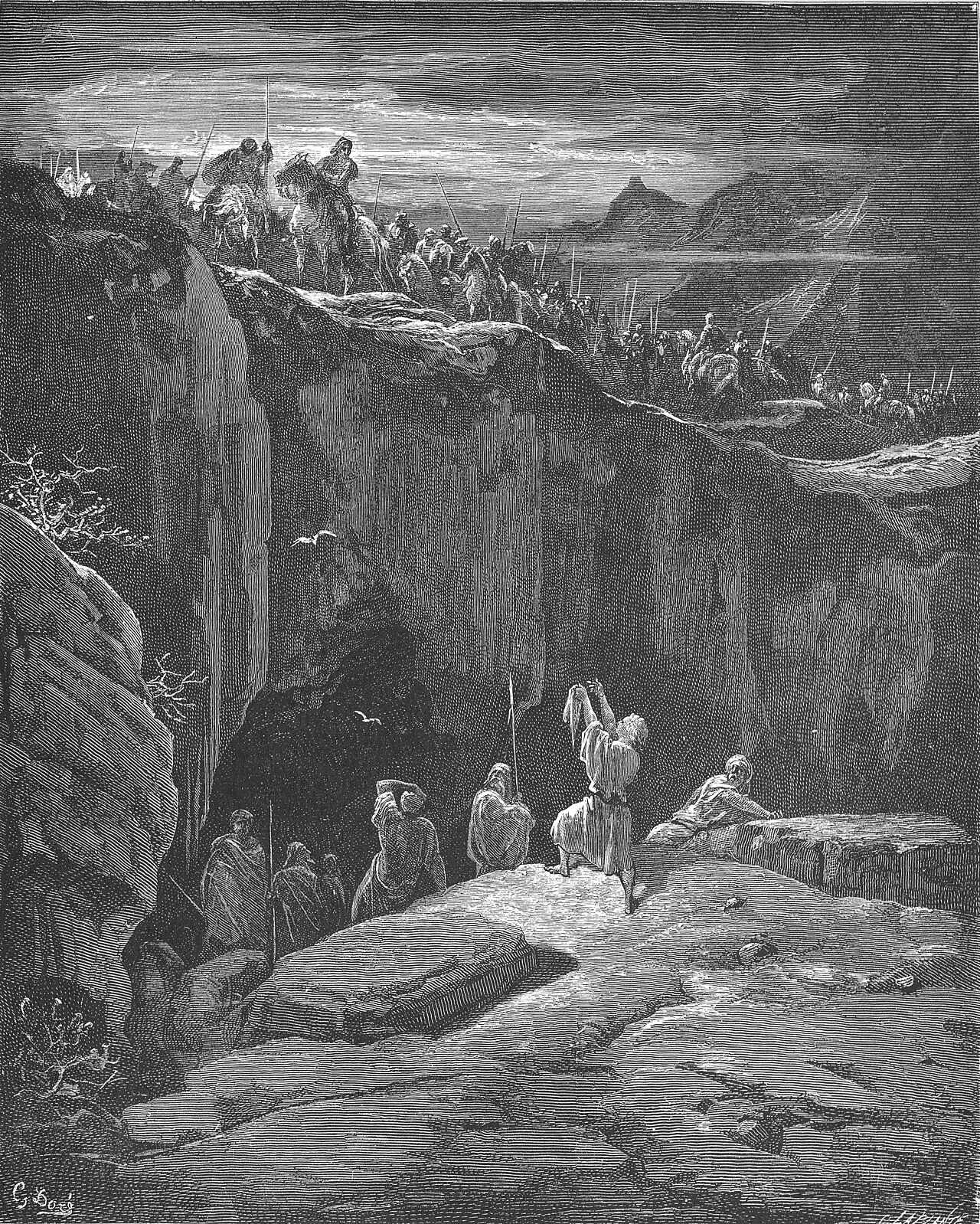
David Spares Saul in the Cave. 1 And it came to pass, when Saul was returned from following the Philistines, that it was told him, saying, Behold, David is in the wilderness of Engedi.
quarantine:scripture (2026-07-29) — scripture-overlap:94%@v1-3
Swear now therefore unto me by the Lord,....
The Nineteenth Century1 voice
Swear now - Saul knew that an oath would bind David, though it was insufficient to bind himself; see 1Sa 19:6. He had sworn to his son Jonathan that David should not be slain; and yet sought by all means in his power to destroy him!
The words behind it
15 Hebrew wordsEvery Hebrew word of this verse in the order it stands, with what it means and the door to its own study. The last column counts the times a word stands in the whole Bible: the rarer the word, the more the places it appears belong together.
| Hebrew | Sound | Meaning | Word study | In the Bible |
|---|---|---|---|---|
| וְעַתָּ֗ה | veatah | and therefore | H6258 → | 433 times |
| הִשָּׁ֤בְעָה | hishaveah | swear an oath ! | H7650 → | 186 times |
| לִּי֙ | li | to <the> me | ||
| בַּֽיהוָ֔ה | bayahweh | by Yahweh | H3068 → | 6520 times |
| אִם־ | ʾim- | if | H518 → | 1069 times |
| תַּכְרִ֥ית | takhrit | you will cut off | H3772 → | 288 times |
| אֶת־ | ʾet- | <obj.> | H853 → | 10935 times |
| זַרְעִ֖י | zari | offspring my | H2233 → | 229 times |
| אַֽחֲרָ֑י | ʾacharai | after me | H310 → | 715 times |
| וְאִם־ | veim- | and if | H518 → | 1069 times |
| תַּשְׁמִ֥יד | tashmid | you will destroy | H8045 → | |
| אֶת־ | ʾet- | <obj.> | H853 → | 10935 times |
| שְׁמִ֖י | shemi | name my | H8034 → | 864 times |
| מִבֵּ֥ית | mibeit | from [the] house of | H1004 → | 2046 times |
| אָבִֽי׃ | ʾavi | father my | H1 → | 1212 times |
וְעַתָּ֗הand therefore
veatahH6258 →433 times
הִשָּׁ֤בְעָהswear an oath !
hishaveahH7650 →186 times
לִּי֙to <the> me
li
בַּֽיהוָ֔הby Yahweh
bayahwehH3068 →6520 times
אִם־if
ʾim-H518 →1069 times
תַּכְרִ֥יתyou will cut off
takhritH3772 →288 times
אֶת־<obj.>
ʾet-H853 →10935 times
זַרְעִ֖יoffspring my
zariH2233 →229 times
אַֽחֲרָ֑יafter me
ʾacharaiH310 →715 times
וְאִם־and if
veim-H518 →1069 times
תַּשְׁמִ֥ידyou will destroy
tashmidH8045 →
אֶת־<obj.>
ʾet-H853 →10935 times
שְׁמִ֖יname my
shemiH8034 →864 times
מִבֵּ֥יתfrom [the] house of
mibeitH1004 →2046 times
אָבִֽי׃father my
ʾaviH1 →1212 times
A shaded row is a word that stands 400 times or fewer in the Bible.
The walk
8 stopsEach card is a verse this one points to, and under it the verses that one points to in turn. Where several paths arrive at the same place, that place is listed first: the text keeps returning to it.
Through
Genesis 31:53May the God of Abraham and the God of Nahor, the God of their father, judge between us.” So Jacob swore by the Fear of his father Isaac.
it leads to
- Genesis 31:42
If the God of my father, the God of Abraham and the Fear of Isaac, had not been with me, surely by now you would have sent me away empty-handed. But God has seen…
- Genesis 16:5
Then Sarai said to Abram, “May the wrong done to me be upon you! I delivered my servant into your arms, and ever since she saw that she was pregnant, she has treated me…
- Genesis 11:24–29
When Nahor was 29 years old, he became the father of Terah.
- Joshua 24:2
And Joshua said to all the people, “This is what the LORD, the God of Israel, says: ‘Long ago your fathers, including Terah the father of Abraham and Nahor, lived beyond the Euphrates and…
- Exodus 3:6
Then He said, “I am the God of your father, the God of Abraham, the God of Isaac, and the God of Jacob.” At this, Moses hid his face, for he was afraid to…
- Genesis 31:42
Through
Genesis 21:23Now, therefore, swear to me here before God that you will not deal falsely with me or my children or descendants. Show to me and to the country in which you reside the same…
it leads to
- Joshua 2:12
Now therefore, please swear to me by the LORD that you will indeed show kindness to my family, because I showed kindness to you. Give me a sure sign
- Genesis 20:14
So Abimelech brought sheep and cattle, menservants and maidservants, and he gave them to Abraham and restored his wife Sarah to him.
- Joshua 2:12
Through
Genesis 31:48Then Laban declared, “This mound is a witness between you and me this day.” Therefore the place was called Galeed.
it leads to
- Joshua 24:27
And Joshua said to all the people, “You see this stone. It will be a witness against us, for it has heard all the words the LORD has spoken to us, and it will…
- Joshua 24:27
About 1 Samuel
This page draws on Adam Clarke, Commentary on the Bible; Albert Barnes, Notes, Explanatory and Practical, on the Old and New Testaments (1832-1869); Albert Barnes, Notes on the Old Testament; John Gill, Exposition of the Old Testament (1748-1763) and Matthew Henry, Commentary on the Whole Bible.