
1 Samuel 24:22
in 1 Samuel 24So David gave his oath to Saul. Then Saul returned home, but David and his men went up to the stronghold.
BSB
The same verse in ASV and KJV ▾
ASV
And David sware unto Saul. And Saul went home; but David and his men gat them up unto the stronghold.
KJV
And David sware unto Saul. And Saul went home; but David and his men gat them up unto the hold.
⋯
This verse in 1 Samuel 24
Commentary
8 notes on this verseSaul went home - Confounded at a sense of his own baseness, and overwhelmed with a sense of David’s generosity. David and his men gat them up unto the hold - Went up to Mizpeh, according to the Syriac and Arabic. David could not trust Saul with his life; the utmost he could expect from him was that he should cease from persecuting him; but even this was too much to expect from a man of such a character as Saul. He was no longer under the Divine guidance; an evil spirit had full dominion over his soul.
This site's exposition
Swear now therefore unto me
on 1 Samuel 24:21-22
Saul asks for one thing only, an oath that David will not cut off his descendants once the throne is his, the same request Jonathan had already made of David at 20:15. David swears it and Saul goes home, but the scene does not close in reconciliation: David and his men go back up to the stronghold rather than to Saul's court. Clarke reads the parting plainly, David could not trust Saul with his life, for an evil spirit still had dominion over him, and chapter 26 will run this same cave scene almost beat for beat.
This site's exposition
went up to the stronghold
Barnes notes that Saul returned home to Gibeah without inviting David. Henry compares Jesus, who would not entrust Himself to those who believed in Him at John 2:24. Clarke reports that the Syriac and Arabic versions name the stronghold David and his men went up to as Mizpeh.
The record, by era
The Medieval Church1 voice
So Saul went to his house, etc. The people of the Jews who were able to repent from their faithlessness through the teaching of the apostles went to work on the care of their inner salvation. On the other hand, the Lord himself and his …
The Puritans and the Awakening3 voices
It is dangerous venturing upon the mercy of a reconciled enemy. We read of those who believed in Christ, and yet he did not commit himself to them because he knew all men. Those that like David are innocent as doves must thus like him be wise as serpents.
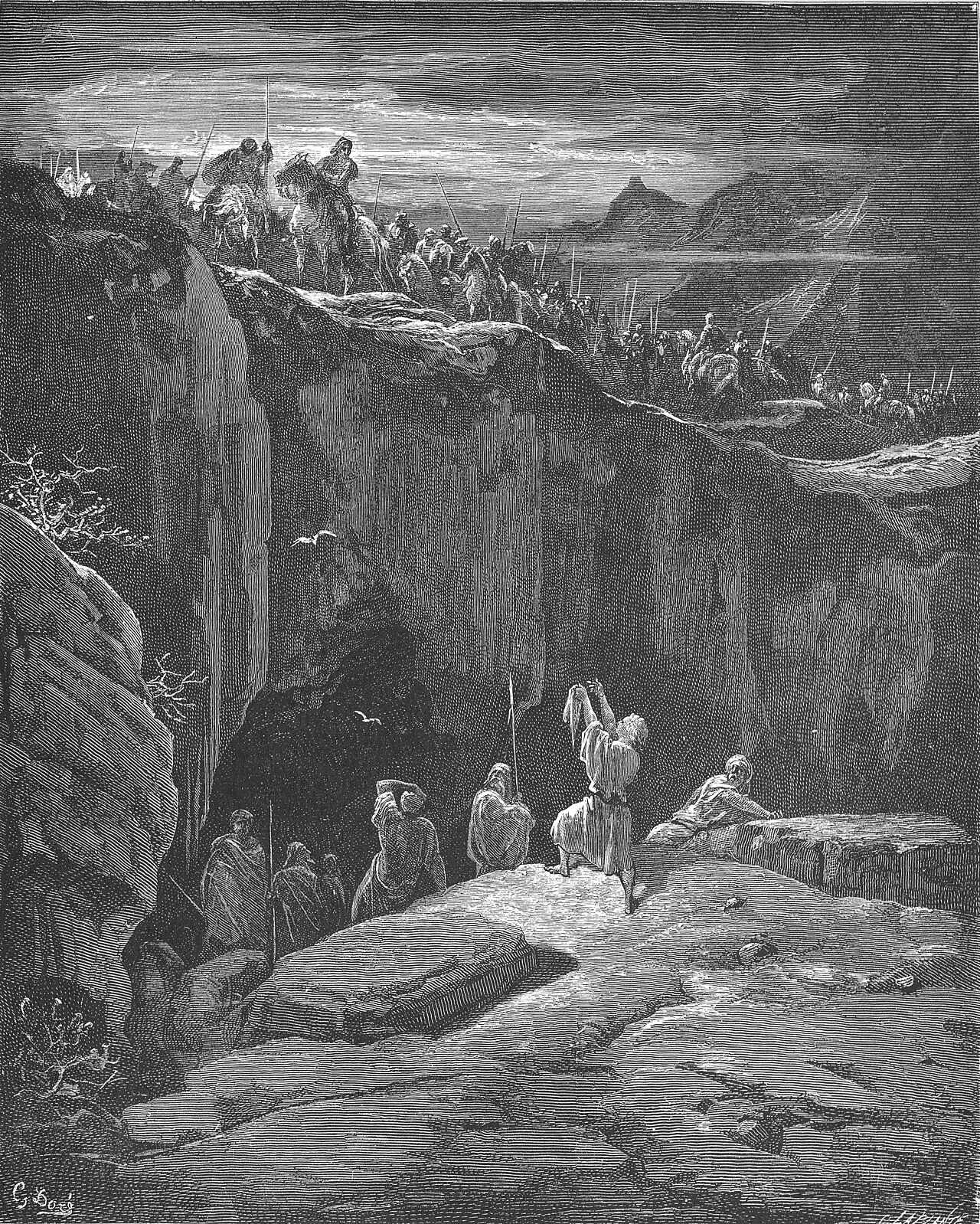
David Spares Saul in the Cave. 1 And it came to pass, when Saul was returned from following the Philistines, that it was told him, saying, Behold, David is in the wilderness of Engedi.
quarantine:scripture (2026-07-29) — scripture-overlap:94%@v1-3
And David sware unto Saul,....
The Nineteenth Century1 voice
A commentator
Albert Barnes1798–1870
Notes, Explanatory and Practical, on the Old and New Testaments (1832-1869)
proposed
Saul does not appear to have invited David to return to Gibeah, or to have given him any security of doing so with safety. David, with his intuitive sagacity, perceived that the softening of Saul’s feelings was only momentary, and that the situation remained unchanged.
The words behind it
12 Hebrew wordsEvery Hebrew word of this verse in the order it stands, with what it means and the door to its own study. The last column counts the times a word stands in the whole Bible: the rarer the word, the more the places it appears belong together.
| Hebrew | Sound | Meaning | Word study | In the Bible |
|---|---|---|---|---|
| וַיִּשָּׁבַ֥ע | vaiyishava' | and he swore an oath | H7650 → | 186 times |
| דָּוִ֖ד | david | David | H1732 → | 999 times |
| לְשָׁא֑וּל | leshaul | to Saul | H7586 → | 402 times |
| וַיֵּ֤לֶךְ | vaiyelekh | and he went | H1980 → | 1546 times |
| שָׁאוּל֙ | shaul | Saul | H7586 → | 402 times |
| אֶל־ | ʾel- | to | H413 → | 5510 times |
| בֵּית֔וֹ | beito | house his | H1004 → | 2046 times |
| וְדָוִד֙ | vedavid | and David | H1732 → | 999 times |
| וַֽאֲנָשָׁ֔יו | vaanashav | and men his | H582 → | 566 times |
| עָל֖וּ | ʾalu | they went up | H5927 → | 890 times |
| עַל־ | ʾal- | to | H5921 → | 5755 times |
| הַמְּצוּדָֽה׃ פ | hametzudah | the stronghold | H4686 → | 21 times |
וַיִּשָּׁבַ֥עand he swore an oath
vaiyishava'H7650 →186 times
דָּוִ֖דDavid
davidH1732 →999 times
לְשָׁא֑וּלto Saul
leshaulH7586 →402 times
וַיֵּ֤לֶךְand he went
vaiyelekhH1980 →1546 times
שָׁאוּל֙Saul
shaulH7586 →402 times
אֶל־to
ʾel-H413 →5510 times
בֵּית֔וֹhouse his
beitoH1004 →2046 times
וְדָוִד֙and David
vedavidH1732 →999 times
וַֽאֲנָשָׁ֔יוand men his
vaanashavH582 →566 times
עָל֖וּthey went up
ʾaluH5927 →890 times
עַל־to
ʾal-H5921 →5755 times
הַמְּצוּדָֽה׃ פthe stronghold
hametzudahH4686 →21 times
A shaded row is a word that stands 400 times or fewer in the Bible.
The walk
8 stopsEach card is a verse this one points to, and under it the verses that one points to in turn. Where several paths arrive at the same place, that place is listed first: the text keeps returning to it.
Through
John 2:24But Jesus did not entrust Himself to them, for He knew them all.
it leads to
- John 6:64
However, there are some of you who do not believe.” (For Jesus had known from the beginning which of them did not believe and who would betray Him.)
- Matthew 9:4
But Jesus knew what they were thinking and said, “Why do you harbor evil in your hearts?
- Hebrews 4:13
Nothing in all creation is hidden from God’s sight; everything is uncovered and exposed before the eyes of Him to whom we must give account.
- Acts 1:24
And they prayed, “Lord, You know everyone’s heart. Show us which of these two You have chosen
- 1 Chronicles 28:9
As for you, Solomon my son, know the God of your father and serve Him wholeheartedly and with a willing mind, for the LORD searches every heart and understands the intent of every thought.…
- John 6:64
Through
1 Samuel 23:29And David went up from there and lived in the strongholds of En-gedi.
it leads to
- 2 Chronicles 20:2
Then some men came and told Jehoshaphat, “A vast army is coming against you from Edom, from beyond the Sea; they are already in Hazazon-tamar” (that is, En-gedi).
- Joshua 15:62
Beth-arabah, Middin, Secacah, Nibshan, the City of Salt, and En-gedi—six cities, along with their villages.
- Song of Solomon 1:14
My beloved is to me a cluster of henna blossoms in the vineyards of En-gedi.
- 2 Chronicles 20:2
About 1 Samuel
Who and where
2 names in this verse with a page on the site.
- PersonUnited MonarchyDavidSecond king of united Israel, shepherd-turned-monarch, ancestor of the Messiah, and traditional author of many Psalms.
- PersonUnited monarchySaulIsrael's first king, head and shoulders above the people; began in humility, ended in rejection — sparing what God devoted, consul…
This page draws on Adam Clarke, Commentary on the Bible; Albert Barnes, Notes on the Old Testament; Albert Barnes, Notes, Explanatory and Practical, on the Old and New Testaments (1832-1869); Bede, Commentary on Samuel; John Gill, Exposition of the Old Testament (1748-1763) and Matthew Henry, Commentary on the Whole Bible.