
1 Samuel 24:3
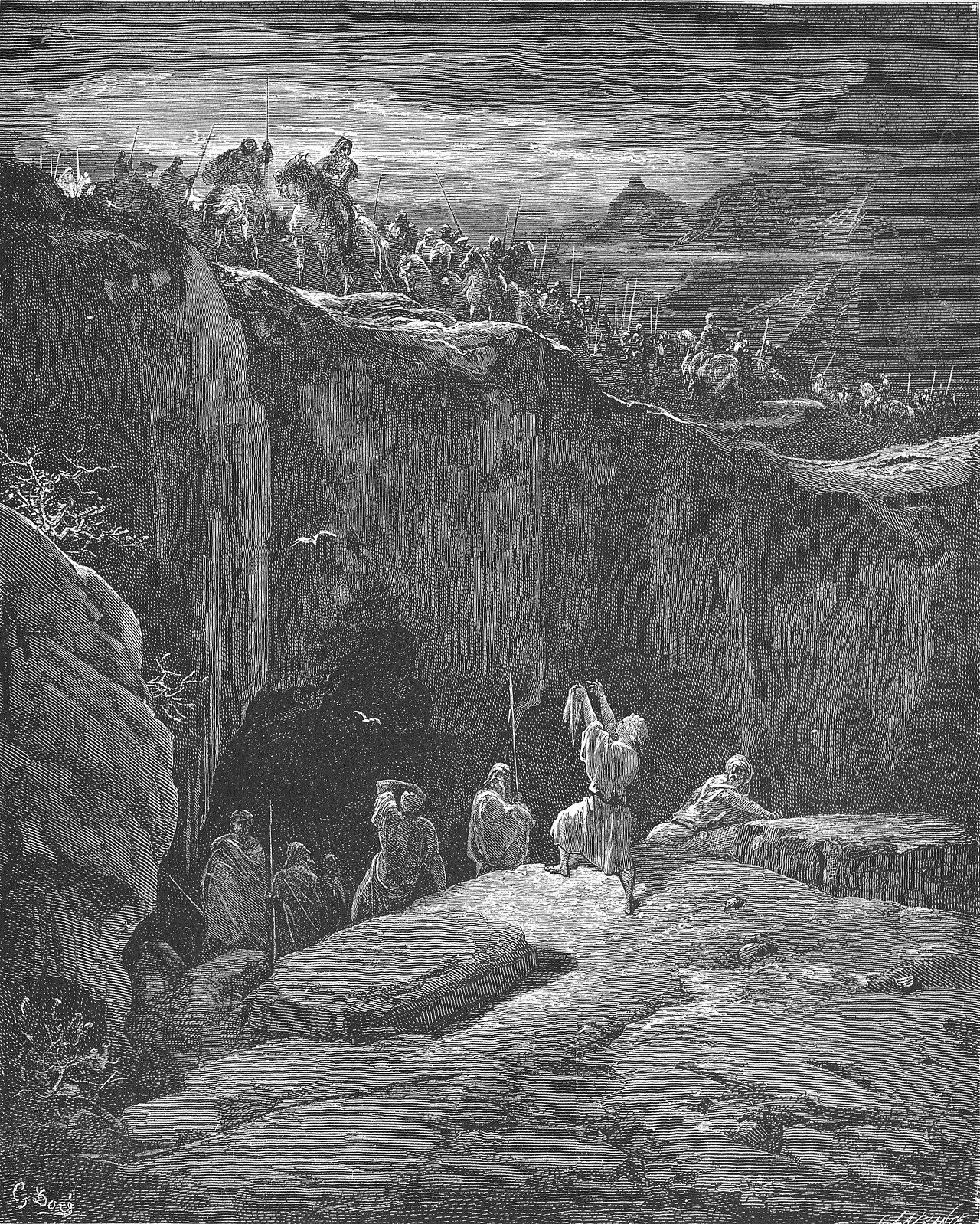
in 1 Samuel 24Soon Saul came to the sheepfolds along the road, where there was a cave, and he went in to relieve himself. And David and his men were hiding in the recesses of the cave.
BSB
The same verse in ASV and KJV ▾
ASV
And he came to the sheepcotes by the way, where was a cave; and Saul went in to cover his feet. Now David and his men were abiding in the innermost parts of the cave.
KJV
And he came to the sheepcotes by the way, where was a cave; and Saul went in to cover his feet: and David and his men remained in the sides of the cave.
⋯
This verse in 1 Samuel 24
Commentary
12 notes on this verseA commentator
Albert Barnes1798–1870
Notes, Explanatory and Practical, on the Old and New Testaments (1832-1869)
Remained in the sides - Rather, “were in the sides of the cave dwelling or abiding there.” Some of these caverns are very deep and spacious. Any one near the mouth of the cave would be visible, but those in the recesses would be quite in the dark and invisible, especially if the incident occurred at night. Psa 67:1-7, according to the title, was composed on this occasion.
This site's exposition
he went in to relieve himself
Henry allows two readings, relieving nature or resting from the heat, and either way providence has walked the hunter into the hunted man's hiding place. Barnes describes these caverns as deep enough that a man near the mouth stays visible while men further in remain hidden even by daylight.
The record, by era
The Church Fathers2 voices
Saul, unaware of David's hiding place, also entered the cave in order to take care of his needs, I presume.… Accordingly, this psalm of David is accepted for certain in the name of the Lord; Saul appears as the devil, and the cave becomes this world. The devil, furthermore, does not discharge any good into this world, but only dung and corruption. Then, too, the cave symbolizes this world because its light is very imperfect when compared with the light of the future world, albeit the Lord, on coming into this world as light, brightens it up considerably.
David, as we have said, took on the character of the Lord Savior, and so what was to take place at the Lord's passion is now recounted of him. David was not to be effaced from the kingdom allotted to him, just as the inscription …
The Medieval Church2 voices
And he also came to the sheepfolds, etc. In persecuting the great shepherd of the sheep, our Lord Jesus Christ, he also dragged the wicked investigation to the gatherings of his faithful disciples, who offered themselves as sheep to the raging wolves, to see if …
And there was a cave, etc. This cave is a symbol of the Lord's tomb, whose entrance Saul entered to relieve himself, while the rulers of the kingdom of the Jews, having departed from Pilate, secured the tomb, sealing the stone with guards, in an …
The Puritans and the Awakening1 voice
And it is not improbable, that being weary with his eager and almost incessant pursuit, first of David, then of the Philistines, and now of David again, he both needed and desired some sleep, God also disposing him thereto, that David might have this eminent occasion to demonstrate his integrity to Saul, and to all Israel.
5 more voices on this verse
The Puritans and the Awakening3 voices
Some by the covering of the feet understand the easing of nature, and think that this was Saul's errand into the cave: but the former interpretation is more probable.
He produces undeniable evidence to prove the falsehood of the suggestion upon which Saul's malice against him was grounded. David was charged with seeking Saul's hurt: " See, " says he, " yea, see the skirt of thy robe,
quarantine:debris (2026-07-29) — odd-straight-quotes
And he came to the sheepcotes by the way, where was a cave,....
The Nineteenth Century2 voices
A commentator
Jamieson, Fausset & Brown1802–1910
Commentary Critical and Explanatory on the Whole Bible (1871)
proposed
he came to the sheepcotes--most probably in the upper ridge of Wady Chareitun. There a large cave--I am quite disposed to say the cave--lies hardly five minutes to the east of the village ruin, on the south side of the wady. It is high upon the side of the calcareous rock, and it has undergone no change since David's time.
quarantine:debris (2026-07-29) — starts-lowercase
The sheep-cotes - Caves in the rocks, in which it is common, even to the present time, for shepherds and their flocks to lodge. According to Strabo there are caverns in Syria, one of which is capable of containing four thousand men: Ὡν ἑν και τετρακισχιλιους ανθρωπους δεξασθαι δυναμενον; lib. xvi. p. 1096. Edit. 1707. Saul went in to cover his feet - Perhaps this phrase signifies exactly what the Vulgate has rendered it, ut purparet ventrem. The Septuagint, the Targum, and the Arabic understand it in the same way. It is likely that, when he had performed this act of necessity, he lay down to repose himself, and it was while he was asleep that David cut off the skirt of his robe. It is strange that Saul was not aware that there might be men lying in wait in such a place; and the rabbins have invented a most curious conceit to account for Saul’s security: “God, foreseeing that Saul would come to this cave, caused a spider to weave her web over the mouth of it, which, when Saul perceived, he took for granted that no person had lately been there, and consequently he entered it without suspicion.” This may be literally true; and we know that even a spider in the hand of God may be the instrument of a great salvation. This is a Jewish tradition, and one of the most elegant and instructive in their whole collection. David and his men remained in the sides of the cave - This is no hyperbole; we have not only the authority of Strabo as above mentioned, but we have the authority of the most accurate travelers, to attest the fact of the vast capacity of caves in the East. Dr. Pococke observes: “Beyond the valley (of Tekoa) there is a very large grotto, which the Arabs call El Maamah, a hiding place; the high rocks on each side of the valley are almost perpendicular, and the way to the grotto is by a terrace formed in the rock, which is very narrow. […]
The words behind it
18 Hebrew wordsEvery Hebrew word of this verse in the order it stands, with what it means and the door to its own study. The last column counts the times a word stands in the whole Bible: the rarer the word, the more the places it appears belong together.
| Hebrew | Sound | Meaning | Word study | In the Bible |
|---|---|---|---|---|
| וַ֠יָּבֹא | vaiyavo' | and he came | H935 → | 2568 times |
| אֶל־ | ʾel- | to | H413 → | 5510 times |
| גִּדְר֨וֹת | gidrot | [the] folds of | H1448 → | |
| הַצֹּ֤אן | hatzon | the sheep | H6629 → | 274 times |
| עַל־ | ʾal- | on | H5921 → | 5755 times |
| הַדֶּ֙רֶךְ֙ | haderekh | the way | H1870 → | 707 times |
| וְשָׁ֣ם | vesham | and [was] there | H8033 → | 834 times |
| מְעָרָ֔ה | mearah | a cave | H4631 → | 37 times |
| וַיָּבֹ֥א | vaiyavo' | and he went | H935 → | 2568 times |
| שָׁא֖וּל | shaul | Saul | H7586 → | 402 times |
| לְהָסֵ֣ךְ | lehasekh | to cover | H5526 → | |
| אֶת־ | ʾet- | <obj.> | H853 → | 10935 times |
| רַגְלָ֑יו | raglav | feet his | H7272 → | 247 times |
| וְדָוִד֙ | vedavid | and David | H1732 → | 999 times |
| וַאֲנָשָׁ֔יו | vaanashav | and men his | H582 → | 566 times |
| בְּיַרְכְּתֵ֥י | beyarketei | in [the] innermost parts of | H3411 → | |
| הַמְּעָרָ֖ה | hamearah | the cave | H4631 → | 37 times |
| יֹשְׁבִֽים׃ | yoshevim | [were] sitting | H3427 → | 1079 times |
וַ֠יָּבֹאand he came
vaiyavo'H935 →2568 times
אֶל־to
ʾel-H413 →5510 times
גִּדְר֨וֹת[the] folds of
gidrotH1448 →
הַצֹּ֤אןthe sheep
hatzonH6629 →274 times
עַל־on
ʾal-H5921 →5755 times
הַדֶּ֙רֶךְ֙the way
haderekhH1870 →707 times
וְשָׁ֣םand [was] there
veshamH8033 →834 times
מְעָרָ֔הa cave
mearahH4631 →37 times
וַיָּבֹ֥אand he went
vaiyavo'H935 →2568 times
שָׁא֖וּלSaul
shaulH7586 →402 times
לְהָסֵ֣ךְto cover
lehasekhH5526 →
אֶת־<obj.>
ʾet-H853 →10935 times
רַגְלָ֑יוfeet his
raglavH7272 →247 times
וְדָוִד֙and David
vedavidH1732 →999 times
וַאֲנָשָׁ֔יוand men his
vaanashavH582 →566 times
בְּיַרְכְּתֵ֥יin [the] innermost parts of
beyarketeiH3411 →
הַמְּעָרָ֖הthe cave
hamearahH4631 →37 times
יֹשְׁבִֽים׃[were] sitting
yoshevimH3427 →1079 times
A shaded row is a word that stands 400 times or fewer in the Bible.
The walk
5 stopsEach card is a verse this one points to, and under it the verses that one points to in turn. Where several paths arrive at the same place, that place is listed first: the text keeps returning to it.
Through
Psalms 141:6When their rulers are thrown down from the cliffs, the people will listen to my words, for they are pleasant.
it leads to
- 2 Chronicles 25:12
and the army of Judah also captured 10,000 men alive. They took them to the top of a cliff and threw them down so that all were dashed to pieces.
- 1 Chronicles 10:1–7
Now the Philistines fought against Israel, and the men of Israel fled before them, and many fell slain on Mount Gilboa.
- 2 Samuel 23:1
These are the last words of David: “The oracle of David son of Jesse, the oracle of the man raised on high, the one anointed by the God of Jacob, and the sweet psalmist…
- 2 Samuel 5:1–3
Then all the tribes of Israel came to David at Hebron and said, “Here we are, your own flesh and blood.
- Luke 4:22
All spoke well of Him and marveled at the gracious words that came from His lips. “Isn’t this the son of Joseph?” they asked.
- 2 Chronicles 25:12
Where this verse is studied
About 1 Samuel
Who and where
2 names in this verse with a page on the site.
- PersonUnited MonarchyDavidSecond king of united Israel, shepherd-turned-monarch, ancestor of the Messiah, and traditional author of many Psalms.
- PersonUnited monarchySaulIsrael's first king, head and shoulders above the people; began in humility, ended in rejection — sparing what God devoted, consul…
This page draws on 10 works. Open the list of works
This page draws on Adam Clarke, Commentary on the Bible; Albert Barnes, Notes, Explanatory and Practical, on the Old and New Testaments (1832-1869); Albert Barnes, Notes on the Old Testament; Bede, Commentary on Samuel; Cassiodorus, EXPOSITION OF THE PSALMS 56.1; Jamieson, Fausset & Brown, Commentary Critical and Explanatory on the Whole Bible; Jerome, HOMILIES ON THE PSALMS 52 (PS 141); John Gill, Exposition of the Old Testament (1748-1763); John Wesley, Explanatory Notes upon the Old Testament and Matthew Henry, Commentary on the Whole Bible.