
1 Samuel 24:7
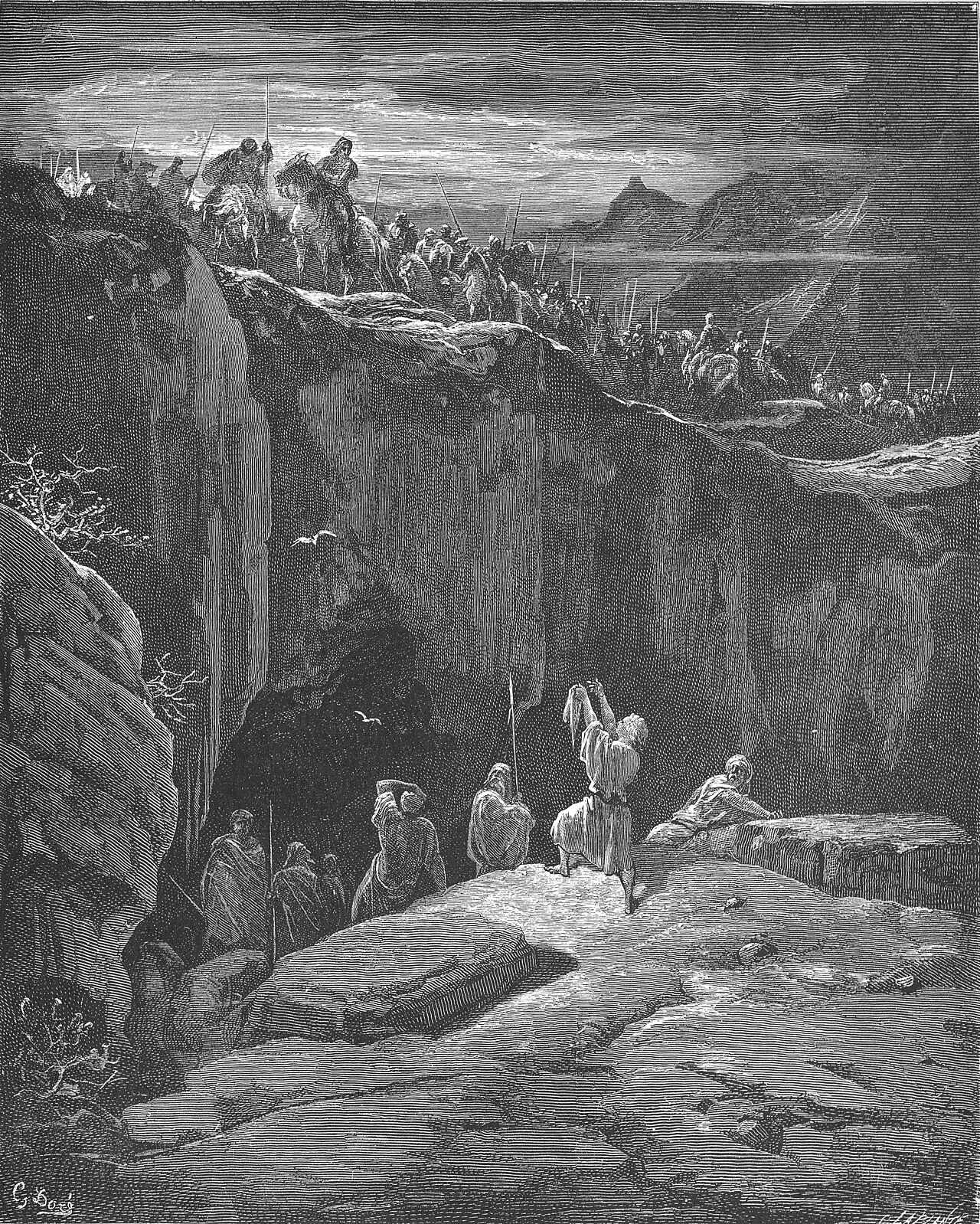
in 1 Samuel 24With these words David restrained his men, and he did not let them rise up against Saul. Then Saul left the cave and went on his way.
BSB
The same verse in ASV and KJV ▾
ASV
So David checked his men with these words, and suffered them not to rise against Saul. And Saul rose up out of the cave, and went on his way.
KJV
So David stayed his servants with these words, and suffered them not to rise against Saul. But Saul rose up out of the cave, and went on his way.
⋯
This verse in 1 Samuel 24
Commentary
10 notes on this verseWhat a virtuous action that was, when David wished rather to spare the king his enemy, though he could have injured him! How useful, too, it was, for it helped him when he succeeded to the throne. For all learned to be faithful to their king and not to seize the kingdom but to fear and reverence him. Thus what is virtuous was preferred to what was useful, and then usefulness followed on what was virtuous.
This site's exposition
to stretch forth mine hand against him
on 1 Samuel 24:6-7
David states the anointed argument at full length for the first time in the book, the Lord forbid that I should do this thing unto my master, the Lord's anointed, seeing he is the anointed of the Lord. The title had entered Scripture as an office at 2:10 and had been fixed on David himself at 16:6, and here he refuses to let his own anointing become grounds for touching Saul's. He does not merely hold his own hand but stays his servants with these words, and Henry calls the restraint a type of Christ, who saved his persecutors rather than striking them down.
This site's exposition
he did not let them rise up against Saul
Clarke holds that David, able to restrain his men, was bound to restrain them, and had he let them rise up against Saul he would have been the murderer. Chrysostom credits the grace of God on David's lips and the training he had given his men before. Saul went on his way knowing nothing.
The record, by era
The Church Fathers1 voice
It was not without God's influence, you see, that he [David] succeeded in prevailing over those frenzied men [his soldiers who wished to kill Saul]: the grace of God was found on the inspired man's lips, adding a sort of inducement to those words. It was, however, no slight contribution that David also made: since he had formed them in the past, consequently in the critical moment he found them ready and willing. It was not as leader of troops, you see, but as priest he commanded them, and that cave was a church on that occasion: like someone appointed as bishop, he delivered a homily to them, and after this homily he offered a kind of remarkable and unusual sacrifice, not sacrificing a calf, not slaying a lamb, but—what was of greater value than these—he offered to God gentleness and clemency, sacrificing irrational resentment, slaying anger and mortifying the limbs that are on the earth. He acted as victim, priest and altar: everything came from him—the thought that offered gentleness and clemency, the clemency and gentleness and the heart in which they were offered.
The Medieval Church2 voices
Moreover, Saul rising from the cave, etc. The keepers of the Lord's tomb, who, having fallen prostrate through fear of the approaching angel and had become like dead men, and fleeing from the tomb, nonetheless continued the evil schemes against the Lord, saying that his …
And David restrained his men with his words, etc. And the Lord restrained the severity of his disciples, who wished the impious to perish, by saying: Do not judge, and you will not be judged (Matthew VII). Do not condemn, and you will not be …
The Puritans and the Awakening2 voices
He would not only not do this evil thing himself, but he would not suffer those about him to do it. Thus did he render good for evil to him from whom he had received evil for good, and was herein both a type of Christ, who saved his persecutors, and an example to all Christians not to be overcome of evil, but to overcome evil with good.
So David stayed his servants with these words,....
2 more voices on this verse
The Nineteenth Century2 voices
Suffered them not to rise against Saul - As he could restrain them, it was his duty to do so; had he connived at their killing him, David would have been the murderer. In praying for the king we call God the only Ruler of princes, for this simple reason, that their authority is the highest among men, and next to that of God himself; hence he alone is above them. We find this sentiment well expressed by an elegant poet: - Regum timendorum in proprios greges, Reges in ipsos imperium est Jovis.
A commentator
Jamieson, Fausset & Brown1802–1910
Commentary Critical and Explanatory on the Whole Bible (1871)
proposed
Behold the day of which the Lord said unto thee, Behold, I will deliver thine enemy into thine hand--God had never made any promise of delivering Saul into David's hand; but, from the general and repeated promises of the kingdom to him, they concluded that the king's death was to be effected by taking advantage of some such opportunity as the present.
The words behind it
15 Hebrew wordsEvery Hebrew word of this verse in the order it stands, with what it means and the door to its own study. The last column counts the times a word stands in the whole Bible: the rarer the word, the more the places it appears belong together.
| Hebrew | Sound | Meaning | Word study | In the Bible |
|---|---|---|---|---|
| וַיְשַׁסַּ֨ע | vayshasa' | and he reprimanded | H8156 → | |
| דָּוִ֤ד | david | David | H1732 → | 999 times |
| אֶת־ | ʾet- | <obj.> | H853 → | 10935 times |
| אֲנָשָׁיו֙ | ʾanashav | men his | H582 → | 566 times |
| בַּדְּבָרִ֔ים | badevarim | by the words | H1697 → | 1440 times |
| וְלֹ֥א | velo' | and not | H3808 → | 5168 times |
| נְתָנָ֖ם | netanam | he permitted them | H5414 → | 2011 times |
| לָק֣וּם | lakum | to rise up | H6965 → | 628 times |
| אֶל־ | ʾel- | against | H413 → | 5510 times |
| שָׁא֑וּל | shaul | Saul | H7586 → | 402 times |
| וְשָׁא֛וּל | veshaul | and Saul | H7586 → | 402 times |
| קָ֥ם | kam | he arose | H6965 → | 628 times |
| מֵהַמְּעָרָ֖ה | mehamearah | from the cave | H4631 → | 37 times |
| וַיֵּ֥לֶךְ | vaiyelekh | and he went | H1980 → | 1546 times |
| בַּדָּֽרֶךְ׃ ס | badarekh | on the way | H1870 → | 707 times |
וַיְשַׁסַּ֨עand he reprimanded
vayshasa'H8156 →
דָּוִ֤דDavid
davidH1732 →999 times
אֶת־<obj.>
ʾet-H853 →10935 times
אֲנָשָׁיו֙men his
ʾanashavH582 →566 times
בַּדְּבָרִ֔יםby the words
badevarimH1697 →1440 times
וְלֹ֥אand not
velo'H3808 →5168 times
נְתָנָ֖םhe permitted them
netanamH5414 →2011 times
לָק֣וּםto rise up
lakumH6965 →628 times
אֶל־against
ʾel-H413 →5510 times
שָׁא֑וּלSaul
shaulH7586 →402 times
וְשָׁא֛וּלand Saul
veshaulH7586 →402 times
קָ֥םhe arose
kamH6965 →628 times
מֵהַמְּעָרָ֖הfrom the cave
mehamearahH4631 →37 times
וַיֵּ֥לֶךְand he went
vaiyelekhH1980 →1546 times
בַּדָּֽרֶךְ׃ סon the way
badarekhH1870 →707 times
A shaded row is a word that stands 400 times or fewer in the Bible.
The walk
8 stopsEach card is a verse this one points to, and under it the verses that one points to in turn. Where several paths arrive at the same place, that place is listed first: the text keeps returning to it.
Through
Matthew 5:44But I tell you, love your enemies and pray for those who persecute you,
it leads to
- Romans 12:14
Bless those who persecute you. Bless and do not curse.
- 1 Peter 3:9
Do not repay evil with evil or insult with insult, but with blessing, because to this you were called so that you may inherit a blessing.
- Luke 6:27–28
But to those of you who will listen, I say: Love your enemies, do good to those who hate you,
- Romans 12:20–21
On the contrary, “If your enemy is hungry, feed him; if he is thirsty, give him a drink. For in so doing, you will heap burning coals on his head.”
- Proverbs 25:21–22
If your enemy is hungry, give him food to eat, and if he is thirsty, give him water to drink.
- Romans 12:14
Through
1 Samuel 25:33Blessed is your discernment, and blessed are you, because today you kept me from bloodshed and from avenging myself by my own hand.
it leads to
- 1 Samuel 25:26
Now, my lord, as surely as the LORD lives and you yourself live, the LORD has held you back from coming to bloodshed and avenging yourself with your own hand. May your enemies and…
- 1 Samuel 25:26
Through
Psalms 7:4if I have rewarded my ally with evil, if I have plundered my foe without cause,
it leads to
- 1 Samuel 24:17–19
and said to David, “You are more righteous than I, for you have rewarded me with good, though I have rewarded you with evil.
- Psalms 55:20
My companion attacks his friends; he violates his covenant.
- 1 Samuel 24:17–19
About 1 Samuel
Who and where
2 names in this verse with a page on the site.
- PersonUnited MonarchyDavidSecond king of united Israel, shepherd-turned-monarch, ancestor of the Messiah, and traditional author of many Psalms.
- PersonUnited monarchySaulIsrael's first king, head and shoulders above the people; began in humility, ended in rejection — sparing what God devoted, consul…
This page draws on Adam Clarke, Commentary on the Bible; Ambrose of Milan, On the Duties of the Clergy 3.9.60; Bede, Commentary on Samuel; Jamieson, Fausset & Brown, Commentary Critical and Explanatory on the Whole Bible; John Chrysostom, HOMILIES ON DAVID AND SAUL 2; John Gill, Exposition of the Old Testament (1748-1763) and Matthew Henry, Commentary on the Whole Bible.