
1 Samuel 24:14
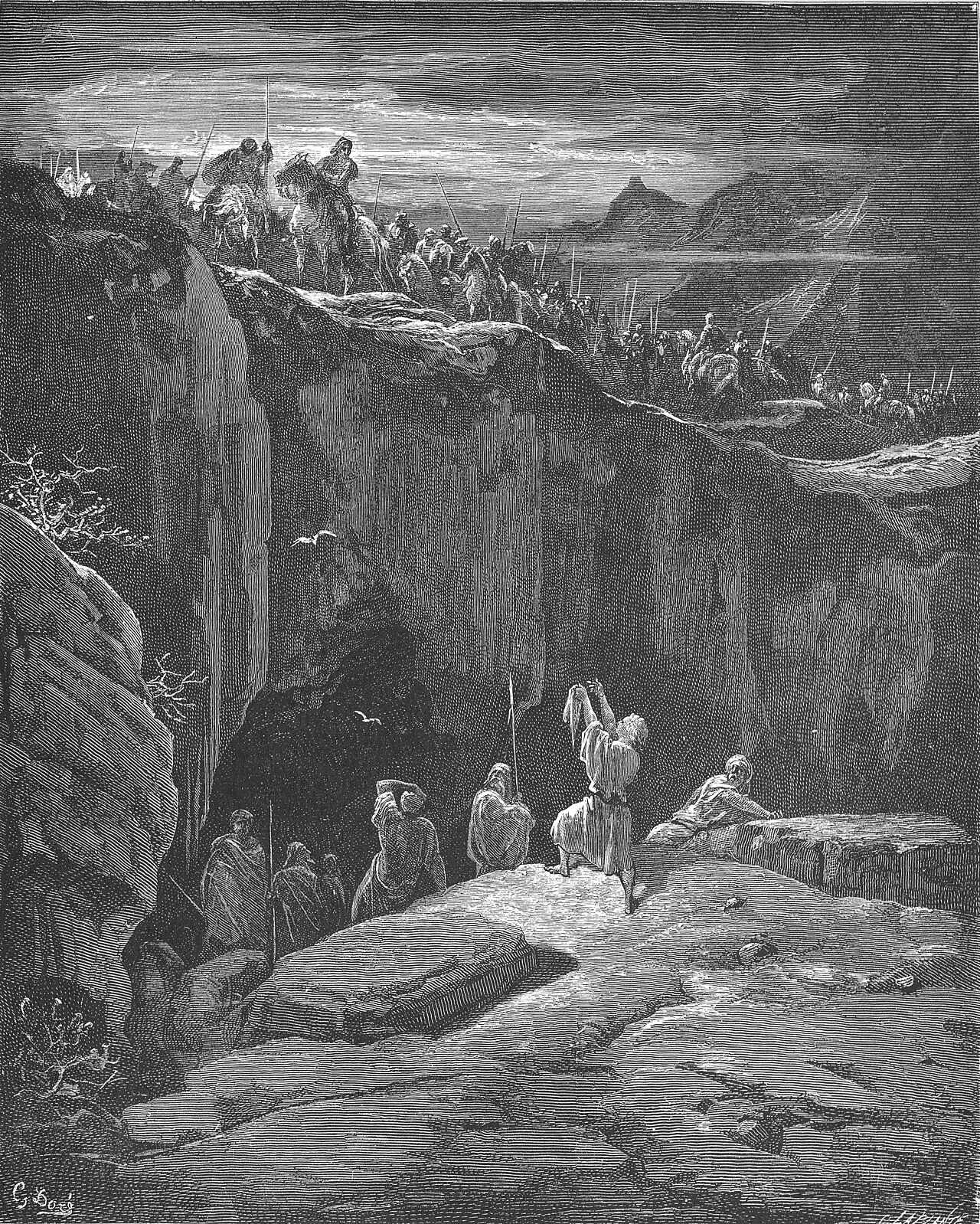
in 1 Samuel 24Against whom has the king of Israel come out? Whom are you pursuing? A dead dog? A flea?
BSB
The same verse in ASV and KJV ▾
ASV
After whom is the king of Israel come out? after whom dost thou pursue? after a dead dog, after a flea.
KJV
After whom is the king of Israel come out? after whom dost thou pursue? after a dead dog, after a flea.
⋯
This verse in 1 Samuel 24
Commentary
8 notes on this verseAfter a dead dog - A term used among the Hebrews to signify the most sovereign contempt; see 2Sa 16:9. One utterly incapable of making the least resistance against Saul, and the troops of Israel. The same idea is expressed in the term flea. The Targum properly expresses both thus: one who is weak, one who is contemptible.
This site's exposition
after a dead dog, after a flea
on 1 Samuel 24:14-15
David measures himself down to nothing in the same breath he measures Saul's whole army, after whom is the king of Israel come out, after a dead dog, after a flea. Clarke reads the two images together as total contempt joined to total harmlessness, a target too small to justify three thousand men in pursuit. The appeal opened at verse 12 closes here with three verbs stacked on one judge, be judge, and plead my cause, and deliver me, leaving the outcome entirely outside David's own hand.
The record, by era
The Church Fathers1 voice
The Creator compares himself to the lowest of his creatures so that you may regard nothing as despicable which is known to have been fashioned by his agency. As Scripture has it, "God made all things very good." Thus David too followed his Teacher and …
The Medieval Church1 voice
Whom do you persecute, king of Israel? Whom do you persecute? etc. Israel means a man seeing God. Whom then do you persecute, O people, who were chosen before all other nations to see the glory of divine brightness? Whom do you persecute? Is it …
The Puritans and the Awakening2 voices
): Whom does the king of Israel pursue with all this care and force? A dead dog; a flea; one flea, so it is in the Hebrew. It is below so great a king to enter the lists with one that is so unequal a match for him, one of his own servants, bred a poor shepherd, now an exile, neither able nor willing to make any resistance.
quarantine:debris (2026-07-29) — leading-punctuation+unbalanced-parens
After whom is the king of Israel come out?....
The Nineteenth Century1 voice
A commentator
Jamieson, Fausset & Brown1802–1910
Commentary Critical and Explanatory on the Whole Bible (1871)
He seems to have been naturally susceptible of strong, and, as in this instance, of good and grateful impressions. The improvement of his temper, indeed, was but transient--his language that of a man overwhelmed by the force of impetuous emotions and constrained to admire the conduct, and esteem the character, of one whom he hated and dreaded.
1 more voice on this verse
The Nineteenth Century1 voice
A commentator
Albert Barnes1798–1870
Notes, Explanatory and Practical, on the Old and New Testaments (1832-1869)
proposed
After whom ... - i. e., was it consistent with the dignity of the king of Israel to lead armies in pursuit of a weak and helpless individual like David?
How the passage was read
What the Jewish commentators add
As the ancient proverb says. The proverb of the Ancient One of the world. It may also mean ‘old proverb’ or it may refer to a ‘Kadmonite proverb,’ a nation mentioned in Bereishis:19. [referring to] the Torah, which is the proverb of the Holy One, Blessed is He.
This section is reception history: how the passage was read and kept in the Jewish tradition. Where a reading parts from an essential of the Christian faith, the section says so at that point.
Texts and citation data: Sefaria; each excerpt follows its version’s licence. 4 further sources are cited on this chapter that carry no English text this site may quote or only restate the verse.
The words behind it
15 Hebrew wordsEvery Hebrew word of this verse in the order it stands, with what it means and the door to its own study. The last column counts the times a word stands in the whole Bible: the rarer the word, the more the places it appears belong together.
| Hebrew | Sound | Meaning | Word study | In the Bible |
|---|---|---|---|---|
| אַחֲרֵ֨י | ʾacharei | after | H310 → | 715 times |
| מִ֤י | mi | whom? | H4310 → | 423 times |
| יָצָא֙ | yatza' | has he come out | H3318 → | 1067 times |
| מֶ֣לֶךְ | melekh | [the] king of | H4428 → | 2525 times |
| יִשְׂרָאֵ֔ל | yisrael | Israel | H3478 → | 2507 times |
| אַחֲרֵ֥י | ʾacharei | after | H310 → | 715 times |
| מִ֖י | mi | whom? | H4310 → | 423 times |
| אַתָּ֣ה | ʾatah | [are] you | H859 → | 1094 times |
| רֹדֵ֑ף | rodef | pursuing | H7291 → | 143 times |
| אַֽחֲרֵי֙ | ʾacharei | after | H310 → | 715 times |
| כֶּ֣לֶב | kelev | a dog | H3611 → | |
| מֵ֔ת | met | dead | H4191 → | 839 times |
| אַחֲרֵ֖י | ʾacharei | after | H310 → | 715 times |
| פַּרְעֹ֥שׁ | parosh | a flea | H6550 → | |
| אֶחָֽד׃ | ʾechad | one | H259 → | 971 times |
אַחֲרֵ֨יafter
ʾachareiH310 →715 times
מִ֤יwhom?
miH4310 →423 times
יָצָא֙has he come out
yatza'H3318 →1067 times
מֶ֣לֶךְ[the] king of
melekhH4428 →2525 times
יִשְׂרָאֵ֔לIsrael
yisraelH3478 →2507 times
אַחֲרֵ֥יafter
ʾachareiH310 →715 times
מִ֖יwhom?
miH4310 →423 times
אַתָּ֣ה[are] you
ʾatahH859 →1094 times
רֹדֵ֑ףpursuing
rodefH7291 →143 times
אַֽחֲרֵי֙after
ʾachareiH310 →715 times
כֶּ֣לֶבa dog
kelevH3611 →
מֵ֔תdead
metH4191 →839 times
אַחֲרֵ֖יafter
ʾachareiH310 →715 times
פַּרְעֹ֥שׁa flea
paroshH6550 →
אֶחָֽד׃one
ʾechadH259 →971 times
A shaded row is a word that stands 400 times or fewer in the Bible.
The walk
8 stopsEach card is a verse this one points to, and under it the verses that one points to in turn. Where several paths arrive at the same place, that place is listed first: the text keeps returning to it.
Through
1 Samuel 17:43“Am I a dog,” he said to David, “that you come at me with sticks?” And the Philistine cursed David by his gods.
it leads to
- 2 Samuel 3:8
Abner was furious over Ish-bosheth’s accusation. “Am I the head of a dog that belongs to Judah?” he asked. “All this time I have been loyal to the house of your father Saul, to…
Reached by 3 separate paths from here.
- 2 Kings 8:13
“But how could your servant, a mere dog, do such a monstrous thing?” said Hazael. And Elisha answered, “The LORD has shown me that you will be king over Aram.”
- Genesis 27:29
May peoples serve you and nations bow down to you. May you be the master of your brothers, and may the sons of your mother bow down to you. May those who curse you…
- 2 Samuel 3:8
Through
2 Samuel 16:9Then Abishai son of Zeruiah said to the king, “Why should this dead dog curse my lord the king? Let me go over and cut off his head!”
it leads to
- 2 Samuel 9:8
Mephibosheth bowed down and said, “What is your servant, that you should show regard for a dead dog like me?”
Reached by 2 separate paths from here.
- Exodus 22:28
You must not blaspheme God or curse the ruler of your people.
- 2 Samuel 9:8
Through
2 Samuel 9:8Mephibosheth bowed down and said, “What is your servant, that you should show regard for a dead dog like me?”
it leads to
- 2 Samuel 16:9
Then Abishai son of Zeruiah said to the king, “Why should this dead dog curse my lord the king? Let me go over and cut off his head!”
Reached by 2 separate paths from here.
- Matthew 15:26–27
But Jesus replied, “It is not right to take the children’s bread and toss it to the dogs.”
- 1 Samuel 24:14–15
Against whom has the king of Israel come out? Whom are you pursuing? A dead dog? A flea?
- 2 Samuel 16:9
About 1 Samuel
This page draws on Adam Clarke, Commentary on the Bible; Albert Barnes, Notes, Explanatory and Practical, on the Old and New Testaments (1832-1869); Bede, Commentary on Samuel; Cassiodorus, EXPOSITION OF THE PSALMS 21.7; Jamieson, Fausset & Brown, Commentary Critical and Explanatory on the Whole Bible; John Gill, Exposition of the Old Testament; John Gill, Exposition of the Old Testament (1748-1763) and Matthew Henry, Commentary on the Whole Bible.