
Ruth 2:14
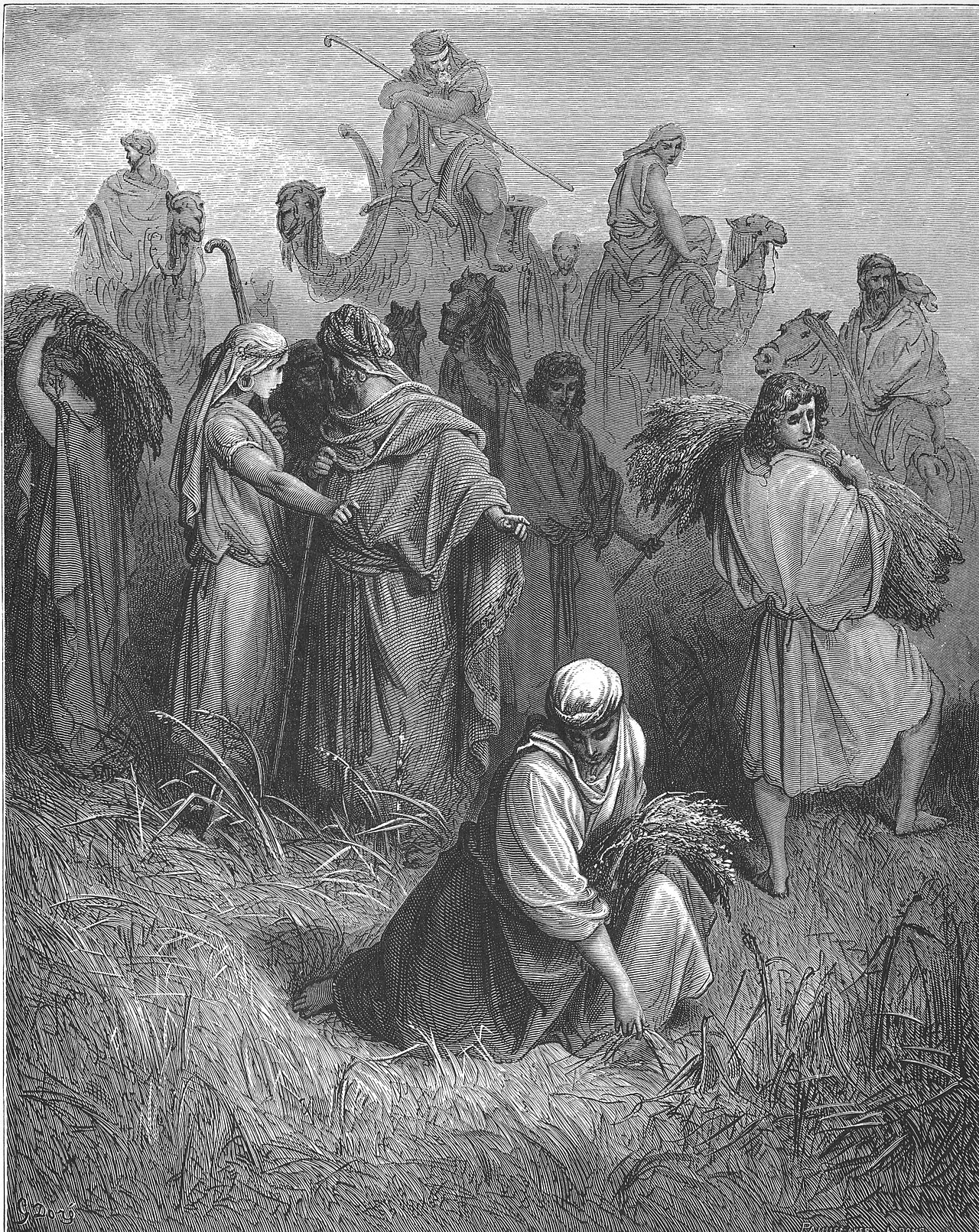
in Ruth 2At mealtime Boaz said to her, “Come over here; have some bread and dip it into the vinegar sauce.” So she sat down beside the harvesters, and he offered her roasted grain, and she ate and was satisfied and had some left over.
BSB
The same verse in ASV and KJV ▾
ASV
And at meal-time Boaz said unto her, Come hither, and eat of the bread, and dip thy morsel in the vinegar. And she sat beside the reapers, and they reached her parched grain, and she did eat, and was sufficed, and left thereof.
KJV
And Boaz said unto her, At mealtime come thou hither, and eat of the bread, and dip thy morsel in the vinegar. And she sat beside the reapers: and he reached her parched corn, and she did eat, and was sufficed, and left.
⋯
This verse in Ruth 2
Commentary
11 notes on this verseDip thy morsel in the vinegar - The חמץ chomets, which we here translate vinegar, seems to have been some refreshing kind of acid sauce used by the reapers to dip their bread in, which both cooled and refreshed them. Vinegar, rob of fruits, etc., are used for this purpose in the East to the present day; and the custom of the Arabs, according to Dr. Shaw, is to dip the bread and hand together into these cooling and refreshing articles.
This site's exposition
At mealtime come thou hither
on Ruth 2:14-16
He seats her beside the reapers and reaches her the parched corn himself, and the verse ends with she did eat, and was sufficed, and left, which is the portion she carries home at verse 18. Then he commands the young men twice over, to let her glean among the sheaves and to let fall handfuls of purpose for her. The law set a floor at the corners and the forgotten sheaf, and nothing in Leviticus 19 or Deuteronomy 24 asks a man to drop grain deliberately.
The record, by era
The Puritans and the Awakening5 voices
It is a good question for us to ask ourselves in the close of every day, " Where have I gleaned to-day? What improvements have I made in knowledge and grace?
quarantine:debris (2026-07-29) — odd-straight-quotes
She sat - Not with or among them, but at some little distance from them, as one inferior to them. It is no disparagement to the finest hand, to be reached forth to the needy.
And Boaz said, at mealtime come thou hither,.... This looks as if she was now in the booth, or house in the field, where the reapers used to retire to eat their food, or rest themselves, or take shelter from the heat of the sun. This meal was very likely dinner, the time of which was not yet come, but would soon, and to which Boaz invited Ruth: and eat of the bread; his servants did, that is, partake of the provisions they should have; bread being put for all.
It is no disparagement to the finest hand to be reached forth to the needy ( Prov. xxxi. 20 ), and to be employed in serving the poor. Observe, Boaz was not scanty in his provision for his reapers, but sent them so much more than enough for themselves as would be entertainment for a stranger.
She did not, under pretence either of her want or of her labour, eat more than was convenient for her, nor so much as to unfit her for work in the afternoon. Temperance is a friend to industry; and we must eat and drink to strengthen us for business, not to indispose us to it.
4 more voices on this verse
The Nineteenth Century4 voices
A commentator
Jamieson, Fausset & Brown1802–1910
Commentary Critical and Explanatory on the Whole Bible (1871)
proposed
he reached her parched corn, and she did eat, and was sufficed, and left--some of the new grain, roasted on the spot, and fit for use after being rubbed in the hands--a favorite viand in the East.
quarantine:debris (2026-07-29) — starts-lowercase
IF we lived in the country it would not be necessary for me to remind you that the time of harvest has again happily come upon us. I saw, one day last week, a fine sample of the new wheat, part of a considerable quantity which had just been sold. And in many places I have observed the fields yielding their sheaves to the reapers' sickle. Let us loudly lift our praises to God for the abundance which loads the land. An unusually heavy crop has been given in many quarters and scarcely anywhere is there any deficiency.
IF we lived in the country it would not be necessary for me to remind you that the time of harvest has again happily come upon us. I saw, one day last week, a fine sample of the new wheat, part of a considerable quantity which had just been sold. And in many places I have observed the fields yielding their sheaves to the reapers' sickle. Let us loudly lift our praises to God for the abundance which loads the land. An unusually heavy crop has been given in many quarters and scarcely anywhere is there any deficiency. While there is so much of distress abroad—while the great factories of our country are standing still—we should be grateful that God is pleased to alleviate the sufferings of the poor by an unusually bountiful harvest. And we must not forget to pray that during the next few weeks the Lord would be pleased to give suitable weather so that the corn may be safely gathered into the garner. That there may be abundance of bread and no complaining in our streets. I always feel it necessary, just at this season, to give these hints, because God's natural remembrances cannot reach us—we hear not the lark teaching us how to praise, nor do the green fields of grass, and the yellow ears of corn preach to us of the Lord's bounty. Little is there to be learned from these long corridors of dreary cells which we call streets and houses. I see dull brown or dirty-white bricks everywhere—enough to make one earthly—however much we may pant for heavenly things. We see neither the green blade nor the full corn in the ear, and we are so apt to forget that we all depend upon the labor of the field. Let us unite with the peasant and his master in blessing and praising the God of Providence, who first covered the fields with grass for the cattle and now with herbs for the food of man.
A commentator
Albert Barnes1798–1870
Notes, Explanatory and Practical, on the Old and New Testaments (1832-1869)
proposed
To dip the morsel, or sop, whether it were bread or meat, in the dish containing the vinegar (compare Mat 26:23; Mar 14:20: Exo 25:29; Num 7:13) was, and still is, the common custom in the East. Parched or “roasted” corn - Grain was the common food of the country then (compare 1Sa 17:17; 1Sa 25:18; 2Sa 17:28) as it is now. And left - Or “reserved” Rth 2:18. Rather, “had some over” (compare Luk 15:17). Rth 2:18 tells us that she took to her mother-in-law what she had left over.
How the passage was read
What the Jewish commentators add
And dip your bread in the vinegar. From here [we derive] that vinegar is good for the heat. 12 Maseches Shabbos 113b. It is a popular and refreshing drink for those who toil in extremely hot climates.
2 more on this passage, in their own words ▾
I cannot even be considered as one of your handmaidens. I am not as worthy as one of your handmaidens.
Do not reproach her. Derived from the root שלל (to plunder). Some say it is like an error from [the word] של.
This section is reception history: how the passage was read and kept in the Jewish tradition. Where a reading parts from an essential of the Christian faith, the section says so at that point.
Texts and citation data: Sefaria; each excerpt follows its version’s licence. 2 further sources are cited on this chapter that carry no English text this site may quote or only restate the verse.
The words behind it
22 Hebrew wordsEvery Hebrew word of this verse in the order it stands, with what it means and the door to its own study. The last column counts the times a word stands in the whole Bible: the rarer the word, the more the places it appears belong together.
| Hebrew | Sound | Meaning | Word study | In the Bible |
|---|---|---|---|---|
| וַיֹּאמֶר֩ | vaiyomer | and he said | H559 → | 5305 times |
| לָ֨ה | lah | to <the> her | ||
| בֹ֜עַז | voaz | Boaz | H1162 → | 24 times |
| לְעֵ֣ת | leet | to [the] time of | H6256 → | |
| הָאֹ֗כֶל | haokhel | the meal | H400 → | |
| גֹּ֤שִֽׁי | goshi | approach | H5066 → | |
| הֲלֹם֙ | halom | here | H1988 → | |
| וְאָכַ֣לְתְּ | veakhalt | and you will eat | H398 → | 810 times |
| מִן־ | min- | some of | H4480 → | 1188 times |
| הַלֶּ֔חֶם | halechem | the food | H3899 → | |
| וְטָבַ֥לְתְּ | vetavalt | and you will dip | H2881 → | |
| פִּתֵּ֖ךְ | pitekh | portion your | H6595 → | |
| בַּחֹ֑מֶץ | bachometz | in the vinegar | H2558 → | |
| וַתֵּ֙שֶׁב֙ | vateshev | and she sat down | H3427 → | 1079 times |
| מִצַּ֣ד | mitzad | from [the] side of | H6654 → | |
| הַקּֽוֹצְרִ֔ים | hakotzrim | the harvesters | H7114 → | 49 times |
| וַיִּצְבָּט־ | vaiyitzbot- | and he held out | H6642 → | |
| לָ֣הּ | lah | to <the> her | ||
| קָלִ֔י | kali | roasted grain | H7039 → | |
| וַתֹּ֥אכַל | vatokhal | and she ate | H398 → | 810 times |
| וַתִּשְׂבַּ֖ע | vatisba' | and she was satisfied | H7646 → | |
| וַתֹּתַֽר׃ | vatotar | and she had excess | H3498 → |
וַיֹּאמֶר֩and he said
vaiyomerH559 →5305 times
לָ֨הto <the> her
lah
בֹ֜עַזBoaz
voazH1162 →24 times
לְעֵ֣תto [the] time of
leetH6256 →
הָאֹ֗כֶלthe meal
haokhelH400 →
גֹּ֤שִֽׁיapproach
goshiH5066 →
הֲלֹם֙here
halomH1988 →
וְאָכַ֣לְתְּand you will eat
veakhaltH398 →810 times
מִן־some of
min-H4480 →1188 times
הַלֶּ֔חֶםthe food
halechemH3899 →
וְטָבַ֥לְתְּand you will dip
vetavaltH2881 →
פִּתֵּ֖ךְportion your
pitekhH6595 →
בַּחֹ֑מֶץin the vinegar
bachometzH2558 →
וַתֵּ֙שֶׁב֙and she sat down
vateshevH3427 →1079 times
מִצַּ֣דfrom [the] side of
mitzadH6654 →
הַקּֽוֹצְרִ֔יםthe harvesters
hakotzrimH7114 →49 times
וַיִּצְבָּט־and he held out
vaiyitzbot-H6642 →
לָ֣הּto <the> her
lah
קָלִ֔יroasted grain
kaliH7039 →
וַתֹּ֥אכַלand she ate
vatokhalH398 →810 times
וַתִּשְׂבַּ֖עand she was satisfied
vatisba'H7646 →
וַתֹּתַֽר׃and she had excess
vatotarH3498 →
A shaded row is a word that stands 400 times or fewer in the Bible.
The walk
8 stopsEach card is a verse this one points to, and under it the verses that one points to in turn. Where several paths arrive at the same place, that place is listed first: the text keeps returning to it.
Through
Deuteronomy 8:10When you eat and are satisfied, you are to bless the LORD your God for the good land that He has given you.
it leads to
- Psalms 103:2
Bless the LORD, O my soul, and do not forget all His kind deeds—
- Proverbs 3:9
Honor the LORD with your wealth and with the firstfruits of all your harvest;
- Romans 14:6
He who observes a special day does so to the Lord; he who eats does so to the Lord, for he gives thanks to God; and he who abstains does so to the Lord…
- Matthew 14:19
And He directed the crowds to sit down on the grass. Taking the five loaves and the two fish and looking up to heaven, He spoke a blessing. Then He broke the loaves and…
- 1 Chronicles 29:14
But who am I, and who are my people, that we should be able to give as generously as this? For everything comes from You, and from Your own hand we have given to…
- Psalms 103:2
Through
Matthew 14:20They all ate and were satisfied, and the disciples picked up twelve basketfuls of broken pieces that were left over.
it leads to
- Exodus 16:12
“I have heard the grumbling of the Israelites. Tell them, ‘At twilight you will eat meat, and in the morning you will be filled with bread. Then you will know that I am the…
- Matthew 16:8–10
Aware of their conversation, Jesus said, “You of little faith, why are you debating among yourselves about having no bread?
- 1 Kings 17:12–16
But she replied, “As surely as the LORD your God lives, I have no bread—only a handful of flour in a jar and a little oil in a jug. Look, I am gathering a…
- Exodus 16:12
Where this verse is studied
On this page
About Ruth
Who and where
1 name in this verse with a page on the site.
This page draws on Adam Clarke, Commentary on the Bible; Albert Barnes, Notes, Explanatory and Practical, on the Old and New Testaments (1832-1869); Charles Spurgeon, The Metropolitan Tabernacle Pulpit, Sermon No. 522: “Mealtime In The Corn Fields” (lightly modernized text, CCEL edition); Jamieson, Fausset & Brown, Commentary Critical and Explanatory on the Whole Bible; John Gill, Exposition of the Old Testament (1748-1763); John Wesley, Explanatory Notes upon the Old Testament and Matthew Henry, Commentary on the Whole Bible.