
Ruth 2:12
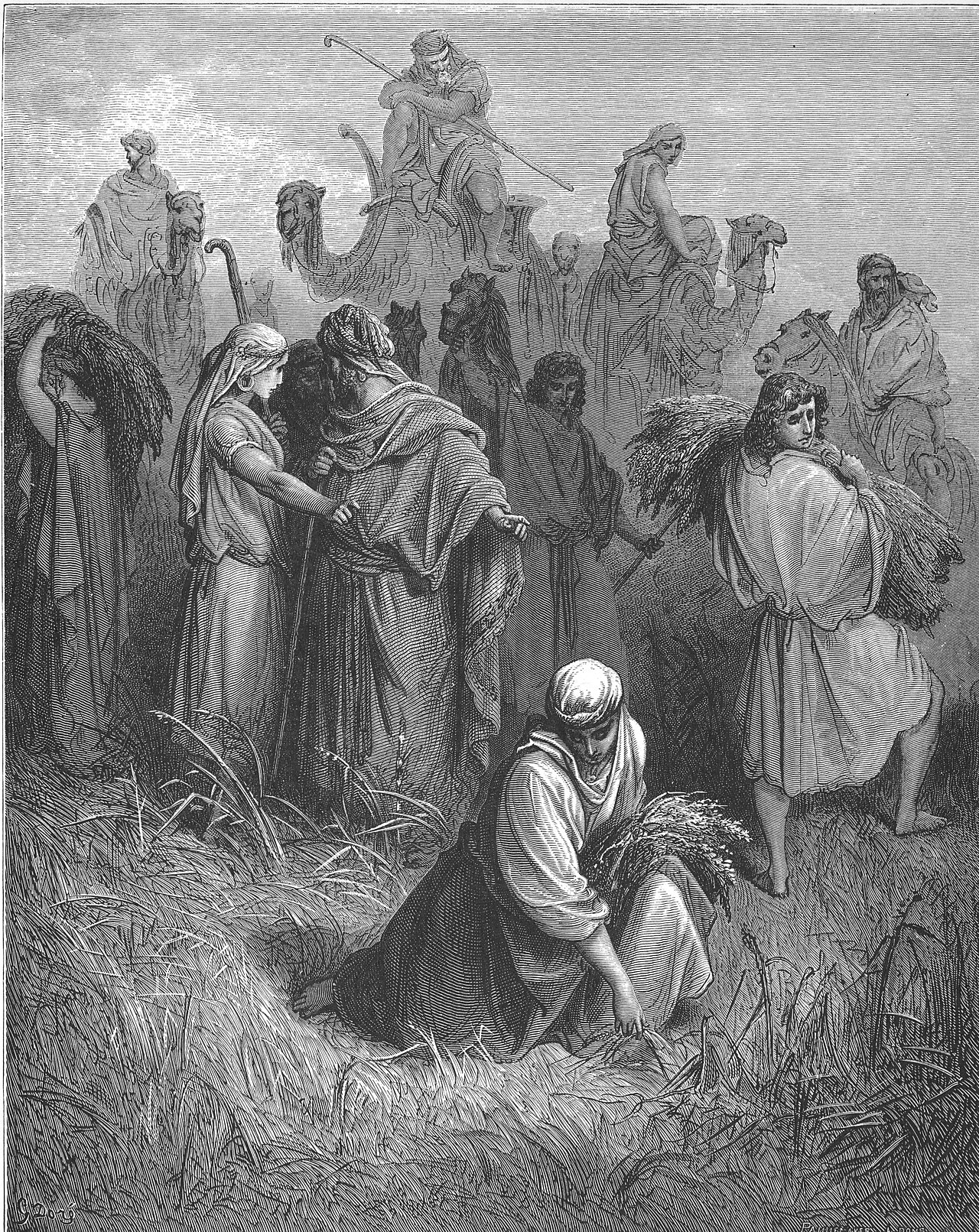
in Ruth 2May the LORD repay your work, and may you receive a rich reward from the LORD, the God of Israel, under whose wings you have taken refuge.”
BSB
The same verse in ASV and KJV ▾
ASV
Jehovah recompense thy work, and a full reward be given thee of Jehovah, the God of Israel, under whose wings thou art come to take refuge.
KJV
The Lord recompense thy work, and a full reward be given thee of the Lord God of Israel, under whose wings thou art come to trust.
⋯
This verse in Ruth 2
Commentary
10 notes on this verseThe blessing followed as Boaz said it would. For Ruth received the full reward from God, so that she was the progenitor of the blessing of the nations.
This site's exposition
May the LORD repay your work
on Ruth 2:12-13
The phrase "under whose wings you have taken refuge" uses kanaph, wing, the word for the garment's corner Ruth asks him to spread at 3:9. What he prays for here, he is later asked to become. The image runs through Psalm 17:8, 36:7, 57:1 and 91:4.
The record, by era
The Church Fathers1 voice
The story of Boaz also teaches us about virtue. For he not only liberally shares his grain with Ruth but also consoles her with words. Not only does he share food with her but also was himself the minister of his kindness; so that whoever …
The Puritans and the Awakening3 voices
Wings - That is, protection and care. An allusion either to hens, which protect and cherish their young ones under their wings; or to the wings of the Cherubim, between which God dwelt.
Note, Those that by faith come under the wings of the divine grace, and have a full complacency and confidence in that grace, may be sure of a full recompence of reward for their so doing. From this expression, the Jews describe a proselyte to be one that is gathered under the wings of the divine majesty.
The Lord recompence thy work,....
The Nineteenth Century1 voice
THIS was the language of Boaz, a man of substance and of note in Bethlehem, to a poor stranger of whom he had heard that she had left her kindred and the idols of her nation, that she might become a worshipper of the living and true God. He acted a noble part when he cheered her and bade her be of good courage, now that she was casting in her lot with Naomi and the chosen nation.
3 more voices on this verse
The Nineteenth Century3 voices
THIS was the language of Boaz, a man of substance and of note in Bethlehem, to a poor stranger of whom he had heard that she had left her kindred and the idols of her nation, that she might become a worshipper of the living and true God. He acted a noble part when he cheered her and bade her be of good courage, now that she was casting in her lot with Naomi and the chosen nation. Observe that he saluted her with words of tender encouragement, for this is precisely what I want all the elder Christians among you to do to those who are the counterparts of Ruth. You who have long been Believers in the Lord Jesus, who have grown rich in experience, who know the love and faithfulness of our Covenant God and who are strong in the Lord and in the power of His might, I want you to make a point of looking out for the young converts and speaking goodly and comfortable words to them, whereby they may be cheered and strengthened. There is a text, a very short one, which I would like to often preach from in reference to those who are newly saved, and I would invite you to be continually practicing it. That text is, "Encourage him." So many throw cold water upon the aspirants after holiness that I would urge others of you to heartily cheer them. Where spiritual life is weak, it should be nurtured with affectionate care. We desire to cherish, not to censure. That the lambs may grow, they must be shepherded. That the tender babes in the household may become strong members of the Divine family, they must be nursed and fed. If Ruth is to be happy in the land of Israel, a Boaz must look after her and be her true friend. Let her nearest kinsmen be speedy in fulfilling this duty. I have no doubt that much sorrow might be prevented if words of encouragement were more frequently spoken fitly and in season and, therefore, to withhold them is sin.
The Lord recompense thy work - The dutiful respect which thou hast paid to thy husband, and thy tender and affectionate attachment to thy aged mother-in-law. And a full reward be given thee - This is spoken with great modesty and piety: The kindness I show thee is little in comparison of thy desert; God alone can give thee a full reward for thy kindness to thy husband and mother-in-law, and he will do it, because thou art come to trust under his wings - to become a proselyte to his religion.
A commentator
Albert Barnes1798–1870
Notes, Explanatory and Practical, on the Old and New Testaments (1832-1869)
proposed
The similarity of expression here to Gen 15:1, and in Rth 2:11 to Gen 12:1, makes it probable that Boaz had the case of Abraham in his mind. The Lord God of Israel - “Jehovah the God of Israel.” Compare Jos 14:14, where, as here, the force of the addition, the God of Israel, lies in the person spoken of being a foreigner (see Jdg 11:21 note).
How the passage was read
What the Jewish commentators add
Thy reward. Like "the tally of bricks," it is a noun from the intensive binyan (conjugation) with an additional mem (מ).
2 more on this passage, in their own words ▾
I cannot even be considered as one of your handmaidens. I am not as worthy as one of your handmaidens.
It has been fully related to me. An action where the agent is not specified.
This section is reception history: how the passage was read and kept in the Jewish tradition. Where a reading parts from an essential of the Christian faith, the section says so at that point.
Texts and citation data: Sefaria; each excerpt follows its version’s licence. 2 further sources are cited on this chapter that carry no English text this site may quote or only restate the verse.
The words behind it
15 Hebrew wordsEvery Hebrew word of this verse in the order it stands, with what it means and the door to its own study. The last column counts the times a word stands in the whole Bible: the rarer the word, the more the places it appears belong together.
| Hebrew | Sound | Meaning | Word study | In the Bible |
|---|---|---|---|---|
| יְשַׁלֵּ֥ם | yeshalem | may he reward | H7999 → | |
| יְהוָ֖ה | yahweh | Yahweh | H3068 → | 6520 times |
| פָּעֳלֵ֑ךְ | poolekh | deed[s] your | H6467 → | |
| וּתְהִ֨י | utehi | and may it be | H1961 → | 3559 times |
| מַשְׂכֻּרְתֵּ֜ךְ | maskurtekh | wage[s] your | H4909 → | |
| שְׁלֵמָ֗ה | shelemah | complete | H8003 → | |
| מֵעִ֤ם | meim | from with | H5973 → | 1050 times |
| יְהוָה֙ | yahweh | Yahweh | H3068 → | 6520 times |
| אֱלֹהֵ֣י | ʾelohei | [the] God of | H430 → | 2601 times |
| יִשְׂרָאֵ֔ל | yisrael | Israel | H3478 → | 2507 times |
| אֲשֶׁר־ | ʾasher- | whom | H834 → | 5497 times |
| בָּ֖את | bat | you have come | H935 → | 2568 times |
| לַחֲס֥וֹת | lachasot | to take refuge | H2620 → | |
| תַּֽחַת־ | tachat- | under | H8478 → | |
| כְּנָפָֽיו׃ | kenafav | wings his | H3671 → |
יְשַׁלֵּ֥םmay he reward
yeshalemH7999 →
יְהוָ֖הYahweh
yahwehH3068 →6520 times
פָּעֳלֵ֑ךְdeed[s] your
poolekhH6467 →
וּתְהִ֨יand may it be
utehiH1961 →3559 times
מַשְׂכֻּרְתֵּ֜ךְwage[s] your
maskurtekhH4909 →
שְׁלֵמָ֗הcomplete
shelemahH8003 →
מֵעִ֤םfrom with
meimH5973 →1050 times
יְהוָה֙Yahweh
yahwehH3068 →6520 times
אֱלֹהֵ֣י[the] God of
ʾeloheiH430 →2601 times
יִשְׂרָאֵ֔לIsrael
yisraelH3478 →2507 times
אֲשֶׁר־whom
ʾasher-H834 →5497 times
בָּ֖אתyou have come
batH935 →2568 times
לַחֲס֥וֹתto take refuge
lachasotH2620 →
תַּֽחַת־under
tachat-H8478 →
כְּנָפָֽיו׃wings his
kenafavH3671 →
A shaded row is a word that stands 400 times or fewer in the Bible.
The walk
8 stopsEach card is a verse this one points to, and under it the verses that one points to in turn. Where several paths arrive at the same place, that place is listed first: the text keeps returning to it.
Through
Psalms 91:4He will cover you with His feathers; under His wings you will find refuge; His faithfulness is a shield and rampart.
it leads to
- Psalms 17:8
Keep me as the apple of Your eye; hide me in the shadow of Your wings
Reached by 4 separate paths from here.
- Psalms 61:4
Let me dwell in Your tent forever and take refuge in the shelter of Your wings. Selah
Reached by 2 separate paths from here.
- Psalms 57:1
Have mercy on me, O God, have mercy, for in You my soul takes refuge. In the shadow of Your wings I will take shelter until the danger has passed.
Reached by 2 separate paths from here.
- Deuteronomy 32:11
As an eagle stirs up its nest and hovers over its young, He spread His wings to catch them and carried them on His pinions.
- Isaiah 43:1–2
Now this is what the LORD says— He who created you, O Jacob, and He who formed you, O Israel: “Do not fear, for I have redeemed you; I have called you by your…
- Psalms 17:8
Through
Psalms 17:8Keep me as the apple of Your eye; hide me in the shadow of Your wings
it leads to
- Psalms 91:4
He will cover you with His feathers; under His wings you will find refuge; His faithfulness is a shield and rampart.
Reached by 3 separate paths from here.
- Deuteronomy 32:10
He found him in a desert land, in a barren, howling wilderness; He surrounded him, He instructed him, He guarded him as the apple of His eye.
- Psalms 91:4
Through
Psalms 36:7How precious is Your loving devotion, O God, that the children of men take refuge in the shadow of Your wings!
it leads to
- Psalms 86:5
For You, O Lord, are kind and forgiving, rich in loving devotion to all who call on You.
- Psalms 86:5
Where this verse is studied
On this page
Studies10
About Ruth
This page draws on 9 works. Open the list of works
This page draws on Adam Clarke, Commentary on the Bible; Albert Barnes, Notes, Explanatory and Practical, on the Old and New Testaments (1832-1869); Charles Spurgeon, The Metropolitan Tabernacle Pulpit, Sermon No. 1851: “Ruth's Reward—or, Cheer for Converts” (lightly modernized text, CCEL edition); John Gill, Exposition of the Old Testament; John Gill, Exposition of the Old Testament (1748-1763); John Wesley, Explanatory Notes upon the Old Testament; Keil and Delitzsch, Biblical Commentary on the Old Testament: Joshua, Judges, Ruth; Matthew Henry, Commentary on the Whole Bible and Theodoret of Cyrus, QUESTIONS ON RUTH.