
2 Samuel 12:15
in 2 Samuel 12After Nathan had gone home, the LORD struck the child that Uriah’s wife had borne to David, and he became ill.
BSB
The same verse in ASV and KJV ▾
ASV
And Nathan departed unto his house. And Jehovah struck the child that Uriah’s wife bare unto David, and it was very sick.
KJV
And Nathan departed unto his house. And the Lord struck the child that Uriah’s wife bare unto David, and it was very sick.
⋯
This verse in 2 Samuel 12
Commentary
4 notes on this verseThe diseases and death of infants that have not sinned after the similitude of Adam's transgression, especially as they are sometimes sadly circumstanced, are sensible proofs of the original sin in which they are conceived.
This site's exposition
the Lord struck the child
on 2 Samuel 12:15-17
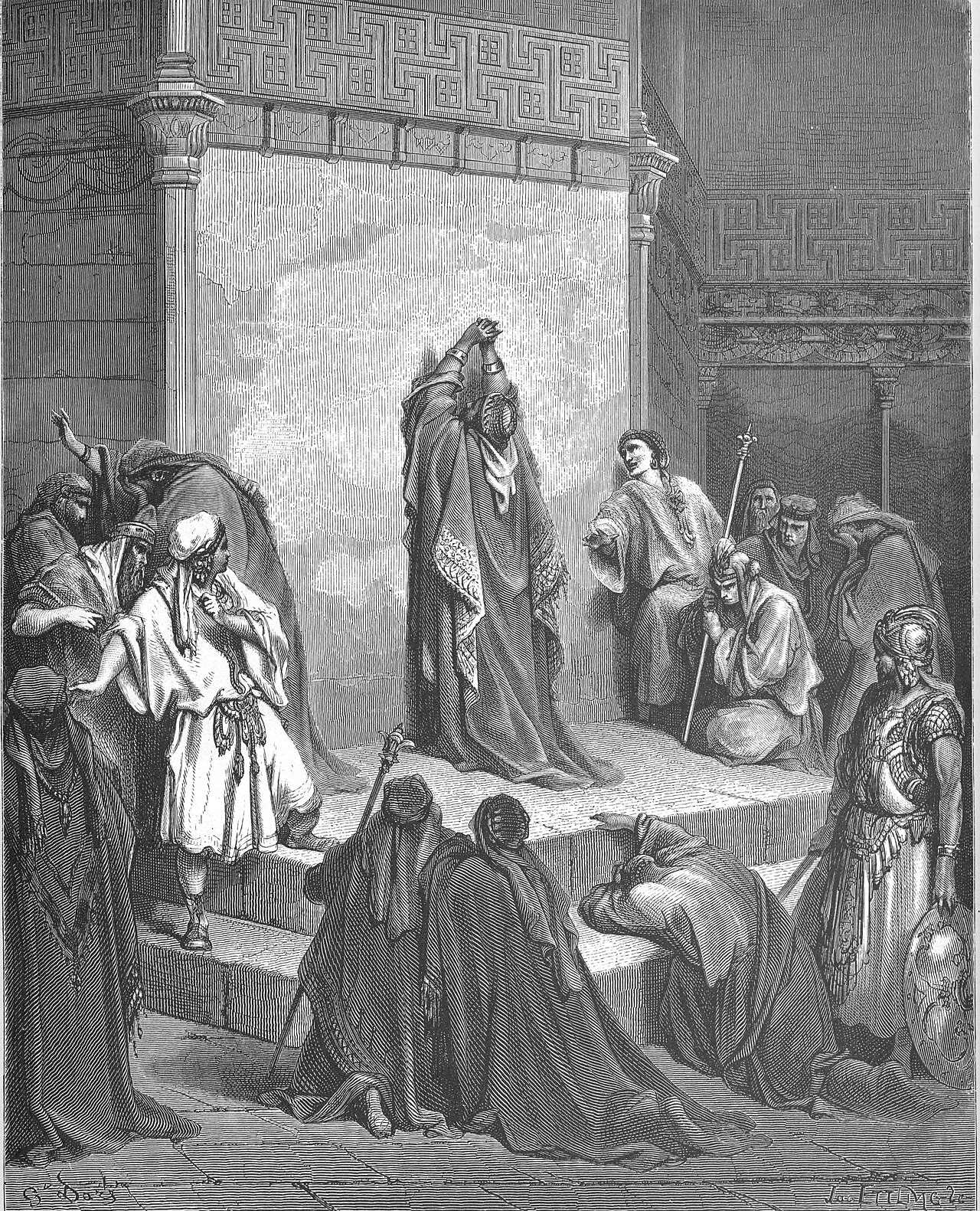
The Lord struck the child in the next clause after Nathan departs, and the sickness that follows is the sentence of verse fourteen already at work. David fasts, lies all night on the earth, and refuses to be raised up by the elders of his own house, a mourning so total that his own household cannot reach him. John Wesley reads the intensity as proof the king was not grieving a possible loss so much as carrying the weight of his own sin before the God who had just named it. The scene stands beside the parable's ewe lamb that lay in the poor man's bosom, another life bound up in a father's love and now under sentence.
The record, by era
The Church Fathers1 voice
How particularly difficult it is to atone for the evil deed of handing over the name of the Lord to the blasphemy of the heathen, we are instructed by the example of the most blessed David who, because of the intercession of his acts of …
The Puritans and the Awakening1 voice
And Nathan departed unto his house,....
How the passage was read
What the Jewish commentators add
On the verses either side of this one
Because you have angered the enemies of Adonoy. This is a euphimism a way [to be] respectable to on High. 6 Using “enemies of God” to stand in for God in order for the word “angered” not to have to be applied to Him in a direct way.
1 more on this passage, in their own words ▾
And came to repose and lied on the ground. And came [back] to the house and reposed at night lying on the ground.
This section is reception history: how the passage was read and kept in the Jewish tradition. Where a reading parts from an essential of the Christian faith, the section says so at that point.
Texts and citation data: Sefaria; each excerpt follows its version’s licence. 6 further sources are cited on this chapter that carry no English text this site may quote or only restate the verse.
The words behind it
14 Hebrew wordsEvery Hebrew word of this verse in the order it stands, with what it means and the door to its own study. The last column counts the times a word stands in the whole Bible: the rarer the word, the more the places it appears belong together.
| Hebrew | Sound | Meaning | Word study | In the Bible |
|---|---|---|---|---|
| וַיֵּ֥לֶךְ | vaiyelekh | and he went | H1980 → | 1546 times |
| נָתָ֖ן | natan | Nathan | H5416 → | 41 times |
| אֶל־ | ʾel- | to | H413 → | 5510 times |
| בֵּית֑וֹ | beito | house his | H1004 → | 2046 times |
| וַיִּגֹּ֣ף | vaiyigof | and he struck | H5062 → | 49 times |
| יְהוָ֗ה | yahweh | Yahweh | H3068 → | 6520 times |
| אֶת־ | ʾet- | <obj.> | H853 → | 10935 times |
| הַיֶּ֜לֶד | haiyeled | the child | H3206 → | 89 times |
| אֲשֶׁ֨ר | ʾasher | whom | H834 → | 5497 times |
| יָלְדָ֧ה | yaldah | she had borne | H3205 → | 496 times |
| אֵֽשֶׁת־ | ʾeshet- | [the] wife of | H802 → | 781 times |
| אוּרִיָּ֛ה | ʾuriyah | Uriah | H223 → | 39 times |
| לְדָוִ֖ד | ledavid | to David | H1732 → | 999 times |
| וַיֵּאָנַֽשׁ׃ | vaiyeanash | and he was sick | H605 → |
וַיֵּ֥לֶךְand he went
vaiyelekhH1980 →1546 times
נָתָ֖ןNathan
natanH5416 →41 times
אֶל־to
ʾel-H413 →5510 times
בֵּית֑וֹhouse his
beitoH1004 →2046 times
וַיִּגֹּ֣ףand he struck
vaiyigofH5062 →49 times
יְהוָ֗הYahweh
yahwehH3068 →6520 times
אֶת־<obj.>
ʾet-H853 →10935 times
הַיֶּ֜לֶדthe child
haiyeledH3206 →89 times
אֲשֶׁ֨רwhom
ʾasherH834 →5497 times
יָלְדָ֧הshe had borne
yaldahH3205 →496 times
אֵֽשֶׁת־[the] wife of
ʾeshet-H802 →781 times
אוּרִיָּ֛הUriah
ʾuriyahH223 →39 times
לְדָוִ֖דto David
ledavidH1732 →999 times
וַיֵּאָנַֽשׁ׃and he was sick
vaiyeanashH605 →
A shaded row is a word that stands 400 times or fewer in the Bible.
The walk
8 stopsEach card is a verse this one points to, and under it the verses that one points to in turn. Where several paths arrive at the same place, that place is listed first: the text keeps returning to it.
Through
Deuteronomy 32:39See now that I am He; there is no God besides Me. I bring death and I give life; I wound and I heal, and there is no one who can deliver from My…
it leads to
- 1 Samuel 2:6
The LORD brings death and gives life; He brings down to Sheol and raises up.
- Hosea 6:1
Come, let us return to the LORD. For He has torn us to pieces, but He will heal us; He has wounded us, but He will bind up our wounds.
- Job 5:18
For He wounds, but He also binds; He strikes, but His hands also heal.
- Isaiah 45:5
I am the LORD, and there is no other; there is no God but Me. I will equip you for battle, though you have not known Me,
- Isaiah 45:22
Turn to Me and be saved, all the ends of the earth; for I am God, and there is no other.
- 1 Samuel 2:6
Through
Psalms 104:29When You hide Your face, they are terrified; when You take away their breath, they die and return to dust.
it leads to
- Job 34:14–15
If He were to set His heart to it and withdraw His Spirit and breath,
- Ecclesiastes 12:7
before the dust returns to the ground from which it came and the spirit returns to God who gave it.
- Job 34:14–15
Through
1 Samuel 26:10David added, “As surely as the LORD lives, the LORD Himself will strike him down; either his day will come and he will die, or he will go into battle and perish.
it leads to
- Deuteronomy 31:14
Then the LORD said to Moses, “Behold, the time of your death is near. Call Joshua and present yourselves at the Tent of Meeting, so that I may commission him.” So Moses and Joshua…
- Deuteronomy 31:14
Where this verse is studied
About 2 Samuel
Who and where
2 names in this verse with a page on the site.
- PersonUnited MonarchyDavidSecond king of united Israel, shepherd-turned-monarch, ancestor of the Messiah, and traditional author of many Psalms.
- PersonUnited monarchyNathanThe prophet at David's court who carried the covenant promise of 2 Samuel 7 and later the parable of the ewe lamb — "thou art the…
This page draws on John Gill, Exposition of the Old Testament; John Gill, Exposition of the Old Testament (1748-1763); John Wesley, Explanatory Notes upon the Old Testament; Matthew Henry, Commentary on the Whole Bible and Salvian the Presbyter, THE GOVERNANCE OF GOD 4.18.