
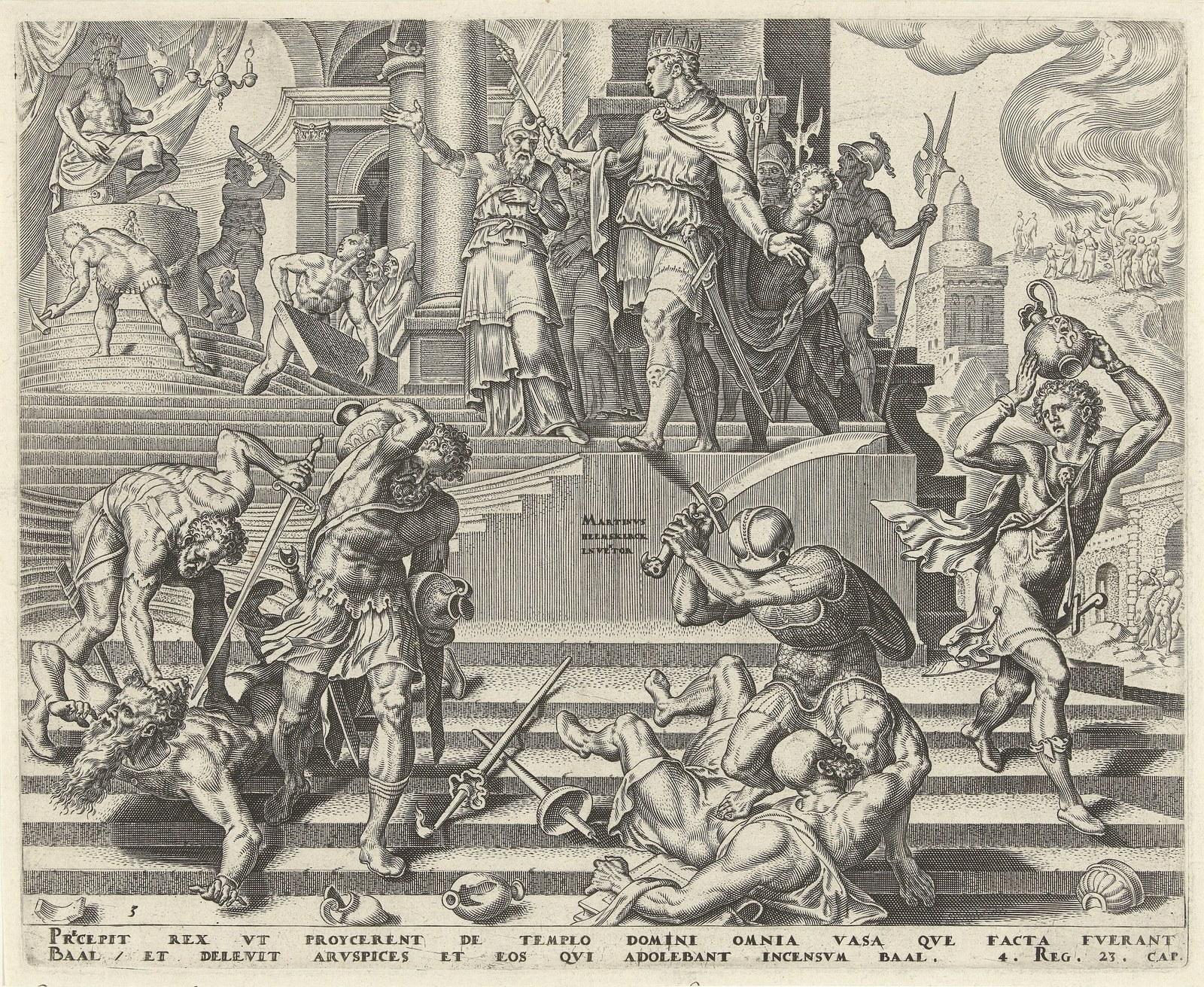
After Maarten van Heemskerck, Josiah Destroys Baal's Temple, about 1569. Public domain.
Zephaniah 1:5 · Subject · Featured Study
The Host of Heaven: Star Worship in Judah
Judah's kings set up altars to the sun, moon and stars, and Josiah tore them down.
those who bow on the rooftops to worship the host of heaven, those who bow down and swear by the LORD but also swear by Milcom,
- Books
- Zephaniah, 2 Kings
- Hold in memory
- Deuteronomy 4:19
The people of Jerusalem burned incense to the stars on the roofs of their houses.
Summary
The host of heaven is the sun, moon and stars, which the law forbade Israel to worship. Their altars stood on house roofs and in the temple courts.
- Under Manasseh the worship reached the house of the LORD.
- Commentators trace the cult to Assyria, to Manasseh and to Baal worship.
- The horses and chariots of the sun stood at the temple's entrance.
The Host in Zephaniah 1
Zephaniah names three kinds of false worship in Jerusalem in two verses.
“I will stretch out My hand against Judah and against all who dwell in Jerusalem. I will cut off from this place every remnant of Baal, the names of the idolatrous and pagan priests—The list of false worship begins with Baal and his priests.
John Wesley read the double oath of Zephaniah 1:5 as worship that mixed the true God with Moloch.
The Cult From the Law to Stephen
Scripture follows the worship of the host from the law's ban to Stephen's speech in Acts.
The kings of Judah led the cult, and the prophets named it.
1The law forbids bowing to the sun, moon and stars
- Deuteronomy 4:19
- Before Israel enters the land
2The northern kingdom bows to all the host of heaven
- 2 Kings 17:16
- Before the fall of Samaria
3Manasseh builds altars to the host in both temple courts
- 2 Kings 21:5
- The reign of Manasseh
4Zephaniah names those who bow on the rooftops
- Zephaniah 1:5
- The days of Josiah
5Josiah removes the articles made for the host from the temple
- 2 Kings 23:4
- The reign of Josiah
6Josiah burns the chariots of the sun
- 2 Kings 23:11
- The reign of Josiah
7Jeremiah names the rooftops where incense burned to the host
- Jeremiah 19:13
- The days of Jeremiah
8Ezekiel sees about twenty-five men bowing to the sun in the inner court
- Ezekiel 8:16
- Before Jerusalem fell
9Stephen says God gave Israel over to the worship of the host
- Acts 7:42
- In Stephen's speech
Nine turns, each with its verse.
Jeremiah names the rooftops where incense burned to the host, Ezekiel sees about twenty-five men bowing to the sun in the inner court, Stephen says God gave Israel over to the worship of the host
Rooftops and Temple Courts
Clarke, Barnes, and Jamieson, Fausset and Brown describe where the worship took place.
He pulled down the altars that the kings of Judah had set up on the roof near the upper chamber of Ahaz, and the altars that Manasseh had set up in the two courtyards of the house of the LORD. The king pulverized them there and threw their dust into the Kidron Valley.The roof altars and Manasseh's court altars fell in the same act.
Adam Clarke wrote that such altars to the heavenly bodies stood on flat roofs. Jamieson, Fausset and Brown called those roofs high places for sacrifices to the sun and planets.
They will be exposed to the sun and moon, and to all the host of heaven which they have loved, served, followed, consulted, and worshiped. Their bones will not be gathered up or buried, but will become like dung lying on the ground.Jeremiah lists five things the people had done for the host.
Albert Barnes wrote that the seat of the LORD in the temple was at the west, so the men of Ezekiel 8:16 turned their backs on the temple to face the rising sun.
The horses of the sunJohn Gill; Adam Clarke; Jamieson, Fausset and Brown
And he removed from the entrance to the house of the LORD the horses that the kings of Judah had dedicated to the sun. They were in the court near the chamber of an official named Nathan-melech. And Josiah burned up the chariots of the sun.Josiah's reform reached the gifts of earlier kings.
John Gill held that the horses were living animals, given most likely by Manasseh and Amon. Adam Clarke thought carved horses the more reasonable reading. The commentary of Jamieson, Fausset and Brown says such horses carried images of the sun in processions or bore worshippers out to greet the sunrise.
The Words of the Cult
Three Hebrew words carry the cult in Zephaniah 1:4 and Zephaniah 1:5.
tsaba
485 uses in the canon
Tsaba is a host or an army, the word for the stars as a marshalled company.
gag
30 uses in the canon
Gag is a roof, the flat housetop where incense was burned.
kemarim
3 uses in the canon
Kemarim are the pagan priests whom Josiah put down in 2 Kings 23:5.
The Host That Serves the LORD
Micaiah and the Levites saw the host in another light.
Micaiah continued, “Therefore hear the word of the LORD: I saw the LORD sitting on His throne, and all the host of heaven standing by Him on His right and on His left.Here the host serves as the LORD's court.
You alone are the LORD. You created the heavens, the highest heavens with all their host, the earth and all that is on it, the seas and all that is in them. You give life to all things, and the host of heaven worships You.The prayer sets the host among the LORD's creatures.
Voices on the Host of Heaven
Two teachers, of the third century and the eighteenth, answer the worship of the stars from the law.
Origen of Alexandria (died 253)
Origen, writing against Celsus, set the people of the law apart from those who worship the sky.
“It is clear then that since those who live according to the law reverence the One who made the heaven, they do not reverence the heaven as if God. Furthermore, none of those who serve the Mosaic law worship the angels in heaven. And in the same way that they do not worship the sun, moon, and stars and ‘the world of heaven.’ They avoid worshiping heaven as such or the angels in it.”
Origen of Alexandria · Against Celsus 5.6 · on Deuteronomy 4:19Patristic
Matthew Henry (1662 to 1714)
Matthew Henry argued from the Hebrew name of the sun.
“It is absurd to worship them, for they are man's servants, were made and ordained to give light on earth; and shall we serve those that were made to serve us? The sun, in Hebrew is called shemesh, which signifies a servant, for it is the minister-general of this visible world, and holds the candle to all mankind; let it not then be worshipped as a lord.”
Matthew Henry · Commentary on the Whole Bible · on Deuteronomy 4:19Puritan
Where the Cult Came From
Four accounts of the cult's origin stand in the older commentaries.
Star worship borrowed from the AssyriansJamieson, Fausset and Brown
In their note on 2 Kings 23:5, Jamieson, Fausset and Brown held that the cult Josiah ended used no images and was pure star worship, borrowed from the old Assyrians.
Brought into Judah by ManassehAlbert Barnes
Albert Barnes wrote that Manasseh first restored the high places and Baal worship, and then took up the worship of the stars, which Judah had not known before.
Partly Baal worship, partly star worshipKeil and Delitzsch
Keil and Delitzsch held that the stars were worshipped in part as bearers of the powers of nature honoured in Baal and Asherah, and in part for themselves. They placed the worship on altars on the flat roofs, chiefly with incense.
The oldest idolatry of allAdam Clarke
Adam Clarke called this the oldest kind of idolatry, born when people took the lights of heaven for the authors of every blessing.
Books to Read Next
Two older commentaries read the chapters of the cult verse by verse.
Commentary on the Whole Bible
Matthew Henry · 1710
Henry explains the rooftop worship of Zephaniah 1 beside the sins it went with.
Read it free at BibleHubCommentary Critical and Explanatory on the Whole Bible
Jamieson, Fausset and Brown · 1871
The commentary explains the star worship, the horses of the sun and the high places of 2 Kings 23.
Read it free at BibleHubHe Calls Each One by Name
Isaiah points the reader past the stars to the One who leads them out.
Lift up your eyes on high: Who created all these? He leads forth the starry host by number; He calls each one by name. Because of His great power and mighty strength, not one of them is missing.The verse answers the worship of the host with the question of who made it.
Sources
Scripture is the Berean Standard Bible.
- The Hebrew text of Zephaniah 1:4 and 1:5, word by word, with Strong's numbers.
- Strong's Hebrew lexicon, h6635, h1406 and h3649.
- Henry, Commentary on the Whole Bible; Wesley, Explanatory Notes; Clarke, Commentary on the Bible; Barnes, Notes; Gill, Exposition; Jamieson, Fausset and Brown, Commentary Critical and Explanatory; Jerome, Commentary on Jeremiah; Bede, Commentary on Acts; Origen, Against Celsus; on Zephaniah 1:4 to 5, 2 Kings 21 and 23, Deuteronomy 4:19, Jeremiah 8 and 19, Ezekiel 8:16 and Acts 7:42.
- Matthew Henry, Commentary on the Whole Bible (1710), on Deuteronomy 4:19.
- Origen of Alexandria, Against Celsus, book 5, chapter 6, on Deuteronomy 4:19.
- Jamieson, Fausset and Brown, Commentary Critical and Explanatory on the Whole Bible (1871), on 2 Kings 23:5, 2 Kings 23:11 and Jeremiah 19:13.
- Albert Barnes, Notes, Explanatory and Practical, on 2 Kings 21:3 and Ezekiel 8:16.
- Adam Clarke, Commentary on the Bible (1832), on Deuteronomy 4:19, 2 Kings 23:11 and 2 Kings 23:12.
- John Gill, Exposition of the Old Testament, on 2 Kings 23:11.
- Carl Friedrich Keil and Franz Delitzsch, Biblical Commentary on the Old Testament: The Minor Prophets, on Zephaniah 1:5.
Keep Studying
Studies1
Places1
Symbols1
Church history1
Doctrines2