
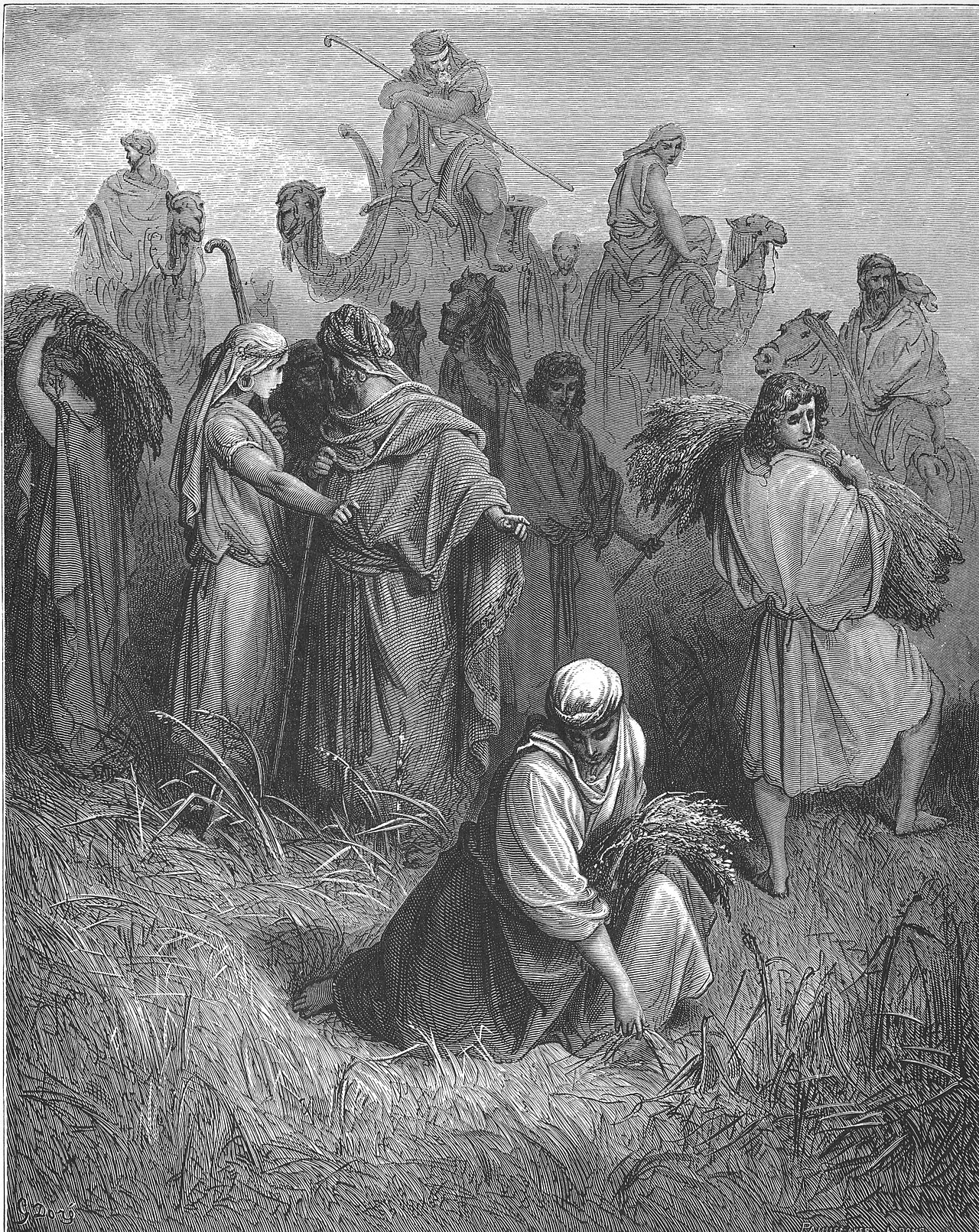
Ruthchapter 2
23 verses · Samuel, by tradition · 10th century BC · History
The Lord recompense thy work, and a full reward be given thee of the Lord God of Israel, under whose wings thou art come to trust.
Introduction
Samuel, by tradition, History, Ruth Overview.
This chapter moves from the road to a grain field outside Bethlehem in the weeks of harvest. It was told to people who lived by Israel's harvest laws and knew who followed behind the reapers. A foreign widow goes out to work for food, and a landowner of standing takes notice of her. The narrator never names God as the cause of anything, and still leaves the reader to ask who arranged the day. Listen for the blessings people speak over one another, and for the word that names a family's protector. Read it as the first answer to the emptiness of chapter 1.
Context
- Who
- Israelites who lived by the harvest laws and knew who ended up behind the reapers
- What
- A narrative of a day of gleaning in which Ruth comes to the field of Boaz and receives his protection and his generosity.
- Where
- A grain field belonging to Boaz outside Bethlehem, and Naomi's house in the town.
- When
- The barley and wheat harvests, about seven weeks from April into June, in the days of the judges.
- Why
- To show God's care for Naomi and Ruth reaching them through Israel's harvest law and the kindness of a godly man.
Historical context
Gleaning was welfare written into the Law. Owners were forbidden to reap the corners of a field, to go back for a dropped sheaf, or to strip a vine twice. What was missed belonged to the poor, the widow, the fatherless and the foreigner. It was a right the poor person exercised by doing the hot, bent, dangerous work of following the reapers all day.
Show the rest of the historical context, 3 more paragraphs
Harvest work ran in a line. Men cut the standing grain with short sickles, gripping a handful at a time, others bound the stalks into sheaves, and a foreman kept the pace and the count. Gleaners worked behind them, and a woman alone behind a crew of hired men was exposed. That is why Boaz twice orders his young men to leave her alone and tells her to stay close to his young women.
Boaz is called a man of standing, the same phrase used of a mighty warrior, and his greeting to the reapers is answered in kind, which says something about the house they work for. His extra instructions bend the law in her favour. She may glean among the sheaves themselves, and his men are to pull stalks out of the bundles for her to find.
The result is measured. An ephah of barley is roughly thirty pounds of grain, which is an extraordinary day's gleaning, and she beat it out on the spot rather than carrying the straw home.
Significance
For first hearers the phrase that mattered was Boaz's blessing, under whose wings you have come to take refuge. It is the language used of God sheltering Israel, said here of a Moabite woman, and by the end of the book Boaz's own coat is the wing she asks him to spread.
Show the rest of the significance, 1 more paragraph
The chapter also answers Naomi's complaint. The woman who said she came home empty now has thirty pounds of barley in the house and the name of a kinsman.
This chapter in Jewish lifeWhat this chapter is in Jewish life and reading.
What is done
This chapter turns on a law kept in the field, and the commentators read the law off Ruth's own conduct. Rashi asks why Boaz inquired after her at all. He answers that Boaz saw how she gleaned. "Two ears she would glean but three she would not glean". She "would glean the standing ears while standing and the lying ones while sitting, in order to avoid bending over". The reference is Rashi on Ruth 2:5:1, The Metsudah Five Megillot, Lakewood, N.J., 2001, CC-BY. The edition's note names the measure she was keeping, the Mishnah at Pe'ah 6:5. It names the statute behind it at Vayikra 19:9, which awards the fallen ears and the forgotten sheaves to the poor. What Boaz noticed, on this reading, was a woman who knew the law and kept it exactly. One custom of the harvest table is read out of the same chapter. On the bread dipped in vinegar Rashi says "From here [we derive] that vinegar is good for the heat". The edition's note names Maseches Shabbos 113b, and the reference is Rashi on Ruth 2:14:1, same edition.
How it is read
The commentators read this chapter as providence working through ordinary care. They begin with the family. Rashi hands on the tradition that Elimelech, Salmon the father of Boaz, the anonymous kinsman and the father of Naomi "were all sons of Nachshon, the son of Aminadav". He cites Maseches Bava Basra 91a, and adds the sting. "Yet the merit of their fathers was no avail them when they left the Land [of Yisroel] to go abroad". The reference is Rashi on Ruth 2:1:1, The Metsudah Five Megillot, Lakewood, N.J., 2001, CC-BY. The identification of the judge Ivtzan with Boaz stands in this chapter's corpus file from the commentary on Judges. It reads "Ivtzan. Boaz", with Bava Basra 91a named. The reference is Rashi on Judges 12:8:1, The Metsudah Tanach series, Lakewood, N.J., CC-BY.
Ruth's own movements are read closely. On the doubled verbs at 2:3 Rashi reports a question raised in Midrash Rus. It runs "Before she had even gone she returned?". The answer is that "she would mark the roads before she entered the field", so that she would know the way back. The alternative in the note comes from Rabbi Eliezer, that she kept returning until she found decent people to go with. It cites Maseches Shabbos 113b, and the reference is Rashi on Ruth 2:3:1, same edition. Her request at 2:2 is read as care not to give offence. She goes after the one "in whose eyes I will find favor, so that he will not rebuke me" (Rashi on Ruth 2:2:1, same edition). Boaz's orders to the young men are read as a staged kindness. On the command to let sheaves fall Rashi glosses the doubled verb as "you should forget; pretend as though you are forgetting". The note reads the doubling as an action to be repeated many times. The reference is Rashi on Ruth 2:16:1, same edition.
Naomi's blessing at 2:20 carries the word the book turns on. Rashi reads it of God as the one "that he feeds and sustains the living, and occupies himself with the needs of the deceased". The edition's note carries Ibn Ezra's reading of the kindness Boaz showed the dead. It carries Alshich's reading of a willingness to marry. The reference is Rashi on Ruth 2:20:1, same edition. Ibn Ezra works the chapter mostly as grammar. At 2:17 he records being asked what the ephah of barley signified. He answered that there was no point to the question, since "the text simply reports what happened" (Ibn Ezra on Ruth 2:17:1, Sefaria Community Translation, CC0). Malbim comments at 2:4, 2:10, 2:18 and 2:21. The corpus holds no English version of any of them, so they stand as citations. They are Malbim on Ruth 2:4:1, 2:10:1, 2:18:1 and 2:21:1.
What the rabbis say
The corpus records forty rabbinic locators on this chapter, thirty-six Midrash and four Talmud. Every one is a locator without text. This site therefore cites where the rabbis took the chapter up rather than what they said there. Boaz and his standing draw Bamidbar Rabbah 10:5 and Esther Rabbah 6:2. Ruth's going out to glean draws Midrash Lekach Tov on Ruth 2:2:1 and Ruth Rabbah (Lerner) 4:4:1. Her coming to the field draws Midrash Lekach Tov on Ruth 2:3:1 and 2:3:2. The greeting Boaz gives his reapers draws Berakhot 54a:9 and Ein Yaakov (Glick Edition), Makkot 3:5. His question about the young woman draws Midrash Lekach Tov on Ruth 2:5:1 and Ruth Rabbah (Lerner) 4:9:1. The answer that names her draws Bamidbar Rabbah 19:26 and Midrash Lekach Tov on Ruth 2:6:1. Her standing in the field draws Midrash Lekach Tov on Ruth 2:7:1 and Ruth Rabbah (Lerner) 4:10:1. Boaz's protection draws Midrash Lekach Tov on Ruth 2:8:1 and Midrash Lekach Tov, Exodus 15:5:1. His offer of water draws Midrash Lekach Tov on Ruth 2:9:1 and 2:9:2. Her question about why a foreigner is noticed draws Midrash Lekach Tov on Ruth 2:10:1 and Ruth Rabbah (Lerner) 5:2:1. What Boaz had heard of her, and the wings of refuge he names, draw four. They are Ein Yaakov, Nedarim 4:4, Jerusalem Talmud Yevamot 8:3:4, Ein Yaakov, Yevamot 4:10 and Midrash Lekach Tov on Ruth 2:12:1. The first two of those are places where the question of the Moabite woman is worked. Her answer at the meal draws Midrash Lekach Tov on Ruth 2:13:1 and Ruth Rabbah (Lerner) 5:5:1. The meal itself draws Aggadat Bereshit 83:1 and Bamidbar Rabbah 21:20. The orders to the reapers draw Midrash Lekach Tov on Ruth 2:15:1 and Ruth Rabbah (Lerner) 5:7:1. With them stand Midrash Lekach Tov on Ruth 2:16:1 and Midrash Sekhel Tov, Shemot 3:5:2. The ephah she carried home draws Midrash Lekach Tov on Ruth 2:17:1 and Ruth Rabbah (Lerner) 5:8:1. The evening that follows draws Midrash Lekach Tov on Ruth 2:18:1 and 2:19:1. With them stands Midrash Aggadah, Leviticus 25:48:7, filed under the law of redeeming a kinsman. The harvest that closes the chapter draws Jerusalem Talmud Yevamot 4:2:4 and Jerusalem Talmud Nedarim 8:4:3. Midrash Lekach Tov on Ruth 2:22:1 stands with them. The rabbis teach in these places. This site reports them as their teaching rather than as a rule of the text.
Sources: Rashi, Rashi on Ruth 2:1:1, 2:2:1, 2:3:1, 2:5:1, 2:14:1, 2:16:1 and 2:20:1, The Metsudah Five Megillot, Lakewood, N.J., 2001, CC-BY, 2001; Rashi, Rashi on Judges 12:8:1, The Metsudah Tanach series, Lakewood, N.J., CC-BY, carried in scripts/data/sources/sefaria/ruth/2.json; Ibn Ezra, Ibn Ezra on Ruth 2:17:1, Sefaria Community Translation, CC0; Malbim, Malbim on Ruth 2:4:1, 2:10:1, 2:18:1 and 2:21:1, cited only, no English version in the corpus; The Mishnah, Pe'ah 6:5, named in the edition's note to Rashi on Ruth 2:5:1 with Vayikra 19:9; The Midrash and the Talmud, the forty locators of scripts/data/sources/sefaria/ruth/2.json, cited by ref alone.
The heads below are this chapter's scenes. The numbered points under each are its verses.
Her hap was to light on the field of Boaz
Ruth 2:1-2
The book names Boaz before Ruth reaches his field, so the reader knows what she does not. Albert Barnes reads the word for "relative" as a near acquaintance, and the office of goel is held back until verse 20. The phrase "a prominent man of noble character" is the Hebrew the angel uses of Gideon at Judges 6:12, and Ruth claims the gleaner's right of Leviticus 19:9-10 and Deuteronomy 24:19.
Ruth 2:1
“A kinsman - More literally “an acquaintance”; here (and in the feminine, Rth 3:2) denoting the person with whom one is intimately acquainted, one’s near relation. The next kinsman of Rth 2:20, etc. גאל gā'al, is a wholly different word. Boaz - Commonly taken to mean, “strength is in him” (compare 1Ki 7:21).”
1 more voice on this verseWhat preachers and commentators have said about this verse, in their own words.
Ruth 2:1
“The Chaldee reads it, mighty in the law. If he was both, it was a most rare and excellent conjunction, to be mighty in wealth and mighty in the scriptures too; those that are so are mighty indeed.”
Matthew Henry · Commentary on the Whole Bible (1707-1721)puritan
Leviticus 19:9 and Deuteronomy 24:19 left the edges of a field and the dropped grain to the widow, the poor and the foreigner. Jamieson, Fausset and Brown note that the right to follow close behind the reapers still depended on the owner's goodwill. So Ruth goes looking for favor.
Ruth 2:2
“Does the widow Naomi seem to you of small account, who supported her widowhood on the gleanings from another's harvest, and who, when heavy with age, was supported by her daughter-in-law? It is a great benefit both for the support and for the advantage of widows that they so train their daughters-in-law as to have in them a support in full old age, and, as it were, payment for their teaching and reward for their training.”
Ambrose of Milan · written before 397 · Concerning Widows 6.33patristic
Ruth 2:3-4
The narrator's phrase, "she happened to come to the part of the field belonging to Boaz", is the flattest Hebrew way of saying chance. Matthew Henry and later writers read it as understatement, since verse 1 has named the field's owner. Boaz greets his harvesters with "The LORD be with you" and they answer "The LORD bless you", an exchange between master and workers found nowhere else in Scripture.
Ruth 2:3
“She knew not whose field it was, nor had she any reason for going to that more than any other, and therefore it is said to be her hap; but Providence directed her steps to this field. Note, God wisely orders small events; and those that seem altogether contingent serve his own glory and the good of his people.”
Matthew Henry · Commentary on the Whole Bible (1707-1721)puritan
The Lord be with you: Boaz arrived from Bethlehem and greets his harvesters with the name of the LORD, and they answer him with a blessing in the same terms. Adam Clarke reads the exchange as the ordinary speech of a godly household. Ruth has found a good master.
Ruth 2:4
Boaz came from Beth-lehem - This salutation between Boaz and his reapers is worthy of particular regard; he said, יהוה עמחם Yehovah immachem, “Jehovah be with you!” They said, יברכך יהוה yebarechecha Yehovah, “May Jehovah bless thee!” Can a pious mind read these godly salutations without wishing for a return of those simple primitive times? The words may be thus paraphrased: “May God be with you, to preserve you from accidents, and strengthen you to accomplish your work!” “May God bless Thee with the increase of the field, and grace to use his bounty to the glory of the Giver!”
Adam Clarke · Commentary on the Bible (1810-1826)evangelical
Ruth 2:5-7
Boaz asks whose she is rather than who she is, the question a landowner asks about a household. The foreman answers by nation before name, "She is the Moabitess who returned with Naomi", and she stays unnamed. Her request to "glean and gather among the sheaves" asks more than the corners of Leviticus 19:9 or the forgotten sheaf of Deuteronomy 24:19, and Boaz himself grants it at verse 15.
Ruth 2:5
“His servant that was set over the reapers - This was a kind of steward or hind who had the under management of the estate.”
Adam Clarke · Commentary on the Bible (1810-1826)evangelical
The foreman says she returned with Naomi, using the same verb as 1:22, though Ruth had never lived in Bethlehem. The town already counts her as part of Naomi's homecoming. Her nation still stands ahead of her name.
Ruth 2:6
“This was both for his own interest (he that wholly leaves his business to others will have it done by the halves; the master's eye makes a fat horse) and it was also for the encouragement of his servants, who would go on the more cheerfully in their work when their master countenanced them so far as to make them a visit.”
Matthew Henry · Commentary on the Whole Bible (1707-1721)puritan
Albert Barnes takes the shelter to be the booth where the harvesters ate and escaped the midday sun. The foreman's report makes her day long and her rest short. He reports her request without saying whether he granted it.
Ruth 2:7
“The house - The shed or booth where they took their meals, and were sheltered from the sun in the heat of the day (see Gen 33:17).”
Handfuls let fall on purpose
Ruth 2:8-9
Boaz calls her "my daughter", Naomi's word for her at 1:11 and 2:2. He gives her a field to work, his servant girls for company, a charge on the young men, and water she did not draw. "I have ordered the young men not to touch you" states what a foreign widow alone could expect in the generation of Judges 19.
Ruth 2:8
“Then said Boaz unto Ruth,.... Having heard what the servant said concerning her, he turned himself to her, and addressed her in the following manner: hearest thou not, my daughter? meaning not what the servant had said, but hereby exciting her to hearken to what he was about to say to her. Noldius (w) takes the particle to signify beseeching and entreating, and renders the words, "hear, I pray thee, my daughter".”
1 more voice on this verse
Ruth 2:8
“Abide here fast by my maidens - These were probably employed in making bands, and laying on them enough to form a sheaf, which the binders would tie and form into shocks or thraves. When the maidens had gathered up the scattered handfuls thrown down by the reapers, Ruth picked up any straggling heads or ears which they had left.”
Adam Clarke · Commentary on the Bible (1810-1826)evangelical
Albert Barnes notes that fields had no hedges, only unploughed strips, so a gleaner could drift onto a stranger's field without knowing it. Boaz keeps her eyes on his own field and his own girls. His young men draw the water, and she drinks it.
Ruth 2:9
“The vessels alluded to were skin bottles, filled with water--and the bread was soaked in vinegar (Ru 2:14); a kind of poor, weak wine, sometimes mingled with a little olive oil--very cooling, as would be required in harvest-time. This grateful refection is still used in the harvest-field.”
Jamieson, Fausset & Brown · Commentary Critical and Explanatory on the Whole Bible (1871)reformed
1 more voice on this verse
Ruth 2:9
“After them - i. e. “after my maidens.” The fields not being divided by hedges, but only by unplowed ridges, it would be easy for her to pass off Boaz’s land without being aware of it, and so find herself among strangers where Boaz could not protect her.”
Ruth 2:10-11
She asks why she has found favor "even though I am a foreigner", using the stronger of the two Hebrew terms for an outsider, one without the standing the law gave a resident alien. Boaz answers with chapter 1 in one sentence, "how you left your father and mother and the land of your birth". Keil and Delitzsch and Matthew Henry both hear Genesis 12:1 behind that clause.
Ruth 2:10
“Then she fell on her face - Prostrated herself, as was the custom in the East when inferiors approached those of superior rank. The Targum adds to the conversation between Ruth and Boaz: “How, says she, have I obtained grace in thy sight, that thou shouldest acknowledge me who am a stranger and one of the daughters of Moab, of whom it is said, The unclean shall not enter into the congregation of the Lord?”
Adam Clarke · Commentary on the Bible (1810-1826)evangelical
The words recall the call of Abraham at Genesis 12:1 to leave his land, his relatives and his father's house. Matthew Henry reports the Targum reading her as a convert who came to a people she did not know. Boaz knows all she has done.
Ruth 2:11
“But that which especially he commended her for was that she had left her own country, and had become a proselyte to the Jewish religion; for so the Chaldee expounds it: "Thou hast come to be proselyted, and to dwell among a people whom thou knowest not. " Those that leave all, to embrace the true religion, are worthy of double honour.”
Matthew Henry · Commentary on the Whole Bible (1707-1721)puritan
Ruth 2:12-13
The phrase "under whose wings you have taken refuge" uses kanaph, wing, the word for the garment's corner Ruth asks him to spread over her at 3:9. What he prays for here, he is later asked to become. The image runs through Psalm 17:8, 36:7, 57:1 and 91:4, and Deuteronomy 23:3 on Moab is never argued, only left beside sentences like this one.
Ruth 2:12
“Note, Those that by faith come under the wings of the divine grace, and have a full complacency and confidence in that grace, may be sure of a full recompence of reward for their so doing. From this expression, the Jews describe a proselyte to be one that is gathered under the wings of the divine majesty.”
Matthew Henry · Commentary on the Whole Bible (1707-1721)puritan
2 more voices on this verse
Ruth 2:12
“The blessing followed as Boaz said it would. For Ruth received the full reward from God, so that she was the progenitor of the blessing of the nations.”
Theodoret of Cyrus · written before 458 · QUESTIONS ON RUTHpatristic
Ruth 2:12
“Wings - That is, protection and care. An allusion either to hens, which protect and cherish their young ones under their wings; or to the wings of the Cherubim, between which God dwelt.”
John Wesley · Explanatory Notes upon the Old Testament (1765)evangelical
Ruth calls herself his maidservant and then ranks herself below his servant girls. The phrase for spoken kindly is to speak to the heart, used of tender speech at Genesis 34:3 and Isaiah 40:2. She takes comfort from his words before any grain is given.
Ruth 2:13
“Not like unto one of thine hand-maidens - I am as unworthy of thy regards as any of thine own maidservants, and yet thou showest me distinguished kindness.”
Adam Clarke · Commentary on the Bible (1810-1826)evangelical
2 more voices on this verse
Ruth 2:13
“Tho' I be not - I humbly implore the continuance of thy good opinion of me, though I do not deserve it, being a person more mean, necessitous, and, obscure, a stranger, and one born of heathen parents, and not of the holy and honourable people of Israel, as they are.”
John Wesley · Explanatory Notes upon the Old Testament (1765)evangelical
Ruth 2:13
“Those that are great, and in high places, know not how much good they may do to their inferiors with a kind look or by speaking friendly to them; and so small an expense, one would think, they should not grudge, when it shall be put upon the score of their charity.”
Matthew Henry · Commentary on the Whole Bible (1707-1721)puritan
Ruth 2:14-16
He seats her beside the harvesters and hands her roasted grain, and "she ate and was satisfied and had some left over", the portion she carries home at verse 18. He then orders the young men to "pull out for her some stalks from the bundles". The law set a floor, and nothing in Leviticus 19 or Deuteronomy 24 asks a man to drop grain on purpose.
Ruth 2:14
“Dip thy morsel in the vinegar - The חמץ chomets, which we here translate vinegar, seems to have been some refreshing kind of acid sauce used by the reapers to dip their bread in, which both cooled and refreshed them. Vinegar, rob of fruits, etc., are used for this purpose in the East to the present day; and the custom of the Arabs, according to Dr. Shaw, is to dip the bread and hand together into these cooling and refreshing articles.”
Adam Clarke · Commentary on the Bible (1810-1826)evangelical
Adam Clarke notes that gleaners normally waited until the sheaves were bound and stacked. Boaz lets her work among the sheaves, which is the request the foreman reported at verse 7. He grants it himself.
Ruth 2:15
“Let her glean even among the sheaves - This was a privilege; for no person should glean till the sheaves were all bound, and the shocks set up.”
Adam Clarke · Commentary on the Bible (1810-1826)evangelical
John Gill reads the order as stalks pulled from the bundles and left on purpose for her to gather. Boaz arranges the gift so that it reaches her as gleaning, and his young men are told not to rebuke her. She keeps her dignity.
Ruth 2:16
“And let fall some of the handfuls on purpose for her,.... That is, when they had reaped an handful, instead of laying it in its proper order, to be taken up by those that gathered after them, or by themselves, in order to be bound up in sheaves, scatter it about, or let it fall where they reaped it: and leave them, that she may glean them, and rebuke her not for taking them, as if she did a wrong thing.”
Naomi hears the name of the near kinsman
Ruth 2:17-18
The yield, "about an ephah of barley", is one of the book's few measures, and Exodus 16:36 fixes an ephah at ten omers. An omer was one person's manna for a day, so one day of gleaning carried home ten days of bread, a yield Matthew Henry and Keil and Delitzsch call remarkable. In town she first hands Naomi "what she had saved from her meal".
Ruth 2:17
“And beat out that she had gleaned - Namely, with a stick, as the word implies (compare Deu 24:20; Isa 27:12). This method is still commonly practiced. Ruth gleaned enough to support herself and her mother-in-law for five days Exo 16:16.”
Adam Clarke notes that Ruth brought home what was left of the meal Boaz gave her at verse 14. Naomi receives both raw grain and food ready to eat. The woman who came home empty now has plenty.
Ruth 2:18
“And gave to her that she had reserved - As Ruth had received a distinct portion at dinner-time, of which she had more than she could eat, Rth 2:14; it appears she brought the rest home to her mother-in-law, as is here related.”
Adam Clarke · Commentary on the Bible (1810-1826)evangelical
Ruth 2:19-20
Naomi blesses the man before she hears his name. The word behind "His kindness" is chesed, her word at 1:8, and here it belongs to God and reaches "the living or the dead", Elimelech and her sons. She then names the office, "one of our kinsman-redeemers", the goel of Leviticus 25:25 and 25:48-49, bound to buy back a relative's land or person.
Ruth 2:19
“And her mother in law said unto her, where hast thou gleaned today?....”
1 more voice on this verse
Ruth 2:19
“Where hast thou gleaned today? - It is a good question to ask ourselves in the evening, "Where have I gleaned today?" What improvements have I made in grace or knowledge?”
John Wesley · Explanatory Notes upon the Old Testament (1765)evangelical
Adam Clarke explains the word as goel, the relative with the right to buy back a family's lost inheritance. The living are Naomi and Ruth, and the dead are Elimelech and Mahlon, whom they represent. Naomi's hope returns in this sentence.
Ruth 2:20
“To the living and to the dead - Naomi and Ruth were the living; and they were also the representatives of Elimelech and Mahlon, who were dead. Naomi was of the family; and Ruth, though not of the family, was a representative of one of its deceased branches, being the widow of Mahlon. One of our next kinsmen - מגאלינו miggoaleynu, of our redeemers, one who has the right to redeem the forfeited inheritance of the family.”
Adam Clarke · Commentary on the Bible (1810-1826)evangelical
Ruth 2:21-23
Ruth reports Boaz as saying "Stay with my young men", where verse 8 has him name his servant girls, and Naomi steers her back toward the young women. The closing clause, "until the barley and wheat harvests were finished", spans the wave sheaf to the Feast of Weeks in Leviticus 23:10-16, about seven weeks. Chapter 3 opens with Naomi as the one who moves.
Ruth 2:21
“Keep fast by my young men - The word הנערים hannearim should be translated servants, both the male and female being included in it; the latter especially, as we see in Rth 2:22, Rth 2:23.”
Adam Clarke · Commentary on the Bible (1810-1826)evangelical
Jamieson, Fausset and Brown read Naomi's advice as prudence on two counts: Ruth's safety, and the goodwill of Boaz, who might take offense if she went elsewhere. The verb for harm can mean to be set upon. Naomi knows the fields better than Ruth does.
Ruth 2:22
“Naomi said unto Ruth . . . It is good . . . that thou go out with his maidens--a prudent recommendation to Ruth to accept the generous invitation of Boaz, lest, if she were seen straying into other fields, she might not only run the risk of rude treatment, but displease him by seeming indifferent to his kind liberality.”
Jamieson, Fausset & Brown · Commentary Critical and Explanatory on the Whole Bible (1871)reformed
Adam Clarke sets the season out as barley first and then wheat, which in Israel ran about seven weeks. Through all of it Ruth lodged with Naomi. The text records no further word between her and Boaz until chapter 3.
Ruth 2:23
“And of wheat harvest - That is, she was to continue gleaning in the farm of Boaz to the end of the barley harvest; and then, when the wheat harvest began, to continue to its conclusion in the same way. In the interim, as well as each night, she lodged with her mother-in-law. 1. Ruth seems to have been a woman of a very amiable mind: she was modest, and she was industrious, and most probably a comely woman; and all these things served to attract the attention of Boaz, and to engage his affection.”
Adam Clarke · Commentary on the Bible (1810-1826)evangelical
How this psalm is built
The form: Narrative prose, one daylight scene in a barley field, which the book page titles The field: gleaning, hesed, and providence at 2:1 to 23, as guide classes it.
The patterns in this chapter
| Device | What it does | Where to see it |
|---|---|---|
| A relative at the top, a redeemer at the bottom | Verse 1 names Boaz as a relative on Elimelech's side, and Albert Barnes reads that word as an acquaintance or near relation. Verse 20 names a different word, the goel of Leviticus 25:25, the kinsman bound to buy back sold land. The office the whole book turns on is held back for nineteen verses and then given to the same man.the site's Ruth exposition, notes on 2:1 to 2 and 2:19 to 20, citing Albert Barnes, Notes on the Old Testament, 1834 to 1885, and Keil and Delitzsch, Biblical Commentary on the Old Testament: Joshua, Judges, Ruth, 1863. | Ruth 2:1, Ruth 2:20 |
| The wing and the skirt are one word | Boaz blesses Ruth for coming under the wings of the God of Israel, and the Hebrew is kanaph. Ruth uses the same word at 3:9 when she asks him to spread the corner of his garment over her. The man who prays the blessing is later asked to be its answer. The same image runs through Psalm 17:8, 36:7, 57:1 and 91:4.the site's Ruth exposition, note on 2:12 to 13, citing Keil and Delitzsch, Biblical Commentary on the Old Testament: Joshua, Judges, Ruth, 1863, and John Gill, Exposition of the Old Testament, 1748 to 1763. | Ruth 2:12, Ruth 3:9 |
| Favour, asked for and then questioned | Ruth sets out to glean after someone in whose sight she may find favour at verse 2. At verse 10 she falls on her face and asks why she has found it, naming herself a foreigner. At verse 13 she asks to keep it, and claims nothing for herself. The word carries the chapter from her plan to her answer.the site's Ruth exposition, notes on 2:10 to 11 and 2:12 to 13, citing Keil and Delitzsch, Biblical Commentary on the Old Testament: Joshua, Judges, Ruth, 1863, and Matthew Henry, Commentary on the Whole Bible, 1710. | Ruth 2:2, Ruth 2:10, Ruth 2:13 |
| Four things given in two verses | Boaz gives her one field to work, the company of his servant girls, an order laid on the young men that they are to leave her alone, and water she did not draw. The order at verse 9 states plainly what a foreign widow alone in a field could otherwise expect, in the same generation that produces Judges 19.the site's Ruth exposition, note on 2:8 to 9, citing Matthew Henry, Commentary on the Whole Bible, 1710, and Jamieson, Fausset and Brown, Commentary Critical and Explanatory on the Whole Bible, 1871. | Ruth 2:8, Ruth 2:9 |
The structure
11 more paragraphs on the patterns
Five movements and one clock, the working day. Verse 7 has her out from morning, verse 17 has her gleaning until evening, and verse 18 brings the yield into the town. The last verse then opens the frame and runs seven weeks, from barley harvest to wheat harvest.
The measure
About an ephah of barley is one of the few measures the book gives. Exodus 16:36 fixes an ephah at ten omers, and an omer was one man's manna for one day. A single day of gleaning carried home ten days of bread for one person.
The seven weeks in the last clause
Barley harvest and wheat harvest together are the stretch from the wave sheaf to the feast of weeks in Leviticus 23:10 to 16. Roughly seven weeks pass inside verse 23, and across all of it the text says she gleaned and lived with her mother-in-law.
The law kept and then exceeded
The statute set a floor. Boaz raises it three times in one chapter. He seats her with the reapers and hands her the roasted grain at verse 14. He grants the gleaning among the sheaves at verse 15, and at verse 16 he tells his men to pull stalks out of the bundles for her. Nothing in Leviticus 19 or Deuteronomy 24 asks a man to drop grain on purpose.
Where the chapter reaches
The wings of verse 12 carry into the appeal at 3:9 and stand behind the way Christ speaks over Jerusalem at Matthew 23:37. The office Naomi names at verse 20 is worked in open court at 4:1 to 12. The water at verse 9 runs against the usual direction, since Deuteronomy 29:11 and Joshua 9:21 put the stranger at the well as the drawer.
The statute left standing
Boaz names the LORD, the God of Israel, to a Moabitess and says she has already taken refuge under Him. Deuteronomy 23:3 is never cited in the book and never argued with. What the book does instead is set sentences like this one beside her origin.
Keep studying
Places1
Sources for this chapter
The summary
Jamieson, Fausset & Brown, Commentary Critical and Explanatory; John Wesley, Notes on the Old Testament and Matthew Henry, Complete Commentary.
The form and classifications
Stephen Bertman, Journal of Biblical Literature, 1965, carried as a proposed chiasm in the site's Ruth dossier; the site's Ruth exposition, notes on 2:1 to 2 and 2:19 to 20, citing Albert Barnes, Notes on the Old Testament, 1834 to 1885, and Keil and Delitzsch, Biblical Commentary on the Old Testament: Joshua, Judges, Ruth, 1863 and the site's Ruth guide, src/components/book/guides/ruth/RuthGuide.tsx, the movements table, movement II.
The exposition
Adam Clarke, Commentary on the Bible; Albert Barnes; Jamieson, Fausset & Brown, Commentary Critical and Explanatory on the Whole Bible; John Gill; Keil and Delitzsch, Biblical Commentary on the Old Testament: Joshua, Judges, Ruth and Matthew Henry, Commentary on the Whole Bible.